


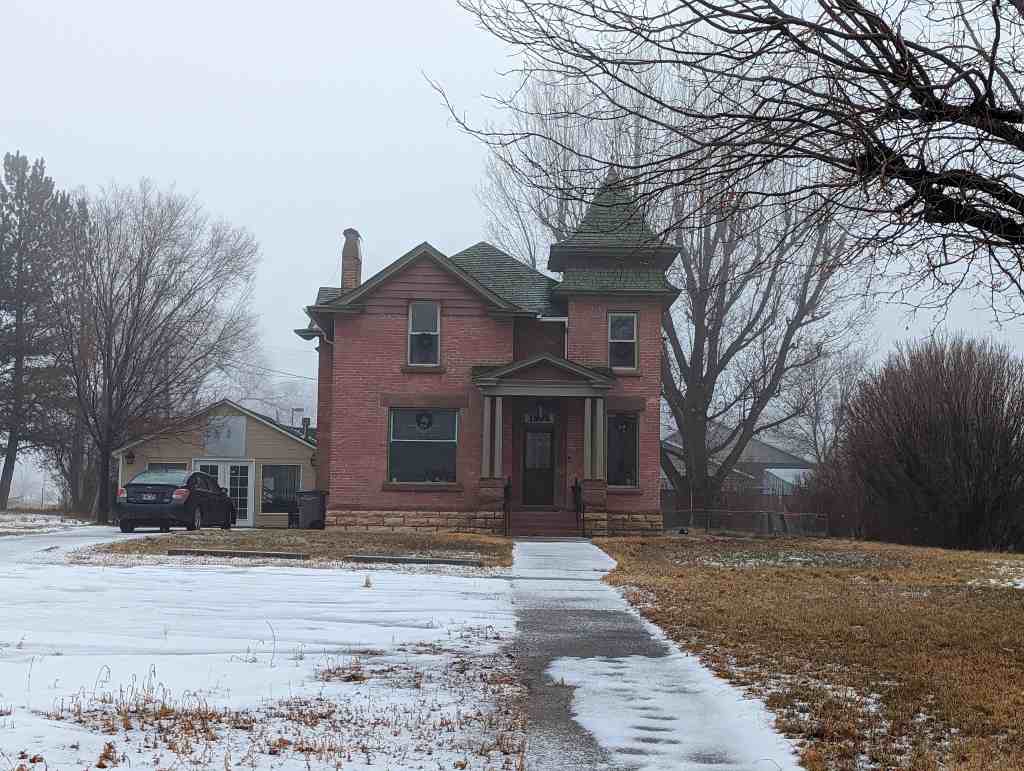
James Bown Home
128 North Main Street in Gunnison, Utah
From flutterbysblog:
A pair of historic homes stand as prominent pillars of Gunnison’s historic roots and open windows to memories of yesteryear.
The homes, standing on the north end of Main Street, were built by two brothers, Lafayette and James Bown.
The brothers built their homes a year apart. Lafayette, who his friends called “Lafe,” built the Bown Villa at 132 North Main in 1898, and James built his home at 168 North Main in 1899.
Both homes have different styles, but they were designed by the same architect from Nephi, whose name is unknown today.
The James Bown home, also a Victorian Eclectic, has a large portico and entrance hall, front parlor and dining room. It was built with red sandstone from a quarry near Fayette. The foundation is oolite limestone extracted from the same rock quarry used for the Manti LDS Temple. Its dark red bricks were manufactured in Manti.
The Bown brothers tended 10,000 sheep on the open range in Utah, Idaho and Colorado. Two hundred sheep usually grazed in a pasture behind the two homes. Before Main Street was built, a large canal ran in front of the two homes. A small indentation in the gravel driveways is all that remains of the canal today.
Because of their large outfit, the brothers hired staff to assist them with the herd. A sheepherder named “Brooks” lived in James’ home. He disappeared for long periods of time with no explanation. He was “a large frightening man with bad table manners,” reports Sanpete.com. “It was later discovered that he was bank robber, among other things.”
James, whose home is still owned by his family, was financially successful and played an important role in building the community of Gunnison. Lafe, although he lived in Gunnison for decades prior to building the Bown Villa, was forced to move north within 10 years of completing the home, says Marie Sanders, great-niece of Lafe and current owner of the James Bown home with her husband Kent.
Another family inhabited the Bown Villa for almost a century before passing it to its current owners, Bill, Charlotte and Shawn Christiansen.
James and Lafe were two of the 10 children in the William Bown and Jane Ann Metcalf family (only six sons lived past 1900). Many of the offspring lived in Fayette where a fort providing shelter from the Indians was located. Some of the Bowns tried settling in St. George, but a flood one year ruined their crops. The Metcalf family rescued the St. George Bowns and brought them back to Fayette.
James and Lafe were able to settle in Gunnison once challenges with the Native Americans had subsided, but their successful sheepherding business was compromised when landowners began fencing their properties. Sheepherders couldn’t lead their sheep across various properties anymore.
When James’ and Lafe’s sheepherding business folded, Lafe moved to Provo, but James maintained his residence in Gunnison and changed his profession to banking. A room upstairs in his home was used as an office, says Marie Sanders, a granddaughter of James Bown.
James Bown helped organize the Gunnison Telephone Company as well as the Citizen’s Bank of Gunnison and Centerfield.
“My grandfather had the first telephone in Gunnison and had enough stock in the phone company to control it,” Marie says. “Even today, there are only 60-70 stockholders.”
Both of Marie’s parents also worked for the telephone company. The phone company is now managed by Kent Sanders and his son, Jim.
James and his wife, Florence Bartholomew Bown, raised five daughters in the home. James told Florence she could have either an indoor toilet or a fireplace in the home.
“She chose the toilet,” Marie says. “The home now has a chimney that goes nowhere.”
Marie, the only child of Howard and Vera Jane Bown Norman (Vera Jane was a daughter of James and Florence). She lived in the home as a girl.
“The bathroom upstairs used to be my bedroom,” Marie says.
There was a vent in the dining room that heated the upstairs, Marie recalls. The north room in the home was the music room. An archway in the music room separated it from another room that James and Florence used as their bedroom, which had blue and purple drapes.
When the Sanders moved in, they “got rid of the drapes and changed the bedroom into a TV room,” Marie says.
Today there are three bedrooms upstairs, one big room and two smaller rooms. One of the rooms still has the original furniture. They cut one wall to make drawers and cupboards. What used to be the large downstairs bathroom with a claw-foot bathtub is now a smaller bath with a shower only and a separate washroom.
Is there a connection between Florence Bartholomew Bown’s family and Byrd Bartholomew, who married Jewel Alexander next door?
Byrd Bartholomew’s grandfather (George Marston Bartholomew) and Florence Bartholomew’s father (Joseph Bartholomew) were brothers—both sons of Joseph Bartholomew and Polly Benson.
The Christiansens have heard that the wives of James and Lafe were sisters, but the truth is they weren’t (since Lafe was married to Clarissa Jane Dack—not a Bartholomew).
However, the oldest brother of James and Lafe (William Bown) was married to Elizabeth Almira Bartholomew, a daughter of the same Joseph Bartholomew and Polly Benson.
And even though the wives of James and Lafe weren’t sisters, they treated each other like sisters: “The brothers didn’t get along, but the wives were good friends,” Shawn says.
It is clear that both Bown homes have been well loved and treasured through the years, continuing to memorialize those who have gone before, along with providing those in the present with pleasant places for memory making—and reminiscing.