


The Great Emigrant Flood of 1849-1854
Historians often compare the 1848 discovery of gold in California to the effect high octane fuel has on a fire. Within the next few years more than 250,000 gold-seekers and farmers scrambled across the Sierra-Nevada in search of fortune or a new life.
The road to California was not a single route. It followed the established Oregon Trail to Fort Bridger before splitting either toward Salt Lake City or to Fort Hall, and eventually the Sierra-Nevada, where it further split into several interior valley destinations. One of the routes through Utah, known as the Hastings Cutoff, rejoined the main California Trail at the Humboldt River in northeastern Nevada.
Travel conditions on the cutoff during most years were generally harsh. Grass for livestock, food to eat, and clean water to drink became scarcer as the pioneers advanced westward. Cholera and other diseases took their toll as well.
American Indians especially suffered from the streaming onslaught of “forty-niners” across the western landscape. For centuries, native peoples had lived in the West without outside competition for resources. However, the flood of pioneers and the additional rivalry for food sources, land, water, and space threatened to destroy their way of life.
Wagon ruts and traces can still be found in the vast undeveloped West – reminders of the triumphs, struggles, and sacrifices made by those who blazed a road through the wilderness in pursuit of a dream.
“We were now thrown entirely upon our own resources. All the country beyond was to us a veritable terra incognita, and we only knew that California lay to the west. Captain Fitzpatrick was not much better informed, but he had heard that parties had penetrated the country to the southwest and west of Salt Lake to trap for beaver; and by his advice four of our men went with the parties to Fort Hall to consult Captain Granto gain information. Meanwhile our depleted party slowly made its way down the west side of Bear River.”
– John Bidwell, “The First Emigrant Train to California,” The Century Illustrated Mothly Magazine 41:1 (November 1890)”

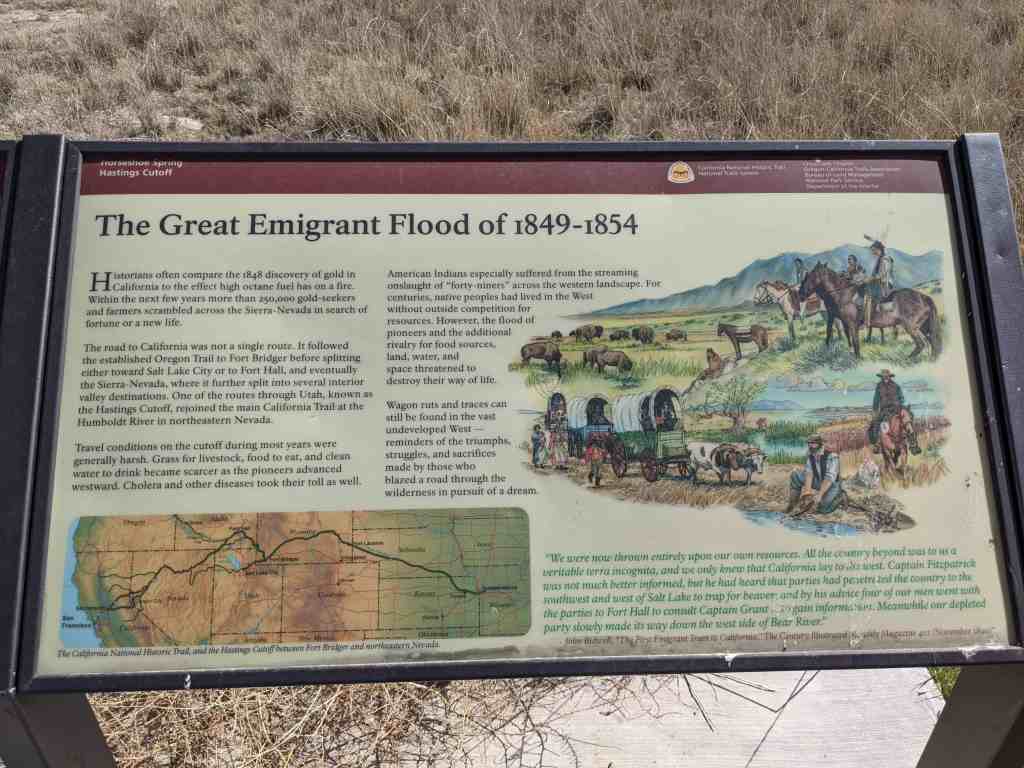
Located at Horseshoe Springs in Tooele County.