• About JacobBarlow.com
  • Cemeteries in Utah
  • D.U.P. Markers
  • Doors
  • Exploring Utah Email List
  • Geocaching
  • Historic Marker Map
  • Links
  • Movie/TV Show Filming Locations
  • Oldest in Utah
  • Other Travels
  • Photos Then and Now
  • S.U.P. Markers
  • U.P.T.L.A. Markers
  • Utah Cities and Places.
  • Utah Homes for Sale
  • Utah Treasure Hunt

JacobBarlow.com

~ Exploring with Jacob Barlow

JacobBarlow.com

Tag Archives: Davis County

Fielding Garr Ranch

31 Sunday May 2026

Posted by Jacob Barlow in Uncategorized

≈ Leave a comment

Tags

Davis County, NRHP, utah

Fielding Garr Ranch

The Fielding Garr ranch, comprising the only remaining historical structures on Antelope Island in the Great Salt Lake, is significant for its association with the settlement and immigration program of The Church of Jesus Christ of Latter-day Saints (Mormons). Organized in 1849 through the contributions of Mormons already residing in Utah, the Perpetual Emigration Company functioned as the immigration agency for the church in its program for the peopling and settling of Utah. In 1850 the company financed the immigration of some 2,500 British converts to Salt Lake City. Once established in Utah, the newcomers would reimburse the company for their passage, thus creating a revolving emigration fund, called the Perpetual Emigration Fund. The Fielding Garr ranch functioned as the home ranch for the Perpetual Emigration Fund, where cattle were kept which formed a major portion of the fund’s revenue. Payments made to reimburse the fund were often in the form of livestock that were kept and managed on Antelope Island by Fielding Garr. By 1856, the company had brought nearly 56,000 Mormon immigrants from the British Isles and Scandinavia to Utah, forming a most unique private, institutional immigration agency. 1 The Perpetual Emigration Company was dissolved in 1887 by the Edmunds-Tucker Act, but during Its thirty-eight year history, the company aided either directly or indirectly the immigration of over 100,000 persons, of which some 87,000 were from England and northern Europe. 2 The adobe house and outbuildings, erected in 1849-1850^ have been altered, but retain integrity of location, setting, and association. They are among the few structures which continue to .stand from the first decade of Mormon settlement, and are the only remaining historical structures that were directly associated with the important Perpetual Emigration Fund.

The Fielding Garr Ranch is one of the Oldest Homes in Utah, located on Antelope Island in Davis County. It was added to the National Register of Historic Places (#83004402) on January 21, 1983.

The Fielding Garr House (and ranch complex) is significant among Utah’s historic structures not only because of its age (built in 1849, just two years after the Mormon arrival in Utah and, therefore, one of the oldest houses in the state) and location (built on Antelope Island in the Great Salt Lake), but also because, in microcosm, it tells much of the story of the early Mormon pioneer period.

Prior to their coming west, the Mormon experience in the states had been one of settlement, growth, conflict with their neighbors and expulsion. .The decision to come to the Great Basin centered on the desire to be left alone to build their Kingdom of .God in an area uninhabited by “Gentiles.” It is no wonder that Utah became the “Gathering Place” from where the call to come to Zion was issued to Mormons everywhere.

One of the obstacles to heeding the call for many converts was the price of immigration. To help converts too poor to pay their own way, the Perpetual Emigration Company was created. Organized in the fall of 1849, contributions from those already in Utah amounted to $6,000 and helped bring “2,500 persons and an undisclosed value of goods” 3 to Salt Lake City. The initial success led to the incorporation of the Perpetual Emigration Fund in 1850. The company, through donations from the settled pioneers, financed the next immigrant party’s trip to Utah. These saints would reimburse the company, once they established themselves in Utah, thus providing capital for another immigration; and so it went year after year. “The accomplishments of the new company,” write two Mormon historians, “have been recognized as unique in the history of immigration.”

By 1856, less than a decade after the arrival of the initial pioneer party, almost 56,000 Latter-day Saints had arrived in Utah.

The Perpetual Emigration Fund charter authorized the company to “own and manage property of all kinds, to carry on banking operations,” as well as other activities. Such a broad charter was necessary in a nascent community where hard currency was in such short supply. Knowing that a large percentage of the contributions were going to be in kind, the islands of the Great Salt Lake–known as Stansburys Island and the Antelope Island were “reserved and appropriated for the exclusive use and benefit of said company, for the keeping of stock, etc.”

In the fall of 1849, a few months prior to the incorporation of the Perpetual Emigration Fund, Mormon convert, Fielding Garr, from Madison County, Virginia, moved the Church stock to the island. There he tended the cattle, sheep and horses until his death in 1855.7 Garr, a widower brought his seven children with him to the Island and there built a five-room adobe house, a rock milk house with a natural spring running through it, and a corral.

During the survey of the Great Salt Lake by the U.S. Army Corps of Engineers, under the command of Howard Stansbury in 1850, the Fielding Garr establishment was important as a supply point, especially for the survey of the northern and eastern sections of the lake. After the death of Fielding Garr, Briant Stringham became the ranch foreman. He moved his family to the island and occupied the house built by Garr. Stringham and his sons managed the ranch until his death in 1871.

Since those early days, the house and the island have left the ownership of the Church and gone to private hands, only to be sold to the State of Utah, who now owns it. Through the Division of Parks and Recreation, the island is being developed into a multi-use recreational area. Part of this includes the restoration of the Fielding Garr house and outbuildings as an historic site.

The interpretation of the house and property will emphasize the story of the immigration of Mormon converts to their “Zion” by the Perpetual Emigration Fund and how financing and contributions were made in kind in this very young settlement, creating the need for property to care for the sheep, cattle and horses that were the dollars and cents of the day.

The Fielding Garr house, built in 1849, is an early example of vernacular architecture in Utah. Constructed of adobe brick produced at the site, the house is one-story high and originally consisted of five rooms. The main section, contained under a gently sloping gable roof, is a two-room wide “double-pen” type. The double-pen house with its distinctive two-door symmetrical façade (window-door-door-window) is a traditional type found in many Utah communities during the early years of settlement. The house type is characterized by its two roughly square rooms. The Garr house has large gable-end fireplace chimneys and a lean-to extension containing three smaller rooms on the rear. The original woodwork on the house is intact. During the late 19th century another adobe square room was added to the north end of the house. This room continued the door-window opening pattern of the original house. The decorative trim on the inside of this room suggests a c. 1880 building date.

The Garr Ranch also includes a number of outbuildings:

  1. Milk House. This is a small gabled building which stands about 20 feet west of the main house. The upper section is adobe which has been faced with concrete block and there is a stone cellar which is reached through an external stairwell.
  2. Springhouse. This gabled structure is built of rubble stone and stands over one of several fresh water springs on the property. Water was directed through the building in small stone channels which served to cool dairy goods and other perishable foodstuffs in the 19th century. The springhouse has an historically incompatible roof which was added in 1980.
  3. Barn stable. A large rock stable continues to stand against a large modern storage barn. The old stable undoubtedly used to stand against an open hay barn and has a sloping shed roof.
  4. Blacksmith shop. This building has a rectangular plan and a gable roof. It was originally adobe, but is now faced with concrete block and painted white. The blacksmithing equipment of the 19th century remains in the shop.

Extensive remodeling occurred on the Garr house during the 1950-1960 period. A concrete-block addition was added to the north end, one of the two principal windows on the original facade was enlarged by about one-and-a-half feet, and one of the two original doors was closed in. Also at this time the deteriorating adobe was faced on three sides (the north, west, and south sides) with a layer of concrete block about 6 inches wide. In 1980 when the home was acquired by the State of Utah, Parks and Recreation crews removed the stucco from the west facade and shingled the roof with cedar shakes.

Although the historic integrity of the main house and some outbuildings has suffered due to alterations and additions, the ranch complex in general continues to convey important historic qualities, especially as regards to geographical location, setting, and association. Of primary importance is that the Utah State Division of Parks and Recreation, current owners, intend to restore the Fielding Garr ranch as a historic site on Antelope Island. This is part of their master plan in developing the island into a multiple-use recreational area. The importance of the site in its historical association and age renders it a prime project for historic preservation.

The nomnated property includes approximately 6.2 acres. This acreage was chosen as the immediate areaof the Garr ranch complex, comprising all buildings, which has been fenced. This boundary will also allow some extra acreage for protective and preservation purposes of the site.
Thomas & Margaret Brandon House

17 Wednesday Dec 2025

Posted by Jacob Barlow in Uncategorized

≈ Leave a comment

Tags

Centerville, Davis County, NRHP, utah

Thomas & Margaret Brandon House

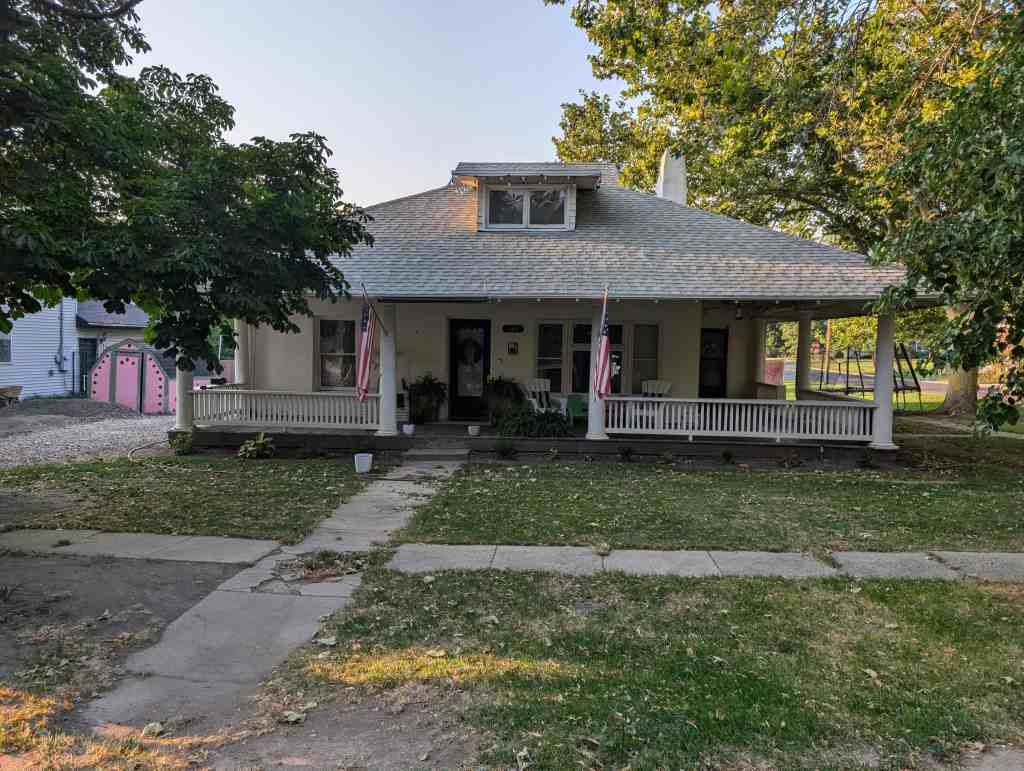
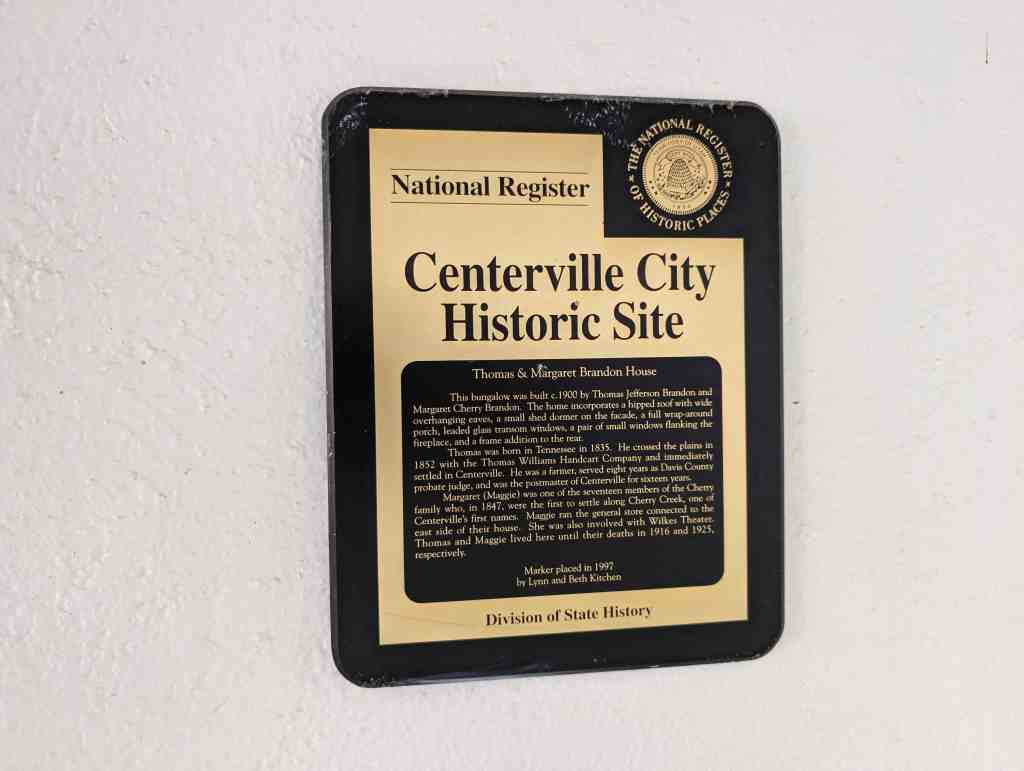
This bungalow was built c.1900 by Thomas Jefferson Brandon and Margaret Cherry Brandon. The home incorporates a hipped roof with wide overhanging eaves, a small shed dormer on the façade, a full wrap-around porch, leaded glass transom windows, a pair of small windows flanking the fireplace, and a frame addition to the rear.

Thomas was born in Tennessee in 1835. He crossed the plains in 1852 with the Thomas Williams Handcart Company and immediately settled in Centerville. He was a farmer, served eight years as Davis County probate judge, and was the postmaster of Centerville for sixteen years.
Margaret (Maggie) was one of the seventeen members of the Cherry family who, in 1847, were the first to settle along Cherry Creek, one of Centerville’s first names. Maggie ran the general store connected to the east side of their house. She was also involved with Wilkes Theater. Thomas and Maggie lived here until their deaths in 1916 and 1925, respectively.

185 East Center Street in Centerville, Utah

Centerville Pioneer Memorial Cabin

17 Wednesday Dec 2025

Posted by Jacob Barlow in Uncategorized

≈ 1 Comment

Tags

Cabins, Centerville, Davis County, DUP, Historic cabins, utah

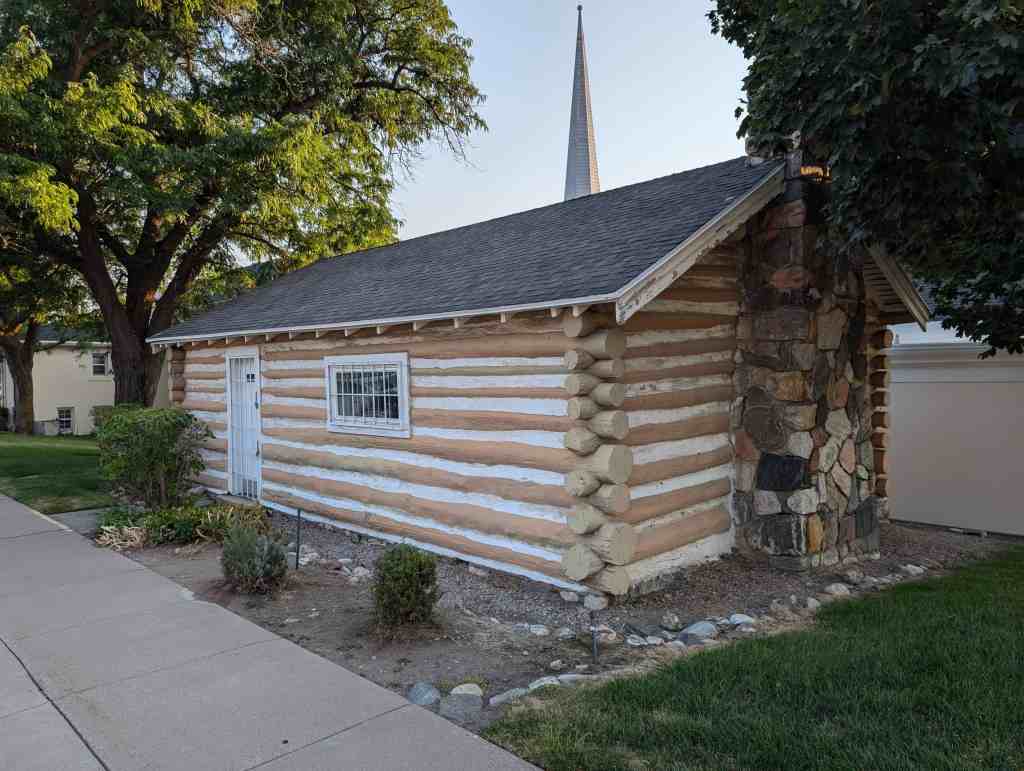
Centerville Pioneer Memorial Cabin on the site of the Centerville 1879 Church.

110 South 300 East in Centerville, Utah

Holland-Smith House

13 Saturday Dec 2025

Posted by Jacob Barlow in Uncategorized

≈ Leave a comment

Tags

Centerville, Davis County, Historic Homes, NRHP, utah

Holland-Smith House

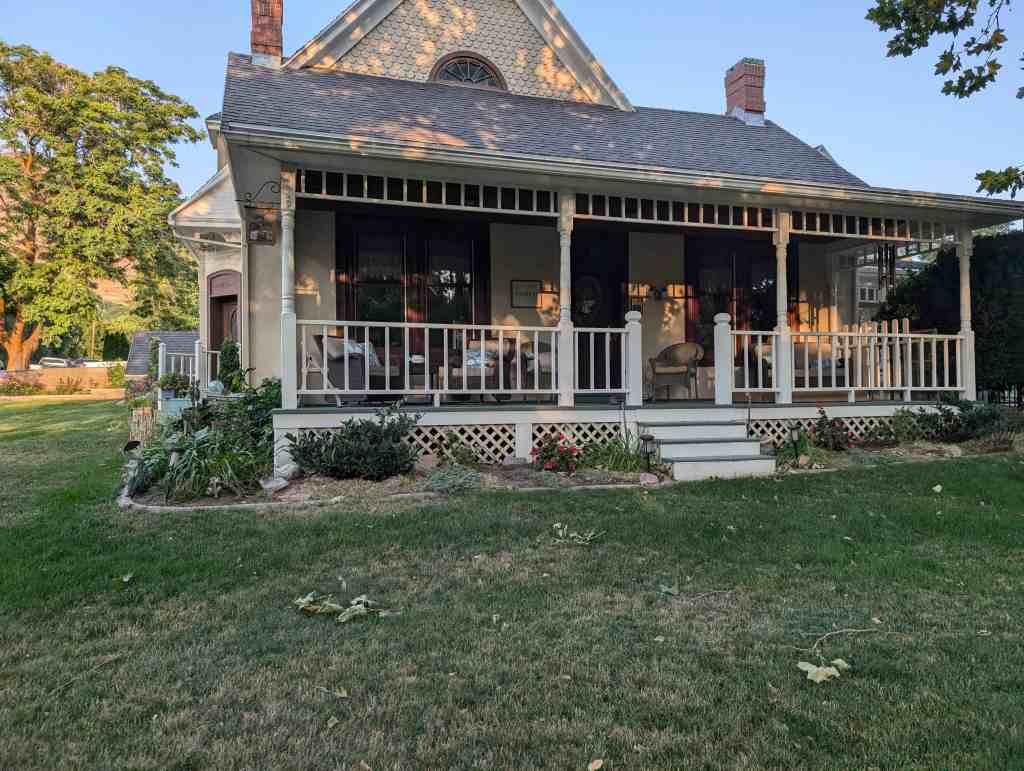
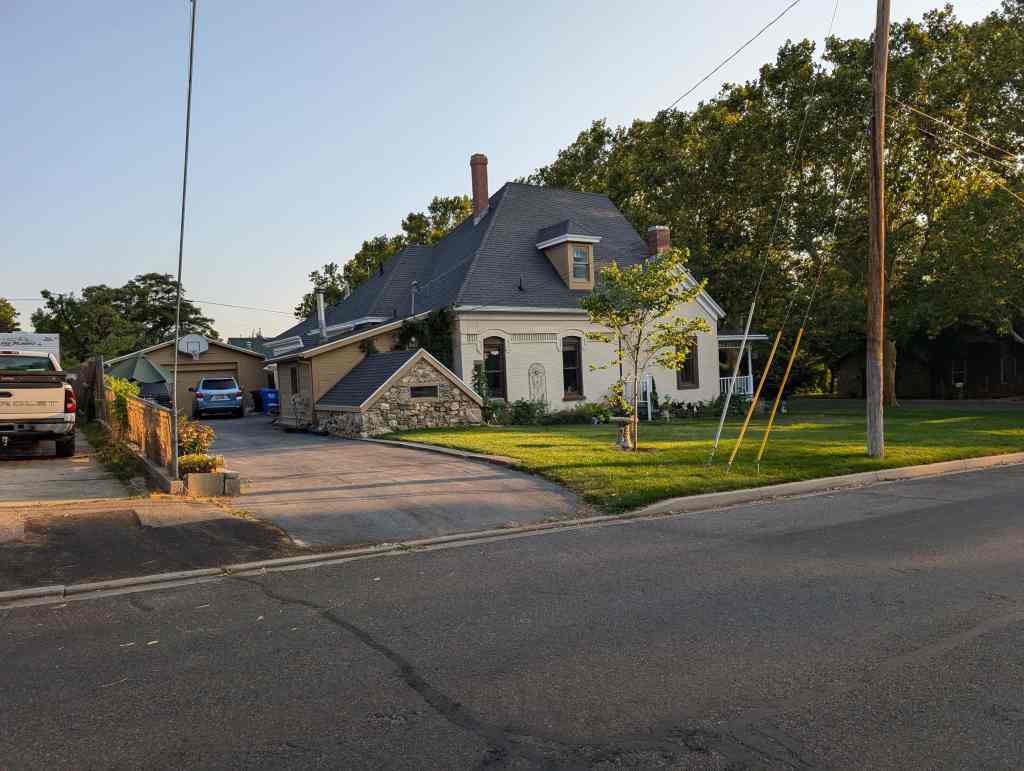
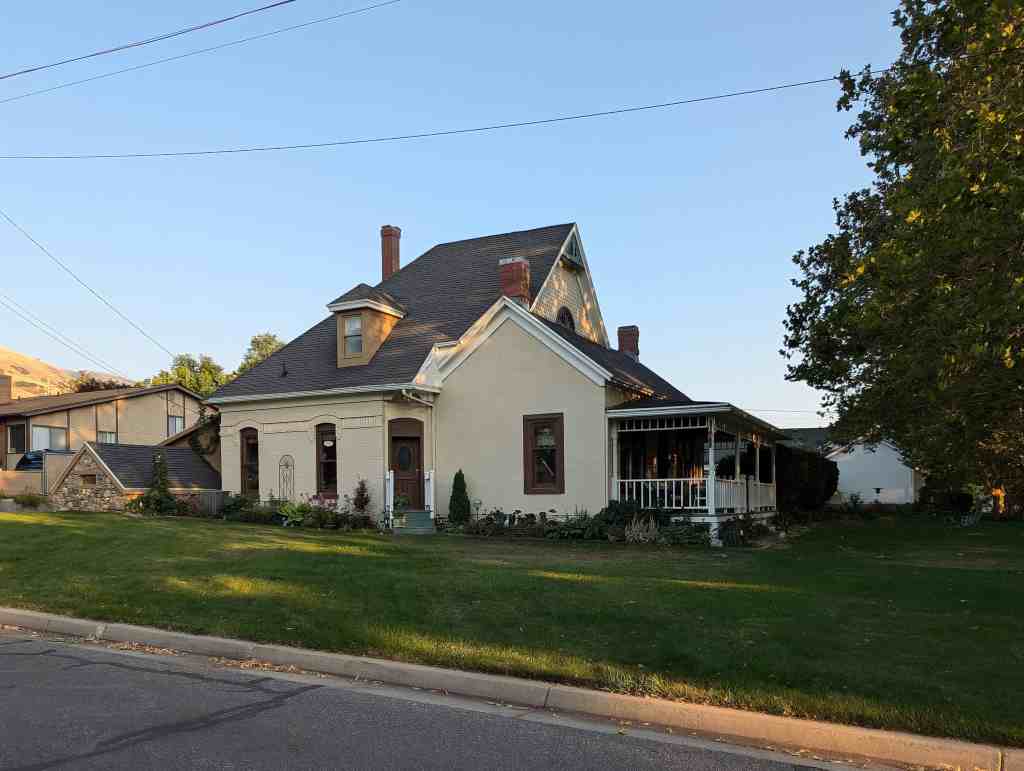
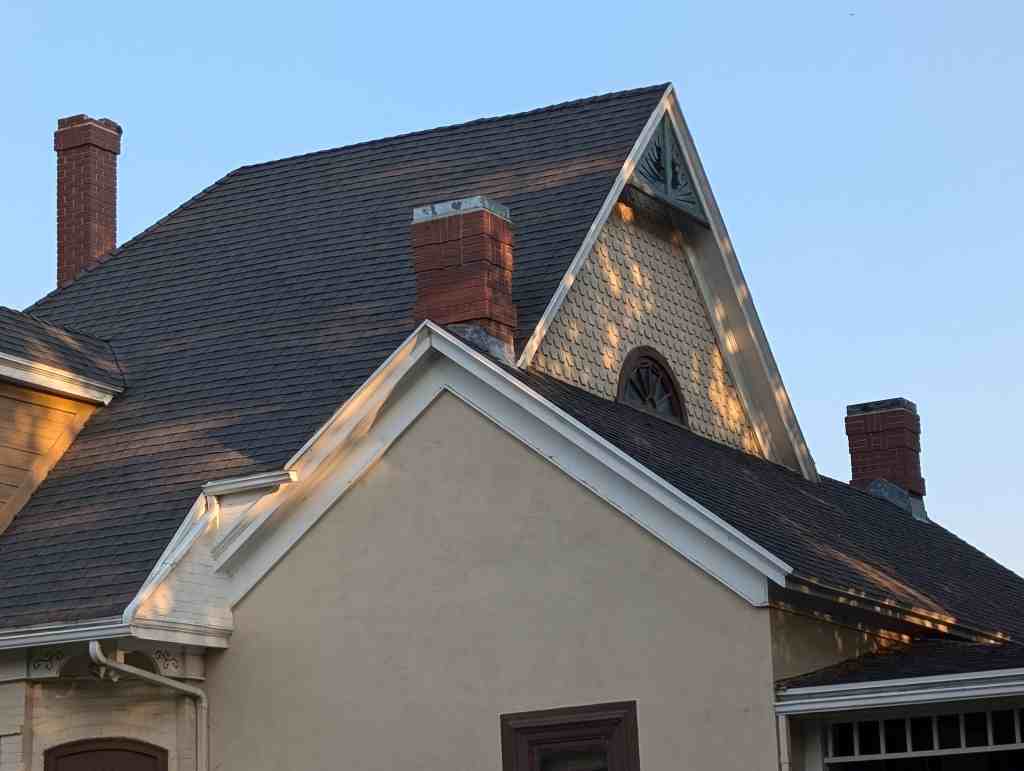
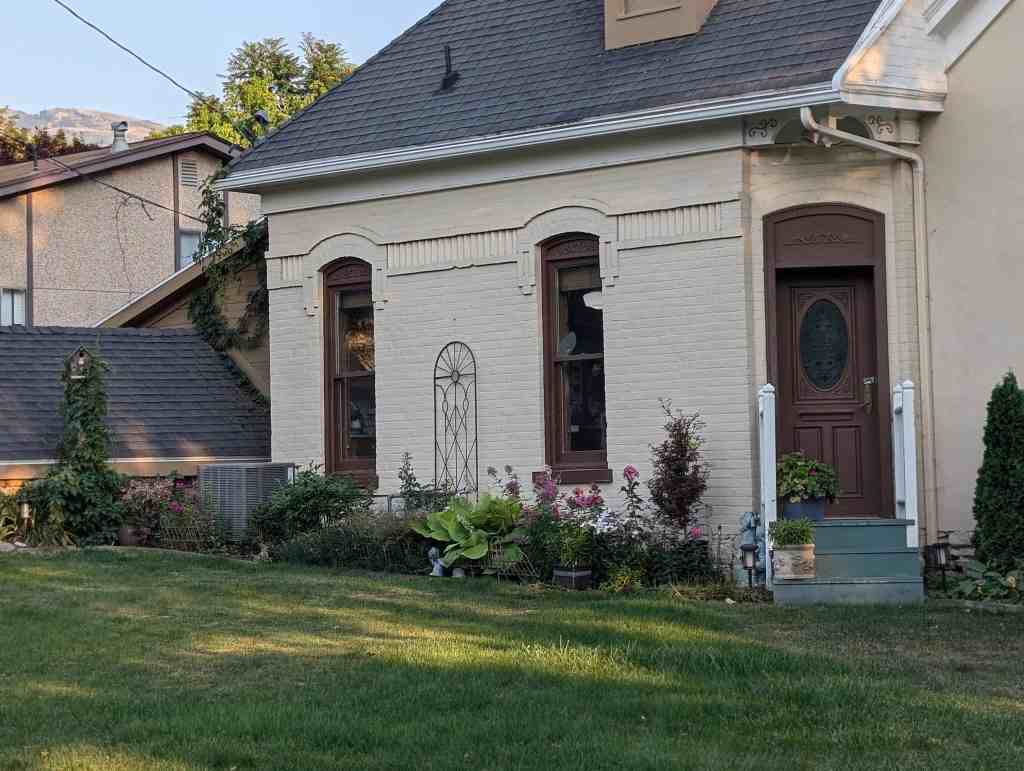
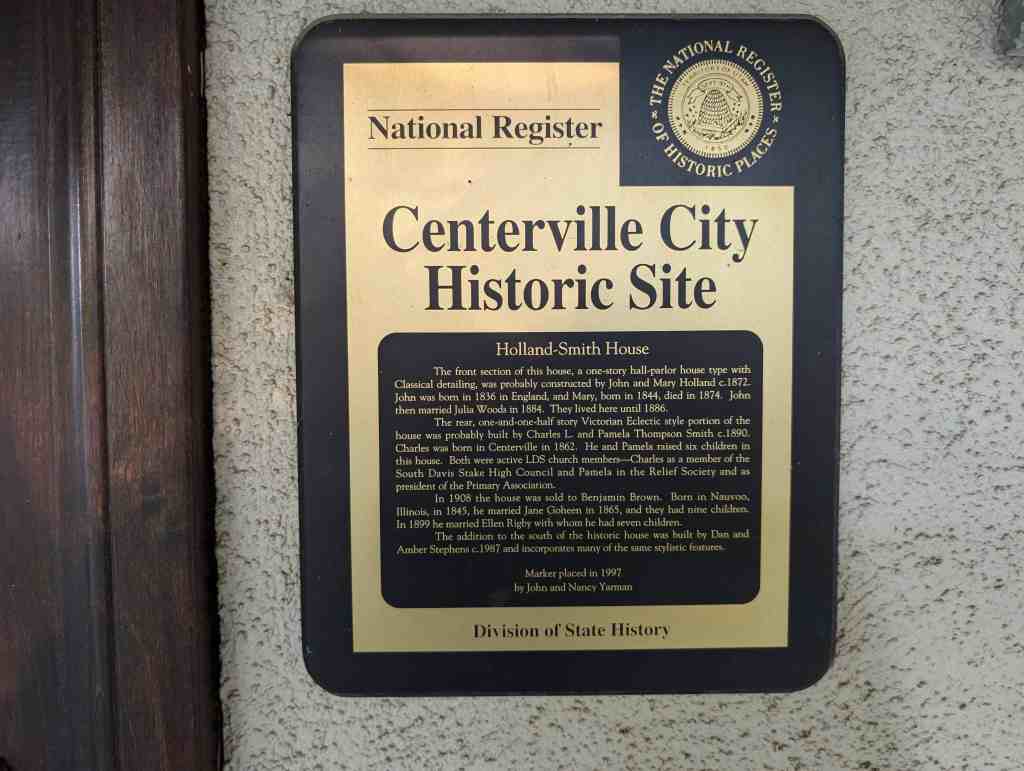
The front section of this house, a one-story hall-parlor house type with Classical detailing, was probably constructed by John and Mary Holland c.1872. John was born in 1836 in England, and Mary, born in 1844, died in 1874. John then married Julia Woods in 1884. They lived here until 1886.

The rear, one-and-one-half story Victorian Eclectic style portion of the house was probably built by Charles L. and Pamela Thompson Smith c.1890. Charles was born in Centerville in 1862. He and Pamela raised six children in this house. Both were active LDS church members-Charles as a member of the South Davis Stake High Council and Pamela in the Relief Society and as president of the Primary Association.

In 1908 the house was sold to Benjamin Brown. Born in Nauvoo, Illinois, in 1845, he married Jane Goheen in 1865, and they had nine children. In 1899 he married Ellen Rigby with whom he had seven children.

The addition to the south of the historic house was built by Dan and Amber Stephens c.1987 and incorporates many of the same stylistic features.

19 South 200 East in Centerville, Utah

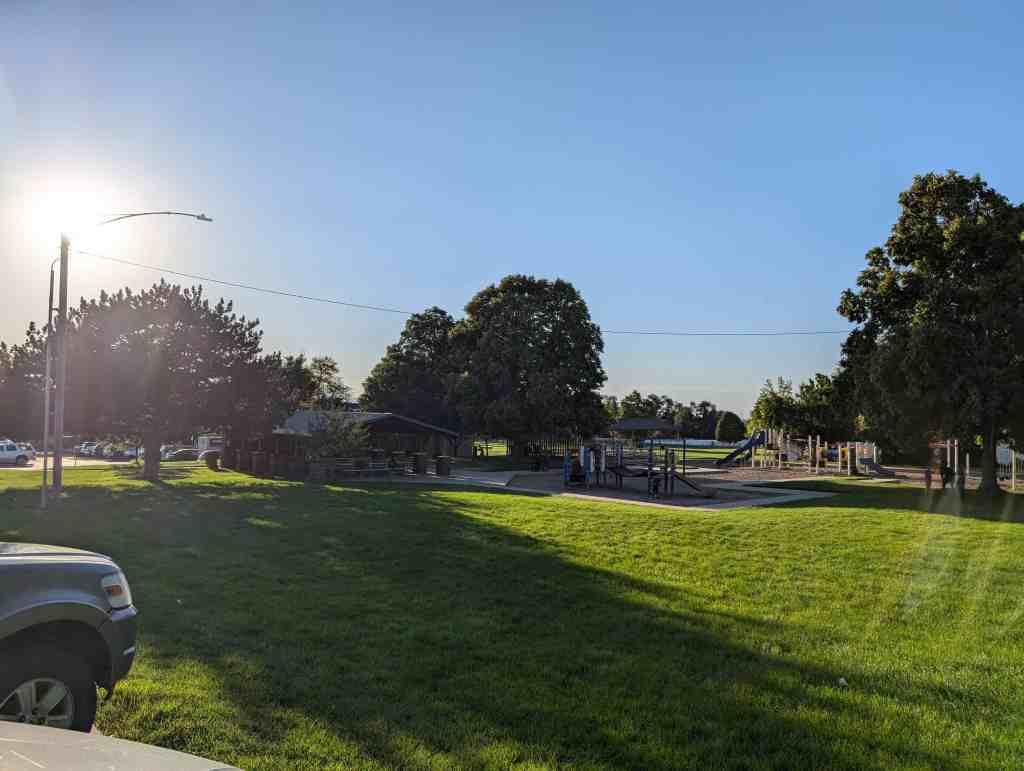
Hatch Park

04 Thursday Dec 2025

Posted by Jacob Barlow in Uncategorized

≈ 1 Comment

Tags

Davis County, North Salt Lake City, Parks, utah

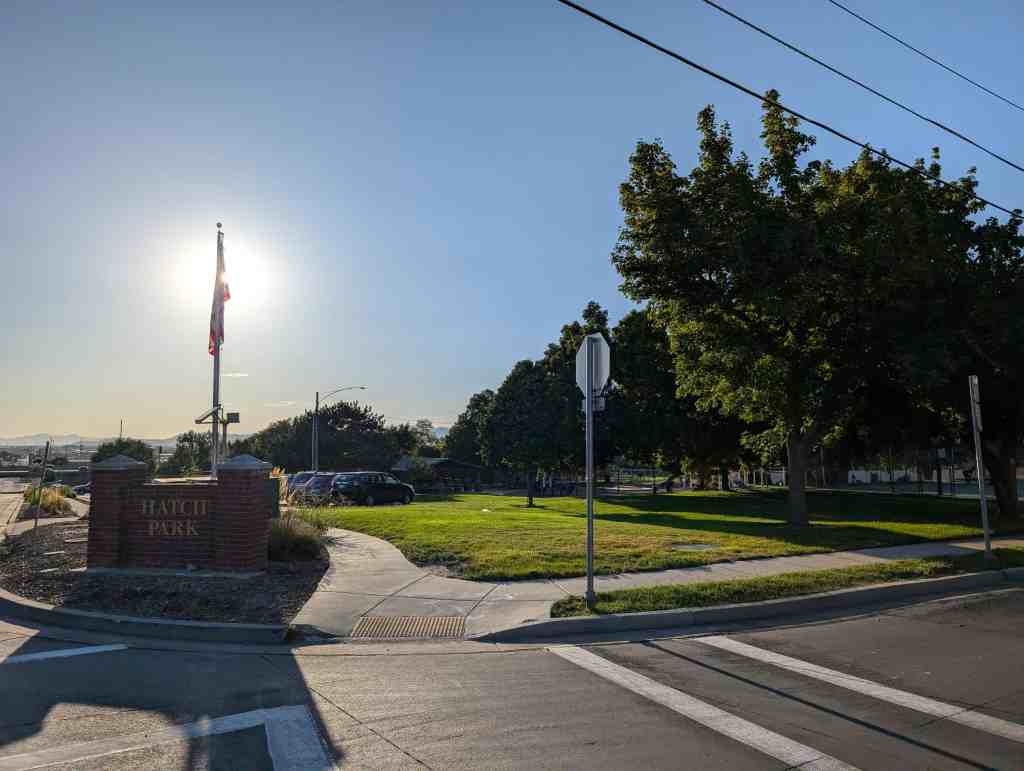
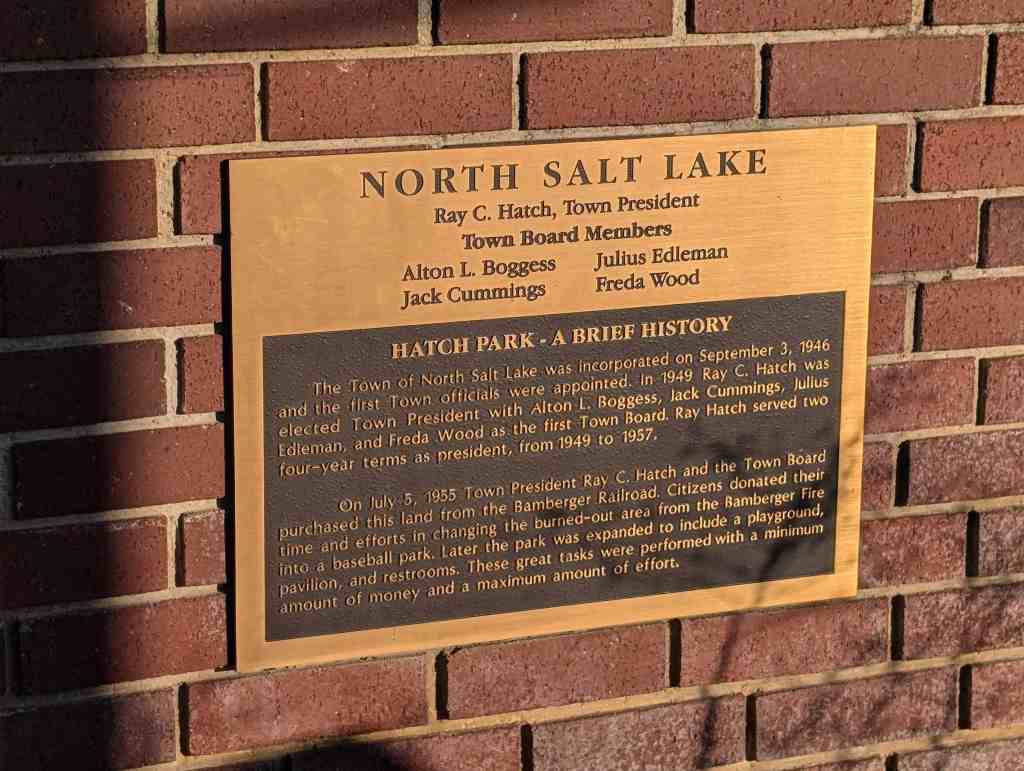
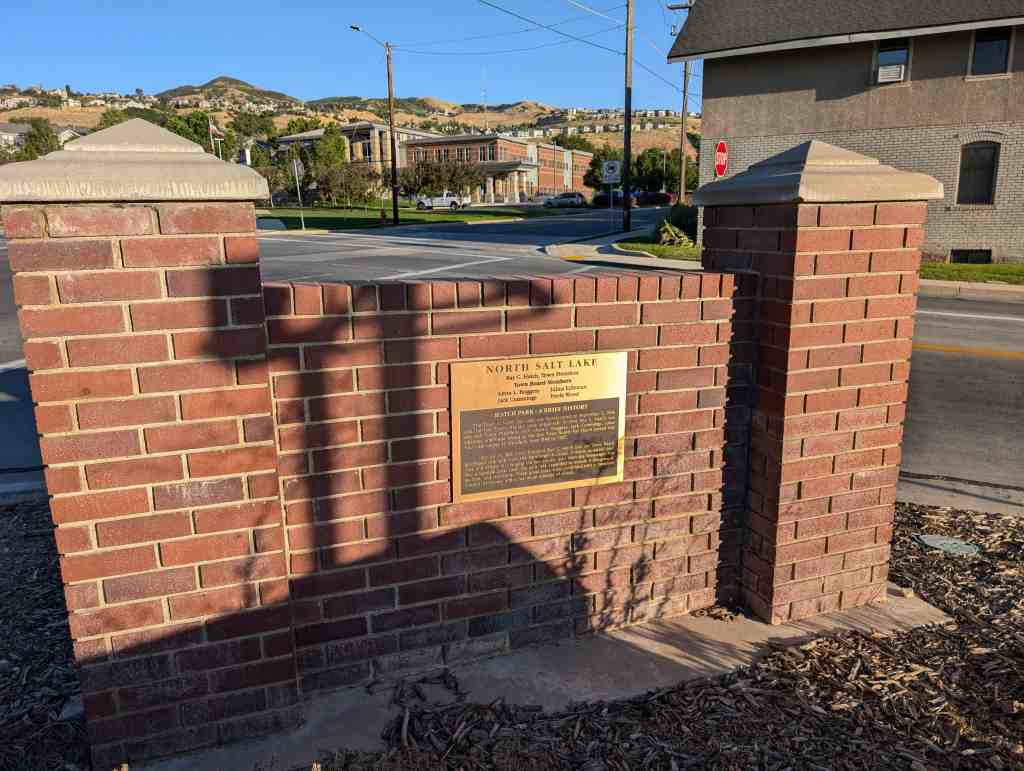
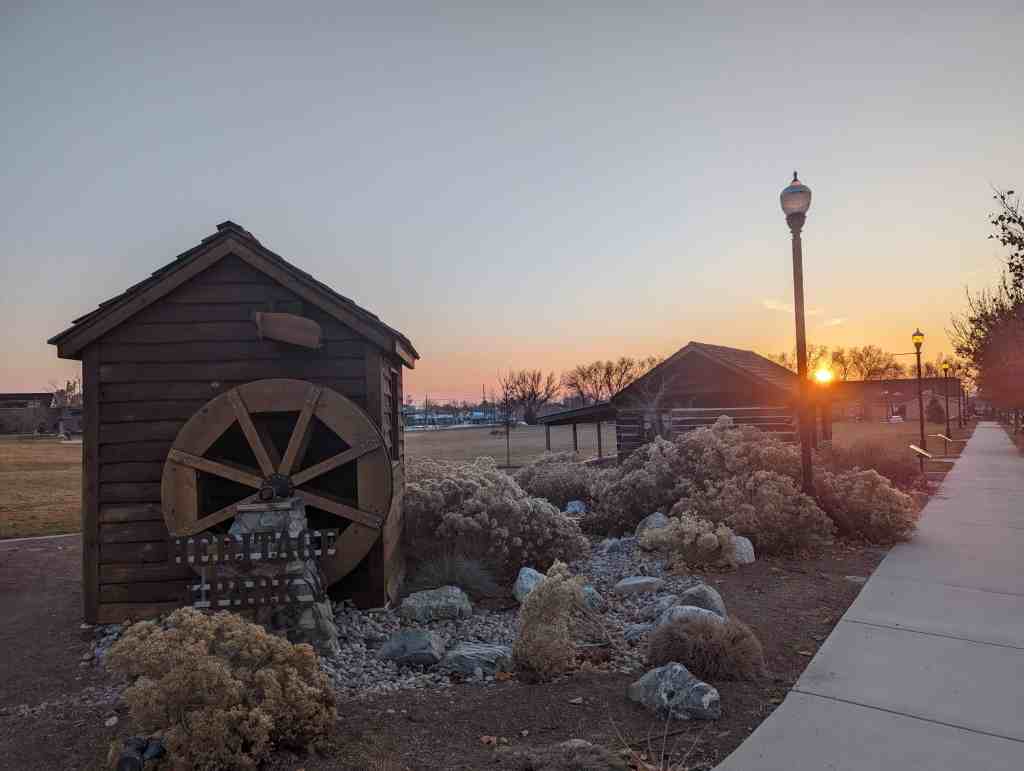
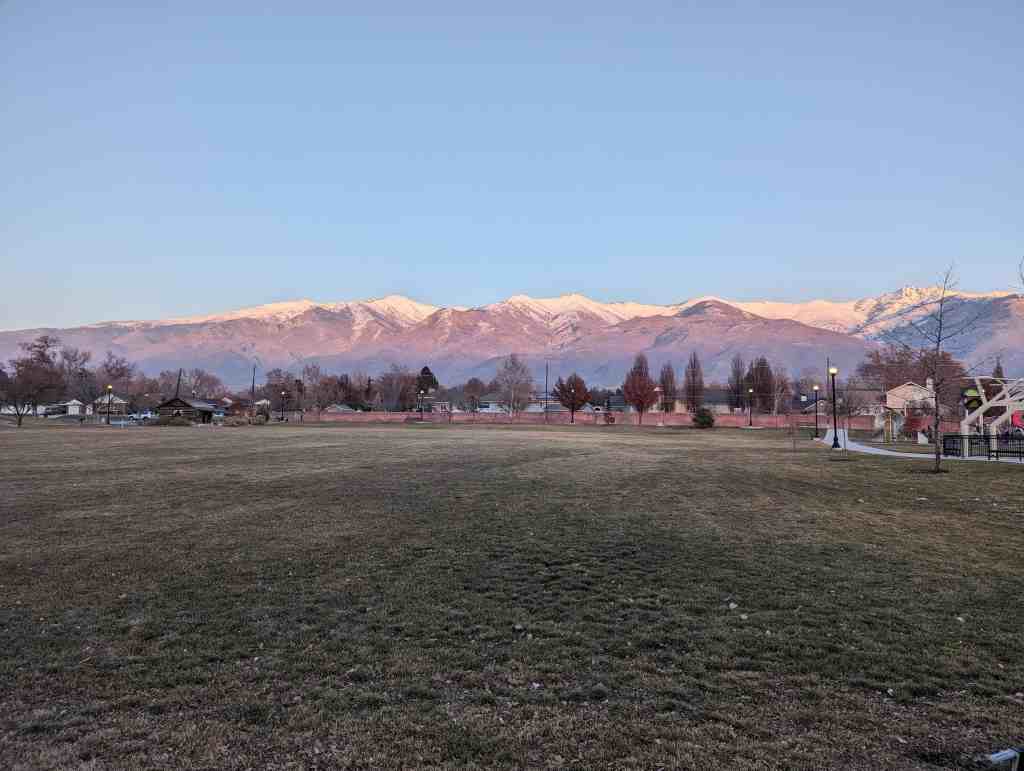
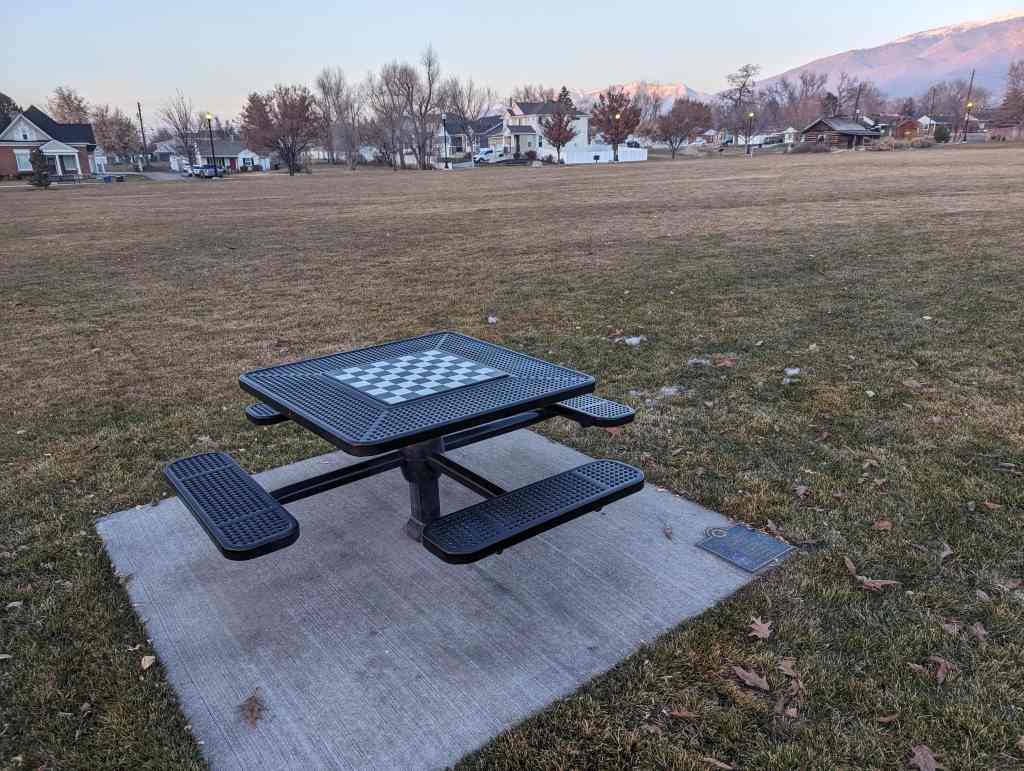
Hatch Park – A Brief History

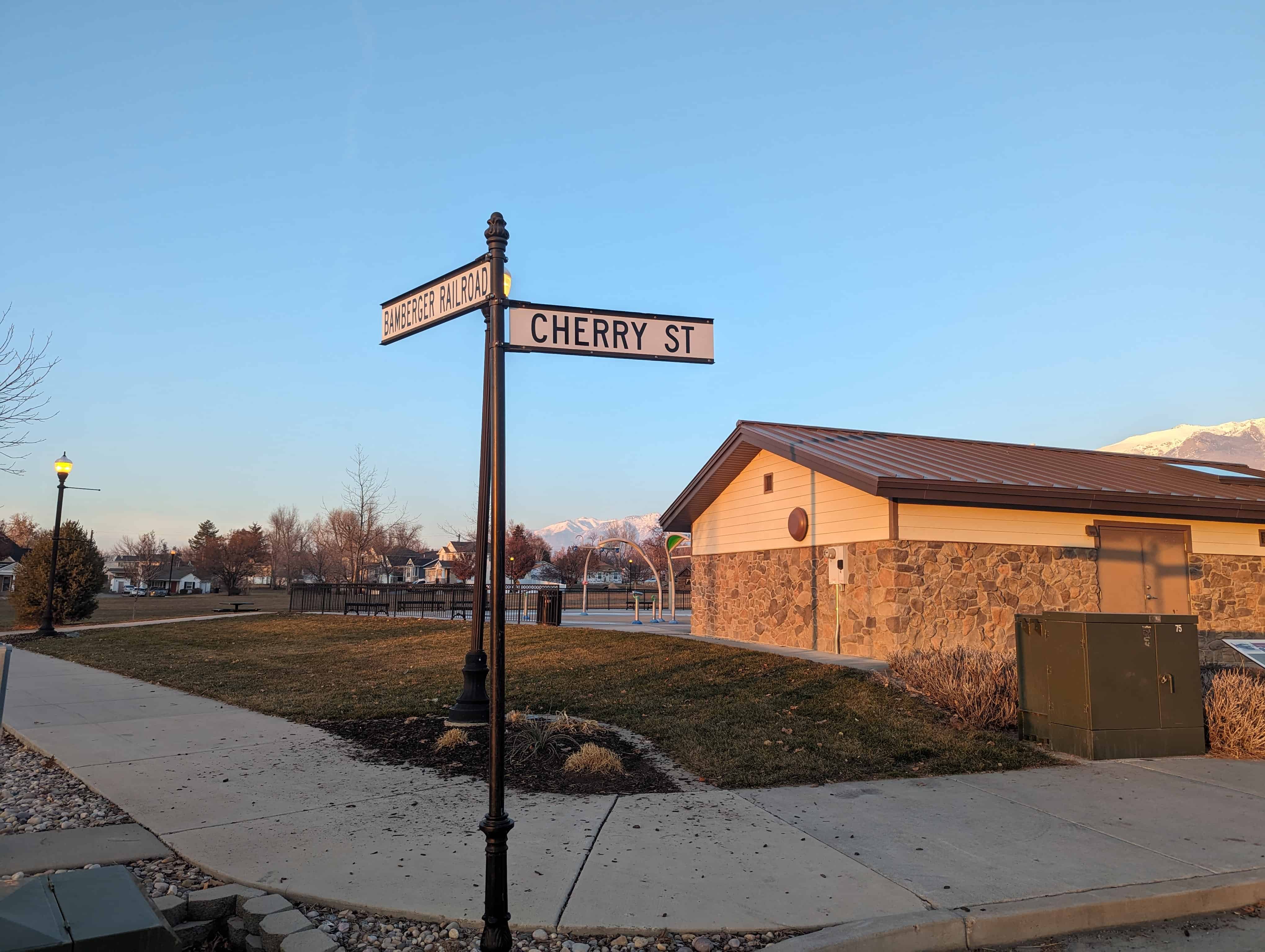
The Town of North Salt Lake was incorporated on September 3, 1946 and the first Town officials were appointed. In 1949 Ray C. Hatch was elected Town President with Alton L. Boggess, Jack Cummings, Julius Edleman, and Freda Wood as the first Town Board. Ray Hatch served two four-year terms as president, from 1949 to 1957.

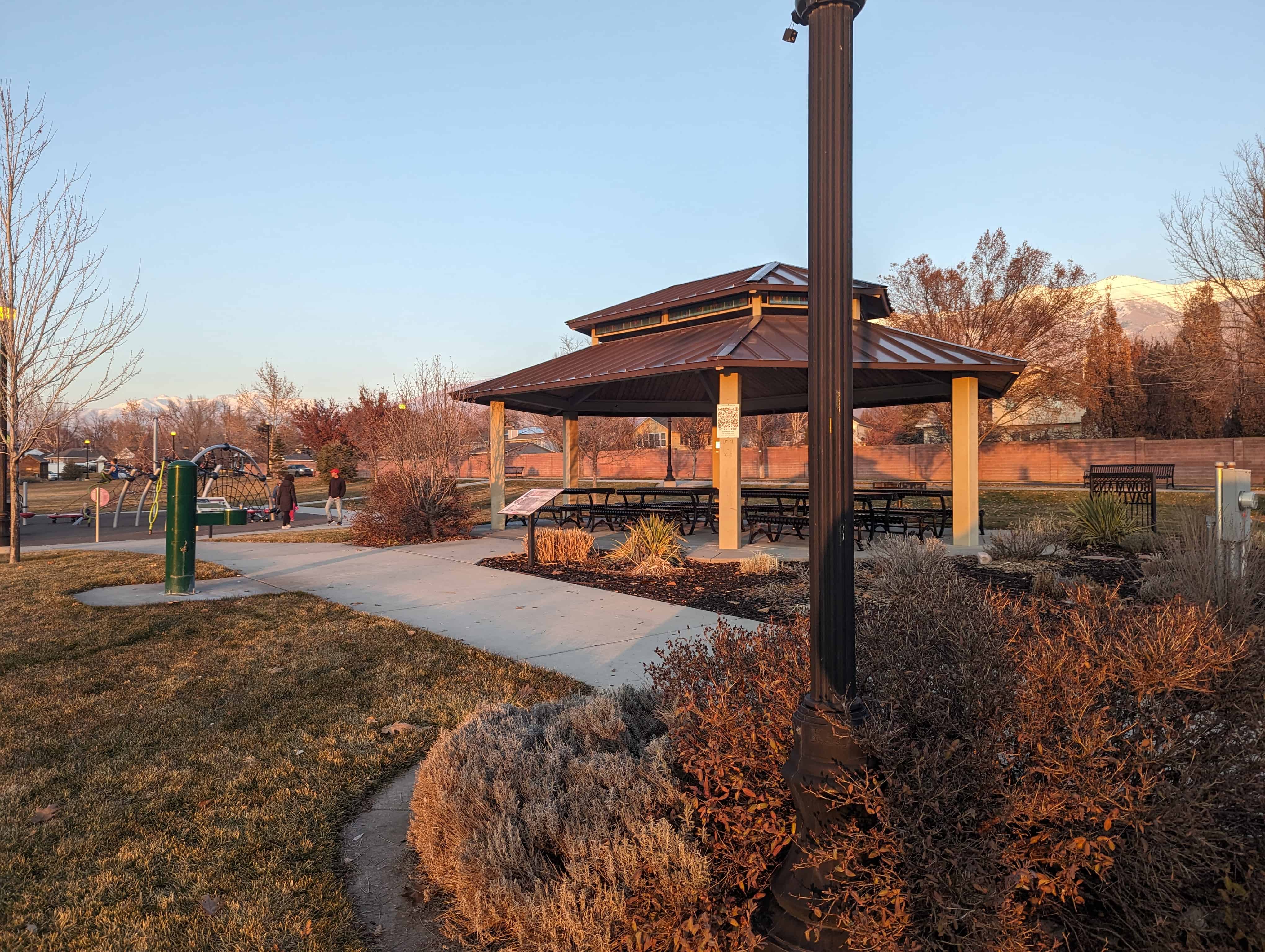
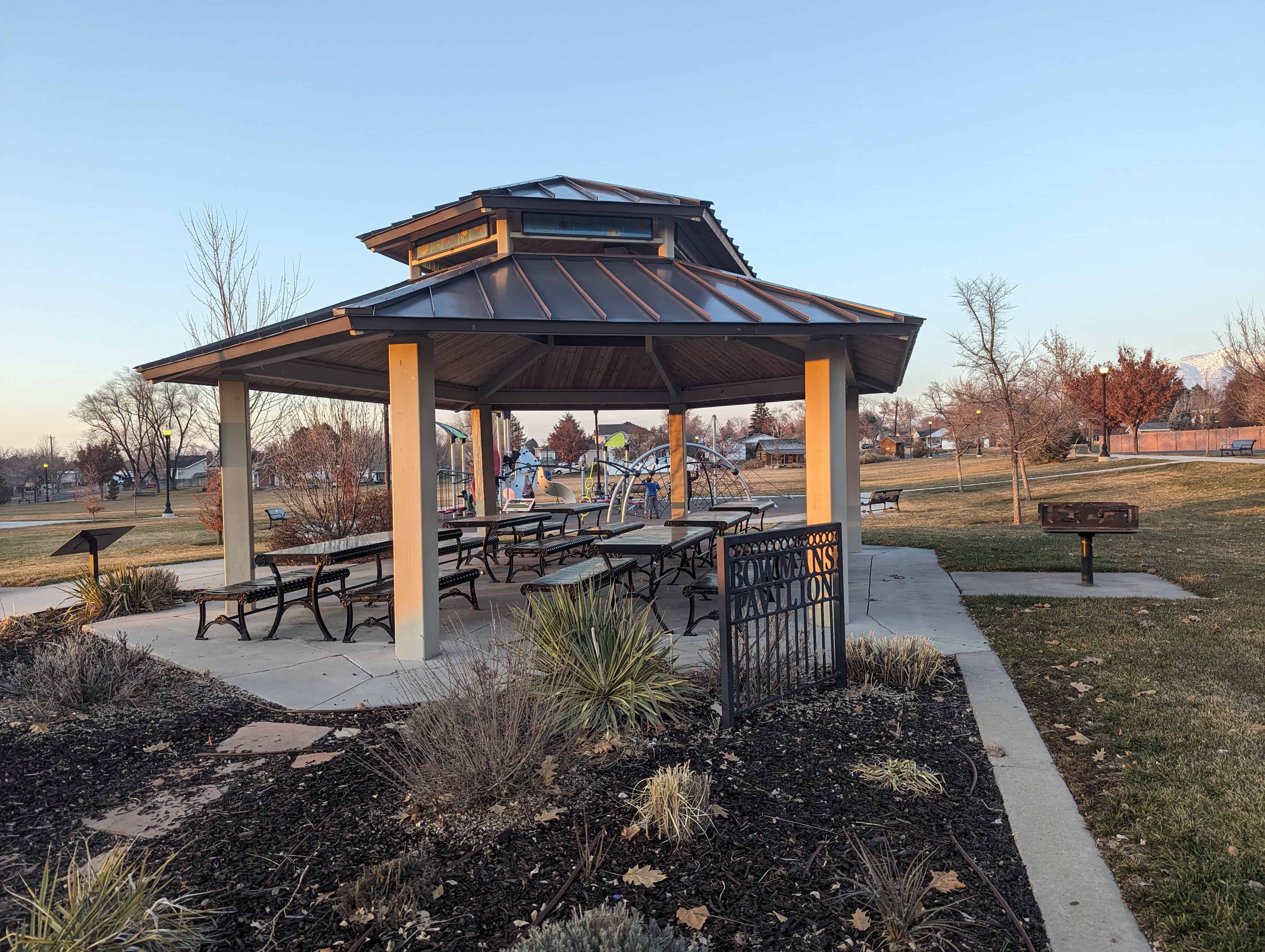
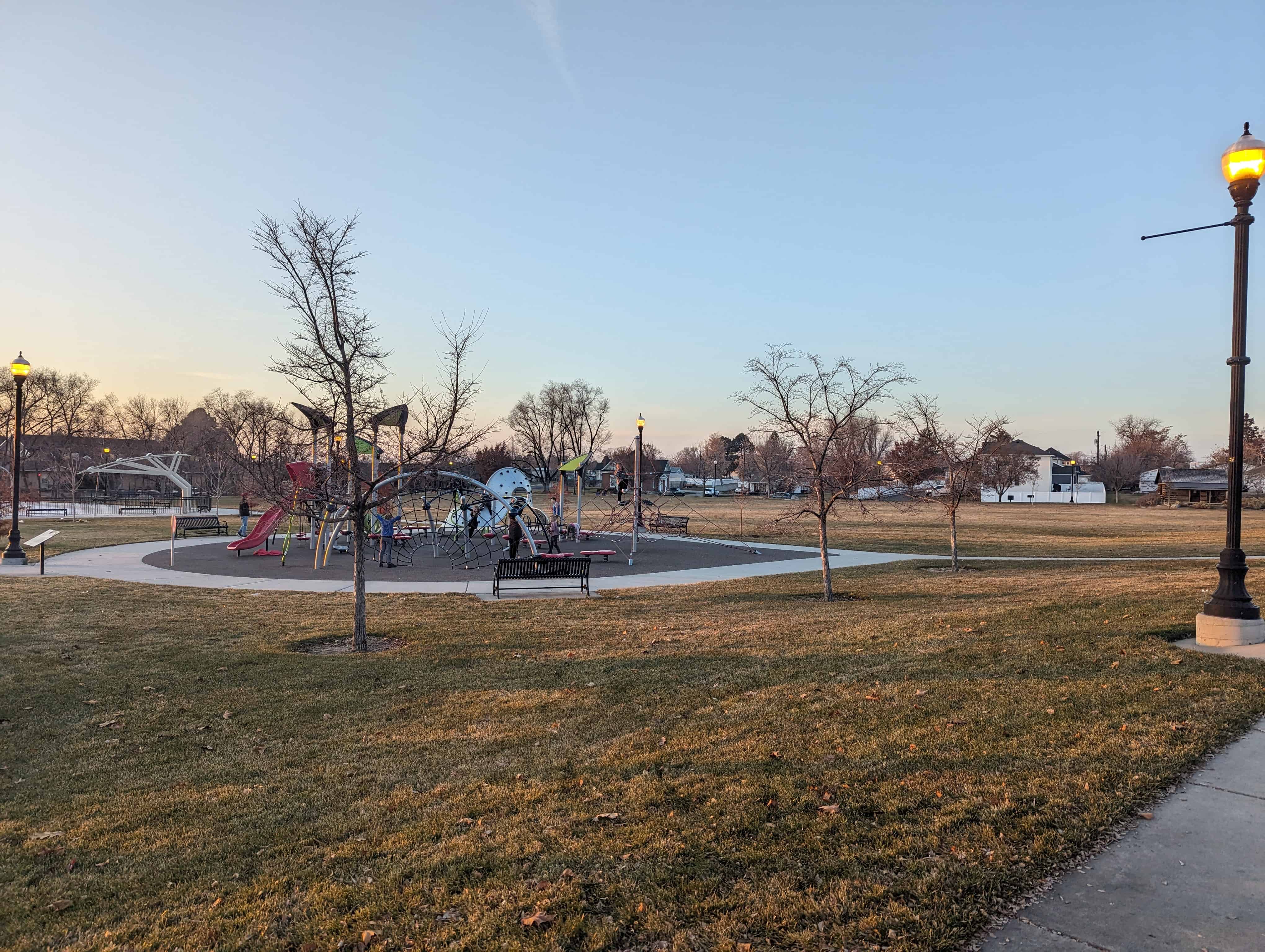
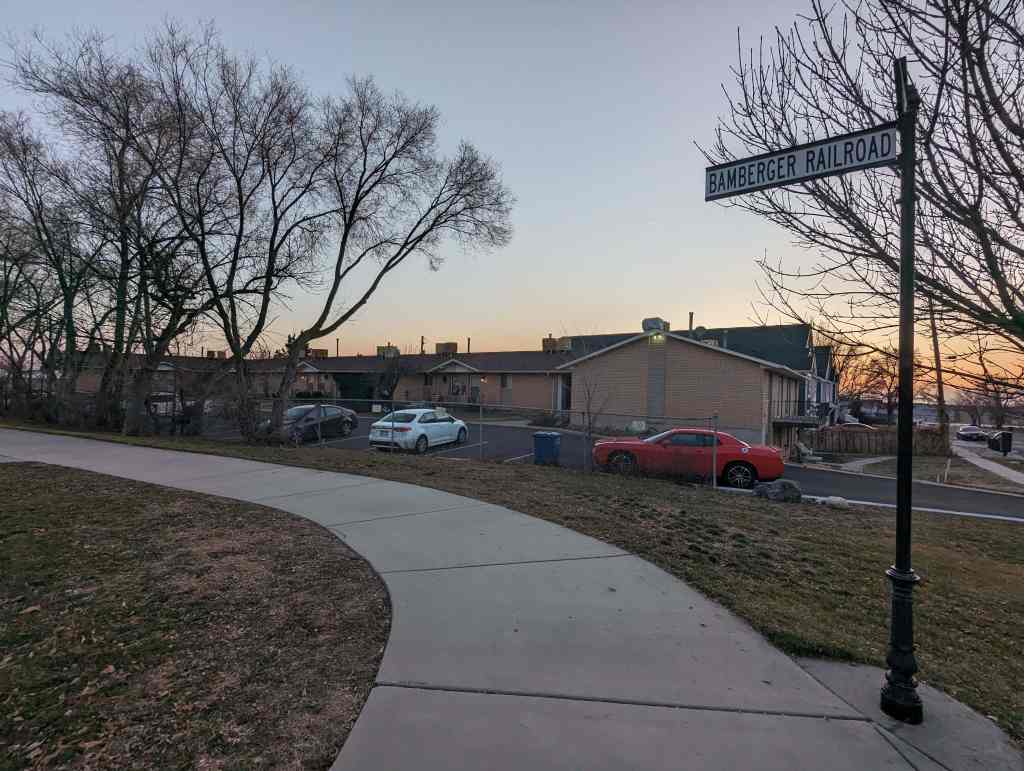
On July 5, 1955 Town President Ray C. Hatch and the Town Board purchased this land from the Bamberger Railroad. Citizens donated their time and efforts in changing the burned-out area from the Bamberger Fire into a baseball park. Later the park was expanded to include a playground, pavilion, and restrooms. These great tasks were performed with a minimum amount of money and a maximum amount of effort.

North Salt Lake
Ray C. Hatch, Town President
Town Board Members
Alton L. Boggess
Jack Cummings
Julius Edleman
Freda Wood

50 West Center Street in North Salt Lake, Utah

Related:

  • Bamberger Railroad Station (historic marker in the park)

James and Mary Forbes House

28 Saturday Dec 2024

Posted by Jacob Barlow in Uncategorized

≈ Leave a comment

Tags

Davis County, Historic Homes, Layton, utah

James and Mary Forbes House

Built in 1863 of fieldstone in the hall-parlor style with a crosswing addition added by son, Will Forbes in 1913.

2776 North Valley View Drive in Layton, Utah

Melvin Harley Randall House

04 Thursday Apr 2024

Posted by Jacob Barlow in Uncategorized

≈ Leave a comment

Tags

Centerville, Davis County, Historic Homes, NRHP, utah

Melvin Harley Randall House

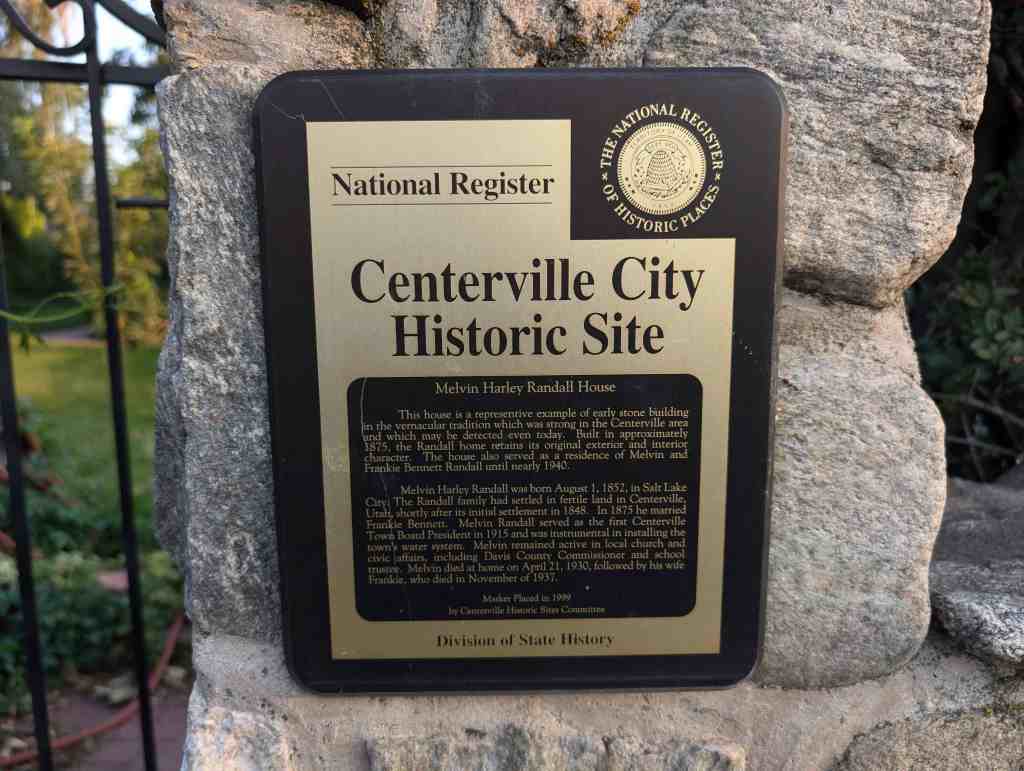
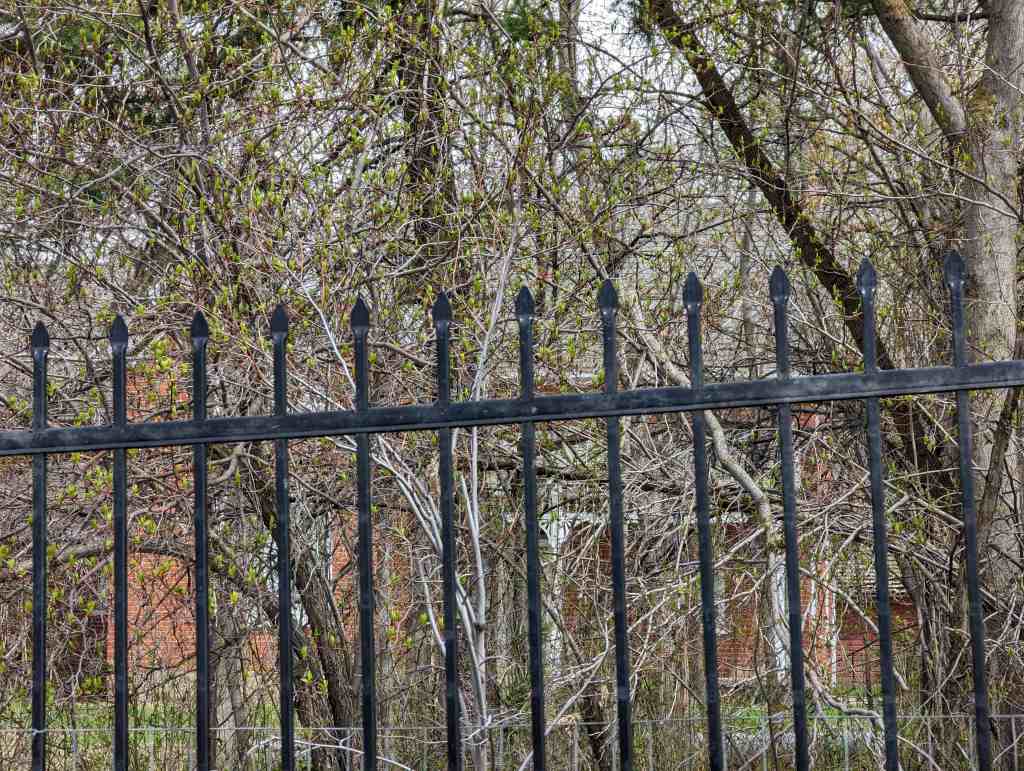
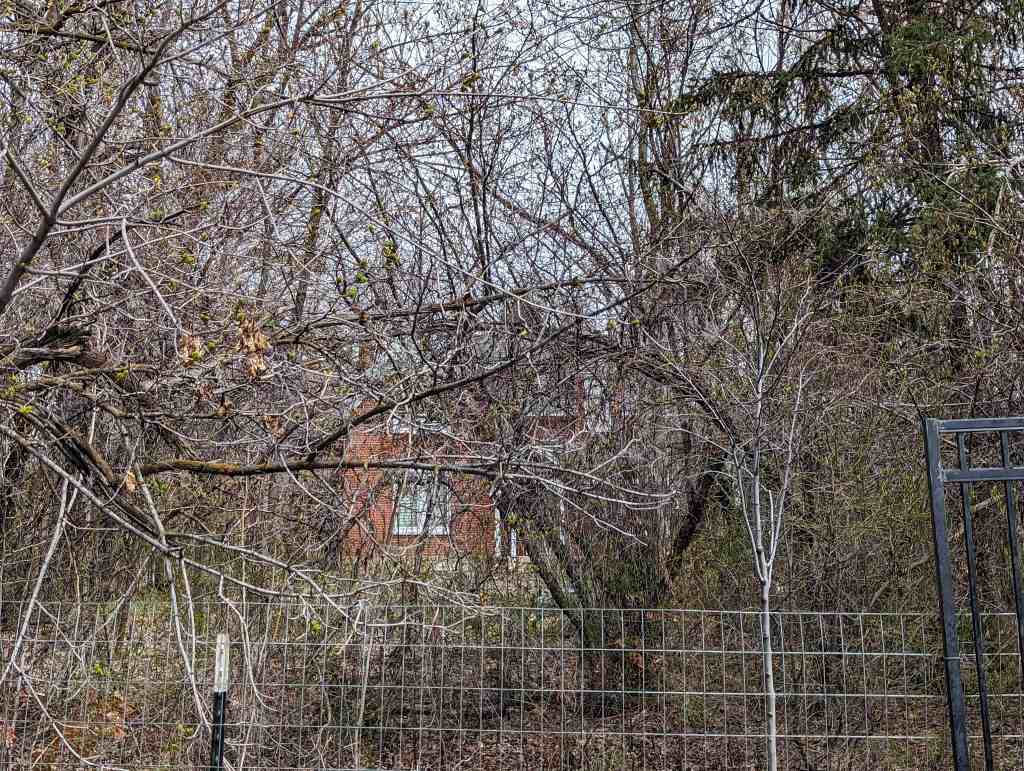
The Melvin Harley Randall House is a representative example of early stone building in the vernacular tradition which was strong in the Centerville area and which may be detected even today. Unlike other parallel stone dwellings of the period which are extant, however, the Randall home retains its original exterior and interior character. The house also served as the residence of Melvin Harley and Frankie Bennett Randall until 1940. Melvin Randall served as the first Centerville Town Board President, and remained active in local church and civic affairs.

Located at 390 East Porter Lane (400 South) in Centerville, Utah and added to the National Historic Register (#80003896) on June 20, 1980.

Melvin Harley Randall was born August 1, 1852 in Salt Lake City, Utah, the son of Alfred Jason and Margaret Hawley Randall. In 1875 he married Frankie Bennett. Randall’s family had settled in the fertile land in Centerville, Utah shortly after its initial settlement in 1848. Centerville, originally called Cherry Cheek, became an important agricultural area, located some twelve miles north of Salt Lake City. As other early Mormon communities, Centerville contained a strong church organization headed by a bishop and counselors who presided over all church affairs. Civil matters also became of concern on the local level.

By 1880 Melvin Randall was listed in local directories as a farmer, with his stone home having been built around 1875. Randall was active in church, political, and educational affairs of Centerville, gaining recognition in various sources as among the prominent pioneers of the town. In 1888 Randall became a First Counselor to Centerville Ward Bishop Aaron B. Porter, and in 1899 he was ordained Bishop, serving in that capacity until 1911.

In 1915 Centerville organized into a town in order to issue bonds to install a needed waterwork. The Davis County commissioners granted the petition by Centerville residents seeking town stature, and resolved that,” the following named persons are hereby appointed as the Board of Trustees of said Centerville Town: M.H. Randall, President of the Board, and as additional members Don Major, William Barber, Joseph E. Williams and F.W. Walton.” Thus, Randall became the first Centerville Town Board President, heading the town from May 15, 1915 to December 31, 1915, and helped to install the Centerville water system. He continued active in civil affairs by serving as a Davis County Commissioner and school trustee.

Melvin Harley Randall died at his home on April 21, 1930, followed by his wife Frankie, who died in November, 1940. The home is cited in the Smoot and Sheriff history of Centerville as one of the historic homes in Centerville, recognizing it as locally significant.

The Randall House is a two-story stone hall and parlor house, two rooms wide with symmetrical door-window-door façade piercing on the first floor with matching six-over-six windows but no center opening on the second floor. A one-story frame addition has been added to the rear, which made the house into a simple “H” plan. The cornice is undecorated, as are the lintels. The door surround is done with very plain pilasters. The wall beneath the cross gable connecting the one and two story sections of the house is set back below the roof, creating a narrow porch.

A later addition containing a utility room and bathroom was built on the west façade of the original house. The interior of the house retains most of the original door, window and baseboard moulding.

A very early twentieth century photograph of the house shows ornamental pediments over the windows of the frame section. The pediments were probably removed when aluminum siding was added.

Joseph Adams House

24 Sunday Mar 2024

Posted by Jacob Barlow in Uncategorized

≈ 2 Comments

Tags

Davis County, Historic Homes, Layton, NRHP, utah

Joseph Adams House

The Joseph Adams House is significant as one of the best remaining examples of the turn-of-the-century farm house in Utah’s Davis County. Located between the two large metropolitan areas of Salt Lake City and Ogden, Davis County became the garden spot of the Wasatch front as a considerable number of prosperous family farms were operated in the county; however, in the last few decades much of the farmland has been appropriated for housing subdivisions, schools, shopping centers, highways, and other urban structures. The Joseph Adams House and out buildings, located in a grove of trees and surrounded by pasture land, provides a glimpse of the by-gone rural-agricultural era of Davis County.

Located at 400 North Adamswood Road in Layton, Utah and added to the National Historic Register (#78002655) on February 17, 1978 (text on this page is mostly from that nomination form).

Related:

  • Joseph Adams Grave

Joseph Samuel Adams was born at Quincy, Adams County, Illinois, September 19, 1841. Earlier his parents Elias and Malinda Railey Adams had joined the Church of Jesus Christ of Latter-day Saints and moved to Illinois to be with the main body of Mormons. Following the exodus from Illinois the Adams family moved to Mount Pisgah in May 1846 and remained there until 1850. In the spring of 1850 Elias Adams was released from his assignment at the Mount Pisgah way station and allowed to complete the journey to the Great Salt Lake Valley.

After their arrival in Salt Lake City, September 7, 1850, the Adams family immediately traveled north to the Kaysville settlement where Elias Adams claimed a parcel of land .approximately one by two miles.

Joseph Adams remained with his family in Kaysville until 1873 when he was called to serve as a colonizing missionary to northern Arizona. The mission proved a failure, and the group returned to Utah. However Joseph Adams left his mark in Arizona at House Rock Springs where his assessment of the mission, carved in stone, can still be read, “Joseph Adams from Kaysville to Arizona and busted June 4, A.D. 1873.”

Joseph returned to Kaysville and in February 1876 married Isabella “Belle” Smith. He purchased 80 acres of land from his father for 450 bushels of grain. In the spring of 1876 a large log house was constructed and several out buildings including the granary, cellar and wash house. The farm proved profitable and in 1889 Adams began construction of the present brick house. Brick for the house was made by Joseph Adams who had learned brick making from his father.

Joseph Adams died October 13, 1901. His wife “Belle” remained in the house until her death in 1944. Prior to that time his son Charles moved into the house and the property passed to him. Charles Adams died in 1966, and his wife, Minnie N. Adams, is the current owner. She has deeded the house and property to her son, Charles P. Adams, who has shown a strong commitment to the preservation of the house and property.

Of the original eighty-acre farm only six acres are included as the National Register property. The six acres include the following buildings: the house, constructed in 1889-1890; the wash house, constructed in 1876; the milk house, constructed c. 1900; the granary, buggy shed, and milking shed, constructed in 1876; and a garage, constructed c. 1920. Also on the property but not included in the nomination is a thresher shed constructed in 1959.

The Adams house is a good example of a basic “T” form, 2-story brick house (with a one-story shed addition), which uses Queen Anne style decorative elements without the variation in plan or massing characteristic of more elaborate Queen Anne buildings. The fine decorative detail, although limited to the front façade, makes for great visual interest. The first floor double two-over-two windows in the gable end framed by a brick arch, with a tracery pattern in the wood infill below the arch. The second floor windows above and the dormer window are set in raised brick corbelling. Both second story windows, one in the gable end and the dormer over the porch, are framed by raised corbelled brick.

The porch projects past the front of the house and is supported by six turned posts with bell and spindle fret work just below the porch roof line. The roof of the porch is broken by a projecting gable over the steps with a turned finial on the gable peak.

The wash house is approximately 10 feet by 14 feet. The log structure was constructed in 1876 for bathing and washing clothes.

The granary, located to the rear, southeast of the house, was constructed in 1876 and is built of wood on a stone foundation which comprises a cellar and is reached by an entry on the west side of the granary. The granary is reached by doors on the north.

Attached to the granary on the east is a buggy shed with three stalls which open to the north. Attached to the buggy shed to the east is the milking shed. It opens to the south. The milk house, a 4 foot by 6 foot wooden shed used to cool the milk is located approximately forty feet west of the granary.

The garage is located east of the house, approximately 120 feet and north of the granary approximately 60 feet. It is a wood frame structure.

The house and out buildings are surrounded by approximately four and a half acres of pasture land.

Franklin D. Richards House

16 Saturday Mar 2024

Posted by Jacob Barlow in Uncategorized

≈ Leave a comment

Tags

Davis County, Farmington, Historic Homes, NRHP, utah

Franklin D. Richards House

The Richards House was constructed in the early 1860 T s by Franklin D. Richards for his plural wife Rhoda H. Foss Richards. Franklin D. Richards married Rhoda after the death of Willard Richards, her first husband and Franklin D. Richard’s uncle.

Located at 386 North 100 East in Farmington, Utah and added to the National Historic Register (#77001303) on December 23, 1977.

Rhoda Foss Richards was born April 19, 1830, in Maine. She was baptized a member of the Church of Jesus Christ of Latter-day Saints in 1844 and in 1850 came to Utah with her mother, brother and sisters. The next year, November 30, 1851. she married Willard Richards, second counselor to President Brigham Young. One son, Calvin W. Richards, was born to Rhoda before Willard Richards died six weeks before his 50th birthday on March 11, 1854. One of several plural wives left by Willard Richards, Rhoda and other wives lived in Salt Lake City while several other wives lived in Farmington.

With no one directly responsible for the welfare of the Willard Richards family and the family facing acute financial problems, several wives wrote to Brigham Young seeking his advice. Following Young’s counsel, four of the wives, including Rhoda, married Franklin D. Richards on March 7, 1857. The marriage might have taken place earlier but Franklin D. Richards left for a proselyting mission to England two weeks after Willard’s death in March 1854 and did not return to Utah until October 1856.

Following the unsettled period caused by President James Buchanan’s sending a Federal Army to put down an alleged rebellion among the Mormons, Franklin D. Richards moved Rhoda to Farmington in 1858 where she occupied a log cabin until the three-room rock house was completed some time after the birth of twin boys, Ira and Exra, on July 27, 1860. Earlier another son, Hyrum, was born to Franklin and Rhoda on December 14, 1857. Later a daughter, Sarah Elizabeth, was born on October 31, 1862.

Rhoda lived in the Farmington home until her death in 1881. Although the official residence of Franklin D. Richards was Ogden, his journal notes frequent visits to Farmington to care for Rhoda and three other wives who lived in the community. An attractive lady of twenty-seven at the time of her marriage to Franklin, Rhoda seems to have been an understanding wife for whom Franklin had a great concern. A few days before her death, Franklin, upon her advice, reluctantly left to accompany other church authorities on a visit to the Southern part of Utah. In a biographical sketch of Rhoda Foss Richards, Mathias F. Cowley writes, “She was kind and lovable, yet firm for the right in everything whether of small or great importance. She and her family were very poor in this world’s goods, but rich in faith and the hopes of a glorious future. She was well educated but yet willing not only to be a school teacher but to milk a cow, feed chickens and attend to every essential work whether in the house or out of doors. She raised her family in the main with little help from her husband for his duties as a faithful apostle of the Lord called him away from home most of the time, and having a large family they had to struggle but it made them self reliant. . ..”

Franklin D. Richards was one of the most important intellectual leaders of the LDS church and Utah during the Nineteenth Century. Born April 2, 1821, in Richmond, Berkshire County, Massachusetts, he joined the Mormon Church in June 1838 and moved West first to Missouri and then Illinois. During the period from 1840 to 1845 he served several proselyting missions in the United States and in July 1846 he left for a two-year mission to England.

Arriving in Salt Lake City in October 1848 he was called as one of the Church’s twelve Apostles on February 12, 1849. In October 1849 he returned to England as President of the British Mission from January 1, 1851, until he left England for Utah in May 1852. Under his administration the Prepetual Emigration Fund, a system whereby emigrants could borrow from a fund to pay for their travel to Utah then return the money to the fund for the use of others, was established in England. A successful administrator and missionary, Franklin D. Richards served as President of the entire European Mission, which included the British, French, Scandinavian, Swiss, German, and Italian mission fields, from 1854 to 1856 and 1866 to 1868.

Following his return from the last mission he was asked to move to Ogden to be the presiding ecclesiastical authority in Weber County. In this capacity he represented Brigham Young at the ceremonies marking the completion of the Transcontinental Railroad on May 10, 1869.

During the polygamy crusade of the 1880 ! s he was described as the “visible head of the church.” While Church President John Taylor was forced into hiding because of the polygamy issue, Franklin D. Richards and his wives, “. . . conformed their mode of life to the requirements of the law.” Without harassment by Federal authorities, Franklin Richards, while in communication with his colleagues who were in hiding, was able to act in an official capacity for the church including presiding over the church general conferences from October 1884 to October 1887.

In 1884 Franklin D. Richards was assigned to assist the Church Historian, Wilford Woodruff, and in 1889, when Wilford Woodruff became President of the church, Franklin D. Richards was appointed Church Historian. As a:_ historian, Richards was devoted to objectivity and authenticity. “His administration was marked by an intense desire to secure the strictest accuracy possible, and to have all history subject to the most careful scrutiny that may be available.”

He assisted Hubert Howe Bancroft in his preparation of his History of Utah which was completed in 1885 but not published until 1889. He participated in the founding of the Utah Genealogical Society in November 1894 and served as its first president. Recognizing that Utah’s History extended beyond the bounds of “Mormon History,” he also participated in the founding of the Utah Historical Society in 1897 and served as its president until his death on December 9, 1899. His Presidential address of 1898, given less than three weeks after his appointment as president, sought to define areas of possible research into Utah’s varied past. He noted the areas of agriculture, irrigation, manufacturing, mining, architecture, transportation, communication, colonization, education, Mormon and non-Mormon religious institutions, literature, fine arts, invention, social customs, manners and morals, politics, and woman’s suffrage. Regarding architecture he noted, “The evolution of architecture, as exhibited in the advancement from primitive log cabin to the stately mansion, and from the plain adobe structure with its small openings and little sashes, to the imposing edifices, public and private, erected and beautified with sandstone, granite, marble, onyx and other costly materials, obtained within our borders, must not be forgotten.”

He concluded the address with an optimistic outlook for the newborn organization’s future, “I regard the organization of this society as the foundation for a superstructure which will be continuously added upon, as the years pass by, until an edifice will appear which will command the admiration of successive generations, which will be invaluable to our mountain State, which will rank among the foremost institutions of the kind in our beloved country, and which will aid materially in the education of our people and advance the welfare of mankind.”

Following the death of Rhoda Foss Richards in 1881 the house remained in her family’s possession, and in 1890 Ezra Richards brought his new bride, Amanda Reeder, to the Farmington home. A farmer by occupation, Ezra also served a mission to New Zealand from 1885 to 1888 where he directed the translation of the Book of Mormon into the Maori language. Later from 1896 to 1898 he served as President of the New Zealand Mission. He added a fourth room to the three-room house in 1904.

Ezra Richards died February 1, 1930. However, his wife Amanda lived in the house until her death on March 4,1962. The house is currently owned by Clara Richards, a daughter of Ezra and Amanda Richards and granddaughters of Franklin D. Richards.

The Richards house is significant as one of the early rock houses constructed in Farmington. Since the Franklin D. Richards residence in Ogden has been destroyed, the Farmington House is perhaps the best tangible reminder of the life of this early church leader and historian. The relationship which developed between Rhoda Richards and her first husband’s nephew is an example of the workings of polygamy among Nineteenth Century Mormons.

The original portion of the Franklin D. Richards House is a one-story, three room stone structure with a T-shaped plan. The stone used in the building is a hard, igneous stone gathered from nearby fields and riverbeds. The walls of multicolored stone are laid up in random rubble fashion. Basically vernacular in character, the Richards’ House is trimmed with a plain cornice and frieze and flat lintels and sills, all of plain, unmoulded wood. The window and door bays are square. The windows are 6/6 double-hung sash with simple beveled muntins.

The front porch, a hipped roof canopy which extends across the full length of the western side of the trunk of the T appears on early photographs with round wooden columns and brackets. It is likely that this porch, along with a one-story, frame, hipped wing along the eastern and southern sides of the trunk of the T, were added after 1890. The posts and brackets remain on the later porch, but the frame siding has been covered with newer sheathing. Fortunately, these exterior alterations are on the backside of the house and are not visible from the front view.

Inside, the original rooms retain their original dimensions, trim and spacial arrangements. One fireplace of c. 1890 vintage is also extant. The house has been carefully maintained so that the original design and fabric contribute to our knowledge of pioneer vernacular craftsmanship.

Heritage Park

17 Saturday Feb 2024

Posted by Jacob Barlow in Uncategorized

≈ Leave a comment

Tags

Davis County, Kaysville, Parks, utah

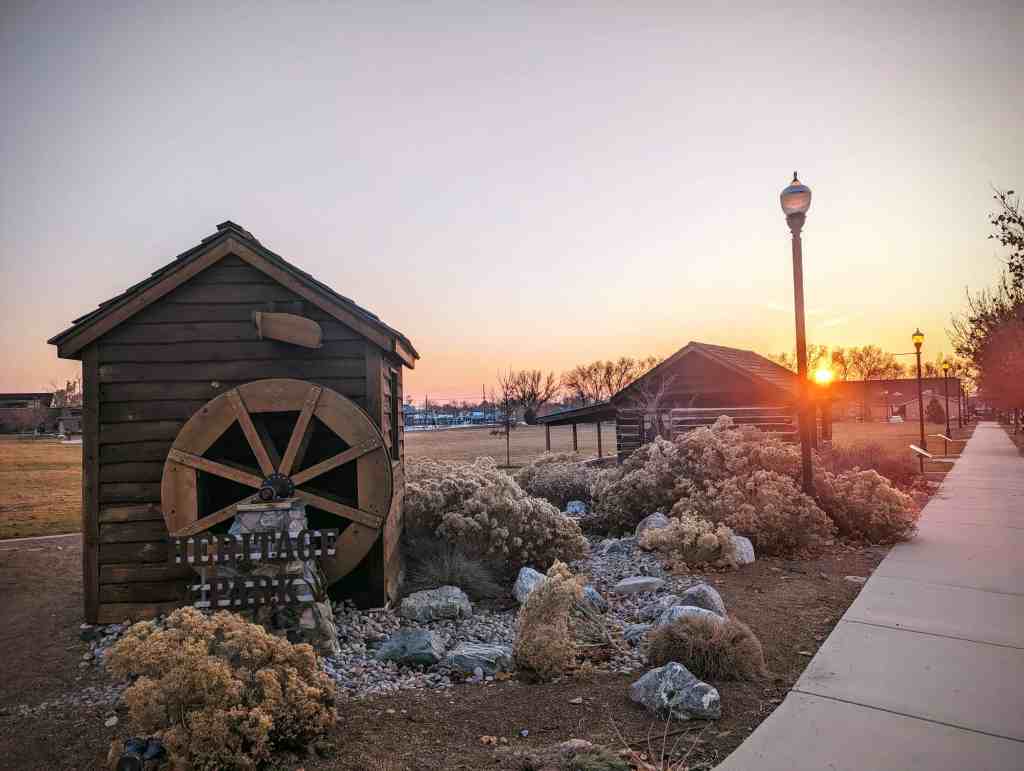
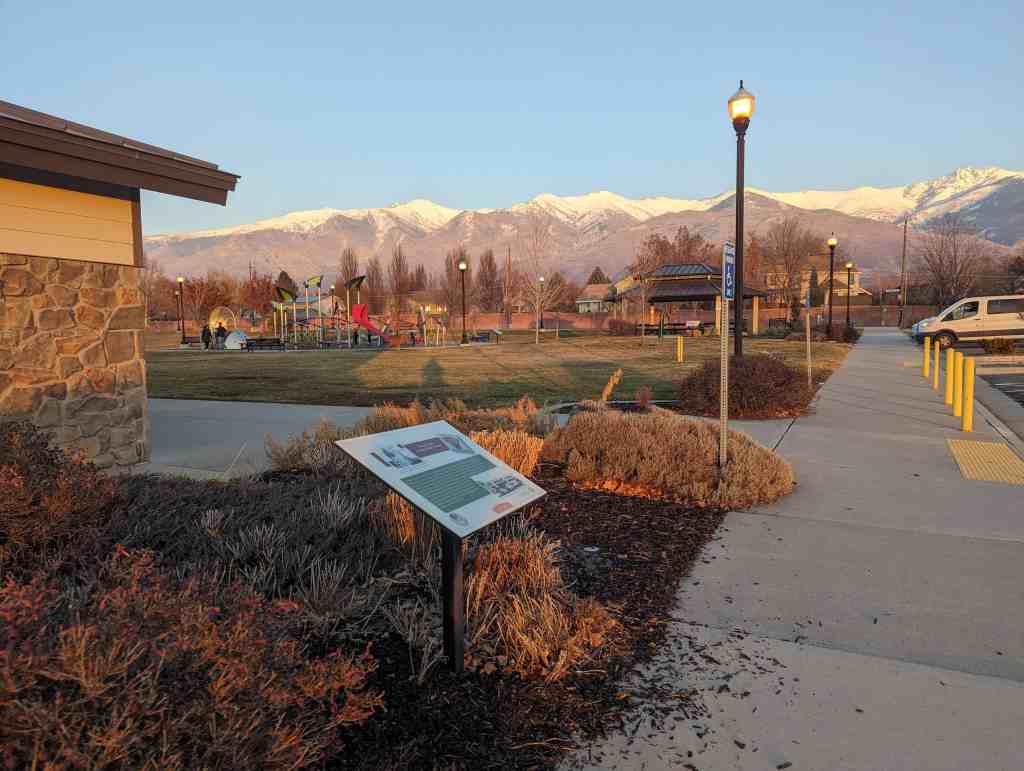
Heritage Park at 250 North Fairfield Road in Kaysville, Utah

Related:

  • Parks in Kaysville

There are historic cabins, a playground, plaques and monuments about local history and more in this park.

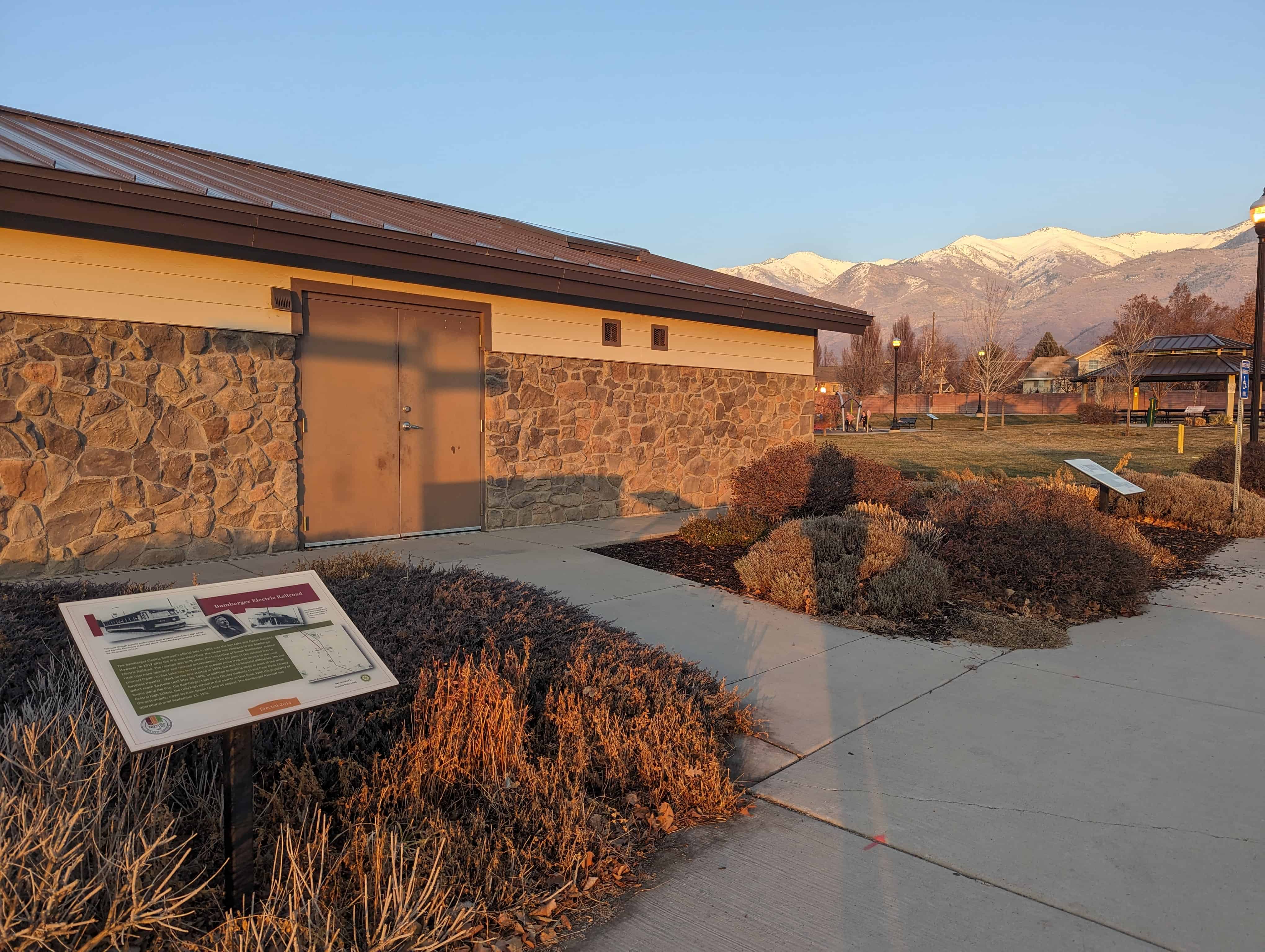
Bamberger Electric Railroad

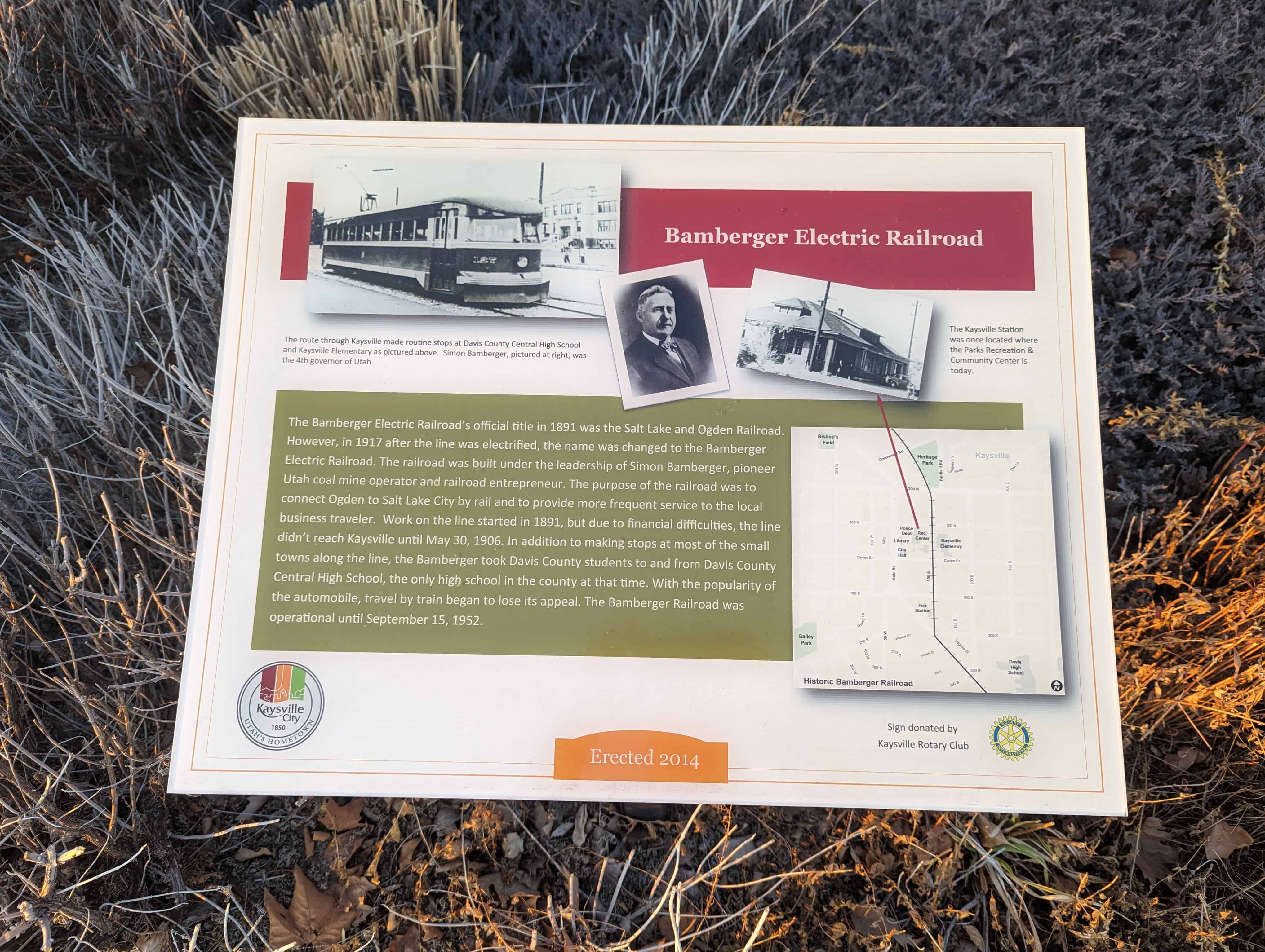
The Bamberger Electric Railroad’s official title in 1891 was the Salt Lake and Ogden Railroad. However, in 1917 after the line was electrified, the name was changed to the Bamberger Electric Railroad. The railroad was built under the leadership of Simon Bamberger, pioneer Utah coal mine operator and railroad entrepreneur. The purpose of the railroad was to connect Ogden to Salt Lake City by rail and to provide more frequent service to the local business traveler. Work on the line started in 1891, but due to financial difficulties, the line didn’t reach Kaysville until May 30, 1906. In addition to making stops at most of the small towns along the line, the Bamberger took Davis County students to and from Davis County Central High School, the only high school in the county at that time. With the popularity of the automobile, travel by train began to lose its appeal. The Bamberger Railroad was operational until September 15, 1952.

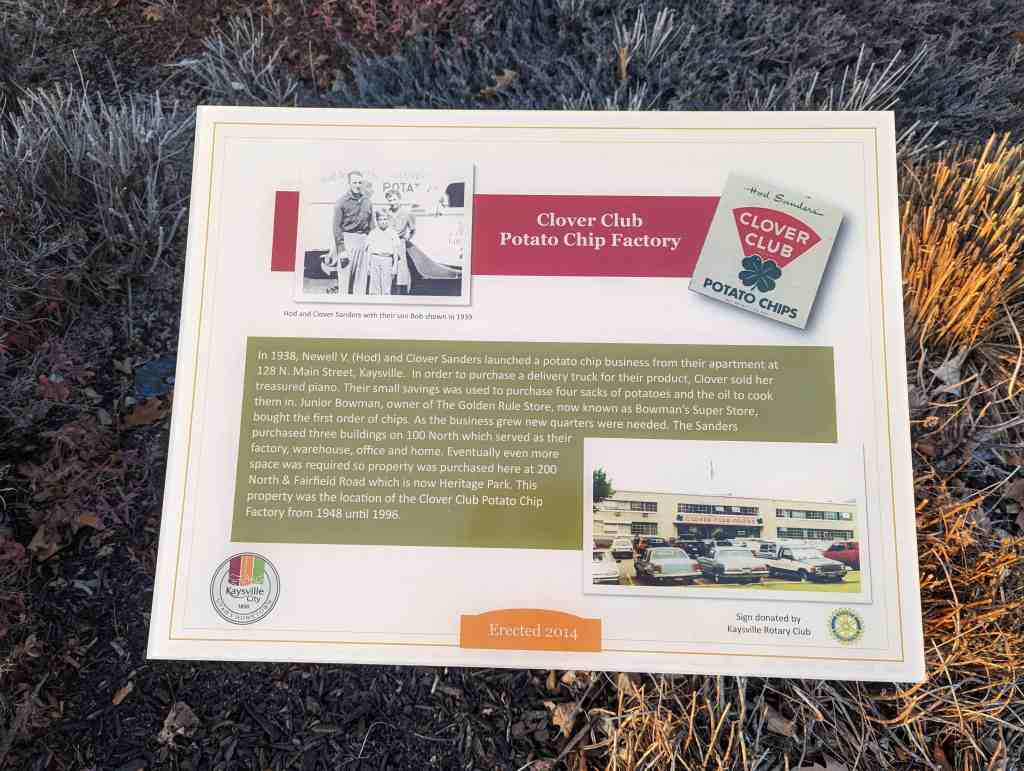
Clover Club Potato Chip Factory

In 1938, Newell V. (Hod) and Clover Sanders launched a potato chip business from their apartment at 128 N. Main Street, Kaysville. In order to purchase a delivery truck for their product, Clover sold her treasured piano. Their small savings was used to purchase four sacks of potatoes and the oil to cook them in. Junior Bowman, owner of The Golden Rule Store, now known as Bowman’s Super Store, bought the first order of chips. As the business grew new quarters were needed. The Sanders purchased three buildings on 100 North which served as their factory, warehouse, office and home. Eventually even more space was required so property was purchased here at 200 North & Fairfield Road which is now Heritage Park. This property was the location of the Clover Club Potato Chip Factory from 1948 until 1996.

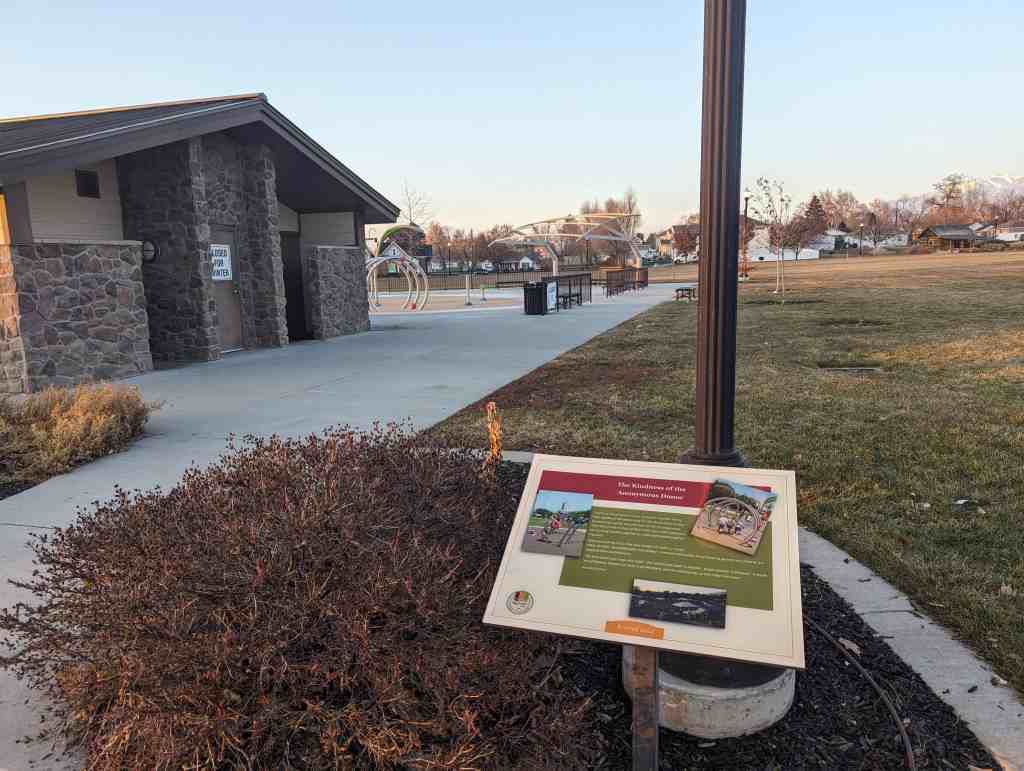
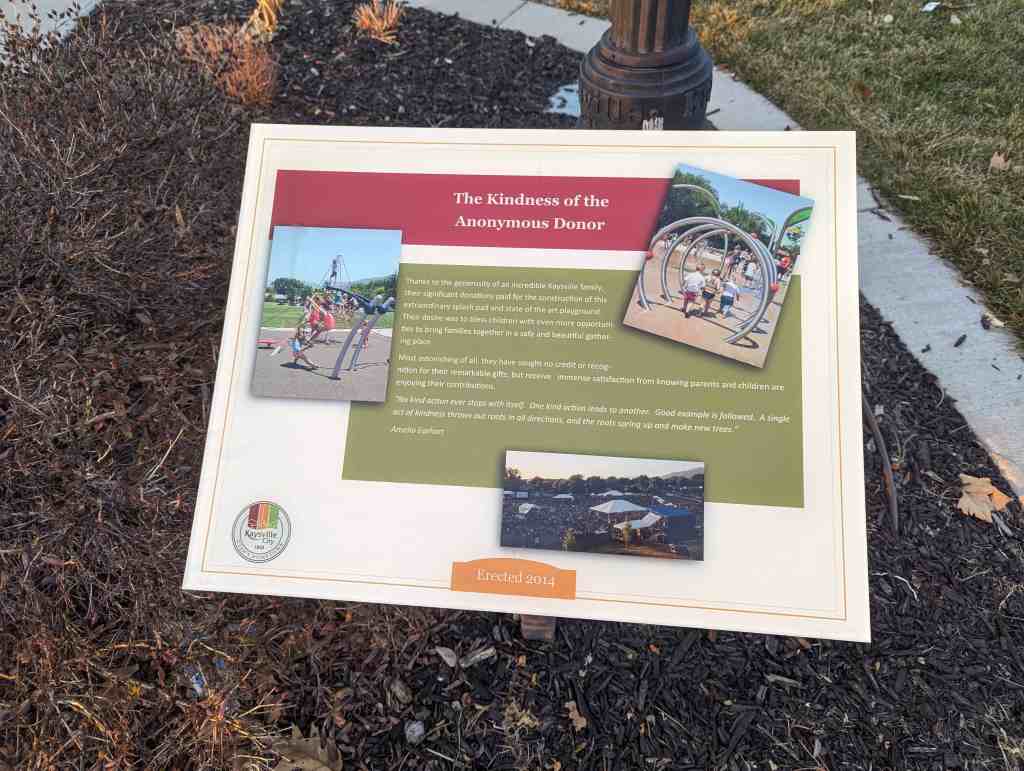
The Kindness of the Anonymous Donor

Thanks to the generosity of an incredible Kaysville family, their significant donations paid for the construction of this extraordinary splash pad and state of the art playground. Their desire was to bless children with even more opportunities to bring families together in a safe and beautiful gathering place.

Most astonishing of all, they have sought no credit or recognition for their remarkable gifts, but receive immense satisfaction from knowing parents and children are enjoying their contributions.

“No kind action ever stops with itself. One kind action leads to another. Good example is followed. A single act of kindness throws out roots in all directions, and the roots spring up and make new trees.” – Amelia Earhart

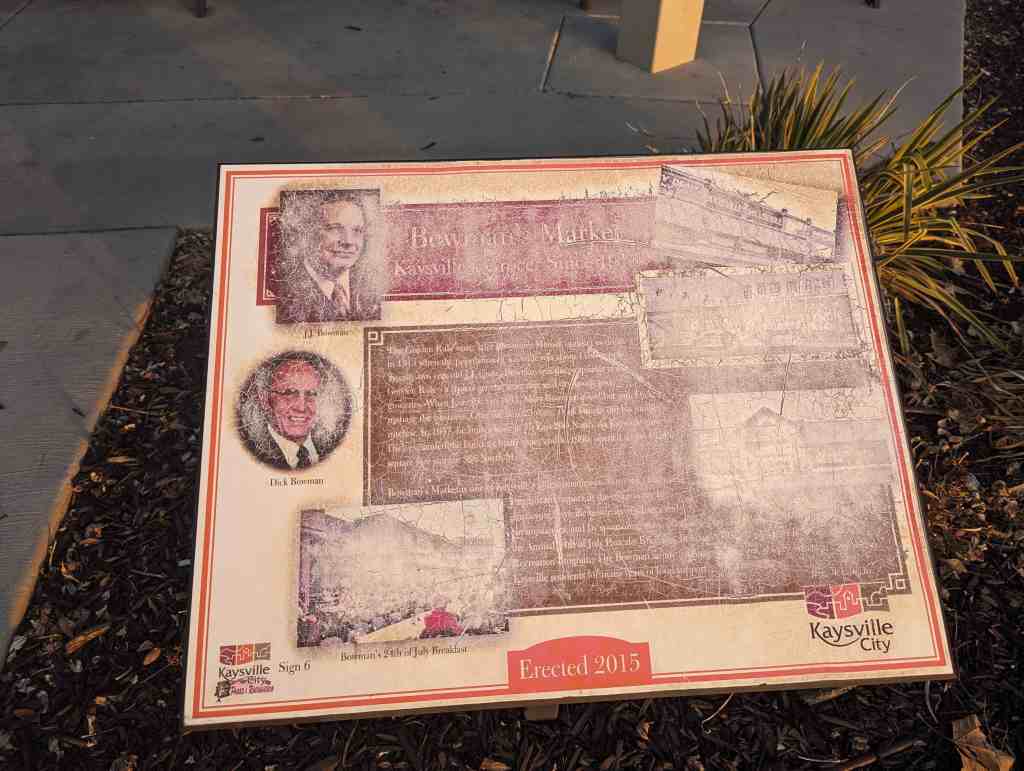
Bowman’s Market
Kaysville’s Grocer Since 1913

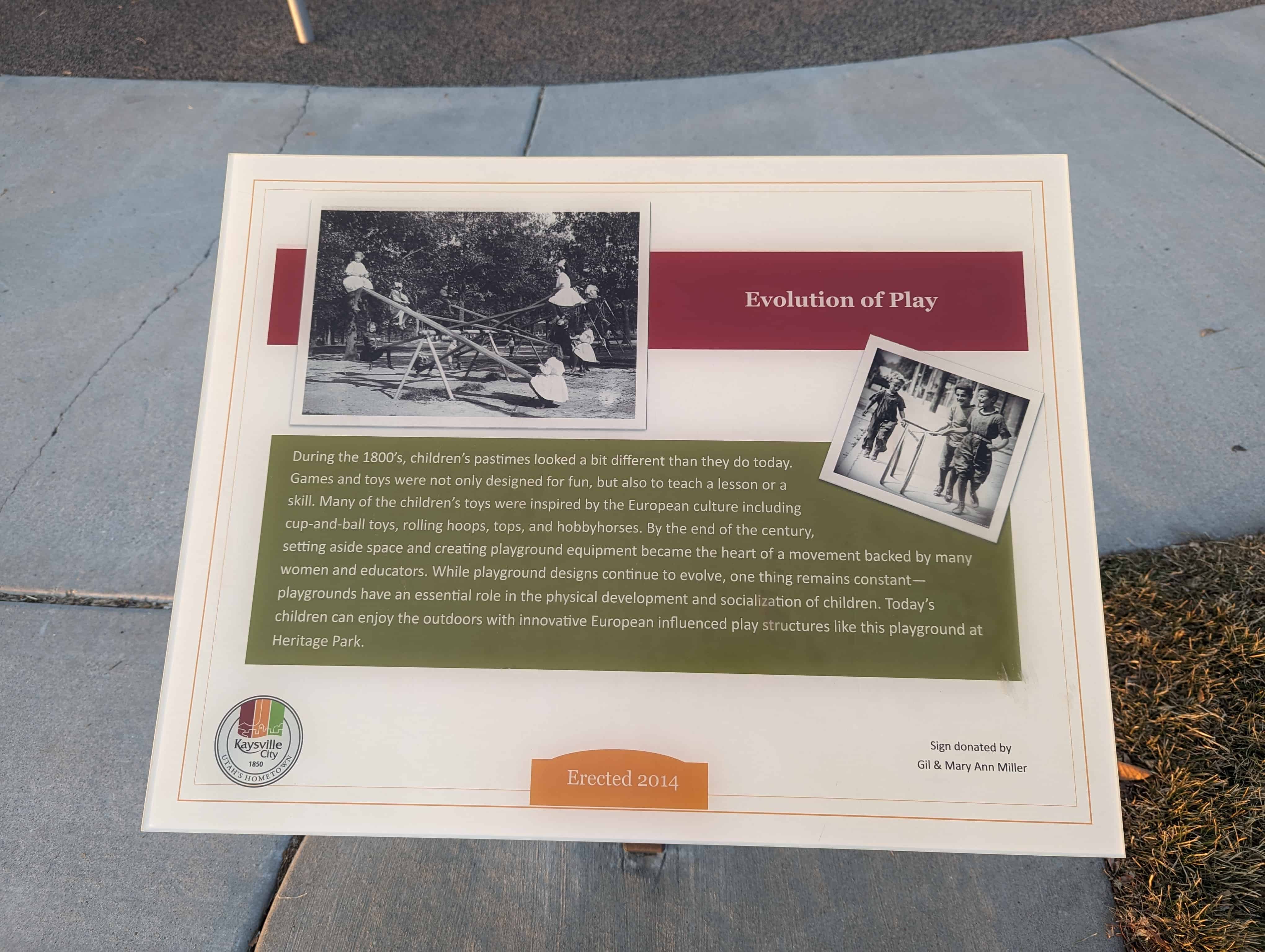
Evolution of Play

During the 1800’s, children’s pastimes looked a bit different than they do today. Games and toys were not only designed for fun, but also to teach a lesson or a skill. Many of the children’s toys were inspired by the European culture including cup-and-ball toys, rolling hoops, tops, and hobbyhorses. By the end of the century, setting aside space and creating playground equipment became the heart of a movement backed by many women and educators. While playground designs continue to evolve, one thing remains constant— playgrounds have an essential role in the physical development and socialization of children. Today’s children can enjoy the outdoors with innovative European influenced play structures like this playground at Heritage Park.

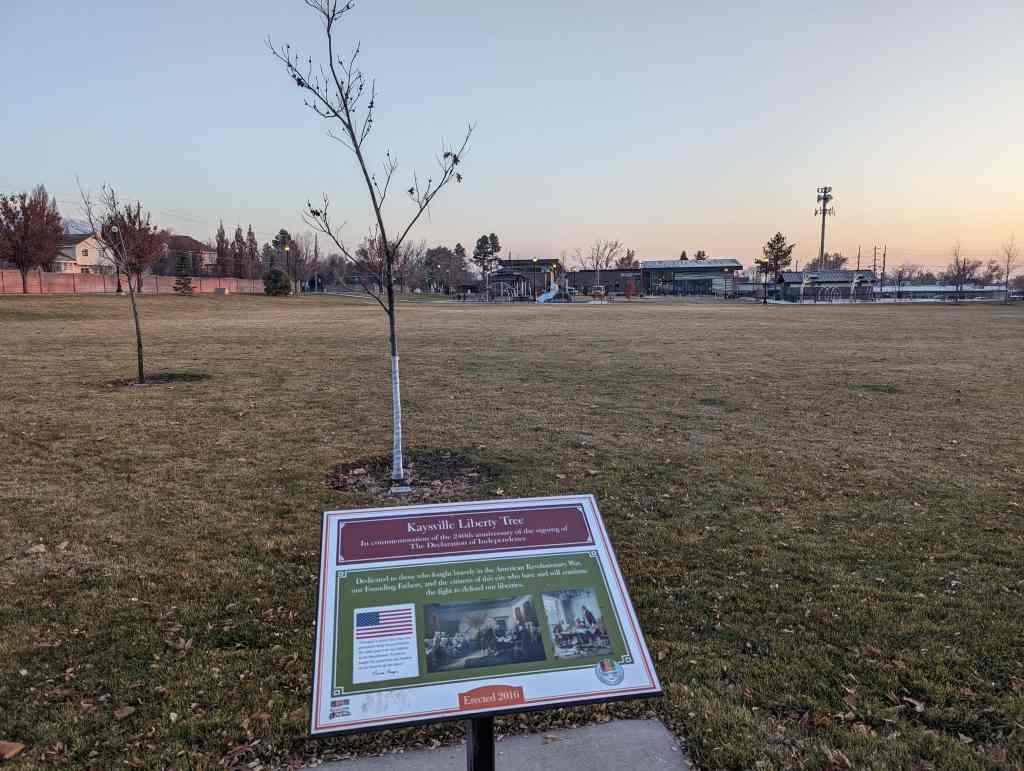
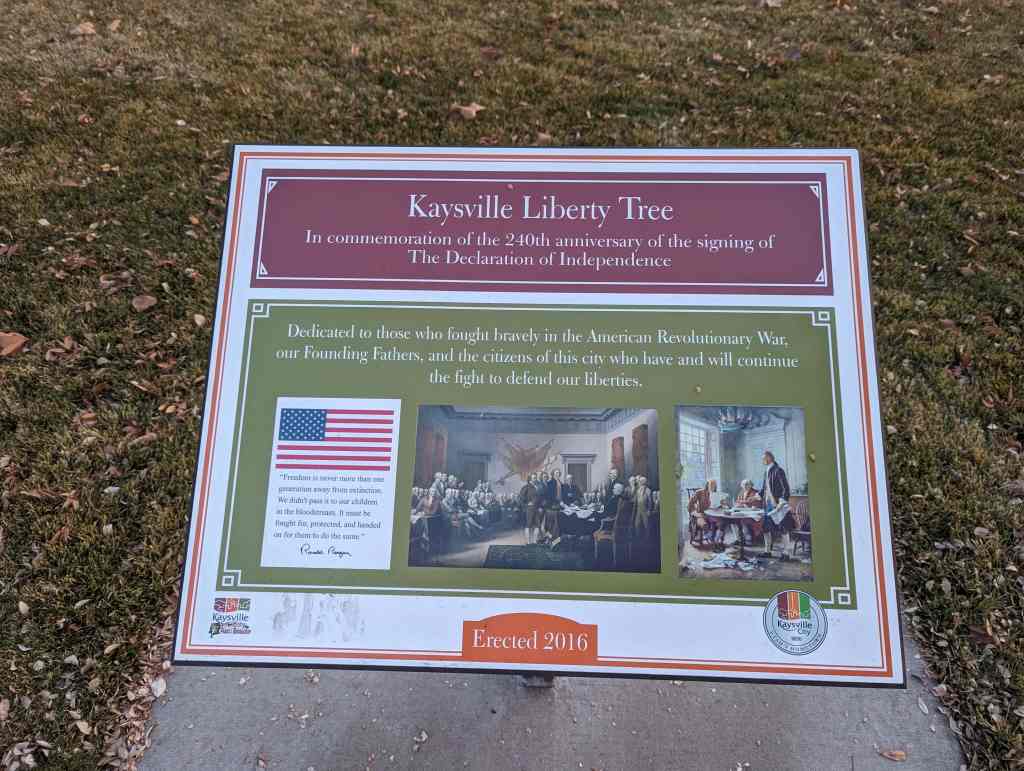
Kaysville Liberty Tree

In commemoration of the 240th anniversary of the signing of The Declaration of Independence.

Dedicated to those who fought bravely in the American Revolutionary War, our Founding Fathers, and the citizens of this city who have and will continue the fight to defend our liberties.

“Freedom is never more than one generation away from extinction. We didn’t pass it to our children in the bloodstream. It must be fought for, protected, and handed on for them to do the same.” – Ronald Reagan

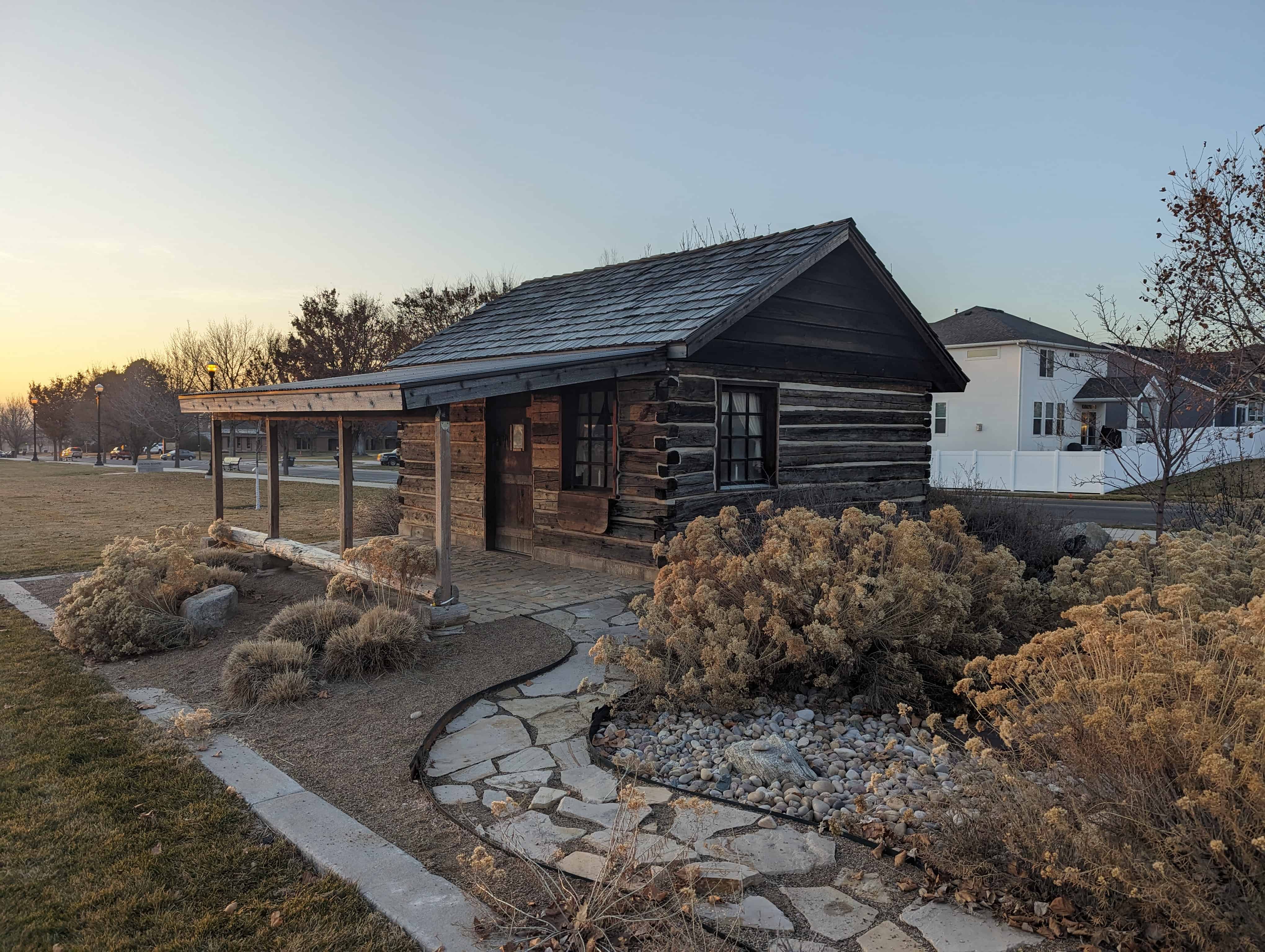
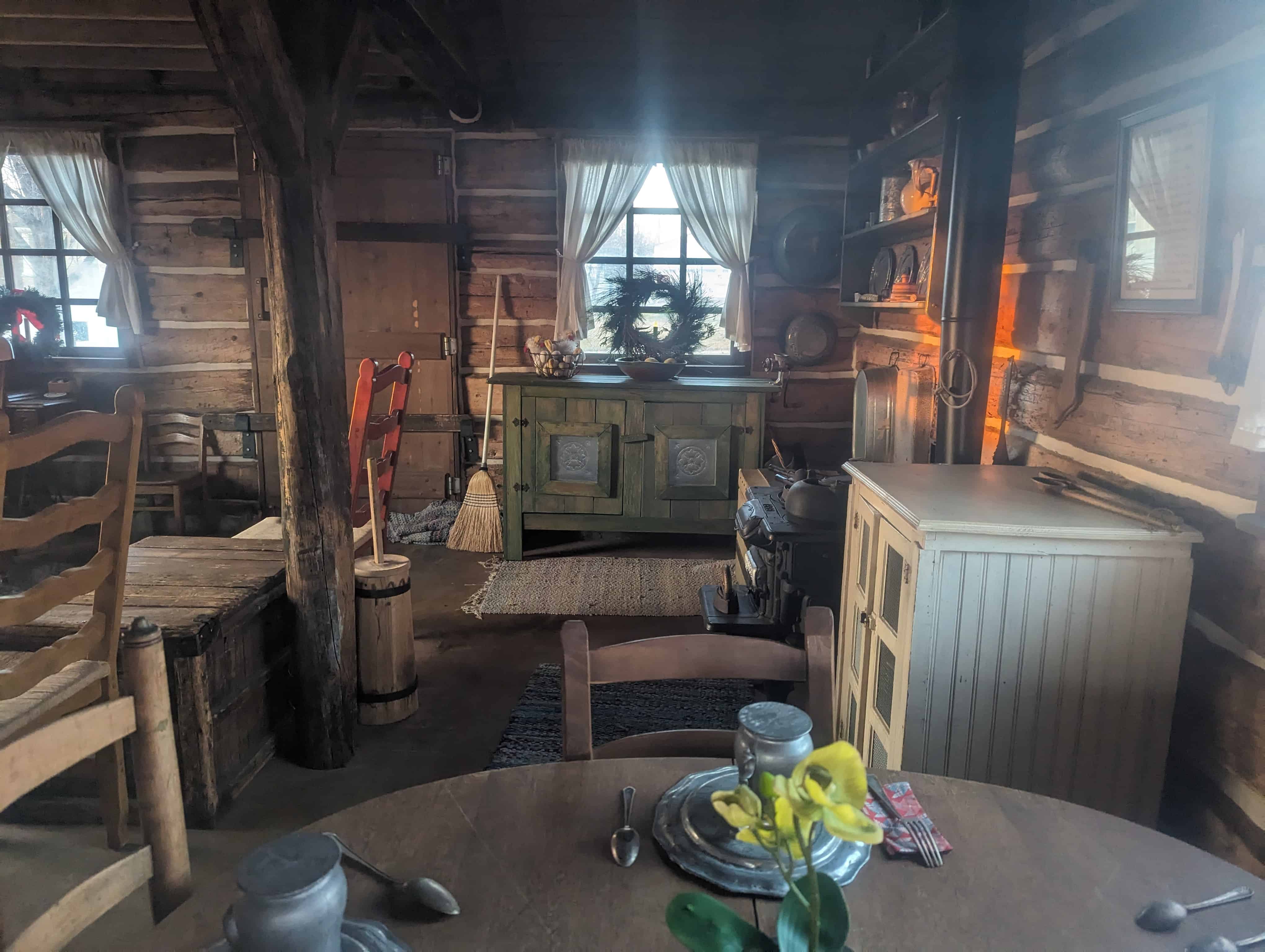
George Pilling Adams Cabin

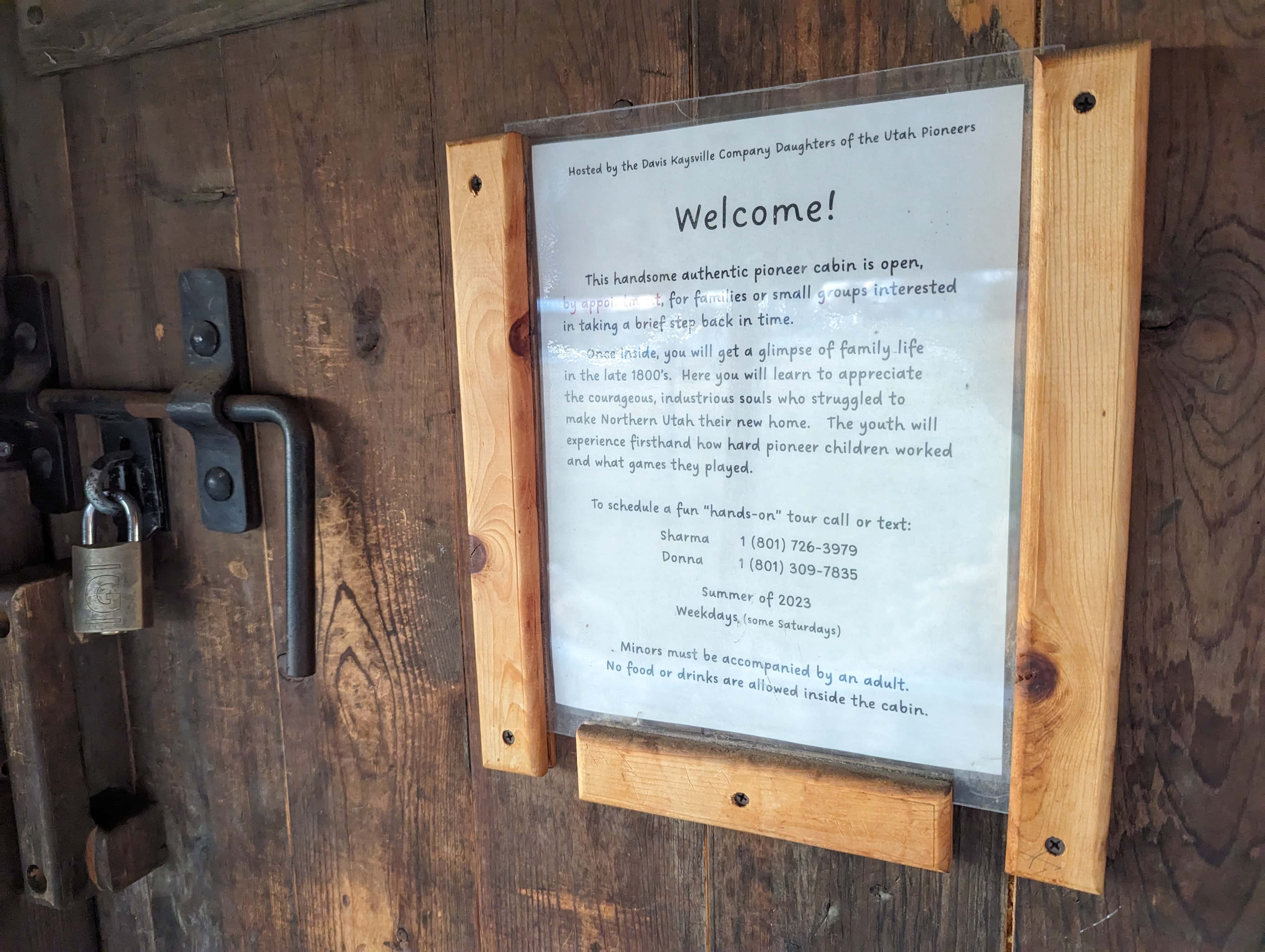
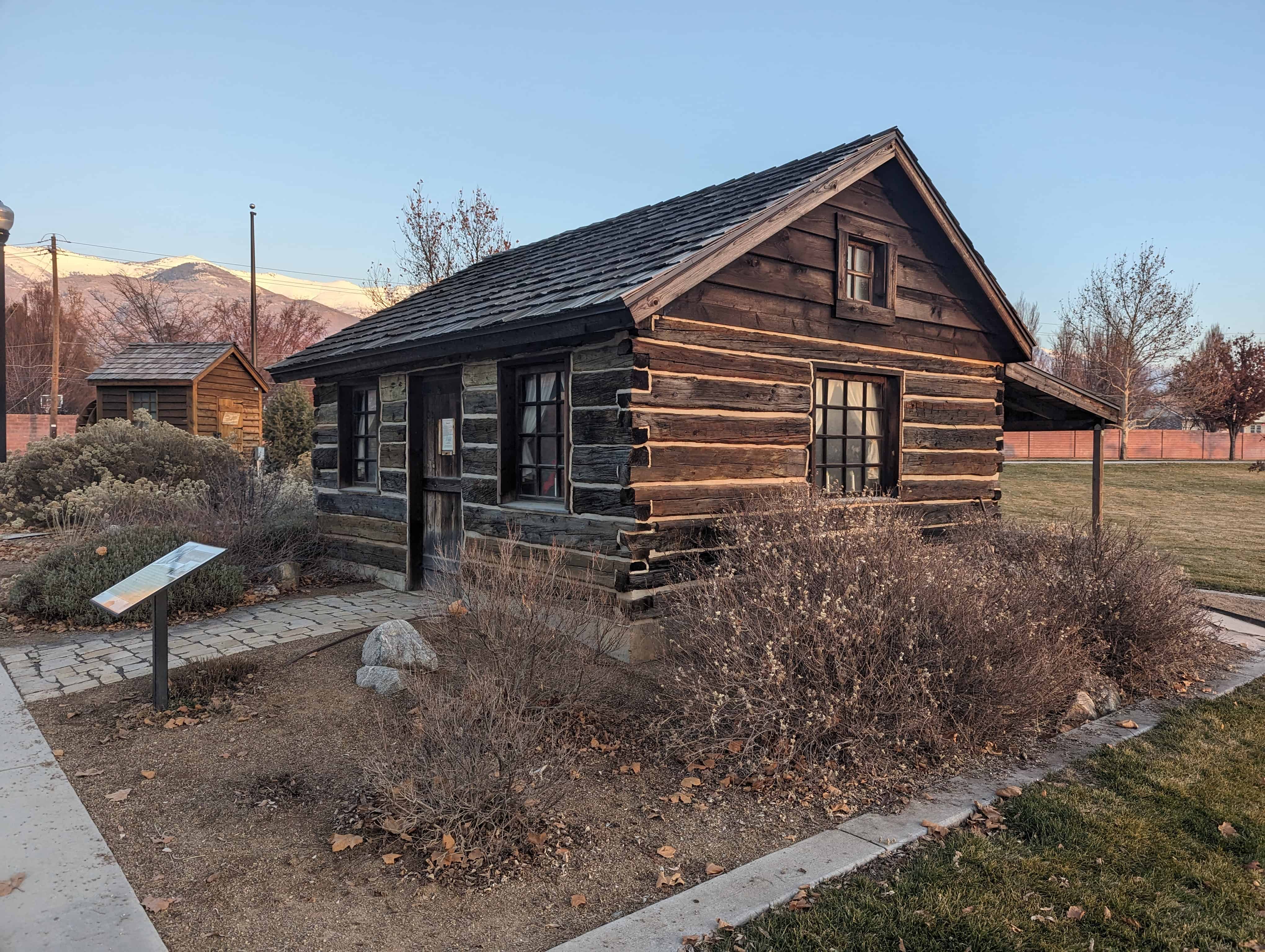
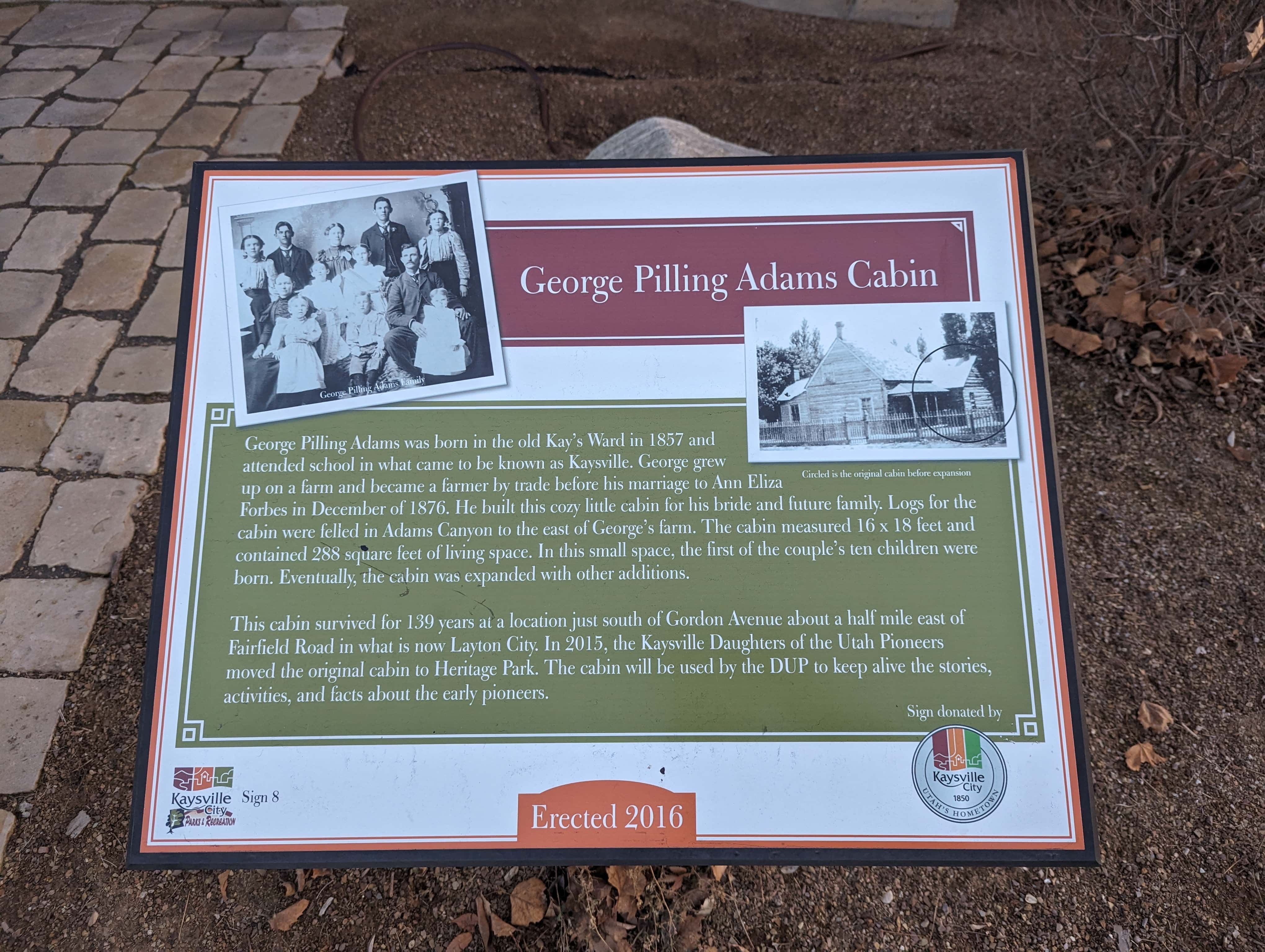
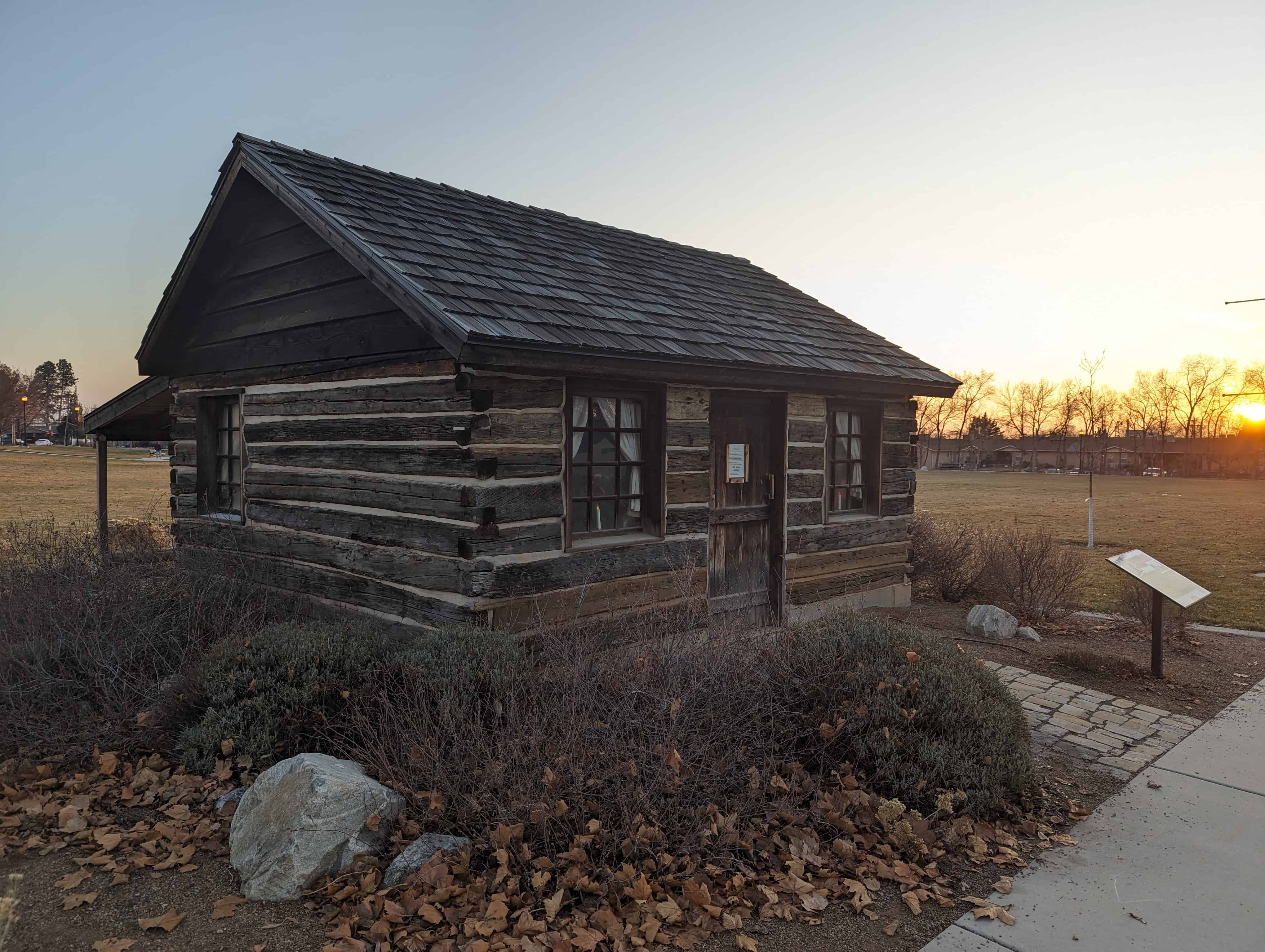
George Pilling Adams was born in the old Kay’s Ward in 1857 and attended school in what came to be known as Kaysville. George grew up on a farm and became a farmer by trade before his marriage to Ann Eliza Forbes in December of 1876. He built this cozy little cabin for his bride and future family. Logs for the cabin were felled in Adams Canyon to the east of George’s farm. The cabin measured 16 x 18 feet and contained 288 square feet of living space. In this small space, the first of the couple’s ten children were born. Eventually, the cabin was expanded with other additions.

This cabin survived for 139 years at a location just south of Gordon Avenue about a half mile east of Fairfield Road in what is now Layton City. In 2015, the Kaysville Daughters of the Utah Pioneers moved the original cabin to Heritage Park. The cabin will be used by the DUP to keep alive the stories, activities, and facts about the early pioneers.

Circled is the original cabin before expansion
← Older posts

Follow Jacob

Follow Jacob

Blog Stats

  • 2,085,981 hits

Social and Other Links

BarlowLinks.com

Recent Posts

  • Provo High School Seminary Building
  • 821 E 100 S
  • 820 E 100 S
  • 817-819 E 100 S
  • 814 E 100 S

Archives

Loading Comments...