

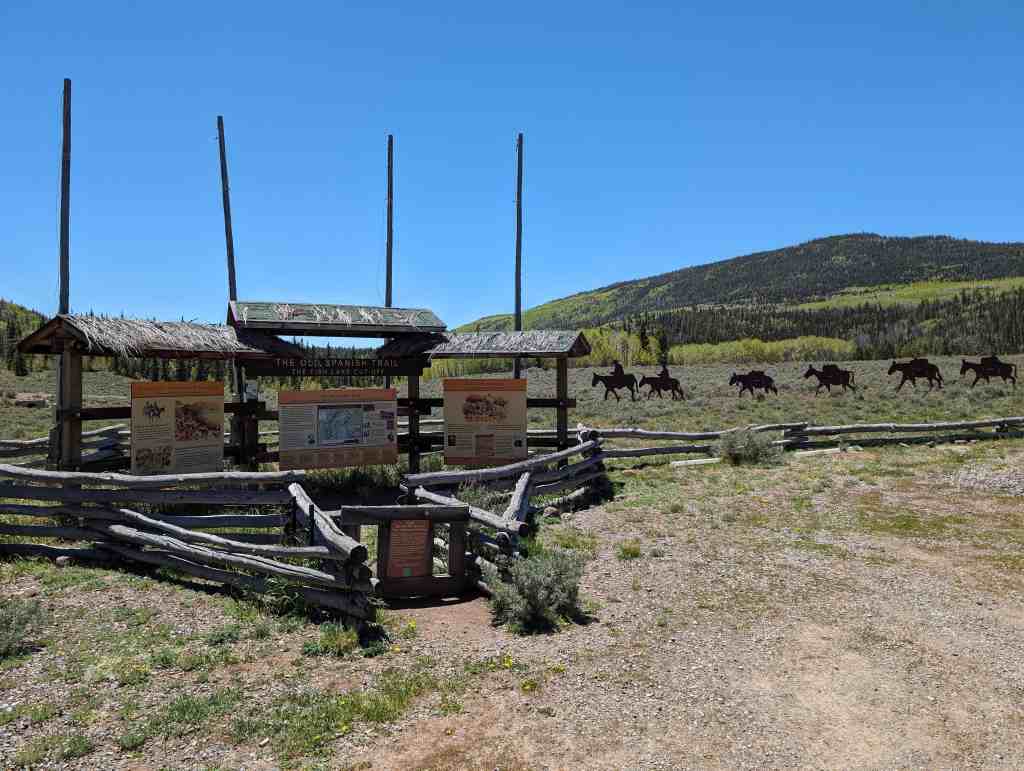
The Old Spanish Trail – The Fish Lake Cut-Off
The Old Spanish Trail
The Longest, Crookedest, Most Ornery Pack Trail in the History of the United States
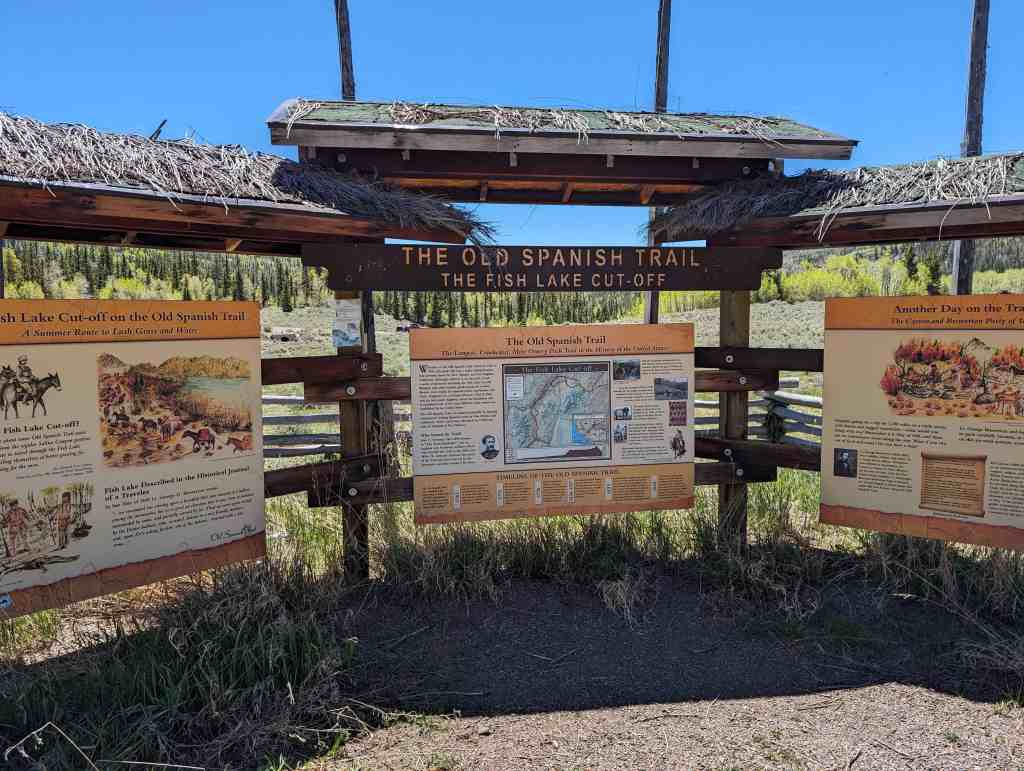
Welcome to the Old Spanish Trail. Between 1829 to link between Santa Fe, New Mexico, and Los Angeles, California. Although referred to as one trail, it had a series of shortcuts including the Fish Lake Cut-off. Blankets and other woolen goods produced in New Mexico were traded for Spanish mules and horses. The Trail, designated as a National Historic Trail in 2002, was the first major highway across the Southwest and is considered one of the most difficult trade routes ever established in the United States.
The Old Spanish Trail was opened primarily by Spanish missionaries linking Spanish towns in New Mexico and California. Mules and horses, abundant in California, were in demand in New Mexico.
Who Named the Trail?
John C. Fremont (1813-1890) known as “The Great Pathfinder,” was an explorer and American military officer who traveled the Trail in the 1840s and 1850s. He correctly assumed that much of the Trail had been laid out by the Spaniards, and thus named it for them.
Opened by Spanish missionaries, the Old Spanish Trail exacted a price. Fray Escalante died at the age of 30 from an undisclosed illness and Fray Garces was killed by Native Americans.
Caravans averaged 1,000 to 2,000 animals, but the largest recorded train numbered 4,150 animals. It was not unusual for these caravans to stretch out over a mile on the trail.
The hardy Churro sheep, brought to America by the Spanish in the 1600s, provided excellent wool fibers for the New Mexican blankets.
Slave trafficking of Native Indians increased after the opening of the Old Spanish Trail. Along the Trail, Spanish and Native traders bought or captured Indians and sold them at both ends of the trail as servants and laborers.
Mules make ideal pack animals as they are born followers, hardy, sure-footed, can travel up to 50 miles per day, and have tougher skin and hooves than horses.
TIMELINE OF THE OLD SPANISH TRAIL
The Old Spanish Trail was established by combining of travel routes of Native Americans, Spanish explorers, and the mountain men who trapped and traded.
1765
Spanish explorer Juan Maria
Antonio Rivera leads an expedition from New Mexico. to eastern Utah, partly to find gold and also to help thwart the expansion of other European powers in the region.
1775
The western portion of the Trail is blazed by Spanish missionary-explorer Francisco Hermenegildo Tomás Garcés, who set out from Arizona to explore a path to the California missions.
1776
Spanish missionaries Francisco Atanasio Dominguez and Silvestre Velez de Escalante leave New Mexico, following Rivera’s route in a failed attempt to reach the California missions.
1826-1827
Fur trapper Jedediah Smith is the first white man to travel overland from the Great Salt Lake to California, virtually connecting the routes of Garces and Dominguez- Escalante.
1829
Spanish-Mexican explorer and merchant Antonio Armijo and 60 men take the first pack train carrying blankets and serapes across the northern borders of New Mexico and Arizona to California. The Armijo party stitched together the routes of the Rivera (1765) and Dominguez-Escalante expeditions
(1776), and the travels of Jedediah Smith.
1848
The Trail, as a pack route, comes to an end. With the conclusion of the Mexican- American War, Mexico lost the region now crossed by the Old Spanish Trail to the United States. Overland commerce,
thereafter, preferred an alternate and more direct route.
Related:

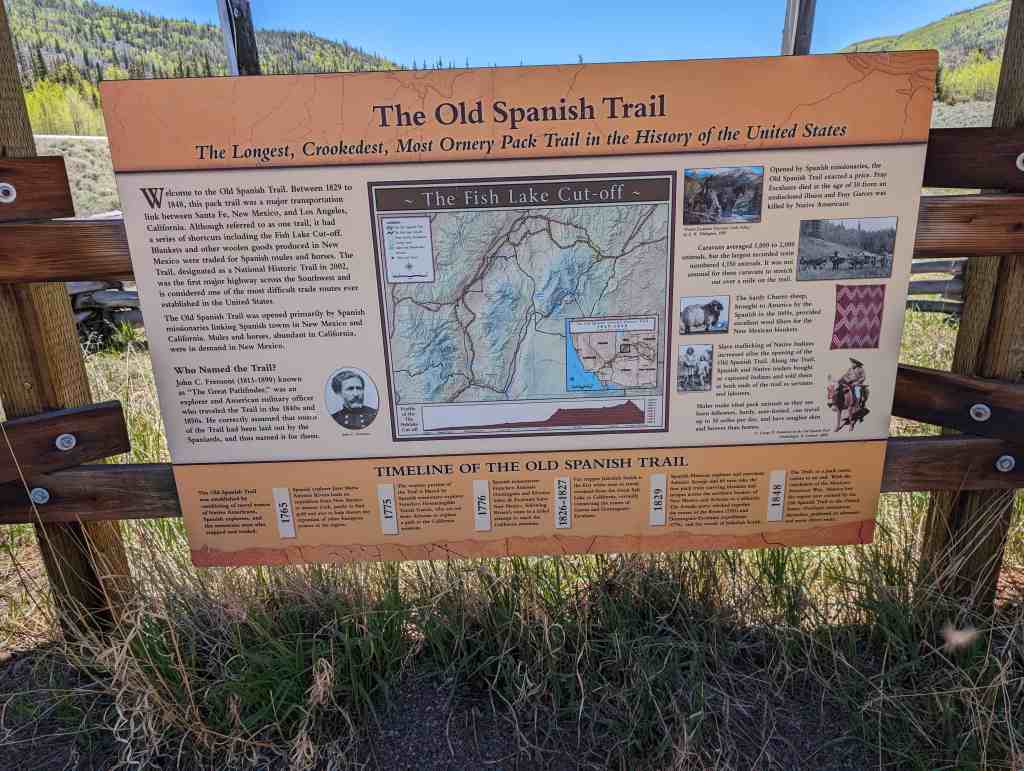
The Fish Lake Cut-off on the Old Spanish Trail
A Summer Route to Lush Grass and Water
What is the Fish Lake Cut-off?
There is no doubt about some Old Spanish Trail users taking a cut-off from the regular Salina Canyon portion of the historic route to travel through the Fish Lake area, thereby availing themselves of better grazing for livestock and fishing for the men.
Fish Lake Described in the Historical Journal of a Traveler
In late May of 1848 Lt. George D. Brewerton wrote,
“…we encamped one evening upon a beautiful little lake situated in a hollow among the mountains, but at so great an elevation that it was, even in summer, surrounded by snow, and partially covered by ice. There we were again visited by the Eutaw Indians, who, as usual, behave in a very friendly manner… and, upon Kit’s asking for fish, one of the Indians…returned with a fine trout…”
