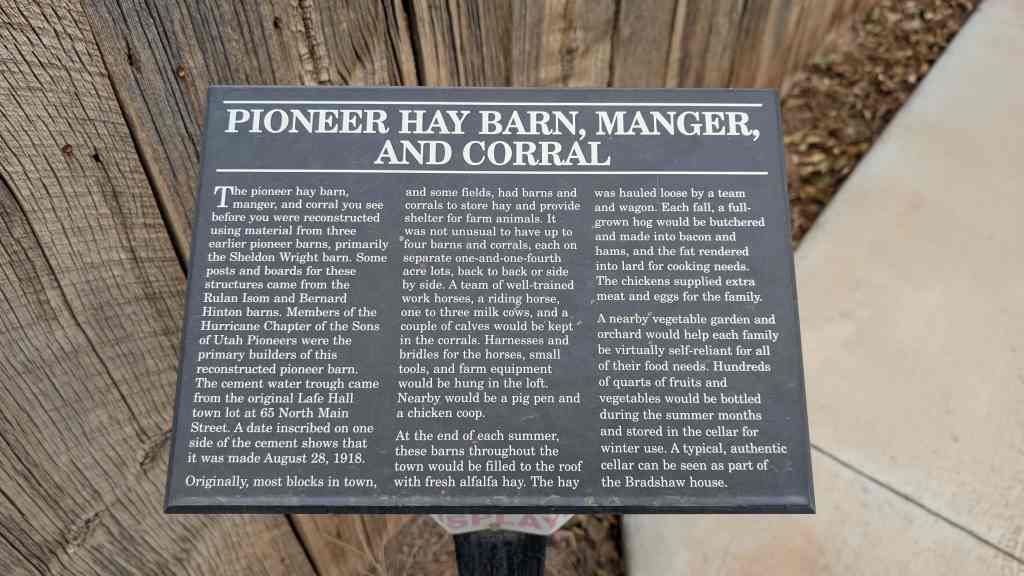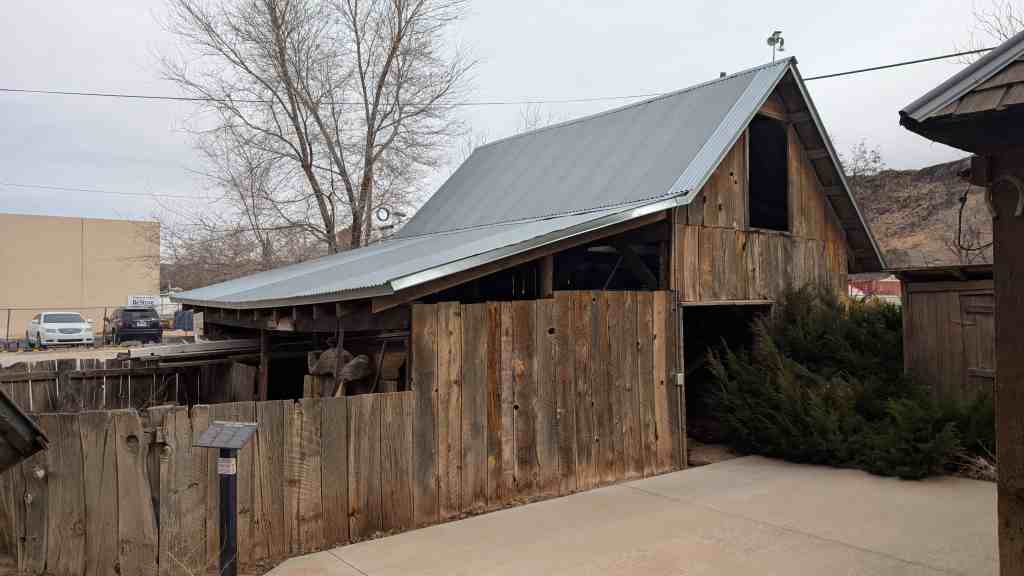
Pioneer Hay Barn, Manger, and Corral
The pioneer hay barn, manger, and corral you see before you were reconstructed using material from three earlier pioneer barns, primarily the Sheldon Wright barn. Some posts and boards for these structures came from the Rulan Isom and Bernard Hinton barns. Members of the Hurricane Chapter of the Sons of Utah Pioneers were the primary builders of this reconstructed pioneer barn. The cement water trough came from the original Lafe Hall town lot at 65 North Main Street. A date inscribed on one side of the cement shows that it was made August 28, 1918.
Originally, most blocks in town, and some fields, had barns and corrals to store hay and provide shelter for farm animals. It was not unusual to have up to four barns and corrals, each on separate one-and-one-fourth acre lots, back to back or side by side. A team of well-trained work horses, a riding horse, one to three milk cows, and a couple of calves would be kept in the corrals. Harnesses and bridles for the horses, small tools, and farm equipment would be hung in the loft. Nearby would be a pig pen and a chicken coop.
At the end of each summer, these barns throughout the town would be filled to the roof with fresh alfalfa hay. The hay was hauled loose by a team and wagon. Each fall, a full- grown hog would be butchered and made into bacon and hams, and the fat rendered into lard for cooking needs. The chickens supplied extra meat and eggs for the family.
A nearby vegetable garden and orchard would help each family be virtually self-reliant for all of their food needs. Hundreds of quarts of fruits and vegetables would be bottled during the summer months and stored in the cellar for winter use. A typical, authentic cellar can be seen as part of the Bradshaw house.
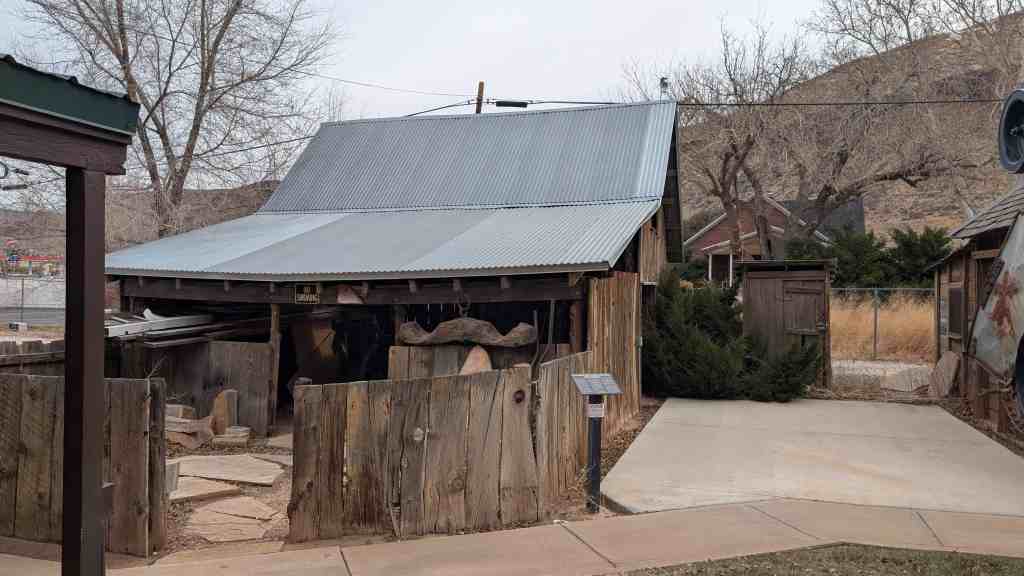
This is located at the Heritage House Pioneer Center / Heritage Park / Museum at the Bradshaw House-Hotel at 85 South Main Street in Hurricane, Utah.