



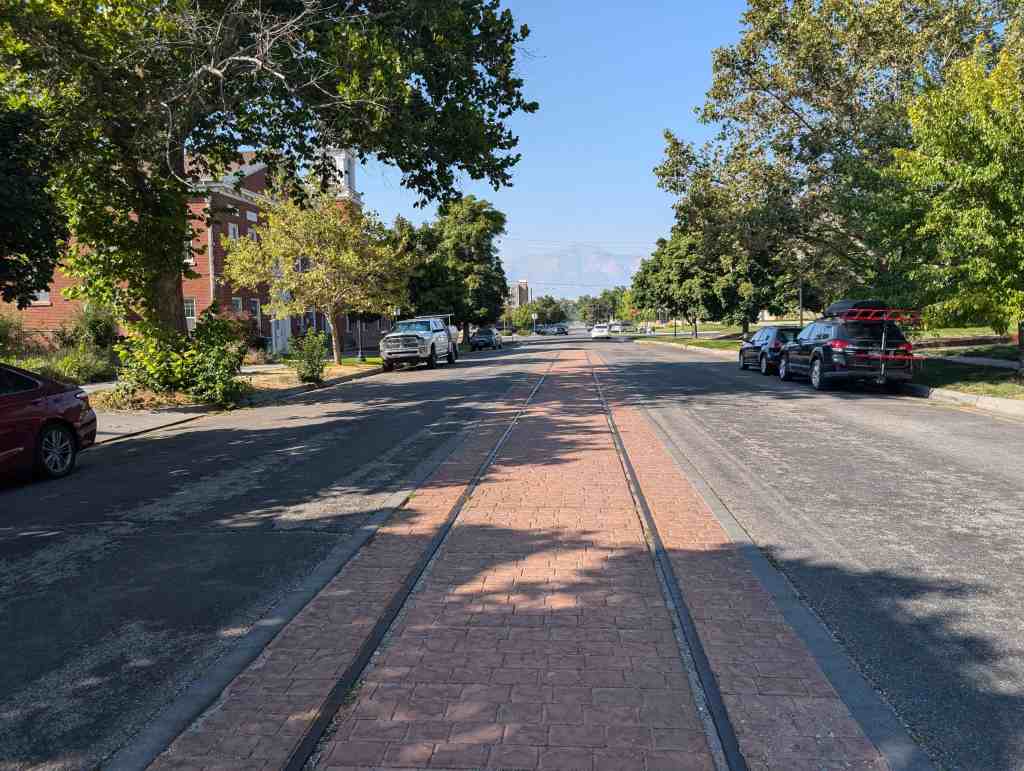
The Jefferson Avenue Historic District is a residential area in Ogden, Utah, developed between the 1880s and 1920s. The district includes both sides of Jefferson Avenue between 25th Street and 27th Street. It is bounded by the central business district to the west, and residential areas to the north, east
and south. It was added to the National Register of Historic Places (#98001214) on September 25, 1998. Washington Boulevard, located two blocks to the west, is the main street running through Ogden. The standard grid system plan, typical of hundreds of Utah towns, is also characteristic of Ogden. The district is within this grid, in which the north-south running streets (Jefferson Avenue) are generally local residential in nature, with less traffic than the east-west streets which function as minor collectors (25th Street, 26th Street and 27th Street). The district includes 40 buildings, of which 32 (80%) contribute to the historic character of the district.
The Jefferson Avenue Historic District is a residential neighborhood that attests to the rapid growth and prospering economy of Ogden during the decades from 1880 to 1900 by its abundance of substantial Victorian period homes. As in other towns along the Wasatch Front, the preferred residential areas in Ogden have been on the east side, moving farther up the bench as utility services were improved and the population increased. The Jefferson District easily fits into this pattern. It is located only two blocks east of Washington Boulevard, originally Main Street, close to the heart of the city. Although some of the buildings replaced earlier dwellings, most were the first on their lot.(*)
Conforming to the grid pattern of planning preferred in the Mormon culture, the Jefferson District is in this respect part of a greater scheme. Studies of Sanborn Insurance Maps and the extant buildings in the Jefferson District suggest a progression of phases. It grew from a sparsely settled neighborhood of smaller homes, to denser development and larger houses in the Victorian style. Yet some smaller, more modest dwellings survived and multiplied in the midst of the Victorian presumptuousness, indicating that the area was not exclusively upper class, but that it also was within reach of the middle classes for building or rental property. Unique house specimens are nevertheless an important factor of the district’s character. Some architect-designed homes are known (i.e., 2523 Jefferson was designed by William W. Fife, a prominent Ogden architect), while others show the originality and sophistication that suggest an architect’s involvement (i.e., 2580 Jefferson and 2504 Jefferson).
The Jefferson District could be considered the first “wave” of residential development that marched up the bench east of the main commercial district, beginning with the prosperous economy of the 1890s and continuing until after the end of World War I. When the height of the Victorian period waned and the next generation of the prominent families of the neighborhood moved farther east (e.g., Eccles Avenue Historic District), the demand for housing close to the downtown area increased, and as the larger homes were sold, or the original owners died, the houses were divided into rental units to meet this demand.
Ogden grew and prospered so quickly in the late nineteenth century that it attracted real estate promoters and boosters from all over the country. William Hope “Coin” Harvey, perhaps the most famous of these, lived in the Jefferson District. Harvey (2671 Jefferson), who along with his group of
boosters known as the Order of Monte Cristo, advertised Ogden as a railroad, mining, and livestock center. As a ploy to endorse Ogden’s real estate, Harvey promoted Ogden’s Carnival, a grand event planned to coincide with New Orleans’ Mardi Gras. Although the carnival only lasted for a few days in 1890, Ogden gained national exposure and a boost in business and real estate. Newspapers outside Utah proclaimed Ogden as the “Boom City of West.” Although Ogden probably felt a slowing of business and growth in the mid 1890s with the “Cleveland Depression,” it was booming again by the turn of the century. The townspeople built impressive brick buildings and invested in a host of new export industries which were serviced by the railroad: canning, flour mills, sugar beet production. One example of this is David Eccles (2580 Jefferson) who was the president of the Amalgamated Sugar Company and was instrumental in the development of other Ogden industries as mentioned previously. After his death, his son David C. Eccles (607 25th Street) took over as vice-president and general manager.
Of course, the railroad lay behind most of this prosperity. Railroad business fostered the growth of industry and banking, providing revenue for the construction of beautiful buildings and parks. Many of Ogden’s leading financiers lived in the Jefferson District.
- David C. Eccles (607 25th Street) was the president of Utah National Bank of Ogden.
- Patrick Healy (2529 Jefferson) was a vice-president of Commercial National Bank.
- Abbott R. Heywood (2540 Jefferson) was a vice-president of Commercial National Bank.
- Isadore Marks (2547 Jefferson) was an important member of the Ogden community and was representative of the non-Latter Day Saint Utahns who had moved to the intermountain west after the establishment of the railroad.9 He was also a vice-president of Commercial National Bank.
Some of Ogden’s leading entrepreneurs who became wealthy by participating in railroad-related businesses also lived in the Jefferson District.
- Thomas H. Carr (2520 Jefferson) was one of the founders of Rexall Drug Stores, and owned and operated a prosperous drug store on 25th Street.
- Patrick Healy (2529 Jefferson) built the Healy Hotel located on the corner of Wall Avenue and Ogden’s popular 25th Street, which was directly across from the Union Station, the hub of railroad activity in Ogden.
- Hiram H. Spencer (2555 Jefferson) was the mayor of Ogden and also the manager of the Eccles Lumber Company. He was the president of the Ogden Rapid Transit, and a vice-president of Amalgamated Sugar.
Many members of the controlling body that made up Ogden’s local government lived in the Jefferson Avenue District. Among them were:
- Judge Jacob Boreman.(2554 Jefferson) served as a second district judge during Utah’s territorial period and practiced law in Ogden.
- Abbott R. Heywood (2540 Jefferson) was the mayor of Ogden and also a vice-president of Commercial National Bank.
- Edmund T. Hulaniski (2523 Jefferson) who was significant to Ogden’s politics by serving as city, county, and district attorney, police judge, and chairman of the county and city Republican Committees. From 1907 to 1909 he was a member of the Utah State Senate. He lived in the
Jefferson District from 1882 until his death in 1928. - Thomas A. Whalen (2532 Jefferson) served on the city council, and was also a member of the executive committee for Commercial National Bank.
There were other influential people not previously mentioned, that lived within the Jefferson District and contributed significantly to the growth of Ogden.
- Emil Bratz (2640 Jefferson) established a successful real estate, loan and investment company and was the director of the Hurst Realty & Mercantile Company of Ogden.
- William Eccles (2555 Jefferson) was the brother of the influential businessman, David Eccles. William was affluent in his own right as the president of W.H. Eccles Lumber Company.
- Robert H. Hinckley (2560 Jefferson) was one of Ogden’s most prominent citizens who was recognized for local, state, and national achievement. He established the Hinckley Dodge automobile dealership in Ogden, was a director of the Chamber of Commerce, president of the Rotary Club, and helped develop the Ogden Airport and was a vice-president of Utah Pacific Airways. With his political success, he was asked to join the Franklin D. Roosevelt Administration as the Assistant Secretary of Commerce and the Director of Contracts Settlement. He established the Hinckley Institute of Politics at the University of Utah. He and Ed Noble worked together to purchase the RCA network and reorganize it as the American Broadcasting Company (ABC).
- Abrelia Clarissa Seely Hinckley (2560 Jefferson) was also a contributing person in Ogden. She was a founder of the first Board of Directors of the Ogden YWCA, and also the first president of the
Utah Wool Growers Association Women’s Auxiliary. - John Hoxer (2540 Jefferson) manufactured and sold canvas products. He owned and operated Ogden Tent & Awning Company, a nationally known business in the canvas industry.
- Fred M. Nye (2546 Jefferson) was a leading Ogden retail merchant. He also served on the Ogden City Board of Education for 20 years, and was a Trustee of Utah State Agricultural College (now Utah State University). He was elected to the Ogden City Charter Commission, where he aided in drafting the City’s council-manager form of government.
- Adam Patterson, Sr., (2547 Jefferson) was the organizer, president and general manager, of the Vineyard Land and Livestock Company. He was also a director of the Utah-Idaho Central marriage, theocratic rule, and Mormon-Gentile conflict. Upon his retirement from a judgeship, he moved to Ogden where he practiced law and engaged in real estate.
- Thomas Jordan Stevens (2575 Jefferson) served in several capacities of government on the City and State level, and at one time was the Weber County Sheriff. He was the executive vice president of the Utah Loan and Trust Company, and served as advisor to two territorial Governors. He was appointed as Commissary General on the staff of Governor Heber M. Wells, and held the rank of Colonel.
- William H. Wattis (2649 Jefferson), along with his brothers, established the Utah Construction Company, which grew into a major international multibillion dollar business corporation. Among his other business interests were the Vineyard Livestock Company which controlled some 40 ranches of 250,000 acres of land located in Utah, Nevada and Idaho. He was also the president and vice president of several Ogden companies, and the president of Dee Memorial Hospital of Ogden. In 1919, he was listed as one of the Men Who Are Making Ogden.
- Thomas Whalen (2532 Jefferson) was an active real estate man. He was also involved with the executive committee of Commercial National Bank, served for two years on the Ogden City Council, and was a tax appraiser. He also built the house located at 2540 Jefferson as the mirror twin of his own and in which John Hoxer resided.
Most of the buildings within the district are still used as residences. Two churches were built in the district in the historic period, the First Baptist Church (c. 1923-26), located at 2519 Jefferson Avenue, and the First Methodist Church (1928), located at 2604 Jefferson.
Many of the houses are accompanied by small outbuildings, usually simple frame garages, some of which were built during the historic period, but are no longer considered contributing to the historic nature of the district due to significant alterations that have taken place. Two exceptions should be noted. The house located at 2640 Jefferson (1903), built in the Victorian/Four Square style, has a two-story carriage house connected with it. The Prairie style house located across the street at 2649 Jefferson (c. 1891 and extensively remodeled c. 1914) has a very good example of a one story carriage house connected with it.
Seven (17.5%) of the buildings that were built during the period of significance have been significantly altered. These include two houses (2529 and 2547 Jefferson) that had been modified with additions to the front of the buildings that obscure the historic fabric. The remaining five buildings have been so significantly altered, that the original stylistic features have been either completely removed, or covered over to the extent that the building no longer resembles its original style.
Two buildings within the district were already listed individually in the National Register prior to the district being listed. These include the Bertha Eccles House, built in 1893, and located at 2580 Jefferson. It was listed in the National Register in 1971. Also listed, was the Farnsworth (Robin) Apartment complex, built in 1922, and located at 2539 Jefferson. It was listed in 1987 as part of the thematic nomination “Three Story Apartment Buildings in Ogden, 1908-1928.”
Architecture and Development Patterns
The most impressive dwellings are brick and stone houses built from the early 1880s through the early 1890s. With asymmetrical facades, multiple roof pitches and planes, and heights reaching two and one-half stories, these homes reflected the prosperity of their owners. They were built for some of the most influential people in Ogden, and became an area of social activity during a period of substantial economic growth.
The 1906 Sanborn maps show the character of the district that is visible today. In 1903 a new wave of building occurred in the Jefferson District, and with it came a new stylistic change: the Four Square. Thereafter, only one Victorian style residence was built (2683 Jefferson). Three Four Square type houses were built in the district between 1903 and 1905: 607 25th Street, 2627 Jefferson and 2640 Jefferson. While still substantial in size, the Four Square reflected the changing attitudes of the population and the rejection of the Victorian presumptuousness.
Beginning in 1906, the bungalow era arrived in the Jefferson District. The shift to the bungalow style of architecture in Utah was a reflection of the phenomenon sweeping the nation during this time: a trend toward efficient, affordable, and relatively simple homes. Bungalows replaced the Victorian cottage as the house for the middle class. Eight bungalows (2520 Jefferson, 2546 Jefferson, 2604 Jefferson, 2615-17 Jefferson, 2619 Jefferson, 2656 Jefferson, 2659-61 Jefferson, and 2687 Jefferson) were built between 1906 and 1915.
After 1915, only one residential dwelling was built (2583 Jefferson, c. 1949). However, two churches were built on lots previously occupied by residences. A First Baptist Church in the English Palladian style was built between 1923-26, on the southwest corner of 25th Street and Jefferson Avenue. It replaced an earlier residential structure. Another church, the First Methodist Church, which was built in 1928 on the southeast corner of 26th Street and Jefferson Avenue, also replaced an earlier structure that appears on the 1890 and 1906 Sanborn maps. The original structure appears to have been a square duplex of undefinable style.
Jefferson Avenue could be considered one of the first “waves” of building that steadily progressed east from the heart of the city. As the aesthetic tastes of affluent citizens changed, so did the location of their homes. The Eccles Avenue Historic District, located several blocks east, is a perfect example of the changing tastes of the aristocracy. Houses there were built between 1909 and 1920 with a majority being Prairie Style. It was not the property owners of the Jefferson District that lived in the Eccles District, but rather their sons and daughters. For example, Patrick Healy and his wife Mary Ann, lived at 2529 Jefferson. Healy, a prominent member of Ogden’s business and financial circles, built and operated the Healy Hotel, a very prosperous hotel located across the street from the Union Station. Their son, Patrick Healy Jr., and his wife Mary Sodwick Healy, built a home on the corner of 26th and Eccles Avenue (Eccles Avenue Historic District) in 1920.