

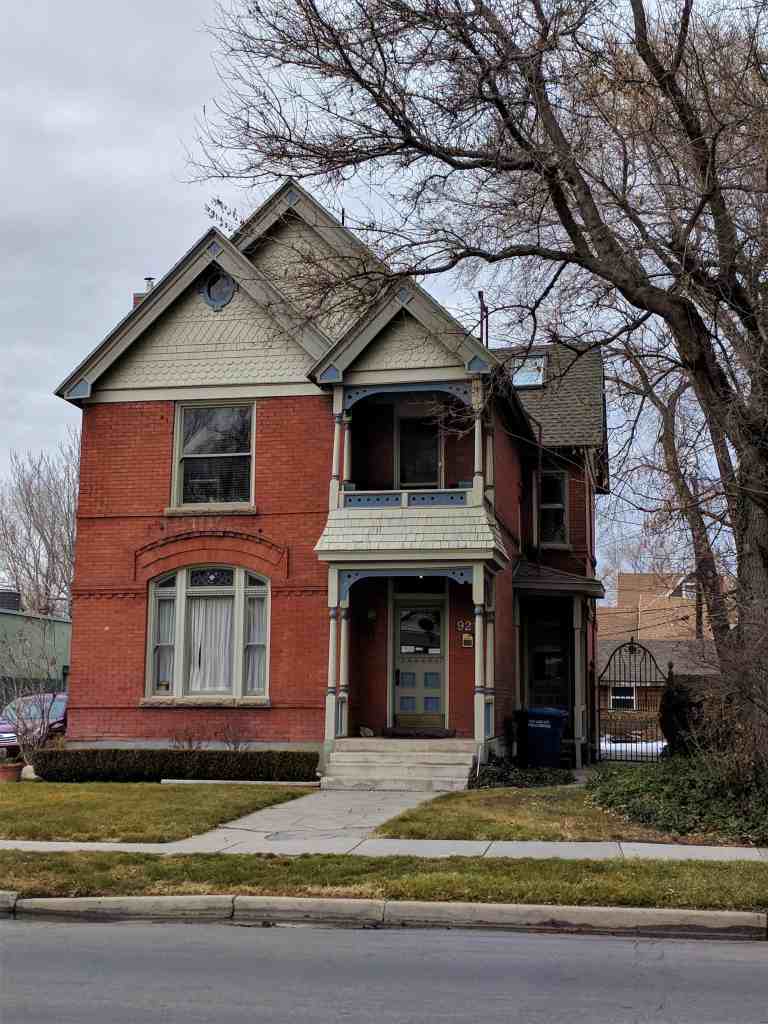
Henry Luce House
The Henry Luce House built in 1891, is part of the Perkins’ Addition Streetcar Suburb of Salt Lake City which is architecturally and historically significant as the most visually cohesive example of a streetcar subdivision within Salt Lake City. Created in the early 1890’s, the Perkins’ Addition development communicates the historical themes of non-Mormon settlement patterns, out-of-state influence on the expansion of Salt Lake City. Henry Luce was the proprietor oand partner in Luce and Berryman’s Mint Saloon.
Located at 921 East 1700 South in Salt Lake City, Utah.
See other historic homes in Salt Lake here.

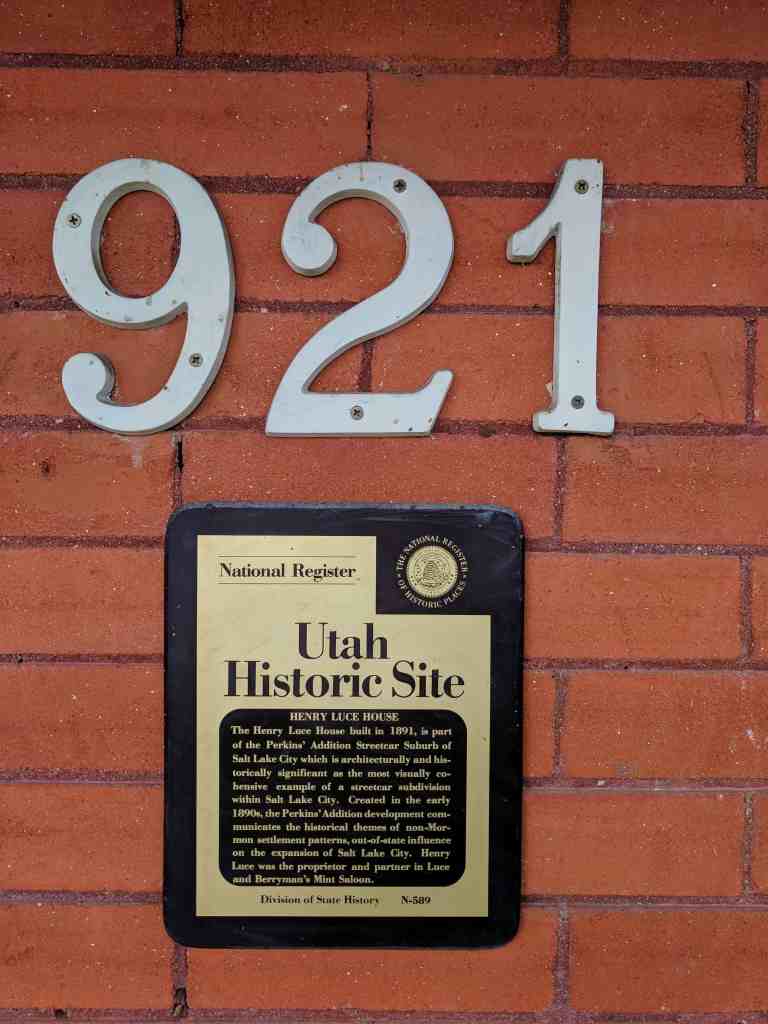
Located at 921 East 1700 South in the Perkins Addition in Salt Lake City, Utah and added to the National Register of Historic Places (#83003953) on October 13, 1983. The text below is from the nomination form for the national register.
The Henry Luce House, built in 1891, is architecturally and historically significant as one of the ten remaining houses that were original to Perkins’ Addition subdivision, the most visually cohesive example of a streetcar subdivision in Salt Lake City. Streetcar subdivisions played a major role in the transformation of the land south of the original city from agricultural to residential use in the 1890s, and Perkins’ Addition was considered the standard of subdivision excellence. The Luce House, as one of seven houses in Perkins’ Addition which are variants of one house pattern, documents a significant process in suburban development the use of standardized plans that could be varied to accommodate individual preferences. Additionally, this house pattern, distinguished by its gable façade and double porch entry, is unique in Salt Lake City, having originated in Colorado.
The Henry Luce House at 921 East 1700 South was built in 1891 as one of the thirteen large, brick houses constructed by Metropolitan Investment Company in Perkins Addition subdivision. Henry Luce, a bartender and partner in Luce & Berryman’s Mint Saloon, and his wife, Annie, apparently had this house built on the lots and in the style they chose in the spring of 1891.
Henry and Annie Vincent Luce had come to Salt Lake City in 1883 from Montana, where Henry had been engaged in the mining and livery business in Helena and Blackfoot. Henry was born October 6, 1842 in Morris town, New Jersey, and on September 23, 1869 he married Annie Vincent; they had nine children. Henry was involved in the mercantile business, primarily as a bartender and a saloon keeper, in Salt Lake City from 1883 until his death on November 15, 1931. Annie died in April of that same year. The Luces lived in this house until about 1899, when they sold it to Warren R. and Roxanna Fitch.
The Fitches, who were never listed in the city directories, apparently rented the house out before selling it in 1902 to Charles T. and Pamelia R. Wardlaw. The Wardlaws rented this house out also, residing at 370 South Main until moving to Milford in 1904. Charles was the proprietor of Brunswick Bowling Parlors.
William H. and Roberta Korns rented this house from Wardlaw for two years before buying it in 1904 for $3200. They continued to live here until William’s death in 1922. William and Roberta Korns had come to Utah in 1901 and lived at 335 2nd Avenue for one year before moving into this house. They had spent the previous seventeen years in various locations Including Iowa, Missouri, Nebraska and Wyoming, where William had been engaged in the newspaper publishing business. William was born In Illinois on April 7, 1862. Roberta Stalcup Korns was born on January 29, 1866 in Hartford, Missouri to Perry Louis and Rowena Baugh Stalcup. She married William on June 26, 1884 in Unionville, Missouri. After first arriving in Salt Lake City, Mr. Korns worked as business manager of the Mining Review. In 1905 he established Korns Warehouse Company (storage and transfer) which he managed until his death. He served a four-year term as a member of the first city commission after the city adapted the commission form of government in 1912. Roberta moved to 613 Third Avenue after William’s death and sold the house to Heber C. and Pearl S. Kimball in 1923.
Heber C. and Pearl S. Kimball, who bought the house In 1923, lived here for only one year, but continued to own and rent it out until 1933, living at several different addresses during that time. Heber C. Kimball was a teacher at LDS Business College. In 1933 Kimball sold the house to Zions Benefit Building Society, which rented it out until the following year when Leroy D. and Harriet F. Swingle bought it.
Leroy Swingle, who had been renting this house since about 1924, operated the Hawthorne Drug Company located nearby at 1650 S. 900 E. For a time, Mr. Swingle operated a family business from the home, Uca-Pak Manufacturing Company, which made and packaged pharmaceuticals. Swingle sold the house in 1937 to Home Owners Loan Corporation, which converted it into four apartments around 1938. Floyd Spilsbury, who bought the house in 1944, rented it out for many years. The current owner, Bill Braak, is restoring the exterior of the house which had undergone alterations over the years.
The Henry Luce House is a two story brick house. It is a rectangular block with crosswings symmetrically placed on the east and west sides of the building, and a one and one half story rear extension. All sections of the house have gable roofs.
The Luce House is one of seven of the houses in Perkins’ Addition which were derived from one basic pattern book design. Inclusively these houses represent the range of variation possible with the use of a single design. Each house is uniquely different from the others, but the basic form, the composition of major elements, and the repetition of specific decorative features tie these houses to a pattern book origin. The basic form repeated in these houses is a long rectangular, two story block with a gable roof, projecting bays and/or crosswings with gable roofs, and a façade composed of an arrangement of four openings. The main entrance is on one side of the façade, flanked by a large window. Distinctive one or two story Henry porches over the entrances have gable roofs and ornamentation that echo the pitch and detailing of the main block. M open porch with a geometric balustrade spanned the façade. Belt courses and a change in building material in the gable serve to interrupt the vertical thrust of the mass of the house, and distinctive shingle patterns, recessed decorative panels, and bargeboards with geometric surface patterns make the gable area a focal point of visual interest.
The design of the Luce House conforms to the description above. It, however, varies from the other seven houses in that it is the only one with a pair of symmetrical crosswings and one and one half story rear extension. It is also one of only two of the seven houses which has an extra projecting gable section on the facade. The Clifford R. Pearsall House, 950 East Logan Avenue, also has a gable set below the main gable over the major window bay. As originally designed, a one story porch extended off of the two story front porch around the front corner and down the east side of the building. Only the Elgin S. Yankee House, 955 East 1700 South, had a similar design feature. In both cases the porch no longer exists.
The façade is divided into two sections, a recessed bay on the east side which includes doors on both stories covered by a double porch, and a pair of large windows on the west half of the building. The porch has a flaired shingle roof section between stories. Porch piers on both sections are lathe turned and arched bands decorated with small holes cut through them extend between the tops of the piers. A narrow band of wood at the top of the flaired shingle roof section repeats the same decorative motif, having a line of cut circles along its width. The gable section of the porch echos the decorative features of the main gables. A combination of fishscale and regular shingles are framed by bargeboards which have a raised geometric pattern. The windows on the west half of the building include a broad double hung sash window on the second story, and a more elaborate three part first floor window. The three part window was a popular Victorian motif, and various types of three part windows were used in the design of eight of the ten houses in Perkins’ Addition. The window on the Luce House consists of a large, single pane of glass centered between a pair of slender double hung sash windows. A variation of this type of window is also found on the Pear sail House. The window opening is arched, therefore tine three part transom has a slightly bowed upper edge. A leaded glass panel highlights the central section of the transom. There is a small line of dentils beneath the transom windows. The relieving arch of this window is composed of a double row of arched bricks with a projecting upper edge instead of the more typical single row of bricks.
A change in material from brick to frame in the two major façade gables, and the combination of shingle types in conjunction with the use of decorative bargsboards make the gable section an area of visual interest, tying it to the distinctive double porch. Diamond shaped, fishscale, and regular shingles occur in alternating bands, ending with a sawtoothed edge on the last row of the front gable. The bargeboards repeat the raised geometric pattern of the porch bargeboard. There is a distinctive porthole window at the peak of the front gable. Belt courses below the second story windows and at the transom level of the first floor window break up the wall surface, negating the vertical thrust of the building. The lower belt course is accented by a row of bricks that project below it resembling dentils.
The bands of patterned shingles are repeated on the gable ends of the cross wings, although the bargeboards are not. Originally a door opened into both sides of the east wing, however, the rear door is being converted into a window. Long, narrow, double hung windows were used on the side and back sections of the house. Only one pair of windows at the rear of the house received any decorative treatment other than the use of raised brick in the relieving arch. It has a simple hood molding. Sandborn-Paris Insurance maps indicate that originally there existed a single story porch across the rear of the house. It no longer exists (the date of removal is unknown).
Alterations to the Luce House have been minor and include: the removal of the one story porch that wrapped around the east side of the house; the addition of a small shed roof section over a basement level window on the west side; the addition of the circular window in the south façade gable, a narrow horizontal window under the eaves of the rear extension on the west side, a double hung window in the rear gable end, and two double hung windows at the rear of the building on the east and west sides. The rear entrance may not be original. The house was converted into four apartments about 1938, which indicates that major changes were made on the interior. Only the addition of the two windows mentioned previously reflects that change on the exterior. These alterations do not affect the original integrity of the Luce House. It stands as a well preserved representative of the types of variations that could be made to the basic pattern book type that was the basis for design of seven of the Perkins’ Addition houses.
Following is a list of the seven houses in the Perkins’ Addition which were derived from, a single pattern book design and represent the range of variation possible with the use of a single design:
- John W. Judd House, 918 East Logan Avenue
- Clifford R. Pearsall House, 950 East Logan Avenue
- Thomas Yardley House, 955 East Logan Avenue
- Henry Luce House, 921 East 1700 South
- Elgin S. Yankee House, 955 East 1700 South
- Byron Cummings House, 936 East 1700 South
- William D. Mabry-Henry Van Pelt House, 946 East 1700 South