

First Explorations to the Great Salt Desert
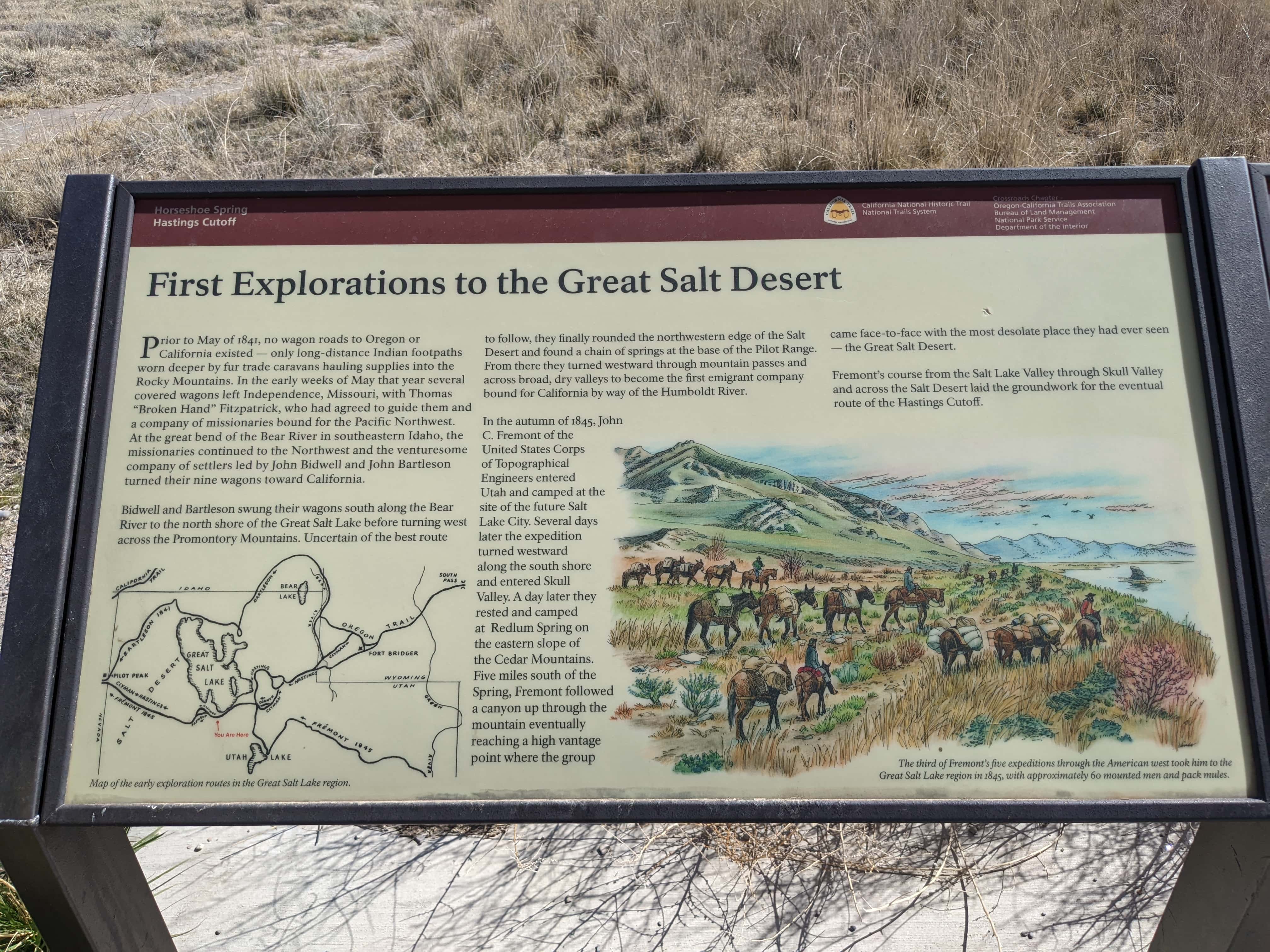
Prior to May of 1841, no wagon roads to Oregon or California existed – only long-distance Indian footpaths worn deeper by fur trade caravans hauling supplies into the Rocky Mountains. In the early weeks of May that year several covered wagons left Independence, Missouri, with Thomas “Broken Hand” Fitzpatrick, who had agreed to guide them and of missionaries bound for the Pacific Northwest. a company At the great bend of the Bear River in southeastern Idaho, the missionaries continued to the Northwest and the venturesome company of settlers led by John Bidwell and John Bartleson turned their nine wagons toward California.
Bidwell and Bartleson swung their wagons south along the Bear River to the north shore of the Great Salt Lake before turning west across the Promontory Mountains. Uncertain of the best route to follow, they finally rounded the northwestern edge of the Salt Desert and found a chain of springs at the base of the Pilot Range. and From there they turned westward through mountain passes across broad, dry valleys to become the first emigrant company bound for California by way of the Humboldt River.
In the autumn of 1845, John C. Fremont of the United States Corps of Topographical Engineers entered
Utah and camped at the site of the future Salt Lake City. Several days later the expedition turned westward along the south shore and entered Skull Valley. A day later they rested and camped at Redlum Spring on the eastern slope of the Cedar Mountains. Five miles south of the Spring, Fremont followed a canyon up through the mountain eventually reaching a high vantage point where the group came face-to-face with the most desolate place they had ever seen – the Great Salt Desert.
Fremont’s course from the Salt Lake Valley through Skull Valley and across the Salt Desert laid the groundwork for the eventual route of the Hastings Cutoff.

Located at Horseshoe Springs in Tooele County.