

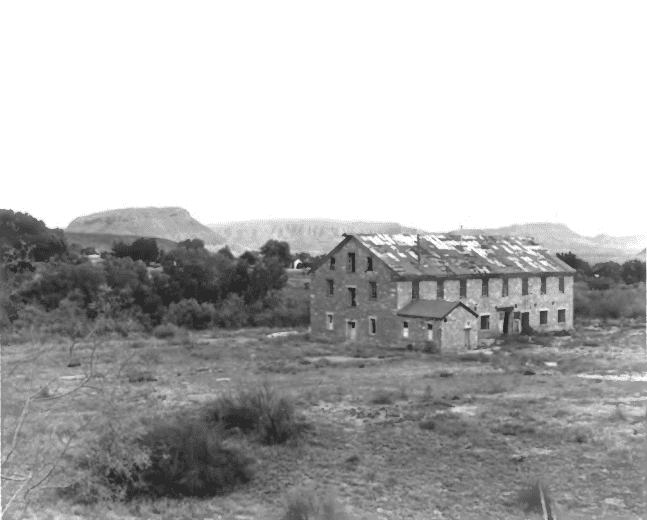
The Washington Cotton Factory was added to the National Historic Register (#71000864) on April 16, 1971 and was located at 385 West Telegraph Street in Washington, Utah. Daughters of Utah Pioneers historic marker #213 talks about it as well. The text below is from the national register nomination form.

Basic to an understanding of early Utah history is an awareness of the Mormon hope for economic independence and the “mission call.” With early explorations into Utah’s southwest, which discovered the mild climate of the valleys of the Virgin River, a major tributary to the Colorado River the agricultural implications became obvious.
By 1854 an Indian Mission had been established on the Santa Clara River. With cotton seed obtained from Nancy Anderson at Parowan, Angus Hardy, Jacob Hamblin and others planted and grew cotton successfully. Colonists moved south to grow cotton between 1856 and i860. An experimental farm was established at Tonaquint (near Bloomington) in 1858. Washington was settled by “Southerners” led by Bishop Robert D. Covington a year earlier. However, although several thousand pounds were grown during these experimental years, not until the fall of 1861 did Brigham Young call 300 families to the Cotton Mission, the Civil War opened this second phase.
With the erratic Virgin River to supply water for irrigation, the settlers suffered extremely. Floods destroyed dams, leaving no water for partially grown crops. No cotton meant no trade, even for foodstuffs. By 1864 about 74,000 pounds of lint had been sent east to markets. As Young wanted economic independence, he located a factory in “Dixie” to support and encourage the missionaries. “Joseph Birch managed this mill. Brigham sold his factory after five years (1870) to the Rio Virgin Manufacturing Company for $44,000; however, most of this debt was cancelled, since the factory was having such a difficult time.
During this second period, the “Saints” were organized into the “United Order,” a communal economic system. “Orders” from Brigham City on the north and Orderville on the east, sent people to Dixie to grow and process their cotton. Only with the boom of Silver Reef did any real economic relief come to the cotton missionaries, and then mainly to those who grew produce for market at the mines. This diversion, however, slighted the factory’s needs for raw cotton. By 1877, new farms were opened on the lower Virgin River at Bunkerville and Mesquite, Nevada. The St. Thomas area was resettled in the 1880’s and also raised cotton for the factory. Its impact was widespread. Its product and script were used extensively.
Finally, in 1890, Thomas Judd, an important southern Utah merchant, leased the factory and operated it profitably for a few years. By 1898, it was again idle, A few brief attempts at reactivation followed until 1910, when some machinery was sold. In 1914, the rest was scrapped. Since that time, the old mill has served primarily as a warehouse and a haunted house for Halloween dances.
The old cotton factory became the heart of the Cotton Mission. It remains its symbol today. In trying to meet the Saints’ needs for cotton goods under extreme conditions, the L.D.S. Church leaders employed both the “mission call” and the “United Order.” Success was limited. After the Civil War and the coming of the transcontinental rail road, competition from the American “Dixie” increased. The factory’s survival until the turn of the century owes much to the dedication of the cotton missionaries.
On a site originally selected for a mill by James Richy and Benjamin F, Pendleton, Brigham Young and the Dixie settlers constructed their cotton factory.
The large sandstone structure was .begun in1865, with Appleton Harmon assigned as superintendent of construction, Elijah and Elisha Averett, stone masons, and John P. Chidester, chief carpenter. August Mackelsprang and Hyrum Walker supplied lumber from Cedar Mountain. One story was completed and machinery in operation by January 1867. Later, because of expanded demand, including processing of woolen goods, two additional stories were added. By 1870 the enlarged factory was in use.
Located on Mill Creek, west of Washington, central to the cotton producing region, the factory used the water from springs feeding the stream, which was stored in a reservoir west of the mill. Fourteen hours of storage plus the stream flow, would operate the factory for ten hours. At peak production, the factory was capable of producing 500 yards of cloth per day and employed scores of local people. Their production included cotton batts mattresses, quilts, blankets, jeans, denims, broadcloth, flannels and gingham. Problems plagued the factory a supply of cotton and wool, a balanced operation, and lack of a market.
The factory has been empty for years. Fortunately, the roof has been in generally good repair until the last few years. The structure is sound, modified very little and in need of a new roof. It awaits preservation interest, which is now appearing. Its restoration is vitally important to telling this facet of Utah and Mormon history.