
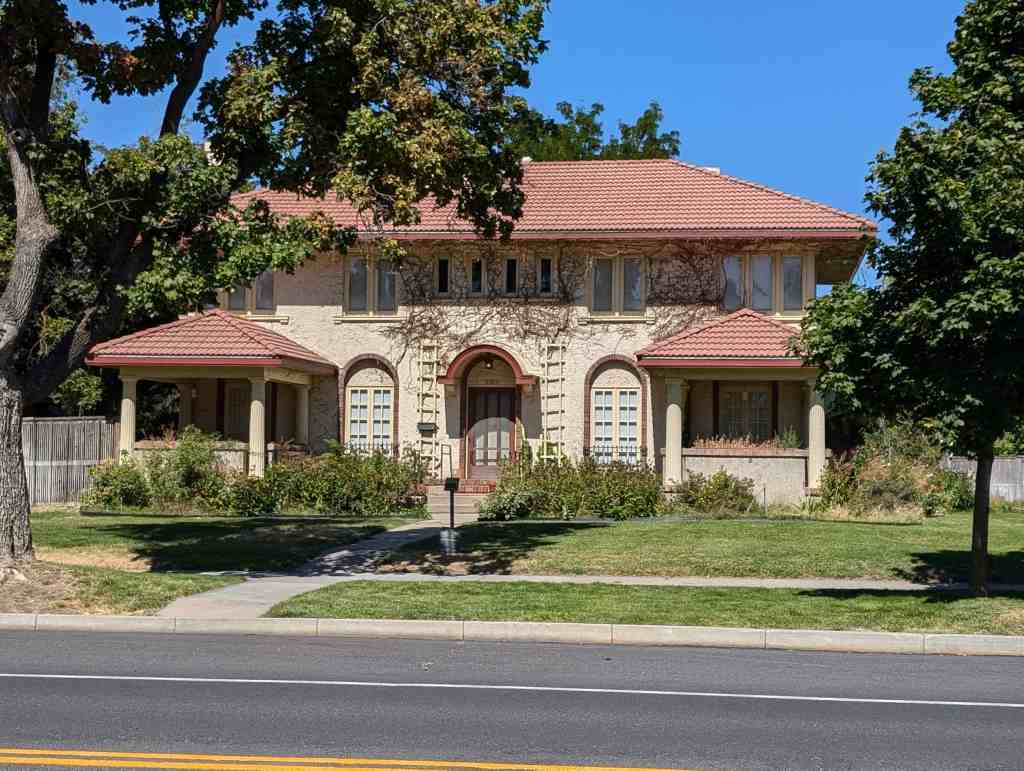
This Prairie-style home is a hip roof villa in the Spanish motif. It was built in 1915 for Julia Budge Nibley, Charles W. Nibley’s third wife. Nibley served as a station master at the depot and was an entrepreneur in early Logan.
The two-story home has stucco walls, strong horizontal symmetry, gently slopping hip roofs, low proportions, heavyset chimneys, sheltering overhangs, and low outreaching terraces that are typically Prairie-style, but the detailing makes it unique and more reminiscent of Classical and Spanish Revival styles. The fluted columns supporting the two front porticoes are Classical and have Doric capitals. A Spanish motif is portrayed by the red tile roof, an arched roof canopy above the front door, French doors used as windows, and openings outlined by brick arches. A garage was added in the 1960s but otherwise the exterior is largely unaltered. The interior was remodeled in the 1930s, again in the 1960s, and returned to its original period style in 1996.
The home was designed by Salt Lake architects Pope and Burton, who studied in Chicago and helped bring the Arts and Crafts style. They designed few residences, and even fewer remain. This house led the break from elaborate Victorian homes and established the Arts and Crafts style, particularly bungalows with Prairie influence, as the preferred homes in Utah. This house is historically important because it represents one of the best and earliest examples of the Chicago school (Commercial style) in the state of Utah.*
301 West Center Street in the Logan Center Street Historic District in Logan, Utah