
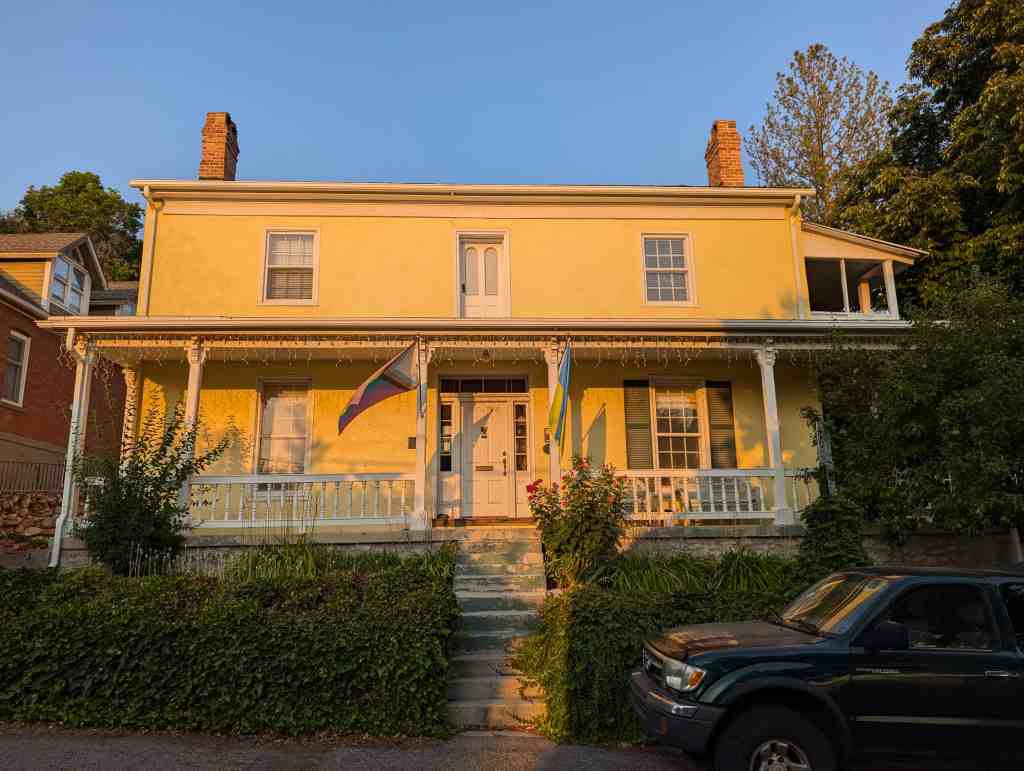
A two-story structure with gable roof. Rear lean-to creates nearly a saltbox configuration. Main façade piercing is a three over three arrangement and includes a second story door. The main entrance is treated in a classical manner with sidelights and transom light. The moulded cornice is also a classical motif. Chimneys are located at gable ends. The porch has square supports with Victorian brackets. Balustrade with turned balusters may be later. A second story porch at side is a later modification. Nine over nine double hung sash windows may be a part of the current preservation program.
This house was built for Richard Vaughn Morris, sometime between 1861 and 1866 but no later than 1866. Morris received title to all of lot 3 in 1861 and the first city directory of 1867 lists him in residence on Quince Street between 2nd North and Apricot.
Morris was born September 23, 1830 in Abergele, Denbigshire, North Wales to John and Barbara Morris. A frail child, he was sent at thirteen to England apprenticed to a lawyer. In 1849 he was baptized into the LDS Church by his brother Elias. In 1850 he left a law office in Liverpool to become secretary to William S. Phillips, head of the LDS Church in Wales. In 1855 he emigrated to Utah.
He was a member of the Nauvoo Legion Cavalry, served in two Indian wars and the Morrisite War, obtaining the rank of lieutenant. He was assistant government assessor and collector of internal revenue under General A.L. Chetlain, secretary to Congressional Delegate William H. Hooper in 1870, secretary of the Deseret Telegraph Company, President of the Utah Soap Factory, and auditor of the Utah Central Railroad.
Utah Soap Factory, and auditor of the Utah Central Railroad. From 1873 to 1875 he filled a mission to England. He served as president of the Birmingham Conference, and returned with 300 converts.
Morris married Hannah Phillips in England by whom he had three sons. Following her death he married Lavinca Robins who emigrated with him. He took a second wife, Harriet Cecilia Jones, May 16, 1868, by whom he had eight children. They adapted an Indian child as well. The house at 132-134 W 300 N was built in 1889 by Harriet, widowed when Morris died March 12, 1882.
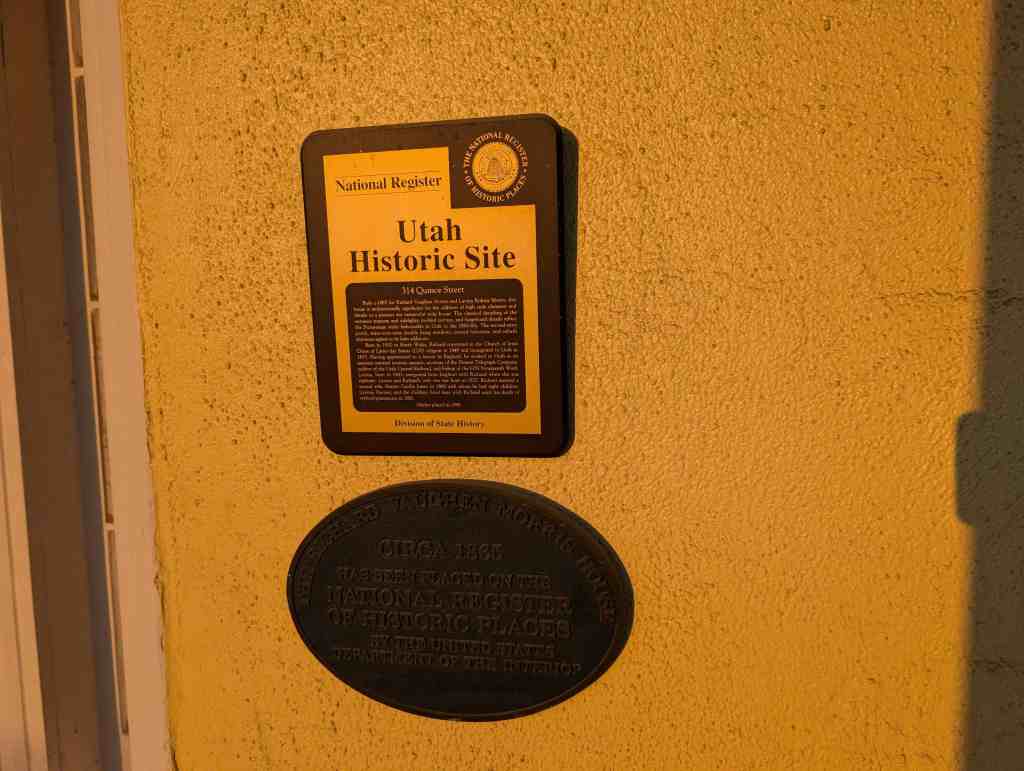
Located at 314 Quince Street in the Capitol Hill Historic District in Salt Lake City, Utah
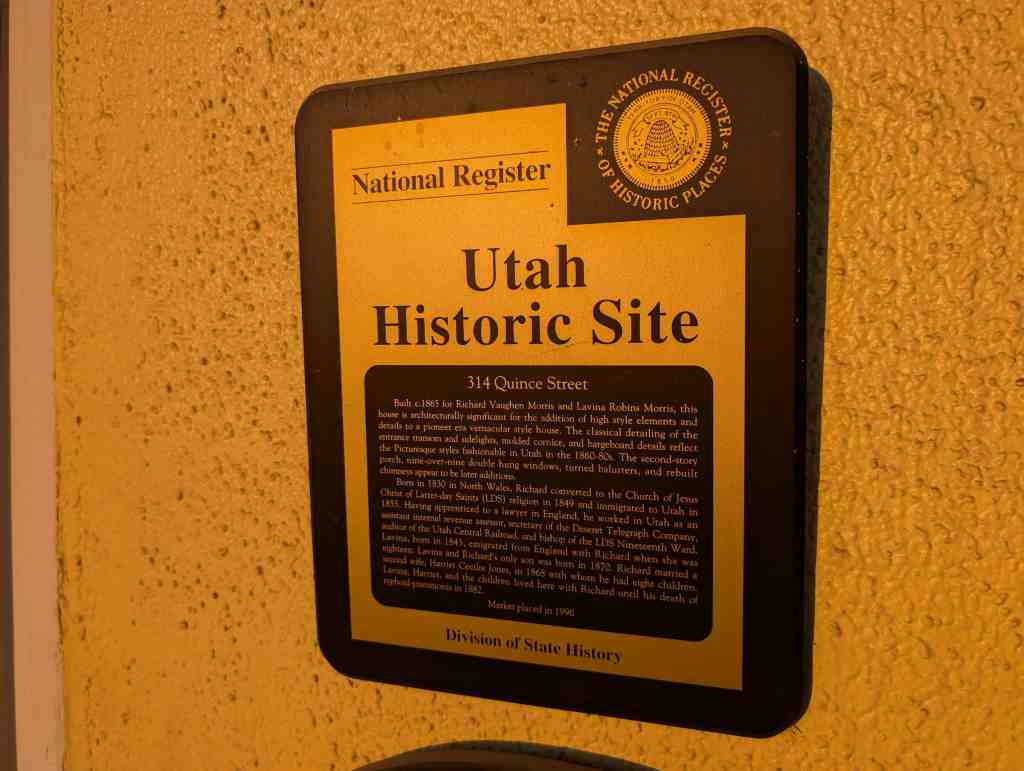
314 Quince Street
Built c.1865 for Richard Vaughen Morris and Lavina Robins Morris, this house is architecturally significant for the addition of high style elements and details to a pioneer era vernacular style house. The classical detailing of the entrance transom and sidelights, molded cornice, and bargeboard details reflect the Picturesque styles fashionable in Utah in the 1860-80s. The second-story porch, nine-over-nine double hung windows, turned balusters, and rebuilt chimneys appear to be later additions.
Born in 1830 in North Wales, Richard converted to the Church of Jesus Christ of Latter-day Saints (LDS) religion in 1849 and immigrated to Utah in 1855. Having apprenticed to a lawyer in England, he worked in Utah as an assistant internal revenue assessor, secretary of the Deseret Telegraph Company, auditor of the Utah Central Railroad, and bishop of the LDS Nineteenth Ward. Lavina, born in 1843, emigrated from England with Richard when she was eighteen. Lavina and Richard’s only son was born in 1870. Richard married a second wife, Harriet Cecilia Jones, in 1868 with whom he had eight children. Lavina, Harriet, and the children lived here with Richard until his death of typhoid-pneumonia in 1882.