

Moulin Rouge Hotel

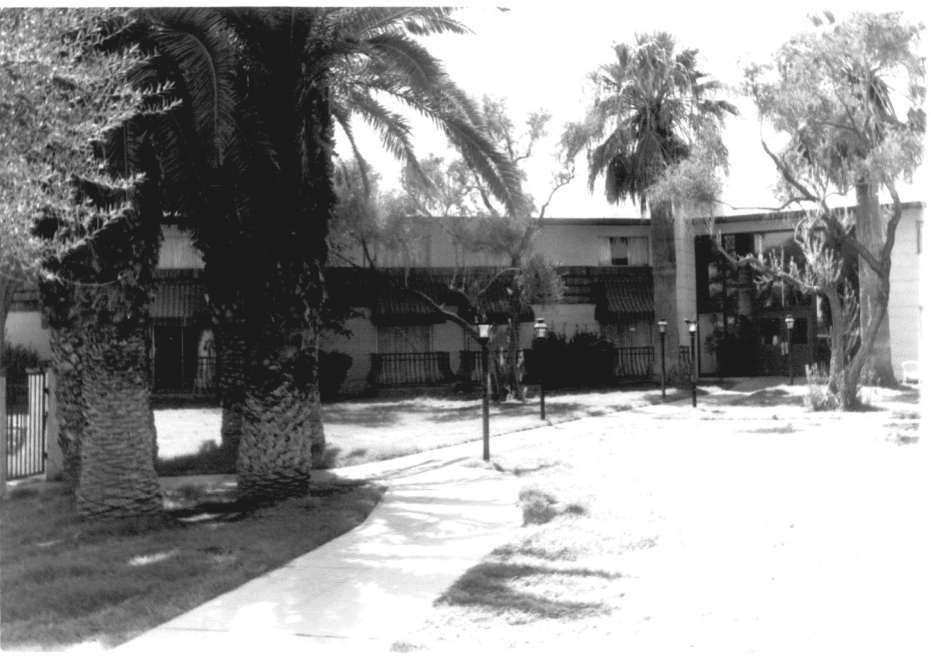
The Moulin Rouge Hotel was located at 900 West Bonanza Road in Las Vegas, Nevada and added to the National Register of Historic Places (#92001701) on December 22, 1992.


From the national register’s nomination form:
The Moulin Rouge Hotel and Casino opened on May 24, 1955. Although it is less than fifty years old, it is of exceptional importance under criterion A in the categories of ethnic heritage, social history, and entertainment. As the African-American population of Las Vegas increased dramatically during the war years of the early 1940s, so did segregationist policies and practices in the city. Increasingly, and especially after 1947, African-Americans were not permitted to gamble, dine, or stay at resort hotels in Las Vegas or on the Las Vegas Strip, which lies outside the city limits. Even nationally prominent African-American musicians and entertainers could not mingle with guests in the public areas of the resorts or often even stay at the hotels at which they were performing. Created specifically as an interracial luxury resort, the Moulin Rouge succeeded brilliantly for a time as the only place where these famous performers could find accommodations, mingle and “jam” before a racially mixed audience of residents and tourists. Its brief success helped pave the way for open accommodations later at downtown and Strip resorts. The hotel closed in October of the same year, but five years later it was to serve as the site for a meeting of local civil rights leaders, business and political leaders, and city and county casino-hotel operators which literally overnight ended the Jim Crow policies of Las Vegas resorts. These two episodes, however brief, lend to the Moulin Rouge an exceptional significance in the social and ethnic history of Las Vegas.
Las Vegas sprang into existence as a city in the spring of 1905 as a railroad division point. Through the first quarter century, the railroad was the dominant economic influence and employer. The African-American population was proportionately very small. In 1910, when the census revealed a population of 945, there were just forty African-American residents. As might be expected, most of the men were employed by the railroad as porters and repairmen. Women who worked served mostly as maids. While railroad officials made half-hearted attempts to encourage African-American residents to live in one part of the small town, there was no official policy of segregation. Still, the small African-American population tended to reside north of Fremont Street, the town’s major commercial thoroughfare, and near so-called “Block 16,” the. saloon and red light district. Aside from exclusionary policies of fraternal organizations such as the Elks, Masons, and Eagles, there seems to have been little white interest in further segregation.
The African-American population remained relatively small in comparison with the total population through 1940. In 1930, when the total population was just over five thousand, there were fifty-eight African-Americans; in 1940, there were under two hundred African-Americans in a total population of over eight thousand. The first major difficulties came with the construction of Hoover (Boulder) Dam between 1931 and 1935. In a time of national depression, African-Americans came to southern Nevada in greater numbers. Frustration at the lack of job opportunities for African-Americans at the construction site led to the creation in 1931 of the Colored Citizens Labor and Protective Association. Pressure from that organization, applied through Nevada political leaders, led finally to the hiring of forty-four African-American workers among the thousands who toiled on the dam.
Stronger segregation practices came to Las Vegas in the 1930s. Increasingly, hotels and clubs along Fremont Street refused entry, and city government began to pressure African-American businesses to move to the “Westside” by denying the renewal of business licenses to those businesses which catered to a mixed trade. Though the Westside had also been settled in 1905, development there had generally lagged far behind the rest of the community; streets were not paved, water supplies were inadequate, and there was no fire station.
The construction of a major defense plant near Las Vegas beginning in late 1941 led to a dramatic increase in the number of African-American residents in southern Nevada. In a time of severe labor shortage, African-Americans, many from the deep South, were recruited by the thousands. Most had to live in appalling circumstances in the underdeveloped Westside where land values were much lower. During the ensuing years of the war, Las Vegas became increasingly segregated. Limited segregated housing for African-Americans near the plant did little to alleviate the situation after 1943. The term “Mississippi of the West” was often applied to the area.
In the postwar year, tourism developed rapidly on the Strip and downtown. The Flamingo opened in 1946, the Thunderbird in 1948 and the Desert Inn in 1950. Five major hotel-casinos opened on the Strip in 1955. African-Americans were not allowed accommodations at the new hotels, nor could they frequent casino and dining areas. After their performances, even nationally famous entertainers such as Sammy Davis Jr. and Pearl Bailey had to seek places to say at boarding houses on the Westside where rooms were actually more expensive. In 1949, one hotel tried to buck the trend. This was the Nevada Biltmore, a downtown hotel and casino located on Main Street at Bonanza, the main access street under the railroad tracks on the Westside. For a short time the hotel was open to White and African-American patronage alike and plans were made to convert the hotel and casino into a resort specifically for African-Americans. Local property owner objection and, probably, lack of financing prevented the plan from coming to fruition.
Early in 1954, the Moulin Rouge project was launched by a group of partners including New York restaurateur Louis Rubin, Beverly Hills developer Alexander Bisno, and a host of smaller investors. The location chosen, 900 West Bonanza, was on the boundary of the original “Westside” area, by then an almost completely African-American residential and commercial area. Requisite permits were obtained after the developers overcame area property owners’ objections, and ground was broken in July. Designers of the $3.5 million building were prominent local architects Walter Zick and Harris Sharp; the general contractor was the Stone Construction Company “of New York and Las Vegas.” Throughout the construction period, newspaper articles kept the spotlight on the resort. Former heavyweight boxing champion Joe Louis arrived to serve as host (he was allotted a small percentage of the ownership) , and Clarence Robinson, who had staged shows at the original Moulin Rouge in Paris, was engaged to put together the floor show and serve as entertainment director. Fighter Archie Moore used the still uncompleted resort as his headquarters for his Las Vegas bout with Nino Valdes, From kitchen to security staff to chorus line, the staff was inter-racial.
A seven page spread in the Review-Journal described the spectacular opening on May 24, 1955. In the newspaper advertising for the opening, the hotel billed itself as “the nation’s first major inter-racial hotel.” In addition to the “Tropic Can Can” floor show, entertainers included comics Stump and Stumpy, the Bill Johnson Quartette, Wild Bill Davis, and the Ahmad Jamal Trio. In the next few weeks, the Platters, Maurice and Gregory Hines, Lionel Hampton and Dinah Washington were featured performers.
The resort became well known for its “third show,” a 2:15 a.m. performance involving entertainers who were working on the strip. William F. (Bob) Bailey, who was master of ceremonies at the resort, recalled the Frank Sinatra, Dean Martin, Harry Belafonte, Louie Armstrong, Sammy Davis Jr. , Tallulah Bankhead, Donald O’Connor, Joe E. Lewis, Gregory Peck, Dorothy Lamour, and Milton Berle were among the stars that performed or attended performances at the Moulin Rouge. One Saturday night’s audience included Jack Benny, Mary Livingston, George Burns, Gracie Alien, Kay Starr, Fran Warren, Herb Mills (of the Mills Brothers), Nat “King” Cole, and Sammy Davis, Jr. For the relatively short period that it was open in 1955, the Moulin Rouge was regarded by some the best entertainment spot in Las Vegas.
The resort closed in October of 1955, probably for a variety of reasons. Most observers report that is was badly managed and under-capitalized. In the face of constant civil suits for payment for goods and services, attempts were made to incorporate the multitude of small investors, to no avail. The resort went into receivership in October. Other observers point to strong opposition from Strip hotel owners afraid of its success and the implications for their own racially exclusive show rooms. Some have said, for example, that Strip establishments rearranged their shifts so that employees and performers were unable to attend the “third show.”
Certainly, the Moulin Rouge is significant for what it aspired to be upon its opening. It gained further significance in 1960 as the site of an important meeting which led directly to the collapse of the segregated system on the Strip and downtown. As part of a national effort to achieve civil rights for AfricanAmericans, the local affiliate of the National Association for the Advancement of Colored People and other local groups planned action to break down the color barrier in Las Vegas hotels and casinos. Mrs. Lubertha Johnson, then herself a leader of NAACP, recalls that to head off a planned demonstration march, numerous hotel owners and city and state officials including Governor Grant Sawyer met at the Moulin Rouge with African-American leaders headed by NAACP president Dr. James McMillan. As Mrs. Johnson recalls the crucial meeting of March 26, i960, it was mediated by Las Vegas Sun publisher Hank Greenspun. The meeting concluded with the abrupt agreement of most Las Vegas hotel owners to end the policy of denying admittance and accommodations to African-Americans. The protest march scheduled for that evening was cancelled. Thus, in a period before state statutes guaranteeing open accommodations and employment opportunities were enacted, the Moulin Rouge was the site of one of the most significant developments in the city’s modern history.
The Moulin Rouge Hotel and Casino, Las Vegas’s first interracial entertainment facility, opened for business on May 24, 1955. The hotel and casino complex was designed by Las Vegas architects Walter Zick and Harris Sharp. The casino and hotel closed five months later, and has housed various businesses over the past several decades. Located on the Westside of Las Vegas, the one and two-story complex survives in good condition.
The Moulin Rouge is located on Bonanza Road, a thoroughfare through the northwest section of the city. The neighborhood is primarily commercial, with warehouses located across the street, a shopping area located to the east of the hotel/casino complex, and apartment buildings to the west. The freeway, 1-95, runs just east of the shopping center. The entrance to the complex faces south onto Bonanza Road with a parking lot between the south elevation and the road. Landscaping includes palms, evergreens, and oleander. The two non-contributing buildings, both small, one-story shopping centers, are located just to the east of the hotel/casino and are of similar design.
The casino and theater of the Moulin Rouge is a one-story, stuccoed building attached to a two-story, V-shaped hotel to the west. A courtyard is enclosed by the interior of the “V” and the west wall of the casino/theater building. The hotel is also stuccoed. The casino entrance and hotel entrance are emphasized by projecting, square pavilions topped by shingled, mansard roofs. To the east of the casino entrance, the building is low and arcaded with a flat roof. A large neon sign, styled in cursive writing, reads “Moulin Rouge” and is mounted on the roof. A decorative, four-story tower, approximately 6′ wide by 12′ deep, with a shingled, mansard roof was constructed at the southeastern corner of the casino building.
The hotel, which extends to the -vest of the hotel entrance, is a low, two-story building with a vary shallow gable roof. A two-story, enclosed tower for mechanical systems is located at the southwest corner of the hotel. The entrances and windows of the building are simple, unornamented openings with glass doors and sliding or hinged metal sash windows. The courtyard contains a pool, now empty, surrounded by a concrete and metal fence, and landscaping.
The casino entrance leads to a lobby area with a restaurant in the rear and a large auditorium to the right. The walls of the auditorium are painted with colorful murals depicting can-can dancers, fancy cars, and onlookers. These murals are original to the opening of the building and are significant for their representation of nightlife in the mid 1950s. Behind the auditorium, a second auditorium area is called “the theater.” The theater survives unaltered from the 1950s; the stepped, stuccoed purple ceiling, the stage, and the light fixtures remain intact. This area is also significant. Overall, the Moulin Rouge is in good condition. Alterations have been limited to interior finishes and fixtures, and the exterior appearance remains close to the original appearance of the building.
Pingback: Las Vegas by Address | JacobBarlow.com