
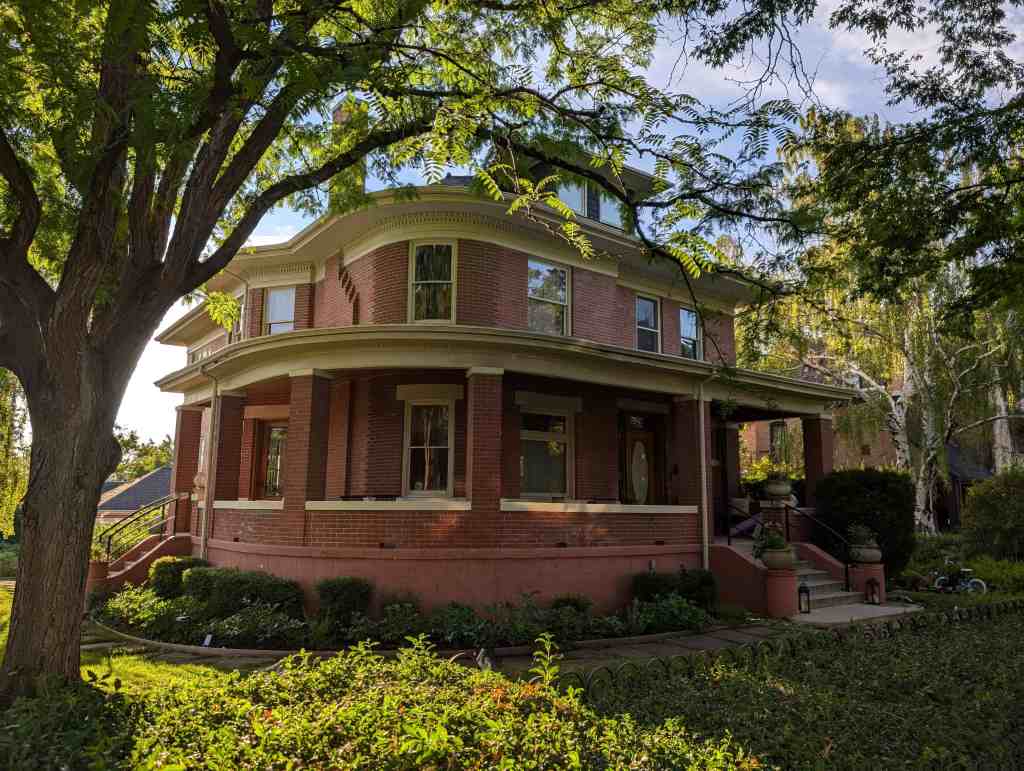
Frank and Orla Orem Home
Built in 1907 for Frank and Orla Orem, this house had several notable occupants. Orem was responsible for the organization of Utah’s second interurban railroad (the first to connect the cities of Utah to Salt Lake County), the Salt Lake and Utah Railroad. In 1925 William, sales manager for the American Steel and Wire Company, and Ella LaPierre, moved into the home. In 1930 Dr. Orin (head of the physics department at the University of Utah) and Eupha Tugman purchased the house.
Located at 274 South 1200 East in the University Neighborhood Historic District in Salt Lake City, Utah, it was listed on the National Register of historic places (#83003175).
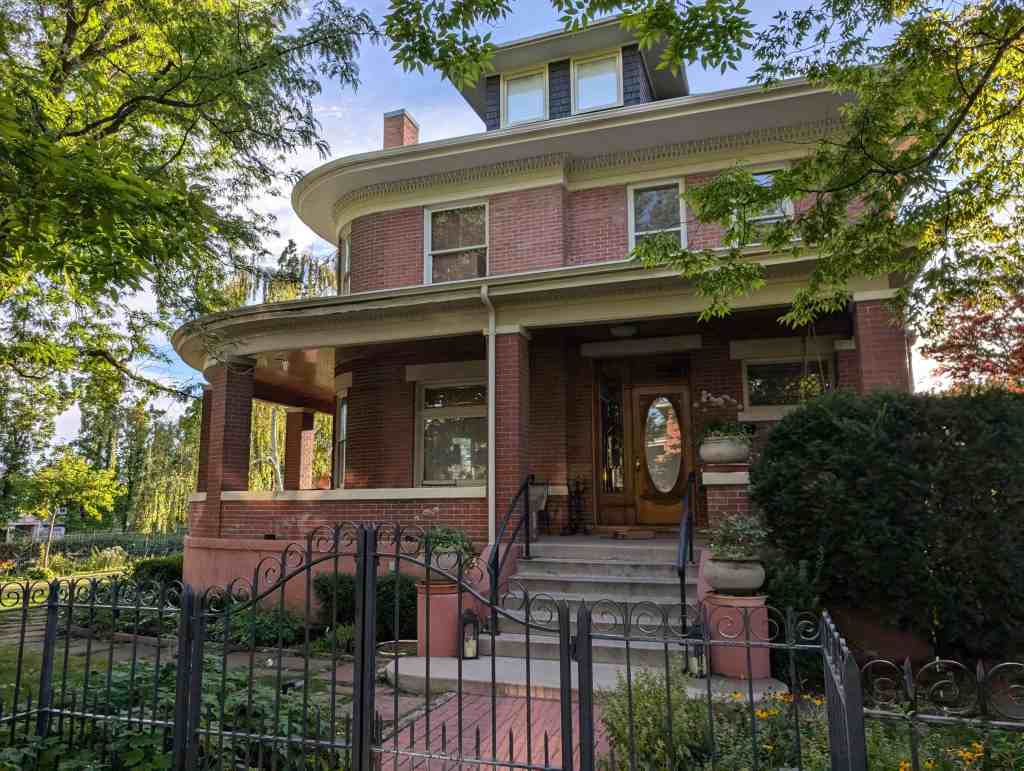
(from the national register’s nomination form)
The Frank M. Orem House is significant for its association with the life of its owner and namesake, an important figure in the creation of the Salt Lake and Utah Railroad the state’s second electric interurban and the first to connect population centers in Utah and Salt Lake Counties. Put into operation in 1913, the SL & URR or “Orem Line” was part of one of the nation’s largest interurban transit systems and gave impetus to the development of 130 new industries along its route. The Orem House, built in 1907, has been well-preserved and recently underwent restoration/renovation by its present owners. Both the interior and exterior of the residence retain integrity of design, materials, workmanship, feeling and association. Situated on its original large corner lot in Salt Lake City, the house also possesses integrity of location and setting. As the Interurban Building and the structures associated with the railroad have been destroyed, the Orem House is the only remaining building most closely associated with the life of Frank M. Orem.
Born September 26, 1874 in Ray County, Missouri, Frank M. Orem accompanied his parents, Albert J. Orem and Martha Leabo Orem, and his brother Walter C., to Utah in 1890. In adulthood, Frank became an attorney, a prominent businessman, and leader in a variety of civic and religious concerns. A Baptist, Frank Orem taught classes in religion and became president of the Utah Baptist Convention in 1926. He was also active in fraternal organizations, belonging to the Argenta Lodge No. 3, F. & A.M. (of which he was Worshipful Master), the Utah Chapter No. 1 Royal Arch Masons, the Utah Commandery Knights Templar, and the El Kalah Temple of the Mystic Shrine, as well as the Kiwanis Club. In 1939, Mr. Orem died while climbing the steps of his office in the Interurban Building (now destroyed). At the time of his death at age sixty-five, Frank M. Orem had lived in Salt Lake City for forty-nine years and was still an officer in the Salt Lake and Utah Railroad (SL & URR), his favorite accomplishment.
Frank M. Orem made significant contributions to Utah with the SL & URR, Utah’s second interurban railroad and the first to connect the cities of Utah County to those of Salt Lake County, particularly Salt Lake City. With his father and brother (after whom the city of Orem, population 45,000, was named), Frank M. Orem organized the SL & URR or “Orem Line” in 1912, with operations beginning in 1913. It was created on the heels of Simon Bamberger’s interurban (Bamberger was later governor of Utah), built in 1891 as a steam-powered railroad but electrified in 1910 in anticipation of the Orem Line.
After the invention of the electric motor in the 1830s, experiments were made with motorized trains in the 1840s. The first continuous-cur rent dynamo, created in 1860, and the earliest self-exciting magnetic fields, developed in 1866-67, led to the construction of the world’s first practical generator in 1870. The first electric train was operated at the Berlin Exhibition of 1879 and by the 1880s, Frank J. Sprague had put into use the first electric commercial line, the Richmond Union Passenger Railway in Virginia.
The interurban movement increased in popularity to the extent that during the first decade of the twentieth century, it was the object of one of America’s leading investment booms, attracting more capital than the competing automobile industry. As cities in the western U.S. increased in size and electricity-generating capacity, they developed interurbans. Utah had one of the longest routes in the west, made of three separately owned but connected lines serving all of the state’s major cities. Stretching 197 miles from Preston, Idaho to Payson, Utah, the line was also one of the nation’s longest-lasting, parts of it surviving until 1959. The southernmost section of this road was the Orem Line, electrified in 1913 and kept in operation until 1946 when parts were abandoned and other parts taken into the Bamberger and Rio Grande systems.
The Orem Line was strictly an interurban transit and had no affiliation with major railroads or power companies. The line was of considerable significance in the development of urban centers in Utah County. It ran parallel and proximate to the main streets of all the cities from Salt Lake City to Payson, offering both passenger and freight carrying services to the populace of 230,000 along its route. The line also ran spurs to nearby mining districts, industrial centers and cities, giving impetus to the construction of new canning and sugar factories, fruit packing plants, oil warehouses, the U.S. Steel Columbia plant, and the five plants of General Motors and Goodyear Co. It is estimated that about 130 new industries grew up along the tracks of the Orem Line. The Orem did a freight business of 10,000-12,000 cars per year and offered an hourly express, making twenty-four trips daily from Salt Lake City to Payson.
Built at a cost of five million dollars and constructed by a female railroad – contractor, Mrs. W. M. Smith, the Orem Line was locally funded, owned and managed, representing a joint-effort between Mormon and non-Mormon financial interests during a new age of inter-religious accommodation and cooperation in Utah.
Frank M. Orem, an attorney by profession, played a major role in expediting the extensive legal work needed to propel the Orem Line into existence. The line was opposed by various governmental agencies and was in the planning stage for several years before being organized and commencing service. Almost from the beginning, the SL & URR encountered financial difficulties. The construction of hard-surfaced roads for the burgeoning automobile industry increasingly eroded the line’s support base. To survive, the line decreased passenger carrying in favor of freight handling, outlasting the Depression of the early 1930s only to go into bankruptcy in 1938. In that year, George S. Eccles and Moses A. Browning of Ogden, owners of the Utah-Idaho Central, purchased the Orem Line and joined it to their own road, under the name of the Salt Lake and Utah Railroad Corporation. Despite a line which now ran both north and south of Salt Lake City, connecting the state’s three largest cities, the new railroad was operating in a deficit by 1944. Its physical – properties had deteriorated to the extent that the line was no longer safe. It fell into receivership in 1945 and made its last run 1 March 1946. The Bamberger Electric Railroad took over the extensive industrial siding in Salt Lake City and vicinity and the Rio Grande acquired sidings in the Provo and Orem area. The use of the old Orem Line thus continued until the demise of the Bamberger passenger service in 1952, and finally the ending of the line itself came with the closing of the freight business in 1959. No other rapid transit had been developed to connect Utah’s major metropolitan areas. During its period of operation from 1913 to 1959, the Orem Line and its subsequent extensions served a transportation need which persists today.
The Frank M. Orem residence was built in 1907 and owned by the Orems until 1925 when it was sold to William A. and Ella La Pierre. Sales Manager for the American Steel and Wire Company, La Pierre kept the home for only five years before selling it to Orin and Eupha Foley Tugman, a couple prominently associated with the University of Utah, located a few blocks east of the house. Dr. Orin Tugman was head of the Physics Department at the university and was also chariman of the Graduate Council. His wife, Eupha, who held a master’s degree from Stanford, was involved in numerous university and civic activities, including those of sorority and honorary groups, and USO and PTA boards. She was chief of manufacturing of sound wave slides for the Central Scientific Co. of Chicago, and was president of the Women’s Republican Club and University of Utah Women’s Club in Salt Lake City. She was also a member of the Salt Lake County Welfare and Civic Center Boards. Shortly after his wife’s death in August 1944, Mr. Tugman sold his house to its third owners, Mr. and Mrs. Charles Ruggeri Jr.
Charles Ruggeri Jr., son of one of Utah’s earliest Italian immigrants, was a physician and surgeon who specialized in eye, ear and nose ailments. He and his family occupied the house until 1971 when they moved away, leaving the house vacant. In 1973 it was purchased by Herbert W. DeVitt Jr. and his wife Maxine. A retired merchant mariner, DeVitt sold the home to Stephen and Lynn Jacobsen in 1982. Stephen is a bio-medical engineer in the University of Utah’s renowned artificial organ program, while Lynn is Director of Development for the university’s Pioneer Memorial Theatre. Before occupying, the Jacobsen’s undertook an extensive restoration/renovation project, completed in early 1983.