
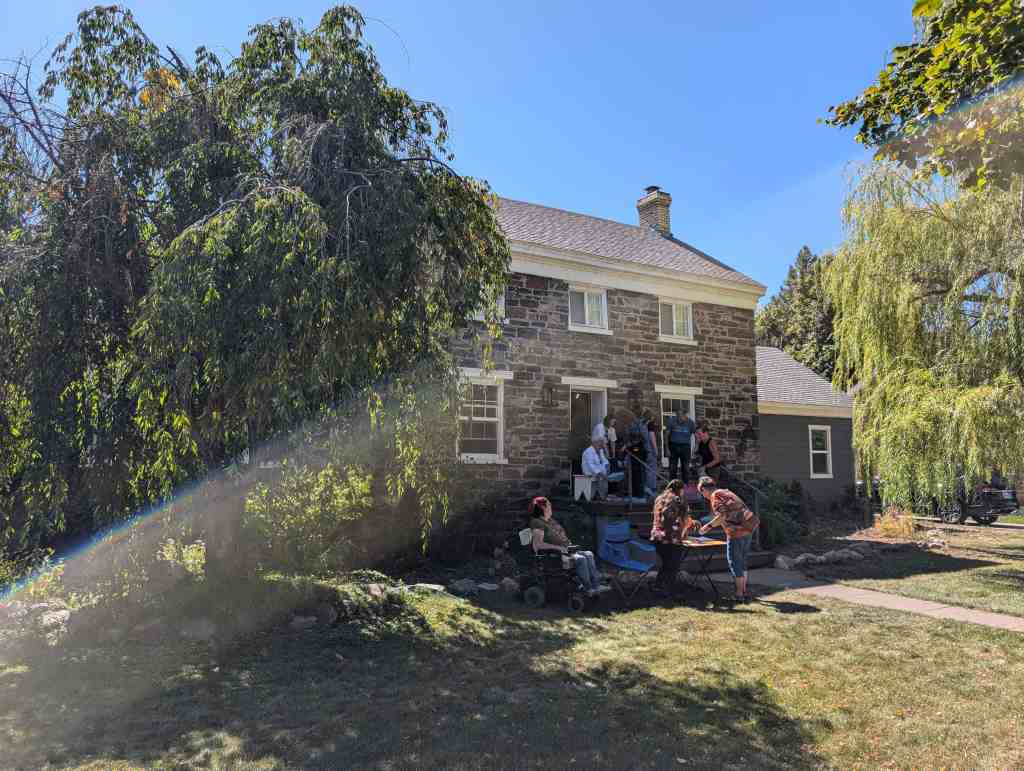
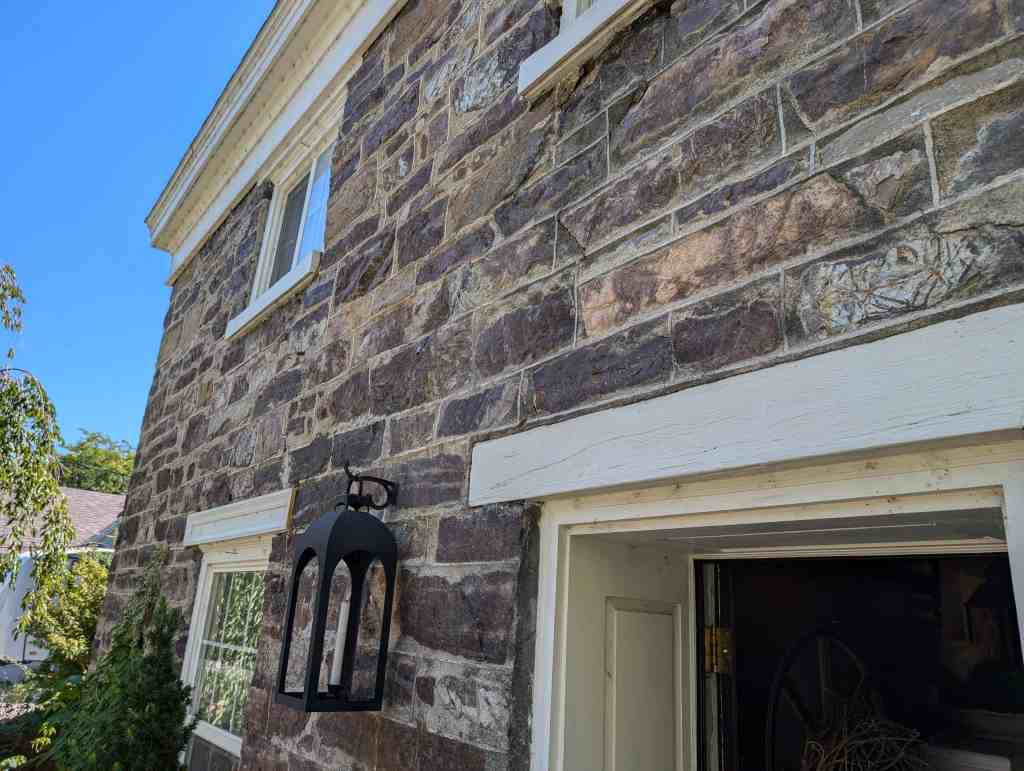
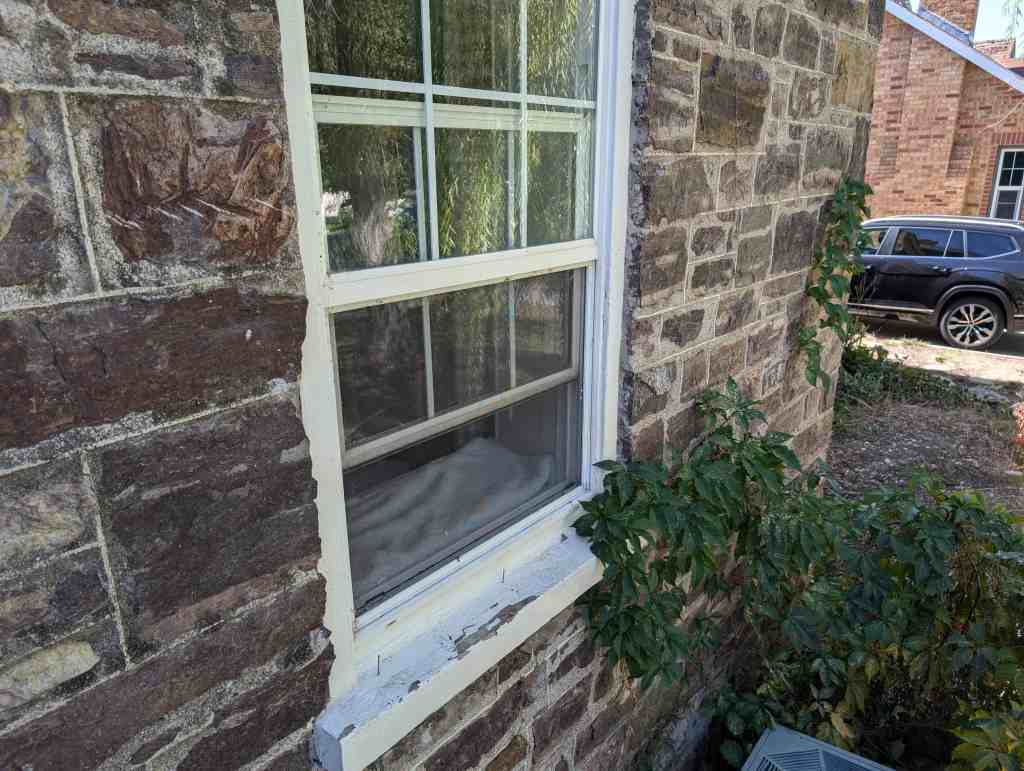
Rebekah Giles home, built by Thomas Tarbet in 1865
372 West 100 North in the Logan Center Street Historic District in Logan, Utah

PIONEER PERSONAL HISTORY QUESTIONNAIRE
NAME: ELIZABETH TARBET EDWARDS
ADDRESS: 372 West 1st North St. Logan Utah
BORN: June 19, 1857
PLACE: Salt Lake City Utah
Age: 79 years
MARRIED: Thomas Edwards in Endowment House, Salt Lake City Utah
October 10, 1879
OCCUPATION:
Landlady, Part of her home is rented as an apartment house. She also has a garden and does her own housework. During her life time she has acted as a seamstress, having taken in sewing after the death of her husband in order to help support her children. She has also done much embroidery and fancy work, and has made many quilts in her time. She at one time worked as a seamstress in connection with Undertaker George W. Lindquist and made Temple clothes and burial garments; also helped lay out the dead. She received .50¢ per day as a seamstress. ANCESTRY: Her parents were Mormon converts from the Isle of Man who came to Utah in 1847 and to Cache Valley in 1860.
FIRST HOMES:
The first home of the Tarbets consisted of a two-room log house the logs of which were hauled from the near-by canyon, chinked with chips and plastered together with mud. The floor of their home was dirt, while the roof consisted of wooden slabs plastered with mud.
Later on they had an adobe house, the clay for adobes being dug from clayey fields west of the town. This was mixed with water and tramped to the proper consistency with bare feet, then placed in wooden molds and left to shape; when hard enough to remove, they were taken out of the molds and left in the sun to thoroughly bake.
LIGHTS:
The earliest lights consisted of a button wrapped in a “bit” of rag and placed in a saucer, or other container, of grease or tallow from which the rag projected and was lighted, and constituted their lamp.
Later, the family used tallow candles. They had candle molds and made their own candles. These consisted of metal tubes or pipes approximately 3/4 inches in diameter and some 10 inches high, the bottoms of which were perforated in order to draw the wick (or string) through which was drawn up the tube and attached to a horizontal wire at the top to hold it straight; then melted tallow was poured into the tube and left to harden. When sufficiently set the candles were lifted from the molds by the wick, or if they were inclined to stich to the mold it was placed in hot water and then the candles came out easily and were ready for use.
In after years, when the Tarbets were able to purchase an oil lamp from Salt Lake City, the children were careful not tp get too near the lamp for fear it might be tipped over and cause fire.
Then when electric power began to be generated in Logan generally around 1900, they followed the fashion and had one light installed in their parlor or front room, for which they paid .75¢ per month. Later, they had lights installed in all their rooms as it is today.
FUEL:
In early days, the pioneer settlers gathered brush and wood, or anything they could find to burn. They also made trips with ox teams to the nearby camyons, where they cut and trimmed trees and hauled them to their homes, to be sawed up and chopped and used for fuel. Previous to the coming of the railroad, there was no coal to be had. Hence, the people used wood for cooking, heating, etc. They used to heat their “flat” or “sad-irons,” which the family had brought over from the old country, on their wood fires and laboriously press the family clothes.
FOOD:
The Tarbet family, being in comfortable circumstances, were always supplied with plenty of good food. Like other pioneer families, they had their vegetable garden, cows and chickens, and they made their oun bread from hop and potato yeast. In this connection, it might be well to describe the dug-out, or celler in which their food was kept cool in summer and their potatoes, carrots and other vegetables stored in winter. This consisted of a hole in the ground, covered over with boards and a dirt roof, and wooden steps leading down to it, Along the walls were board shelves where pans of milk stood with their creamy coating; when sufficiently sour, the milk was skimmed and the cream churned by hand, in a churn and dasher made for this purpose, and the family thus obtained their butter. The family pigs usually got the buttermilk.
Pigs were usually kept in a pig-sty out in the yard, and fed on apples pealings and scraps from the table, and some grain. From this source, the family had their fresh and salted pork meat. A cow or calf was killed occasionally and furnished their beef supply.
Water was carried from the canal, not far away, both for drinking and culinary purposes. Later, a well was dug, some thirty feet deep, which was used until cesspools began to be built, when the well was filled in with dirt and rubbish, it’s supply of water not being sanitary.
Usually in summer time, the pioneer settlers “put up” fruit from their privately owned orchards, or bought it from Brigham City Peddlers Mrs Edwards remembers buying sugar shipped from the east, for $4.00 per 100 pounds. In the very early days the community had a molasses mill and made molasses from sugar cane which was raised locally. They ground the cane between rollers and boiled the juice thus obtained, in bats until it became molasses.
CLOTHING:
In the early days Mrs. Edwards folk make their dresses and part of their other clothing from homespun linsey. Mrs. Edwards older sister spun the yarn, and it was woven by hand-looms owned wned by various people of the time. Thus this good lady early learned to make clothing for the family. In her memory are a fleeting panorama of factory underwear, numerous petticoats, old-fashioned stays whoops, pads, bustles, be-ruffled and very full skirts reaching to the ankle. etc. In those days it was considered bad taste, to say the least, to show one’s ankle.
FARM IMPLEMENTS:
This good woman did not have much to do with the farming end of pioneer life. She remembers that the implements were crude hand-made rakes, scythes, etc, and the plowing was done by man-power with a home-made plow.
EARLY INDUSTRIES:
Mrs. Edwards recalled also the flour mill, where they took their wheat to be made into flour; and the lumber mill where the logs hauled from the canyons were converted into lumber. These along with the molasses mill, constituted the main industries.
EARLY LIFE:
Mrs Edwards was a little girl about three years old when her parents brought her to Logan.
She remembered wondering over the hills to the east of the town, where the city Cemetery and Agricultural College now are located, and gathering sego bulbs to eat just for a pass-time. She could tell where to dig for them from the thick stem jutting from the ground, and having no digging fork, found a pointed stick and proceeded to laboriously dig the bulb from the dry ground. The bulb is like a very small onion and when the thin outer skin is removed, is crisp and sweet to the taste.
She also remembered playing with Indian children. Her parents were always kind to the Indians, who would camp in large numbers on the canal bank near the Tarbet home. Here they put up their wigwams and from here they wondered through the town to beg. On one occasion she remembers a sick squaw lying in a shod on some straw and being attended by her mother. Though very ill, the squaw would take nothing but hot water. After the birth of an Indian papoose, the squaw not long after got up and washed in the nearest brook or convenient place; the bearing or children did not interfere greatly with their daily routine.
Mrs Edwardw still carries a picture in her mind of a yard full of Indians, decked out in head-feathers and war paint, doing their war dances to the rhythm of squaws drumming on crudely made instruments with skins stretched across to drum on who sat around on the ground while the bucks danced; all of them chanting in their weird Indian fashion to the music of the drums.
The Indians were not allowed to make fires at nitht so their celebrations were carried on during the day.
A few of their expressions are still remembered, as biscuit and yuk for bread; sequa-woman. Thus “Yuk, sequa” would mean “Give me Bread, Woman.” In later life, the Indians called Mrs. Edwards, “Cornbia” meaning “mother”.
As a child, eight or nine years of age, Elizabeth was baptised in the North Logan Canal by Elder in the L.D.S. Church named Harrison. Her Father, Thomas Tarbet, was Bishop of the Third Ward. Their meeting house consisted of a little one-room adobe building located where the Ellis School now stands. The seats consisted of planks on peg-logs withno backs.
As a child, also, Elizabeth journeyed from her home on west Center street to the corner where the Public Library of Logan now stands to “Sister” Preston’s School Sister Preston was the wife of Wm. B. Preston conducted the school at her home. This was a log room with a dirt floor; the seats were planks with peg legs and no backs. Here the children were taught their A-B-C’s with the use of a slate and pencil and later were instructed from McDuffy’s Reader.
Outstanding in her memory is the coming of the railroad to Logan. When it was completed this far, the entire town put on their best clothes and walked to the end of Center Street where a Station building has since been erected, to see the train. She remembers the little engine and flat cars as creating quite a sensation among the settlers. She was then a young lady of fifteen years. She took her first train ride in company with her Sunday School Class which went on a excursion to Corinne and Brigham City. They stopped at each place long enough to eat and visit with their friends.
She also remembers their social gatherings and meetings held in “the old hall”. Here also the Home Dramatic Troup, consisting of local talent, gave their entertainments; and sometimes Dramatic Companies from the east, played here. She described the “old Hall” as a frsm building with one large room, facing south on the corner of Main Street and 1st North, now the General Department Store.
To the north of this room was a stage and a pulpit. At first their seats consisted of board planks, without backs: later henches were obtained and placed in the hall. But here the people had many joyous times together.
BLANCHARD HOTEL:
An early hotel of Logan was the Blanchard House, located on Center Street:an 1st West on the northeast corner of the intersection. This was a good-sized frame building with a board walk in front where it’s, patrons might sit and smoke and gossip under the shade of large trees bordering the walk. Building, trees and all are now but a memory and in it’s place an ugly vacant cocrer lot.
CELEBRATIONS:
As a girl, Mrs. Edwards remembers the 24th of July Celebrations. Usually the weather was hot. Attired in their best clothes, the people usually went to the parade with it’s pretty girls all dressed in white and other attractive features. At night the young people usually participated in a dance at the “Old Hall”. There were also pioneer programs and speeches in honor of the occasion. Throughout the year the young people had their socials and dances, the Old Hall being the social center.
In the winter time, there being plenty of snow, the flok had their bob-sleighs with jingling bells; covering the box of the sleigh with straw or quilts and blankets and hot bricks to help keep them warm, they had many a hilarious and joyous times riding through the village lanes and over the adjoining country side. At Christmas, they celebrated with plum pudding and roast chicken or turkey, and had decorated pine trees hauled from the canyous in true Christmas fashion. The children hung up their stockings around the stoves or fireplaces and Old Santa brought them gifts. Programs were also given in the Ward Halls, followed by dances participated in by all.
PRAIRIE FIRE:
When 22 years of age, Elizabeth Tarbet was married to Thomas Edwards. They went to Salt Lake for this purpose where they were united in marriage in the old Endowment House.
After their marriage, they moved to Snake River Valley in Idaho, for a time. Outstanding in Mrs. Edwards’s memory at this time, is their combat with a prairie fire which raged for some four or five miles across the valley in one direction and made a path through the forest about a mile wide. In her mind’s eye now she explains it as being like many horses galloping as it crackled along it’s way. Fortunately, no one was hurt or burned at this time.
They encountered many Indians around Snake River Valley, who used to hunt for deer in the nearby mountains and passed the Edwards farm on their return. The Indian Chief was named “Arimo” According to Mrs. Edwards, this man had good manners and could talk English. The Edwards often invited him to eat at their table. In fact, they cultivated the friendship of all the Indians and made it a point to give them meat, bread, flour, sugar, tea or coffee or whatever they asked for.
Being of an independent nature, this good woman now lives alone, except for her renters, and at the age of 79 is still fighting the battle of life and earning her own living. After living many years, she is still young in spirit. She is hospitable and kind to those who visit her from time to time, and is a friend and good neighbor to all who live near.
She takes life philosophically, with neither complaint nor undue praise for the past or present.
Of her union with Thomas Edwards, there were four children, but two
of whom survive. They are:
Mr. Thomas Edwards, Rupert, Idaho
Mr. Heber Edwards, Pocatello Idaho
Her Grandchildren are: Dorthy, Heber, Georgia, Rex and Beverly
Edwards all of Pocatello,
Howard and Thomas Edwards, of Rupert, Idaho