

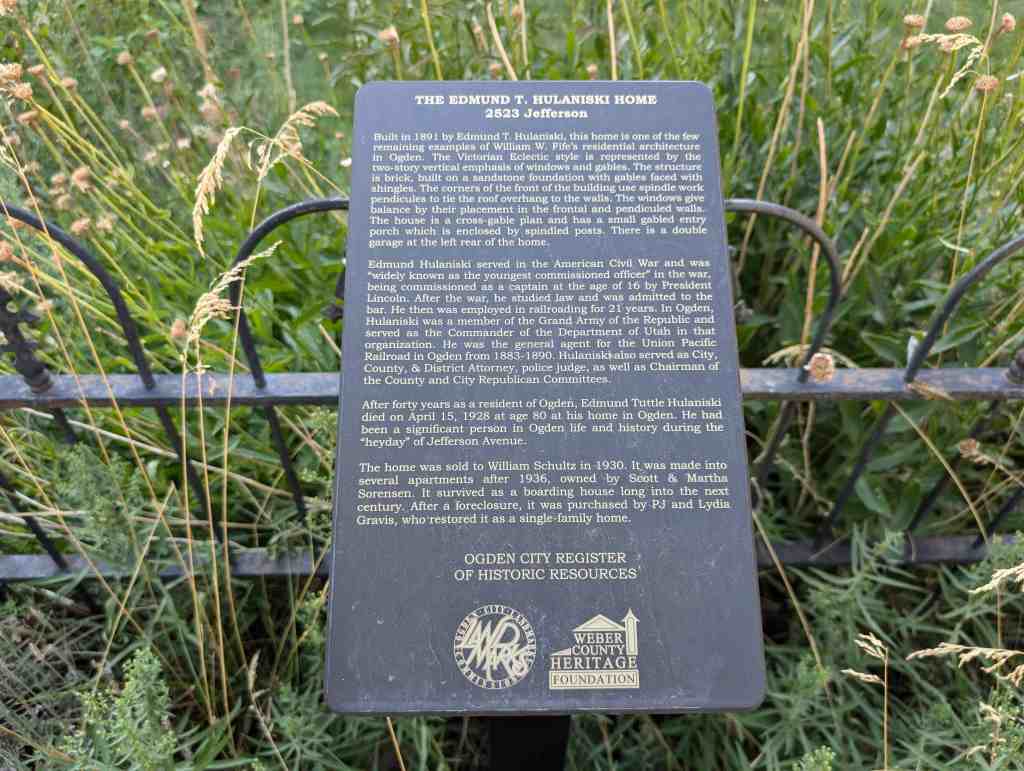
The Edmund T. Hulaniski Home
Built in 1891 by Edmund T. Hulaniski, this home is one of the few remaining examples of William W. Fife’s residential architecture in Ogden. The Victorian Eclectic style is represented by the two-story vertical emphasis of windows and gables. The structure is brick, built on a sandstone foundation with gables faced with shingles. The corners of the front of the building use spindle work pendicules to tie the roof overhang to the walls. The windows give balance by their placement in the frontal and pendiculed walls. The house is a cross-gable plan and has a small gabled entry porch which is enclosed by spindled posts. There is a double garage at the left rear of the home.
Edmund Hulaniski served in the American Civil War and was “widely known as the youngest commissioned officer” in the war, being commissioned as a captain at the age of 16 by President Lincoln. After the war, he studied law and was admitted to the bar. He then was employed in railroading for 21 years. In Ogden, Hulaniski was a member of the Grand Army of the Republic and served as the Commander of the Department of Utah in that organization. He was the general agent for the Union Pacific Railroad in Ogden from 1883-1890. Hulaniski also served as City, County, & District Attorney, police judge, as well as Chairman of the County and City Republican Committees.
After forty years as a resident of Ogden, Edmund Tuttle Hulaniski died on April 15, 1928 at age 80 at his home in Ogden. He had been a significant person in Ogden life and history during the “heyday” of Jefferson Avenue.
The home was sold to William Schultz in 1930. It was made into several apartments after 1936, owned by Scott & Martha Sorensen. It survived as a boarding house long into the next century. After a foreclosure, it was purchased by PJ and Lydia Gravis, who restored it as a single-family home.

2523 Jefferson Avenue in the Jefferson Avenue Historic District and in Ogden’s Central Bench Historic District in Ogden, Utah
- mentioned in Jefferson Avenue Historic District:
Edmund T. Hulaniski (2523 Jefferson) who was significant to Ogden’s politics by serving as city, county, and district attorney, police judge, and chairman of the county and city Republican Committees. From 1907 to 1909 he was a member of the Utah State Senate. He lived in the
Jefferson District from 1882 until his death in 1928.
also,
Unique house specimens are nevertheless an important factor of the district’s character. Some architect-designed homes are known (i.e., 2523 Jefferson was designed by William W. Fife, a prominent Ogden architect), while others show the originality and sophistication that suggest an architect’s involvement (i.e., 2580 Jefferson and 2504 Jefferson).

William W. Fife designed this brick house for Edmund Hulaniski, who lived in the home from 1893 until his death in 1928. Fife also designed Ogden City Hall and Ogden High School.*
Pingback: Jefferson Avenue Historic District | JacobBarlow.com