
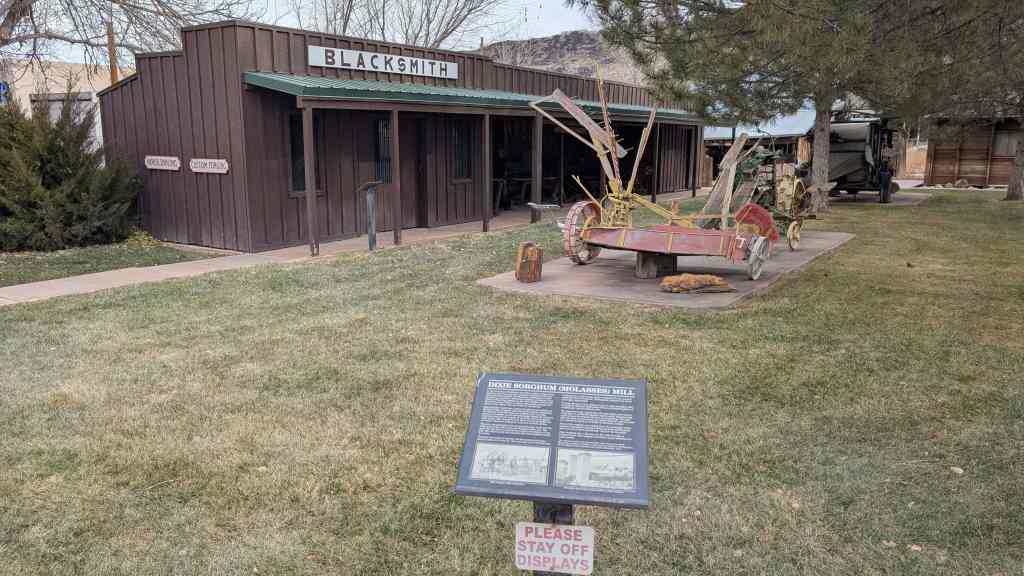
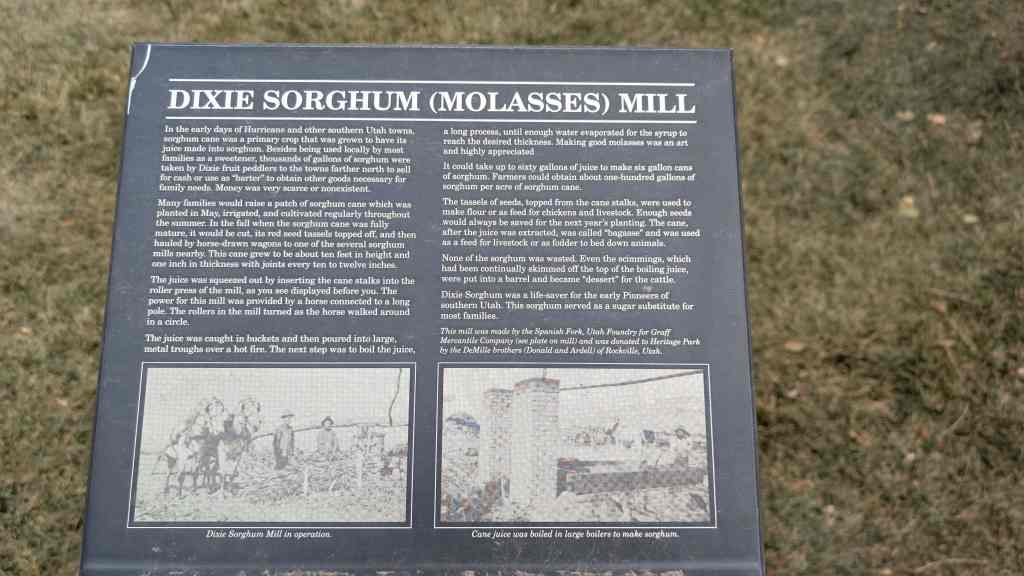
Dixie Sorghum (Molasses) Mill
In the early days of Hurricane and other southern Utah towns, sorghum cane was a primary crop that was grown to have its juice made into sorghum. Besides being used locally by most families as a sweetener, thousands of gallons of sorghum were taken by Dixie fruit peddlers to the towns farther north to sell for cash or use as “barter” to obtain other goods necessary for family needs. Money was very scarce or nonexistent.
Many families would raise a patch of sorghum cane which was planted in May, irrigated, and cultivated regularly throughout the summer. In the fall when the sorghum cane was fully mature, it would be cut, its red seed tassels topped off, and then hauled by horse-drawn wagons to one of the several sorghum mills nearby. This cane grew to be about ten feet in height and one inch in thickness with joints every ten to twelve inches.
The juice was squeezed out by inserting the cane stalks into the roller press of the mill, as you see displayed before you. The power for this mill was provided by a horse connected to a long pole. The rollers in the mill turned as the horse walked around in a circle.
The juice was caught in buckets and then poured into large, metal troughs over a hot fire. The next step was to boil the juice, a long process, until enough water evaporated for the syrup to reach the desired thickness. Making good molasses was an art and highly appreciated.
It could take up to sixty gallons of juice to make six gallon cans of sorghum. Farmers could obtain about one-hundred gallons of sorghum per acre of sorghum cane.
The tassels of seeds, topped from the cane stalks, were used to make flour or as feed for chickens and livestock. Enough seeds would always be saved for the next year’s planting. The cane, after the juice was extracted, was called “bagasse” and was used as a feed for livestock or as fodder to bed down animals.
None of the sorghum was wasted. Even the scimmings, which had been continually skimmed off the top of the boiling juice, were put into a barrel and became “dessert” for the cattle.
Dixie Sorghum was a life-saver for the early Pioneers of southern Utah. This sorghum served as a sugar substitute for most families.
This is located at the Heritage House Pioneer Center / Heritage Park / Museum at the Bradshaw House-Hotel at 85 South Main Street in Hurricane, Utah.