

The Battle of the Signs
In 1913 there was no federal highway system in the United States. That year an entrepreneur named Carl J. Fisher originated the idea of creating a coast- to-coast route that he called the Lincoln Highway. It roughly followed the route of today’s Interstate Highway 80.
When those planning the route reached Echo, Utah, the initial decision was to have the Lincoln Highway turn south and reach Salt Lake City via Coalville and Parleys Canyon. Ogden businesses and civic leaders protested the Coalville route, and with the help of Governor William Spry, they were successful in getting the Lincoln Highway officials to change the route to go through Ogden and then to Salt Lake City.
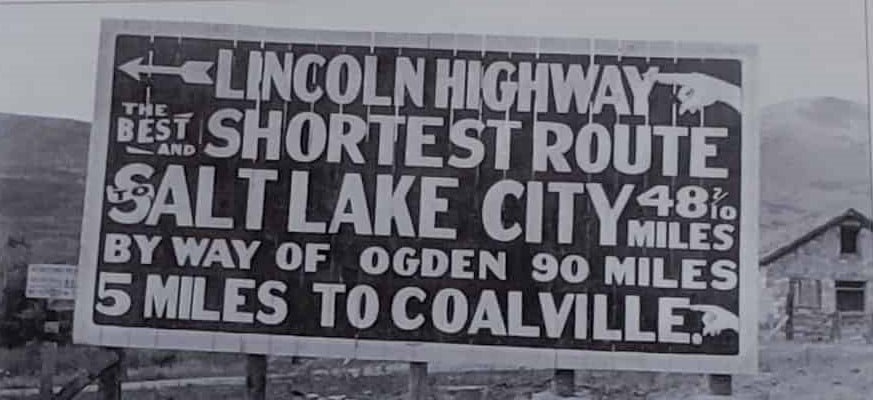
The new routing sparked a highway signs “war” between the communities of the two routes, each claiming their route to be the “real” Lincoln Highway. The first to enter the fray was Coalville, when in 1914 a group erected a sign at Echo junction. The sign extolled the benefits of traveling the 48 miles to Salt Lake City via Coalville, compared with the 90- mile journey by way of Ogden. With arrows pointing in the direction of Coalville, the sign claimed that route as the Lincoln Highway.
In early 1915, the Lincoln Highway Association dropped Ogden from the route and returned the highway to the Coalville route. Ogden and Weber County interests were still opposed to the Coalville sign, and according to a Salt Lake Tribune article on May 6th, Ogden interests threatened to dynamite the sign unless it was removed immediately. Ten days later, a family from Salt Lake City came upon the sign lying in the middle of the road, the supporting posts having been sawed off. Still standing was a sign directing motorists to Ogden. When the Coalville sign was replaced, mention of Ogden was painted over and replaced by reference to Parleys Canyon.
When the national highway system came into effect in the 1920s, the Lincoln Highway and other named routes were left on the trash heap of history. The route from Wyoming to Ogden became part of U.S. Highway 30, and the Coalville route became part of three highways: US 189, State Route 530, and U.S. 40.
The sign put up by Coalville people in 1914 started the dispute between Ogden and Coalville interests regarding how to attract travelers to go through their communities.
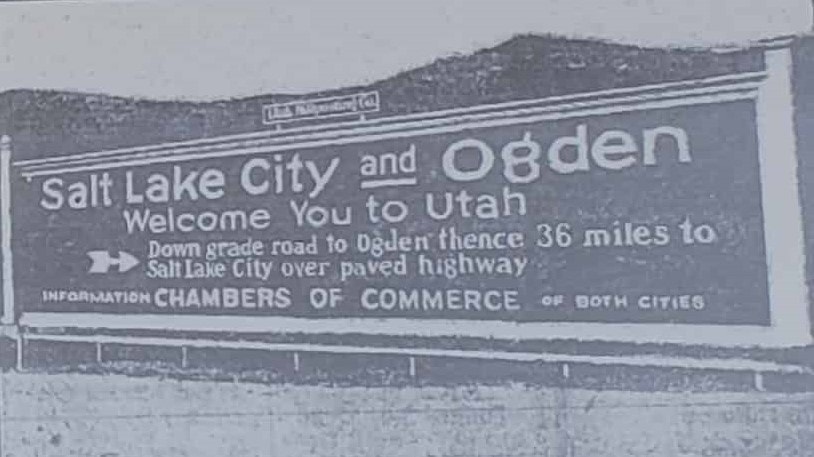
The feud tapered off after a new sign from Salt Lake City and Ogden backers essentially routed travelers on the Ogden route.
A SPECIAL THANKS to Jesse Petersen, former president of the Lincoln Highway Association, who provided the information and photos displayed here.
Located at the Pony Express Station – Weber at Echo, Utah