

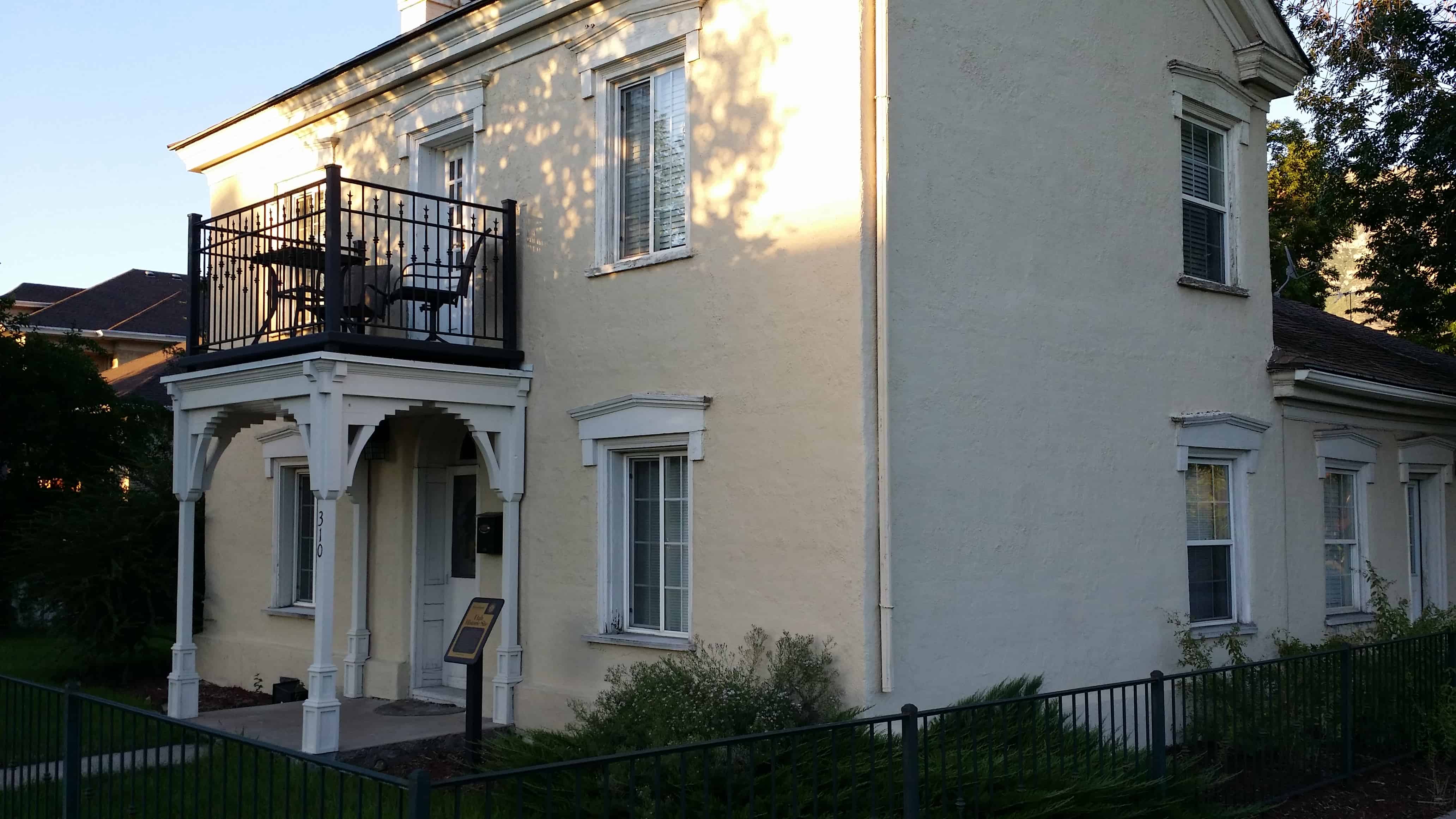
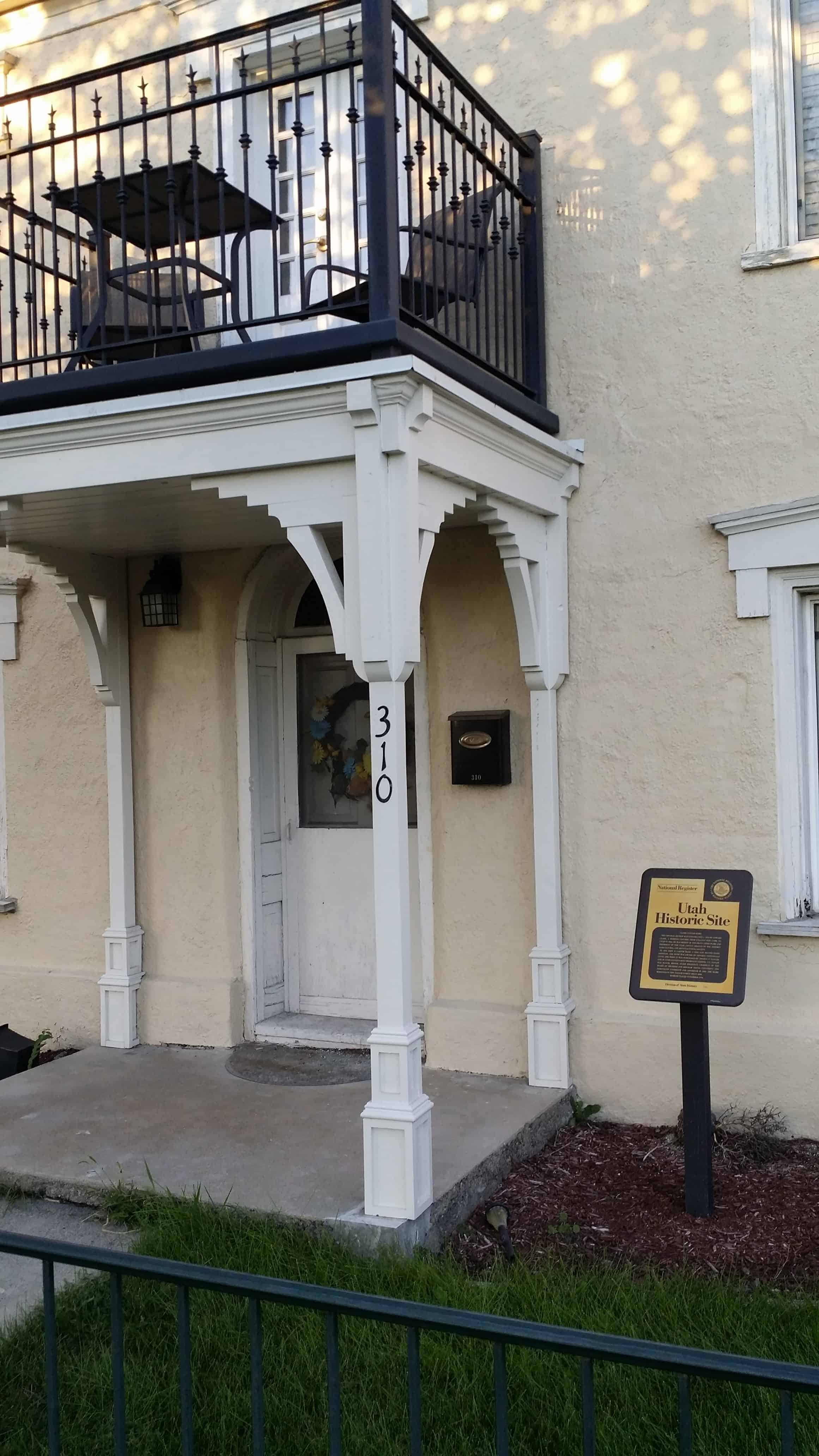
Clark-Taylor Home
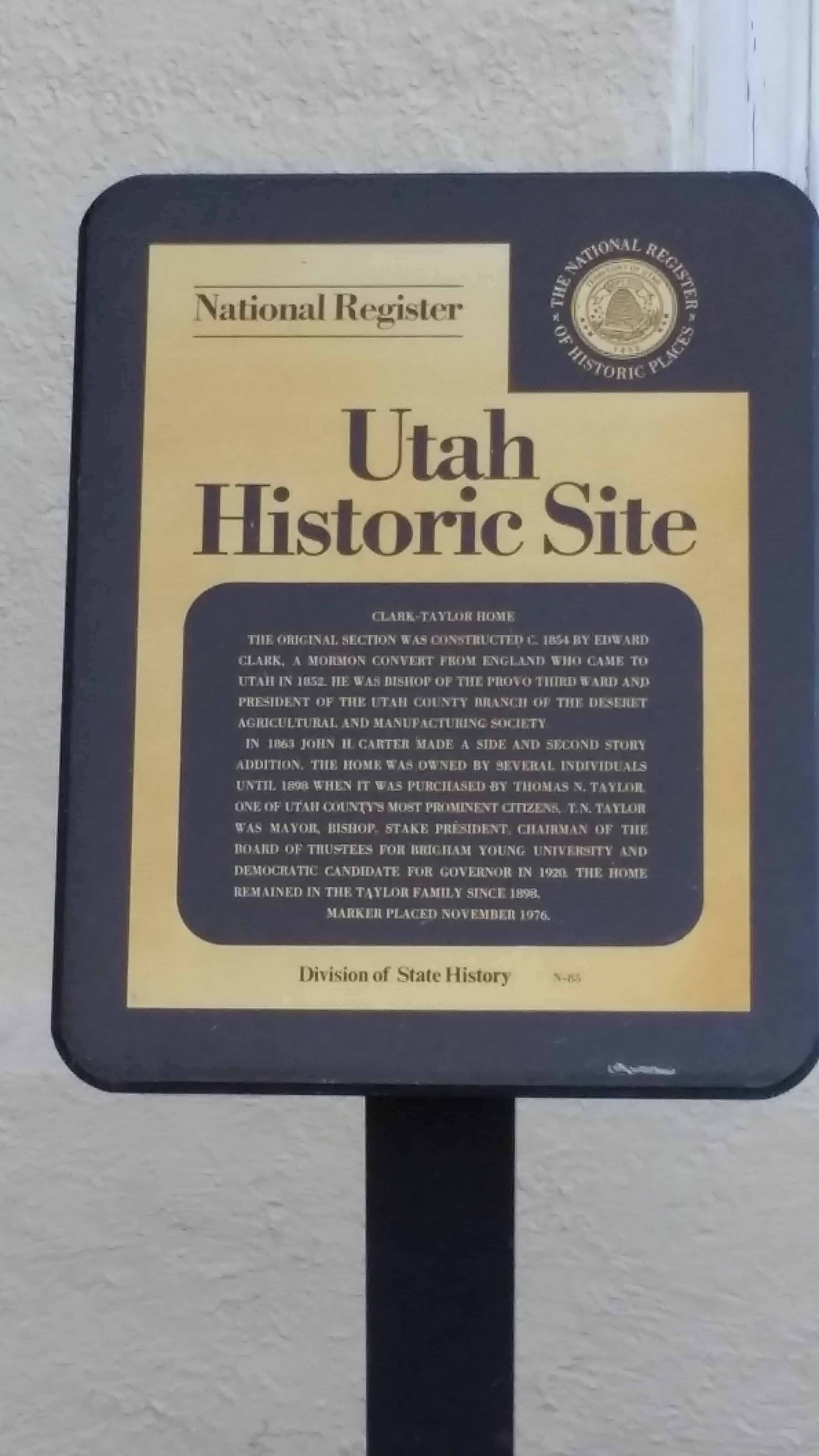
The original section was constructed C. 1854 by Edward Clark, a Mormon convert from England who came to Utah in 1852. He was Bishop of the Provo Third Ward and President of the Utah County Branch of the Deseret Agricultural and Manufacturing Society.
In 1863 John H. Carter made a side and second story addition. The home was owned by several individuals until 1898 when it was purchased by Thomas N. Taylor, one of Utah County’s most prominent citizens. T.N. Taylor was Mayor, Bishop, Stake President, Chairman of the Board of Trustees for Brigham Young University and Democratic Candidate for Governor in 1920. The home remained in the Taylor Family since 1898.
This is one of the oldest homes in Utah, it is located at 306 North 500 West in Provo, Utah and was added to the National Register of Historic Places (#75001829) on October 7, 1975. The following is from the nomination form from when it was added to the register:
The Clark-Taylor house is first mentioned in a consecration deed by Edward W. Clark of Prove to Brigham Young, trustee-in-trust of the Church of Jesus Christ of Latter-day Saints, and dated July 24, 1855. In the deed, Clark gives to the Church, “my claim and ownership” to the plot including “an adobe house thereon and one log (house?) for a shop with 2 rods of fort wall attached.” Thus the records show that CIark’s home was one of the first built after the settlers of Provo moved out of the fort in 1852-53. Built within eight years after the arrival of the first party of Mormon pioneers to the Valley of the Great Salt Lake, and within six years after the initial settlement of Provo, the Clark home is one of the oldest pioneer buildings in Utah. It is also one of the best documented and well preserved pioneer structures.
for
Edward Clark (1820-1909) came to Provo from England in 1852. He was the bishop of the Provo Third Ward, a veteran of the Indian War and director of the Utah County branch of the Agricultural and Manufacturing Company. Later he was prominent in the settlement of Santaquin, Utah.
The house and land (situated on Main Street of the first Provo city survey, now 500 West) was next owned by John H. Carter, who was Edward Clark’s counselor in the bishopric, an alderman and a blacksmith. Carter made a second story addition to the home in 1863. In the early I870’s, John Carter apparently traded his property in the city to Benjamin Bachman, a Provo merchant, for 85 acres of land in the area now called CarterviIle(after Carter), between Provo and Orem. Bachman owned the house until 1897 when George H. Church bought it, owned it briefly, then sold it to Thomas N. Taylor in 1898.
T. N. Taylor was one of Provo’s most prominent citizens at the turn of the century. He was mayor, bishop, stake president, Chairman of the Board of Trustees of BYU and Democratic candidate for governor (1920). He also served as president or directorof Farmer’s Mercantile Bank, Provo Building and Loan, Taylor Investment Company, Ma I ken Glass and Paint, Provo Woolen Mills, and Mapleton Sugar Company. Besides these, he was manager of Taylor Brothers, oneof Provo’s first department stores, founded by his father, George Taylor, 1866. George Taylor came to Provo as a photographer in 1863. One of his first jobs was helping John Carter with the construction of a second story of this house, made of adobe.
T. N. Taylor and his wife lived in the little house until their home next door (342 North 500 West) was completed about 1904. In 1915 when his son, T. Sterling, married, T. N. Taylor gave him the house as a wedding present. The house is presently owned by Thomas S. Taylor, son of T. Sterl ing.
Physical Appearance:
The Clark home derives significance from its age and its representative architecture. There are few other examples of substantial and reasonably preserved homes in the state built within the first ten years after the arrival of the Mormon pioneers in 1847. Aside from some log cabins, we know of no buildings in Utah County older than the Clark home. In form, size, plan and detailing, the home is representative of better homes of the 1850’s and 60’s.
- General form: built in two sections, the two-story western section is a rectangular, gabled roof, single depth, 2/2 “I-form” structure. The eastern section has one story with a large attic. It is situated laterally with respect to the western section and has a broad gabled end.
- Plan: The two sections together form a plan that is nearly square in shape. The two-story western section consists of a hall/parlor arrangement on the main floor with two bedrooms above. The eastern section contains a kitchen, bath, bedroom and screened porch. The original plan appears to have experienced little alteration since initial construction of the various parts.
- DetaiIing: construction and decorative elements are typical of early pioneer structures:
a) Windows: handmade frames and sashes. The front casement windows (8-8) are rather rare. Other windows are more traditional 6/6 double-hung sash type.
b) Doors: the front door has one large panel and a large circular The door and bay are Roman arched an unusual feature. The side door has panes (3X5) of about the same size as the window panes. A door with this of gl s also unusual. The door to the summer porch is of common raised panel type.
c) Trim: the milled trim is quite refined and decorative.
– 1) Lintel caps: Federal in style
– 2) Window trim: moulded casings; boxed frames; wooden sills.
– 3) Door trim: recessed doors within paneled, box encased bays.
– 4) Cornice: boxed soffit; moulded cornices and returns; slight frieze.
d) Masonry: adobe walls with stucco finish; double end-wall chimnies are brick with slight corbeling.
A second story was added to the original house in 1863. From that date until 1915 the house was unchanged. T. Sterling Taylor remodeled the house when he moved there, installing new stairways, flooring and a new furnace. He enlarged the root cellar into storage for coal and put on a new front porch. His father-in-law, John W. Taylor, did not like the picket fence in front, so brought his family over one day and tore it down. Some grillwork had been added to the front of the house and T. S. Taylor removed it also. The original adobe has been sheathed with stucco (date unknown)
The house is neglected and rundown, but is, to all appearances, structurally sound. A great deal of work would be required to restore the home, but the fiber and integrity are enough intact to justify the effort.
The present owner, Thomas S. Taylor, has recently determined to restore the house and will utilize the services of a local restoration architect to accomplish this goal.