


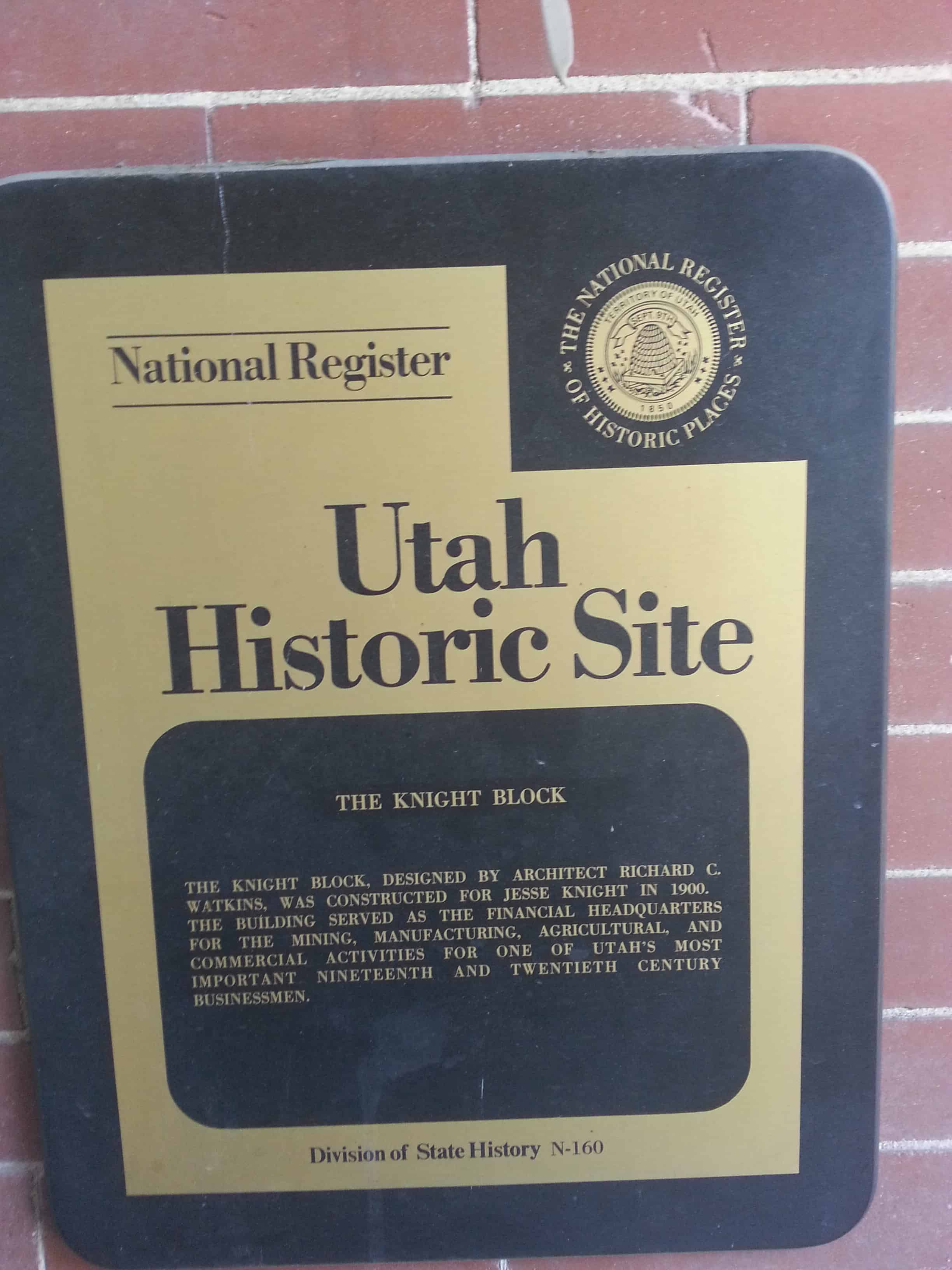
The Knight Block, designed by architect Richard C. Watkins, was constructed for Jesse Knight in 1900. The building served as the financial headquarters for the mining, manufacturing, agricultural, and commercial activities for one of Utah’s most important nineteenth and twentieth century businessmen.
Located at 1 East Center Street in Provo, Utah and added to the National Register of Historic Places (#77001322) on December 2, 1977.

Knight Block
Built: 1900
The Knight Block Building, one of two twin buildings on the north corners of University Avenue and Center Street, is an iconic structure in Provo. It was built in 1900 for local mining magnate and businessman Jesse Knight, to house his financial headquarters. But while the building still bears his name, the Knight family has long since ceased doing business there.Today, the Knight Block rents spaces to several local businesses.It was designated to the National Registry of Historic Places in 1977.
Location: University Avenue and Center Street, Provo


From the National Register’s nomination form:
The Knight Block, built in 1900, is significant for its historical associations with Jesse Knight and the development of Provo and Central Utah. Long one of the city’s most imposing landmarks, its fine architecture also qualifies it for preservation.
Knight was born in Nauvoo, Illinois in 1845 while the “Mormon” Church prepared to move West. His story of growth and prosperity parallels the Church’s progress in Utah, and intertwines the political, financial and religious influences of central Utah’s development. He attributed his vast wealth from mining, ranching, finance, and industry to spiritual insights he had received, and became a major factor in avoiding bankruptcy for the Church during the years the federal government disenfranchised it and took title to Church assets.
Knight’s philanthropy promoted employment and education in Central Utah. His large woolen mills and public works projects were designed to create jobs. Seven major buildings on-the-campus of Brigham Young University resulted from his’ contributions.
In 1909, the Utah democratic convention offered a unanimous nomination as governor to Knight. Because of Church pressure and his own misgivings, he declined. His own town, Knightsville, was unique in Western mining development, for it had no saloons, no gambling houses, and no “honkytonks, ” representing a stark contrast to the development of other “non-Mormon” boom towns in other areas of the state.
As Knight’s financial headquarters, this edifice is the most significant reminder of his career and times. It also is Provo’s best link to the turn-of-the-century commerce that changed it from a farming hamlet to an industrial center. It remains in its original use, a visual tie-to Pioneers, like Jesse Knight and the Mormon role in Utah’s commercial development.
The Knight Block is a three story rectangular building, approximately 55 feet by 118 feet, housing a ground floor of retail space with a full basement and two upper floors of offices. The office levels have six bays on the South facade and 13 on the West. These two facades are the public areas of the exterior walls, The most prominent feature of the structure is a clock tower on the Southwest corner which extends above the roof line of the rest of the building. This tower is flat-roofed, with a center flagpole and finial point on each of the four corners. The clock, with faces on the South and West, still keeps accurate time and is original/except for the electrical rewind system.
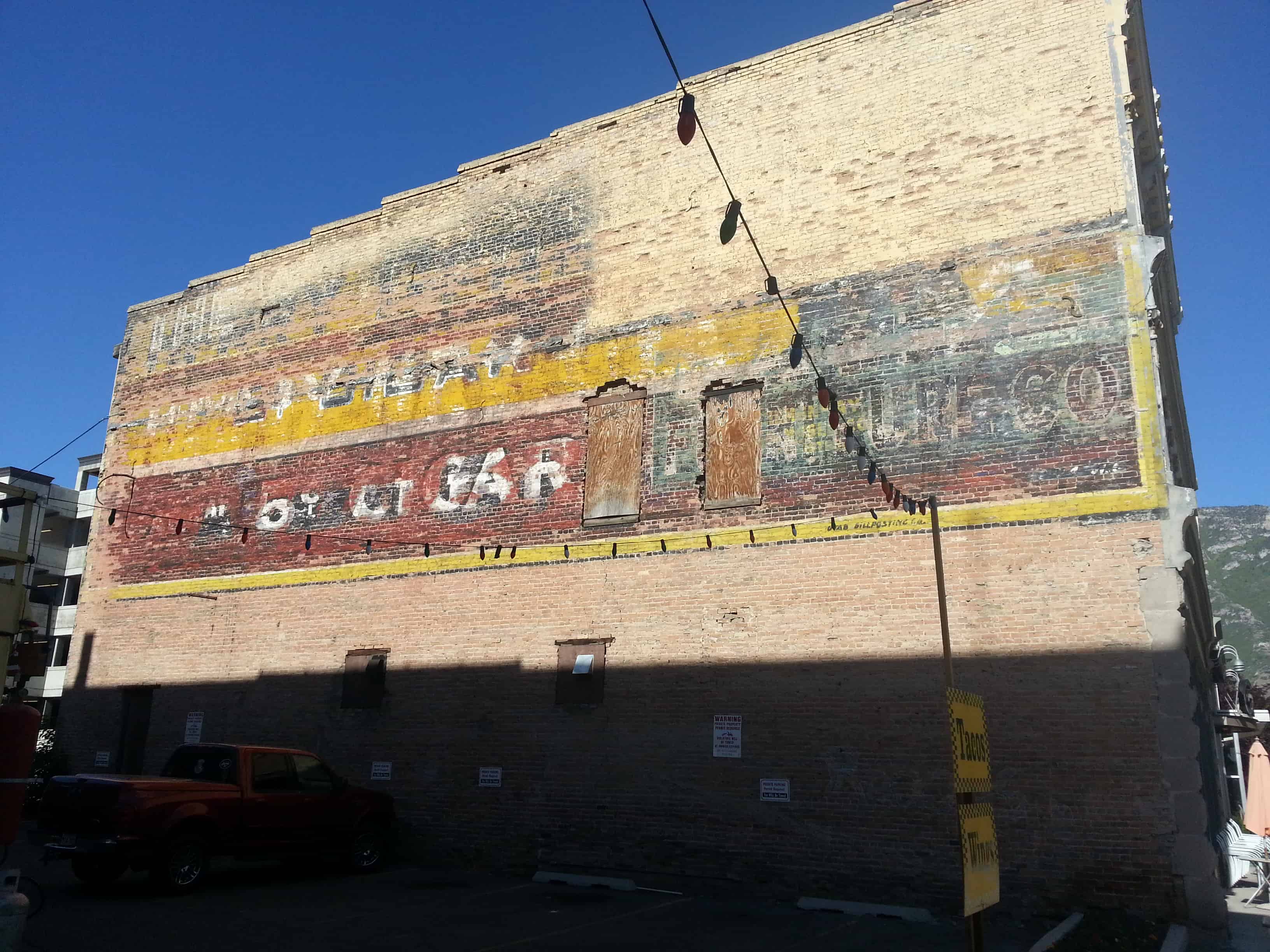
Most of the building is red brick with gray limestone lintels and belt courses that form window sills. Originally large stone arches formed the tower base and framed the entrance to the office stairs on the Eastern side of the South façade. These have been removed and the first floor is now faced with a corrugated metal veneer above and below the plate glass store windows installed after a fire circa 1934. The second and third floors are in an excellent state of preservation, with recent painting of the wood, cleaning of the brick, and rehabilitation of the tin work.
The upper floors of the façade are highlighted by pressed metal trim, which forms a bracketed cornice on the South and West facades, topped by brickwork that features rectangular indentations. A sign “Knight Block” caps the center of the West façade. The clock tower is dignified by more elaborate pressed metal trim, framing the clock faces, and forming a metal frieze and more intricate cornice at the top.
The second floor windows have square openings with limestone -lintels, the third floor, roman arches of stone instead. The corner windows had small balconies with metal railings originally. Only the third floor balconies remain. The last three bays on the north end of the west facade are slightly different having straight lintels on the third level. This part was built on to the structure shortly after completion, and is known as the Annex.
The interior of the first floor has been altered, except for the hexagonal ceramic tile floors that remain. The second and third levels are well preserved with the original banisters, balustrades, doors, hardware, and woodwork intact. An Axminister carpet adds to the historical flavor. An Otis elevator was installed circa 1935, with little effect on the building’s historicity. About \ the original milk glass chandeliers also remain.