
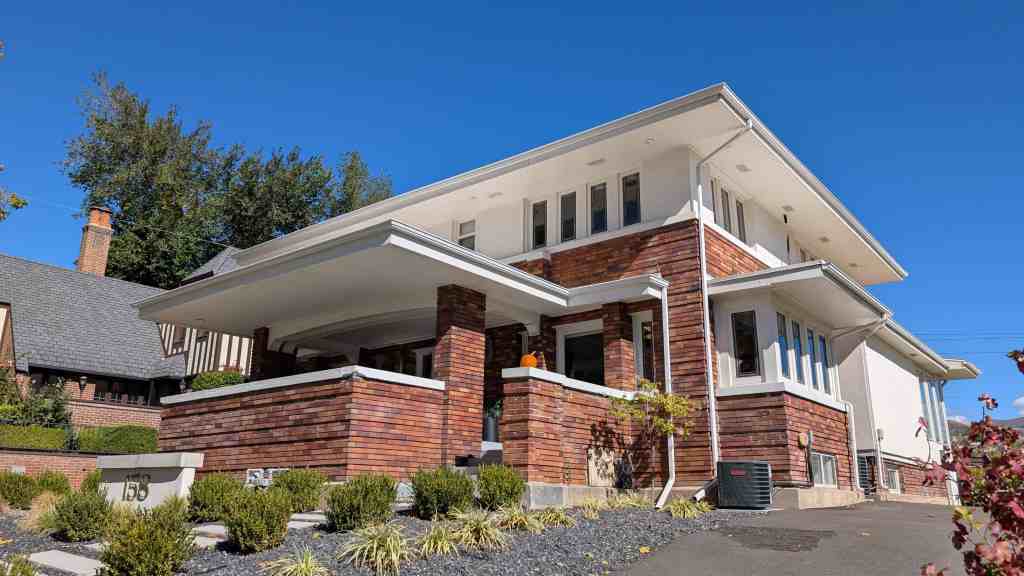
Ashby and Elizabeth Pymm Snow had a home built on this property in 1910, three years after purchasing the land from Samuel W. Stewart, administrator for the John R. Park Estate. Ashby, born 1867 in St. George, Utah, was a son of the Apostle Erastus Snow. As a young man he was appointed to direct the local co-op and shortly thereafter he left Utah to attend law school at Ann Arbor, Michigan.
On returning to Salt Lake, he formed a partnership with General Richard W. Young. His successful association with numerous Utah enterprises, i.e: Utah Portland Cement, ZCMI, Hotel Utah, U & I Sugar, Saltair Beach, and Utah Savings and Trust, made Ashby a prominent Utah financier. In 1926 he ran as a Democrat, against Reed Smoot for a seat in the U.S. Senate. In 1937 Ashby died at the age of 69.
His son, Erastus P. Snow, born in 1891, assumed ownership of the’ home in 1931 and maintained it through 1940. Erastus, like his father was a prominent Utah businessman. He died in 1953.
This is a large two-story Prairie style home on a double lot. It has strong horizontal lines characteristic of the style. There is a truncated hip roof with broad eaves. The second floor is stuccoed with horizontal bands of casement windows and there are more casement windows on the dark brick first floor. All windows have leaded glass border decoration in the manner of Frank Lloyd Wright. There is a south one-story bay window and a projecting front porch with two main brick piers and four slim metal columns that cause the flat roof to appear to float. The brick railing wall with its concrete cap further emphasizes the buildings horizontality.
The text above is from Capitol Hill Historic District national register nomination form, the The text below is from Preservation Utah‘s Historic Buildings on Capitol Hill Self-Guided Tour. The home is located at 158 North State Street in Salt Lake City, Utah.
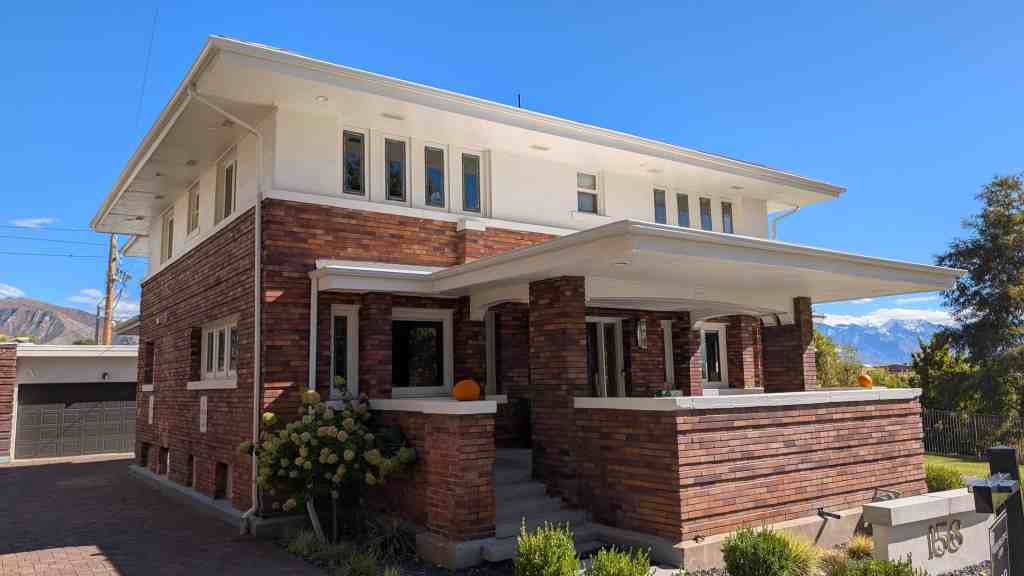
The influence of Frank Lloyd Wright is evidenced in the large two-story Prairie style home built by Ashby Snow in 1909. At that time, Utah was a leader in the western United States in adopting this new progressive architectural form.
In contrast to the vertical lines that are dominant through most of the Capitol Hill District, the brick and stucco house has strong horizontal characteristics. A truncated hipped roof with broad eaves is pitched above a band of casement windows on the second floor. All of the windows contain beautiful leaded glass border decorations. The projecting front porch has two main brick piers and four slim metal columns that give the flat roof the appearance of floating.
Snow was a native Utahn, born in St. George and a son of LDS Apostle Erastus Snow. He attended law school at Ann Arbor, Michigan, and then returned to associate himself with numerous successful enterprises including Utah Portland Cement, ZCMI, Hotel Utah, U &. I Sugar, Saltair Beach, the Salt Lake, Garfield and Western Railway and Utah Savings and Trust.
A son, Erastus P. Snow, assumed ownership of the home in 1931. He added a large swimming pool with underground dressing rooms on the south portion of the double lot.