
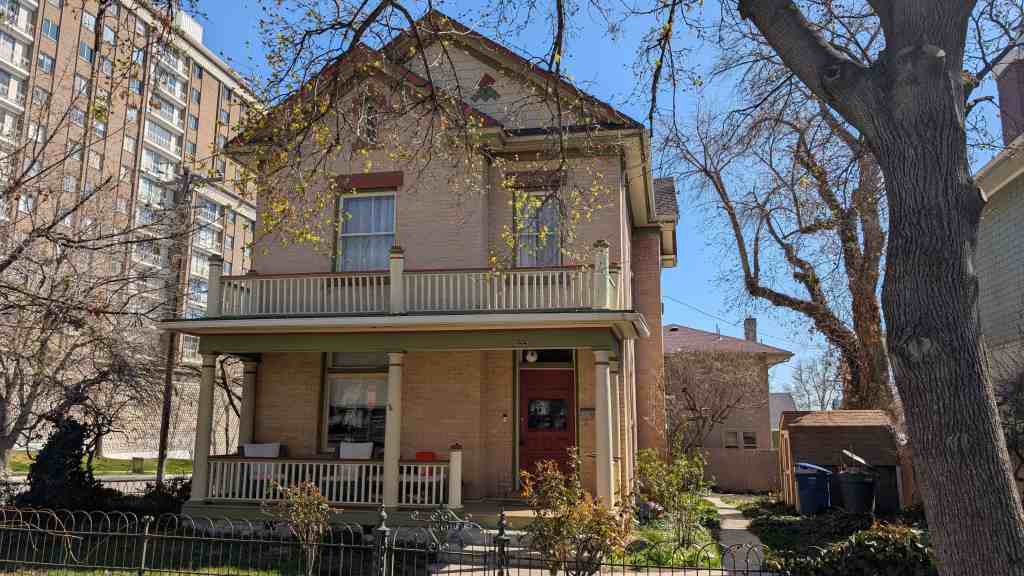
Daniel Eyer / James J. McClellan House
The Daniel Eyer/John J. McClellan house is significant because it’s first owner occupant was an internationally known musician and organist. Built by a prominent realtor for speculative purposes, it represents the trend away from owner-occupied, single-family dwellings that began to develop in the Avenues in the late 19th Century.
The house was built in 1902 by Daniel Eyer, a well-known real estate and mining man. He built the house as an investment, but died shortly after it was constructed. Ownership then passed to his son. Clarendon B. Eyer, also a real estate speculator. In 1906, Eyer sold the house to John J. McClellan. McClellan had been born in Payson, Utah, the son of John Jasper and Eliza W. McClellan. Early in life he showed great musical ability, and at the age of ten was chorister of the Payson LDS Ward. He graduated from the University of Michigan in 1896 with a degree in music and moved to Salt Lake City where he began to teach music, first as a private teacher, and then on the faculty of the University of Utah and BYU. In 1906 he was named organist for the Mormon Tabernacle Choir, and he held that position until his death twenty years later. It was he that initiate d the practice of free daily organ recital s at the Mormon Tabernacle. In 1911 he founded the Utah Conservatory of Music. He also conducted the Salt Lake Opera Company and the Salt Lake Symphony Orchestra. A composer as well as a performer, he wrote a number of LDS hymns. Having acquired a national and intonational reputation as a result of concerts and recitals he gave in the country and abroad, he was decorated by Albert, King of Belgium with the Order of the Cross. Following McClellan’s death in 1925, the house was purchased by Albert D. Byerline, a U.S. Post Office superintendent.
For thirty years, the house changed owners about every six years. In 1936 the owner was Henry A. Pedersen, a salesman. In 1938 Homer S. Liddell , an engineer with the Louis A. Roser Co., which specialized in refrigeration, owned the house, and in 1946, Art S. Larsen, an employee of the Sweet Candy Co. held the house. In the early 1950’s the house was converted into a multi-family dwelling.
688 East First Avenue in The Avenues in Salt Lake City, Utah.
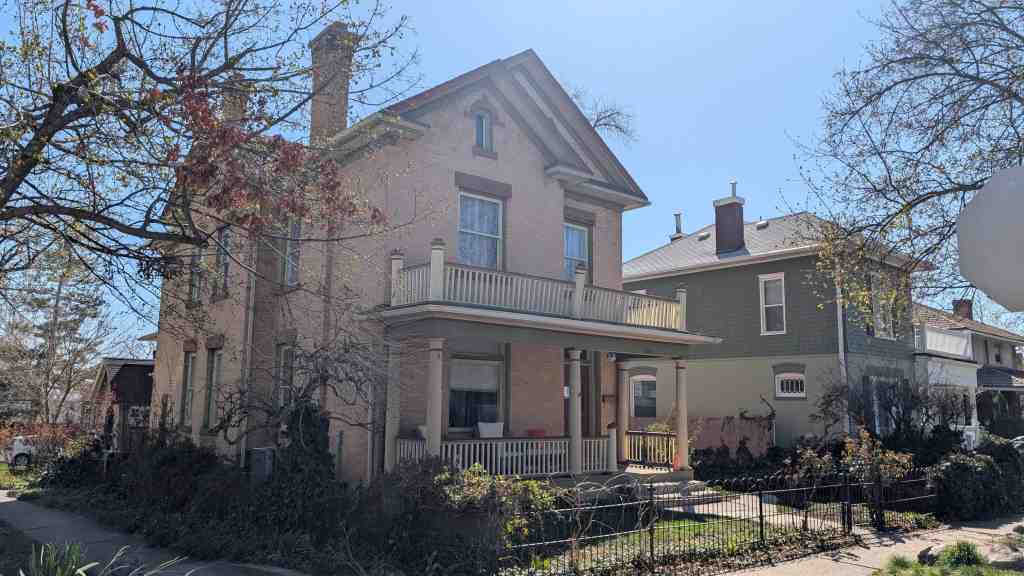
This is a two-story brick home with a symmetrical massing typical of late-Victorian design. The gables have strong wooden cornices with classical type returns. I n the east front gable is a brick arched attic window, while in the west front gable there is wood shingle siding. The walls are random patterned brown and tan brick with sandstone window sill s and lintels. Large chimneys with corbeled tops, from the time when the house was heated by wood or coal, survive intact . Along the street is an iron fence of the type manufactured in Salt Lake City by the Crager Wire and Iron Works in the period. The brick of this house was originally painted to resemble fancy multi-colored-brickwork. I t was one of the many homes in the district built of soft brick that was designed to be painted. The original paint scheme was covered by the present coat of paint in 1978 or 1979.
Pingback: Historic Homes and Buildings in the SLC Avenues | JacobBarlow.com