
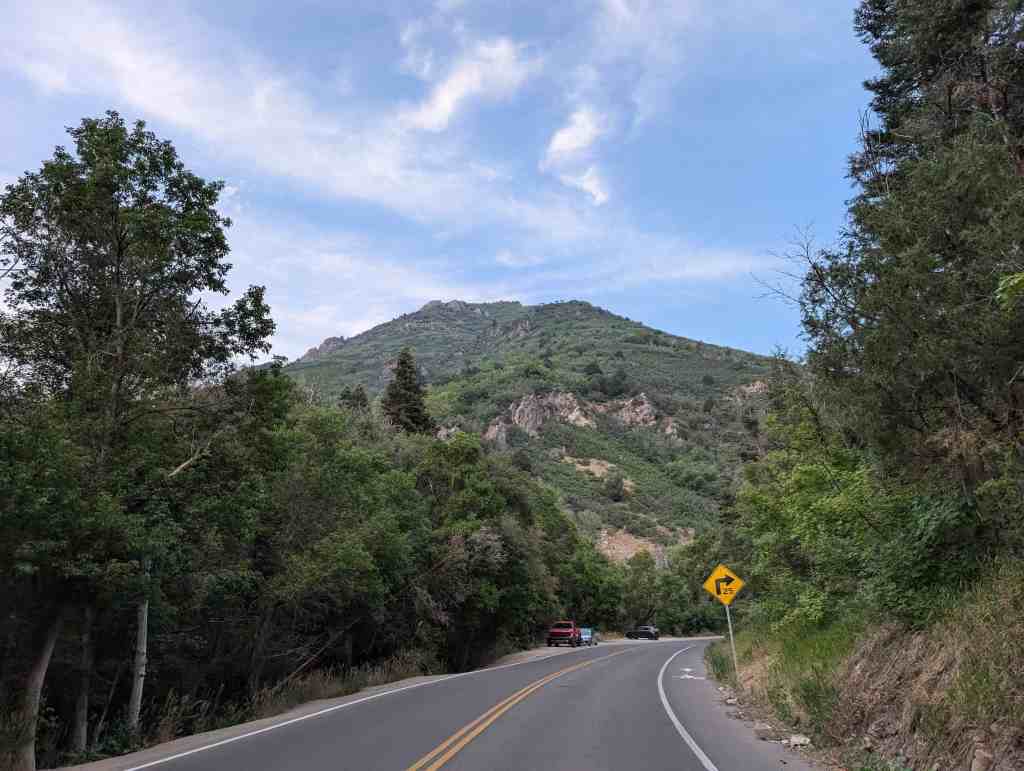
Above Millcreek, Utah in Salt Lake County, Utah.
Related:
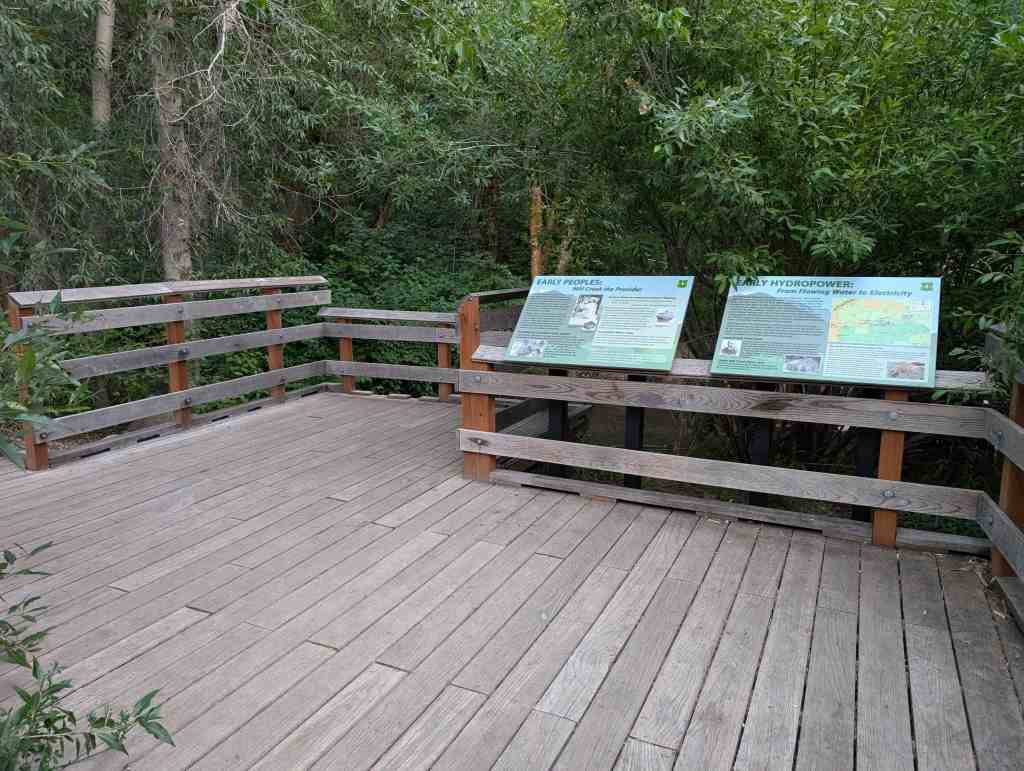
EARLY HYDROPOWER:
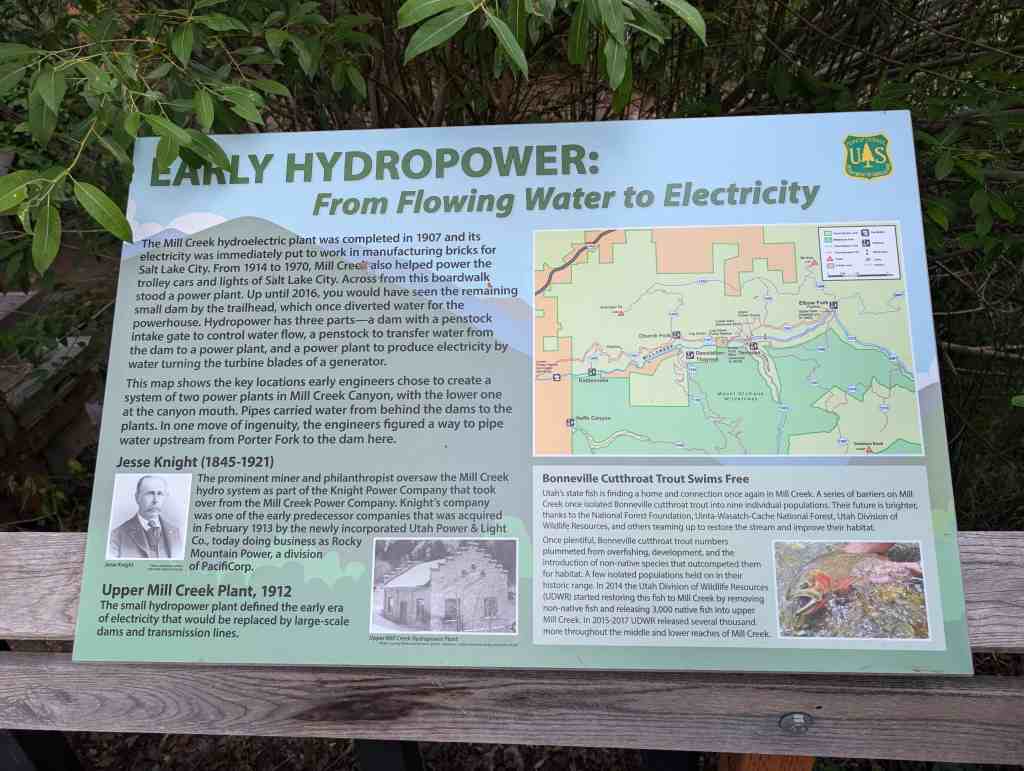
From Flowing Water to Electricity
The Mill Creek hydroelectric plant was completed in 1907 and its electricity was immediately put to work in manufacturing bricks for Salt Lake City. From 1914 to 1970, Mill Creek also helped power the trolley cars and lights of Salt Lake City. Across from this boardwalk stood a power plant. Up until 2016, you would have seen the remaining small dam by the trailhead, which once diverted water for the powerhouse. Hydropower has three parts-a dam with a penstock intake gate to control water flow, a penstock to transfer water from the dam to a power plant, and a power plant to produce electricity by water turning the turbine blades of a generator.
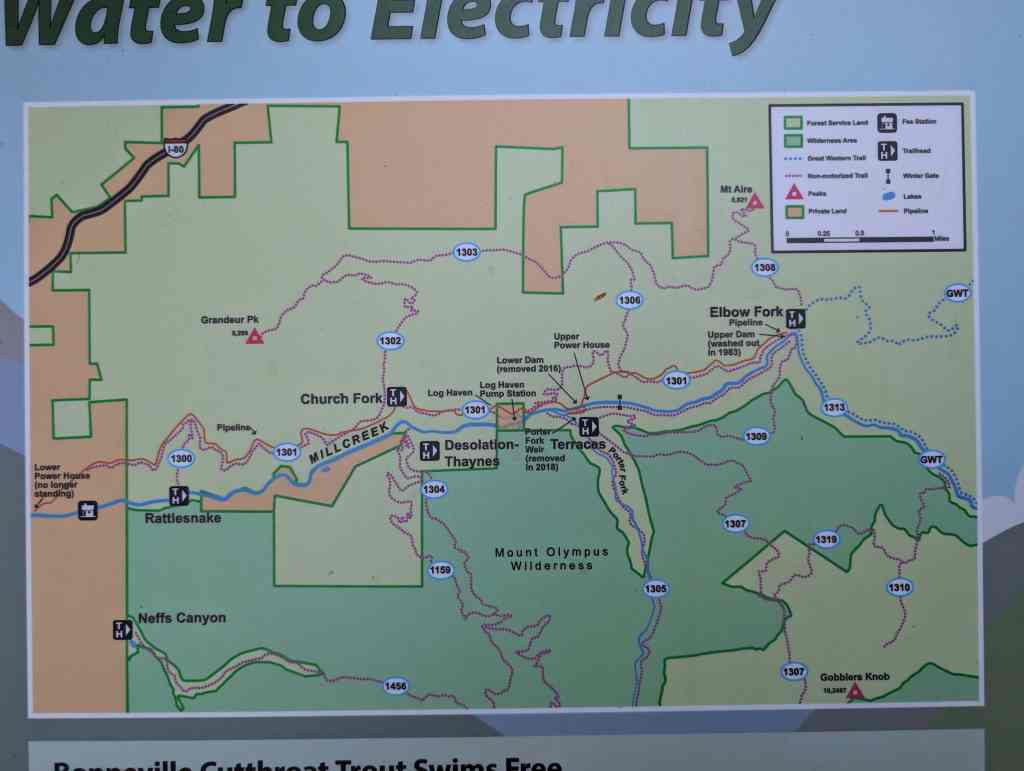
This map shows the key locations early engineers chose to create a system of two power plants in Mill Creek Canyon, with the lower one at the canyon mouth. Pipes carried water from behind the dams to the plants. In one move of ingenuity, the engineers figured a way to pipe water upstream from Porter Fork to the dam here.
Jesse Knight (1845-1921)
The prominent miner and philanthropist oversaw the Mill Creek hydro system as part of the Knight Power Company that took over from the Mill Creek Power Company. Knight’s company was one of the early predecessor companies that was acquired in February 1913 by the newly incorporated Utah Power & Light Co., today doing business as Rocky Mountain Power, a division of PacifiCorp.
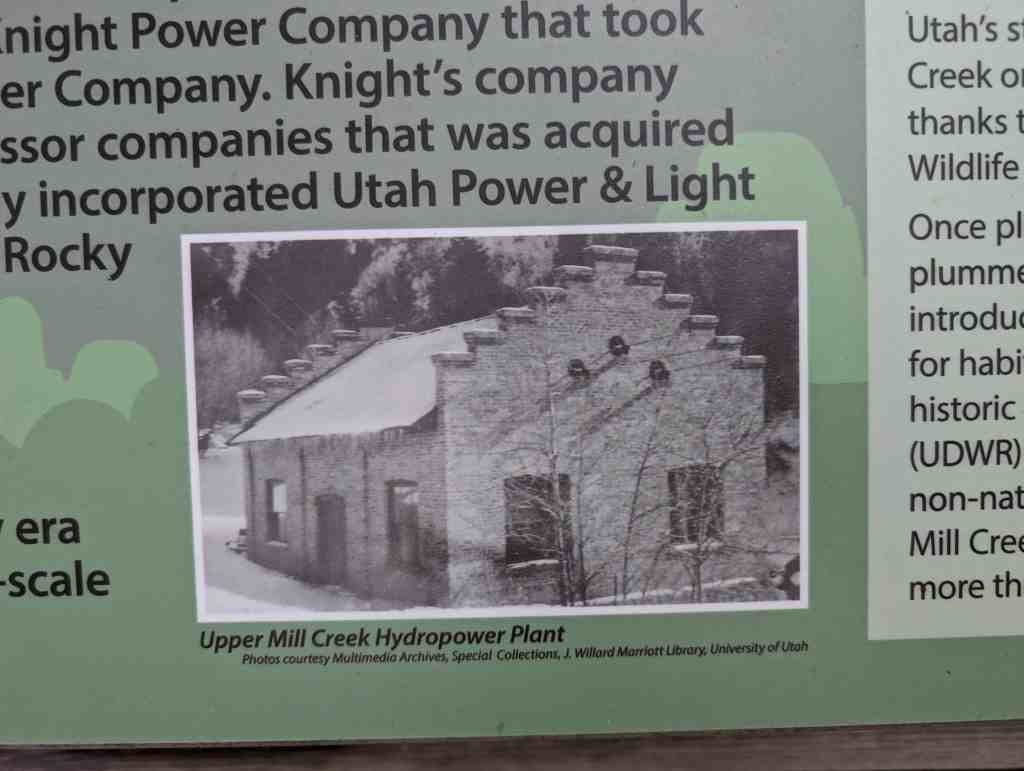
Upper Mill Creek Plant, 1912
The small hydropower plant defined the early era of electricity that would be replaced by large-scale dams and transmission lines.
Bonneville Cutthroat Trout Swims Free
Utah’s state fish is finding a home and connection once again in Mill Creek. A series of barriers on Mill Creek once isolated Bonneville cutthroat trout into nine individual populations. Their future is brighter, thanks to the National Forest Foundation, Uinta-Wasatch-Cache National Forest, Utah Division of Wildlife Resources, and others teaming up to restore the stream and improve their habitat. Once plentiful, Bonneville cutthroat trout numbers plummeted from overfishing, development, and the introduction of non-native species that outcompeted them for habitat. A few isolated populations held on in their historic range. In 2014 the Utah Division of Wildlife Resources (UDWR) started restoring this fish to Mill Creek by removing non-native fish and releasing 3,000 native fish into upper Mill Creek. In 2015-2017 UDWR released several thousand more throughout the middle and lower reaches of Mill Creek.
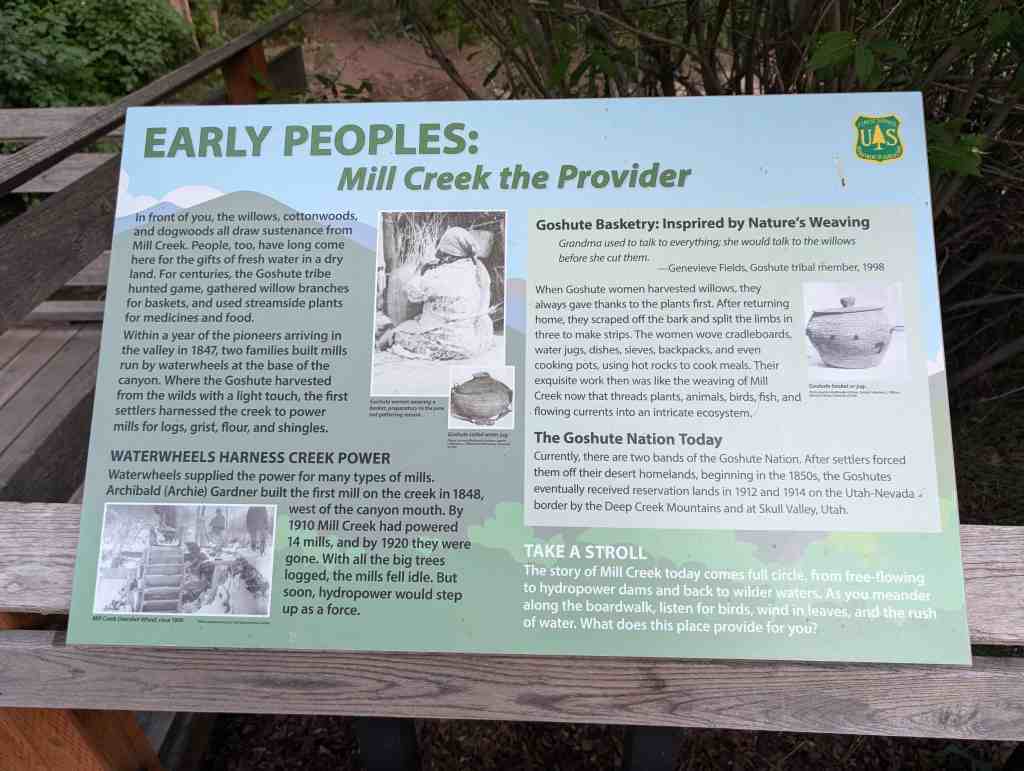
EARLY PEOPLES:
Mill Creek the Provider
In front of you, the willows, cottonwoods, and dogwoods all draw sustenance from Mill Creek. People, too, have long come here for the gifts of fresh water in a dry land. For centuries, the Goshute tribe hunted game, gathered willow branches for baskets, and used streamside plants for medicines and food.
Within a year of the pioneers arriving in the valley in 1847, two families built mills run by waterwheels at the base of the canyon. Where the Goshute harvested from the wilds with a light touch, the first settlers harnessed the creek to power mills for logs, grist, flour, and shingles.
WATERWHEELS HARNESS CREEK POWER
Waterwheels supplied the power for many types of mills. Archibald (Archie) Gardner built the first mill on the creek in 1848, west of the canyon mouth. By 1910 Mill Creek had powered 14 mills, and by 1920 they were gone. With all the big trees logged, the mills fell idle. But soon, hydropower would step up as a force.
Goshute Basketry: Insprired by Nature’s Weaving
Grandma used to talk to everything; she would talk to the willows before she cut them. -Genevieve Fields, Goshute tribal member, 1998
When Goshute women harvested willows, they always gave thanks to the plants first. After returning home, they scraped off the bark and split the limbs in three to make strips. The women wove cradleboards, water jugs, dishes, sieves, backpacks, and even cooking pots, using hot rocks to cook meals. Their exquisite work then was like the weaving of Mill Creek now that threads plants, animals, birds, fish, and flowing currents into an intricate ecosystem.
The Goshute Nation Today
Currently, there are two bands of the Goshute Nation. After settlers forced them off their desert homelands, beginning in the 1850s, the Goshutes eventually received reservation lands in 1912 and 1914 on the Utah-Nevada border by the Deep Creek Mountains and at Skull Valley, Utah.
TAKE A STROLL
The story of Mill Creek today comes full circle, from free-flowing to hydropower dams and back to wilder waters. As you meander along the boardwalk, listen for birds, wind in leaves, and the rush of water. What does this place provide for you?
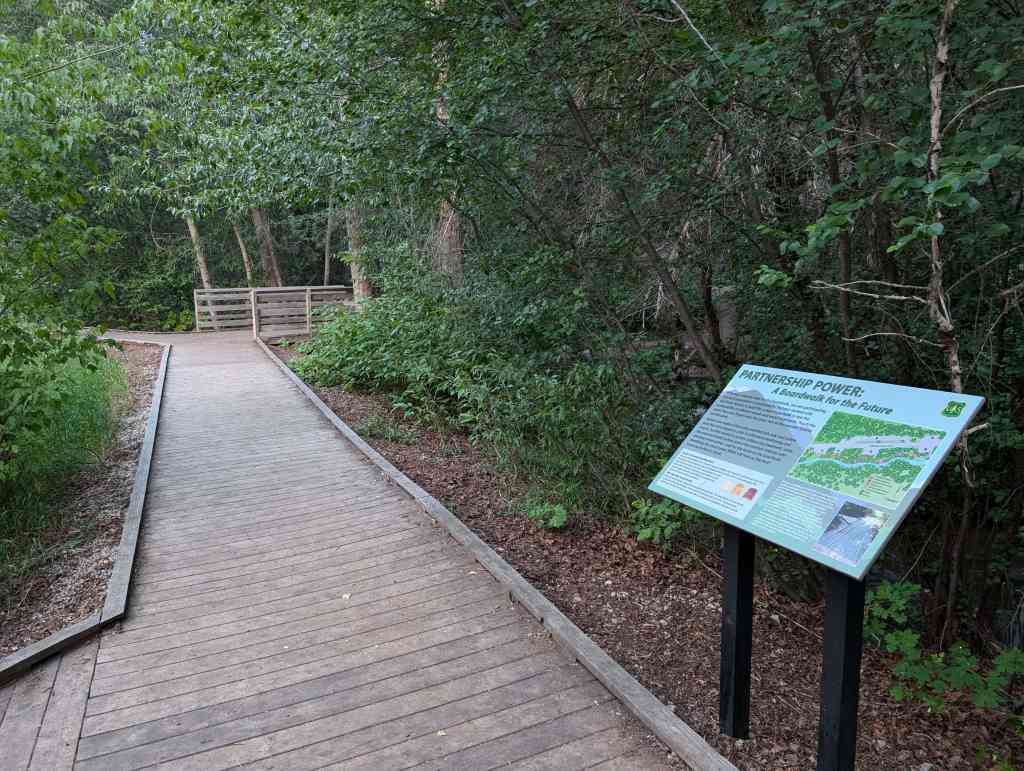
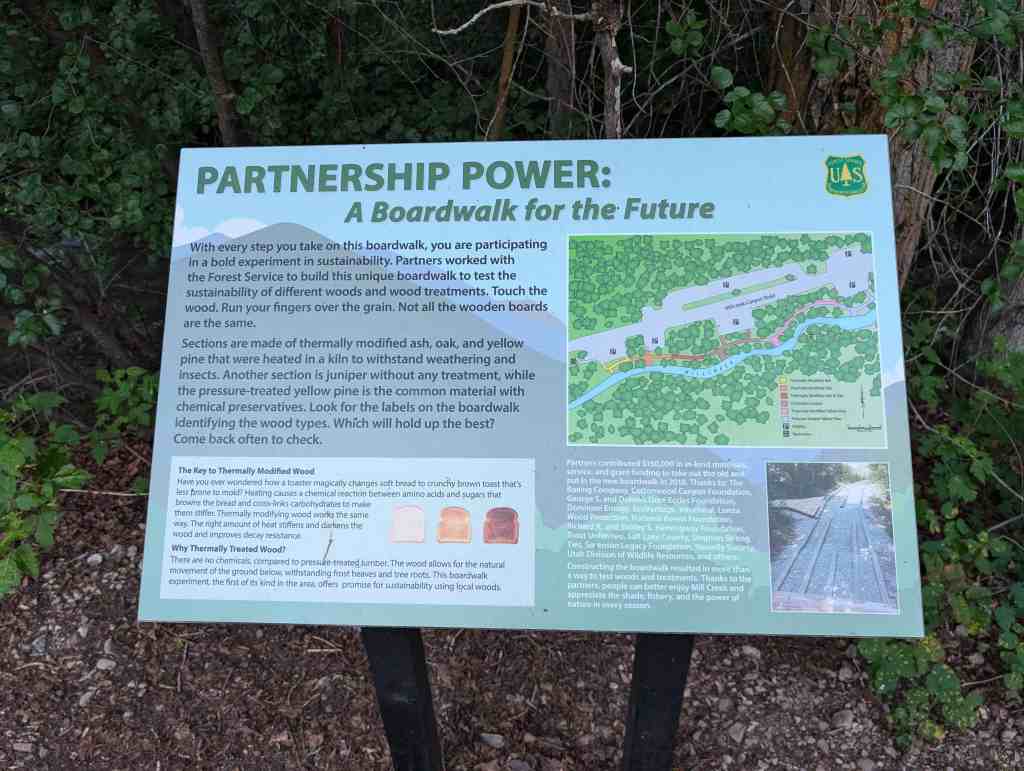
PARTNERSHIP POWER:
A Boardwalk for the Future
With every step you take on this boardwalk, you are participating in a bold experiment in sustainability. Partners worked with the Forest Service to build this unique boardwalk to test the sustainability of different woods and wood treatments. Touch the wood. Run your fingers over the grain. Not all the wooden boards are the same.
Sections are made of thermally modified ash, oak, and yellow pine that were heated in a kiln to withstand weathering and insects. Another section is juniper without any treatment, while the pressure-treated yellow pine is the common material with chemical preservatives. Look for the labels on the boardwalk identifying the wood types. Which will hold up the best? Come back often to check.
The Key to Thermally Modified Wood
Have you ever wondered how a toaster magically changes soft bread to crunchy brown toast that’s less prone to mold? Heating causes a chemical reaction between amino acids and sugars that
browns the bread and cross-links carbohydrates to make them stiffer. Thermally modifying wood works the same way. The right amount of heat stiffens and darkens the wood and improves decay resistance.
Why Thermally Treated Wood?
There are no chemicals, compared to pressure-treated lumber. The wood allows for the natural movement of the ground below, withstanding frost heaves and tree roots. This boardwalk experiment, the first of its kind in the area, offers promise for sustainability using local woods.
Partners contributed $150,000 in in-kind materials, service, and grant funding to take out the old and put in the new boardwalk in 2018. Thanks to: The Boeing Company, Cottonwood Canyon Foundation, George S. and Dolores Doré Eccles Foundation, Dominion Energy, EcoVantage, Intectural, Lonza Wood Protection, National Forest Foundation, Richard K. and Shirley S. Hemingway Foundation, Trout Unlimited, Salt Lake County, Simpson Strong Ties, Sorenson Legacy Foundation, Stonefly Society, Utah Division of Wildlife Resources, and others. Constructing the boardwalk resulted in more than a way to test woods and treatments. Thanks to the partners, people can better enjoy Mill Creek and appreciate the shade, fishery, and the power of nature in every season.