Tags
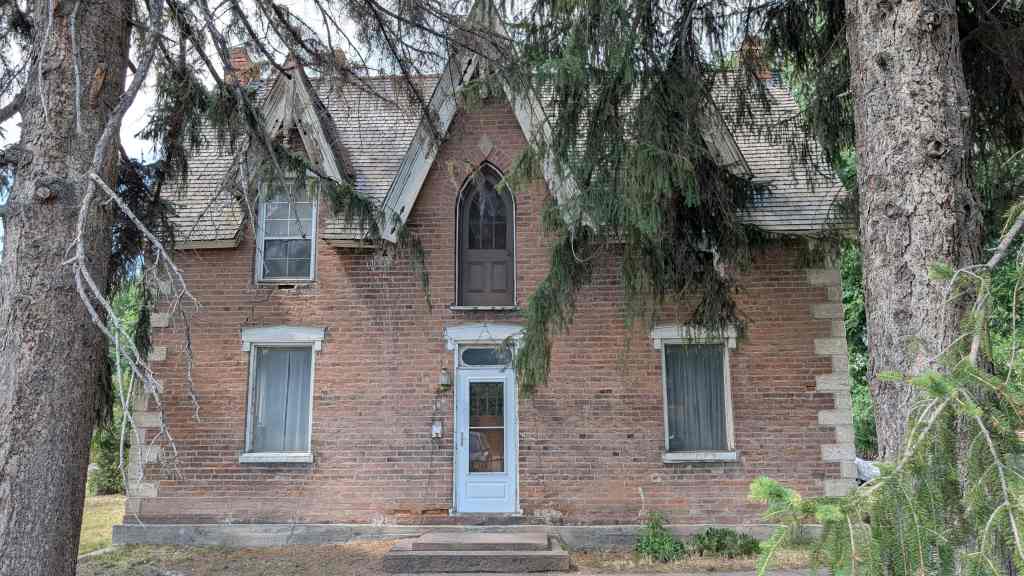
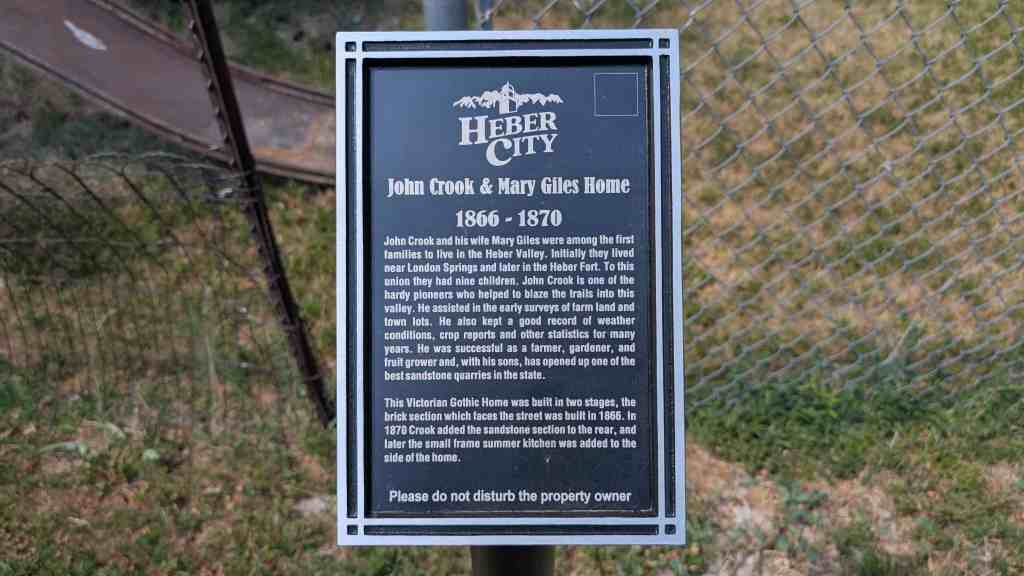
John Crook & Mary Giles Home
1866-1870
John Crook and his wife Mary Giles were among the first families to live in the Heber Valley. Initially they lived near London Springs and later in the Heber Fort. To this union they had nine children. John Crook is one of the hardy pioneers who helped to blaze the trails into this valley. He assisted in the early surveys of farm land and town lots. He also kept a good record of weather conditions, crop reports and other statistics for many years. He was successful as a farmer, gardener, and fruit grower and, with his sons, has opened up one of the best sandstone quarries in the state.
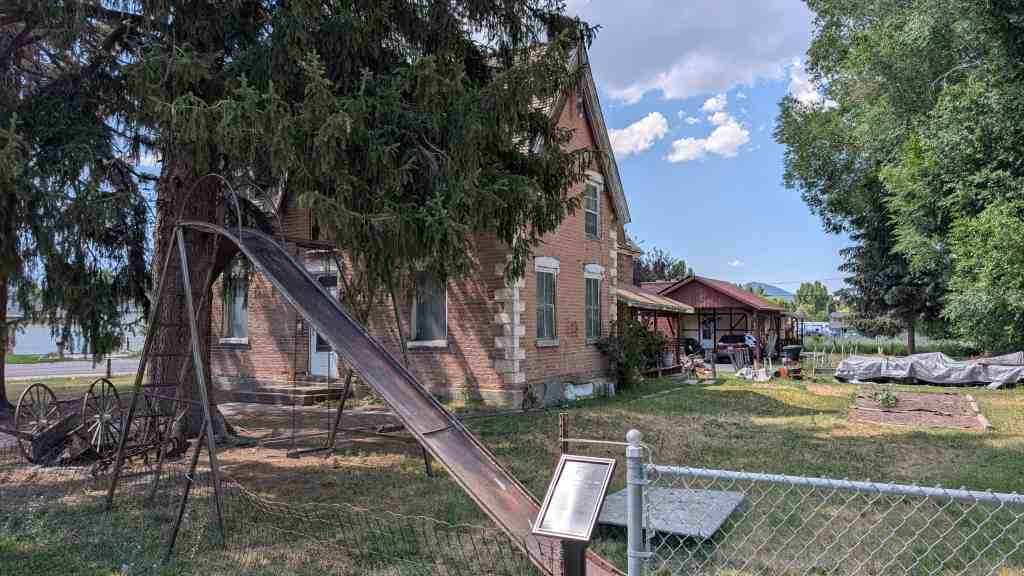
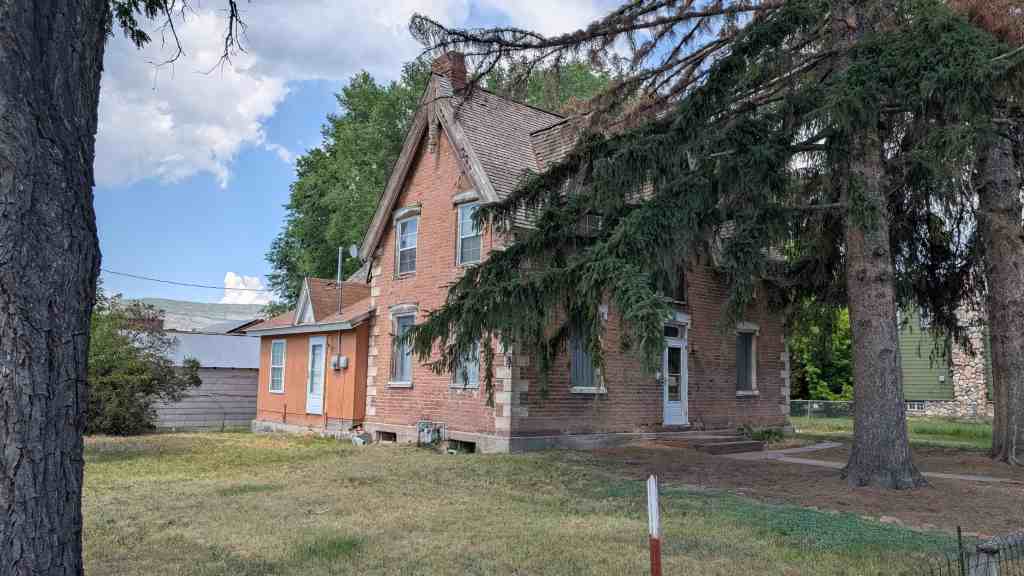
This Victorian Gothic Home was built in two stages, the brick section which faces the street was built in 1866. In 1870 Crook added the sandstone section to the rear, and later the small frame summer kitchen was added to the side of the home.
Part of the Historic Home Tour and located at 188 West 300 North in Heber City, Utah. The home was added to the National Register of Historic Places (#78002705) November 16, 1978
The following text is from the national register’s nomination form:
John Crook, one of the first settlers in Wasatch County, was the areas first historian and a leading church and businessman in Heber.
Crook was born October 11, 1831 in Trenton, Lancashire, England. After he joined the Church of Jesus Christ of Latter-day Saints, he decided to move to Utah. He originally settled in Provo. After the Provo Canyon Road was completed and Wasatch County was opened for settlement, he decided to move there. Crook was one of the first men to survey the area in 1858 and he was one of the original settlers in 1859. He and Thomas Rasband planted some of the first grain in the valley. Crook kept an extensive diary during this period of time and parts of it were later published in the Wasatch Wave, the local newspaper.
Crook continued to be involved in all aspects of Heber life. In 1866 he was an officer in the county militia which was organized to defend the valley in 1866. He was a farmer and stockman. He also worked closely in the development of business in the area. Crook opened a sandstone quarry in Center Creek and opera ted it for many years with his sons. Crook sold the stone to local residents to build schools, homes and churches. He also shipped it to Salt Lake and Provo to be used as sidewalks and foundations.
Crook was an active member of the Mormon Church. He was a choir director and an avid genealogist. He served as First Counselor to Bishop John Foreman of the Heber East Ward. He was a charter member of the Heber Dramatic Association and was an officer for a number of years.
During most of his life in Heber Crook was a volunteer weather observer for the United States Weather Service. He kept a careful log of daily temperatures and weather conditions.
Later in his life Crook traveled a great deal. He was a delegate t& several irrigation congresses. He delivered several trainloads of sheep to the Midwest. Crook died in Heber on March 31, 1921.
Crook was among the first settlers, who moved from the campsite to the city lots. His family lived in a covered wagon at first and then moved to a two-room adobe house inside the fort. After the family moved from the fort, they lived in a three-room log cabin.
According to family tradition, Crook built the brick part of the house that faces Third North, in 1866, The brick was manufactured at the Van Wagoner brick yards. In 1870 the section was added to the rear. Later a frame summer kitchen was also attached to the rear.
The house belonged to members of the Crook family until 1974, when it was sold to Brent E. Groth.
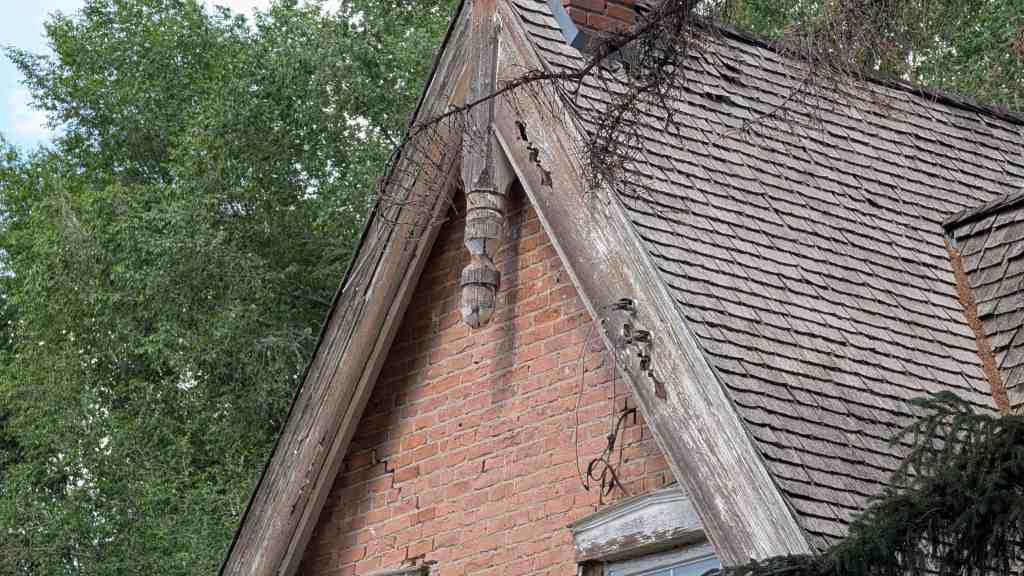
The Crook house is an example of a Gothic Revival cottage, similar to the Carpenter Gothic cottages popular in the East at the time, but rendered in brick instead of timber frame (a consequence of the Mormon preference for brick and stone?). The three steeply-raked dormer gables are decorated like the end gables with bargeboard trim. The pendants extending downward from the gable peaks were probably balanced originally by turned finals. The center gable is penetrated by a pointed arch door, with the door panels subdividing the door in the manner of a Gothic window. The entrance door, below the center gable, is topped by a shortened version of a Gothic hood mould, as are all the windows. The upper story windows are six-over-six, the lower two-over-two. The smooth ashlar quions at all four corners of the original house are not repeated in the stone addition.