
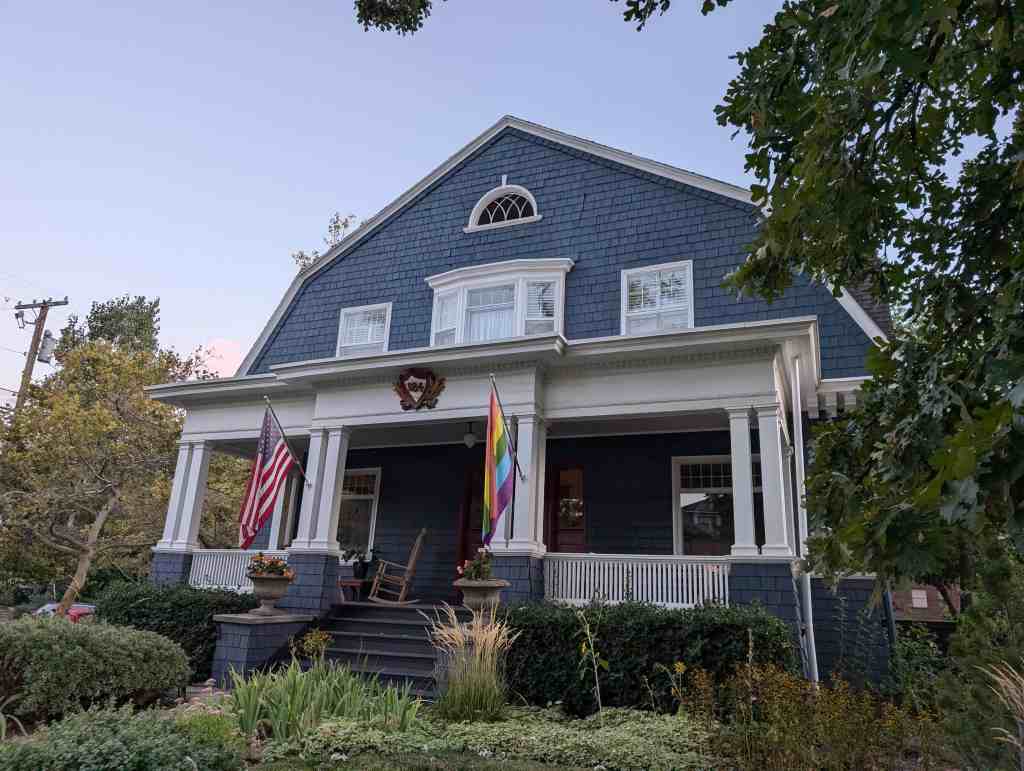
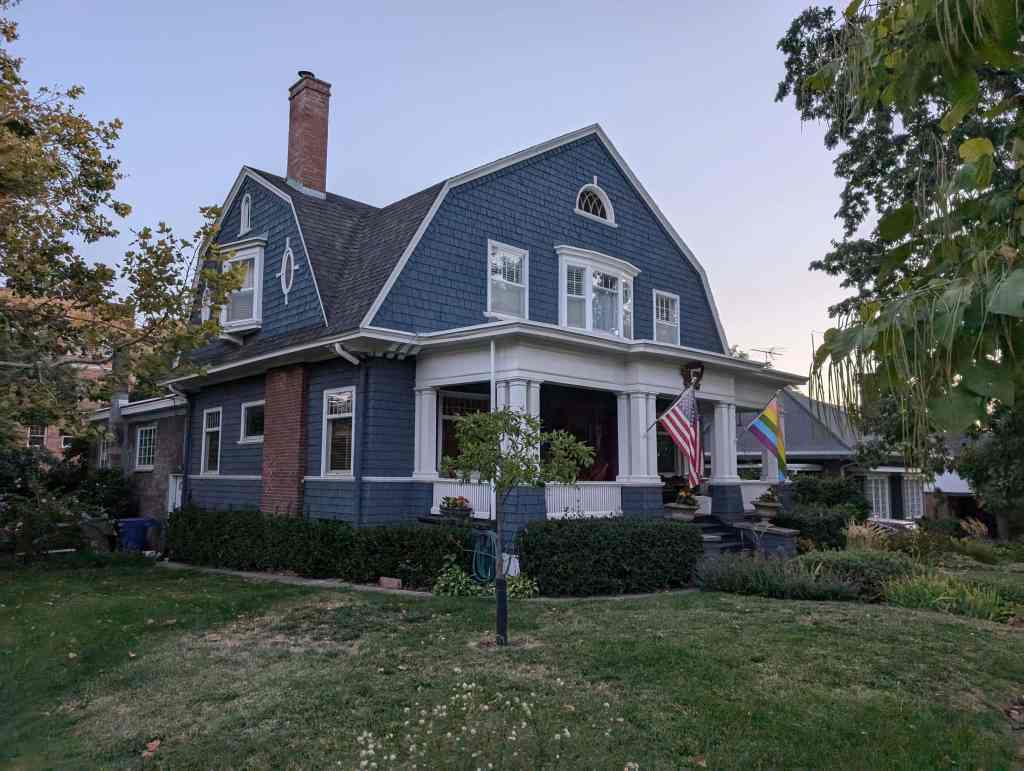
The house is significant as the house of a Prominent Utah architect who practiced in the state for more than 60 years. It was built in 1906 (some sources say 1905) for Walter E. Ware. Ware acquired the property, including 28 square rods in 1904. He was born in Needham, Massachusetts, August 26, 1861, the son of Elijah Ware, whose 1865 invention, a combined steam carriage and engine is now recognized as the forerunner of the automobile. In an article in the Salt Lake Tribune, February 12, 1940, Walter Ware spoke at length about his father’s invention. Elijah Ware was born a mechanic, and his son remembered that he was constantly puttering with new ideas and inventions. Like many inventive geniuses, however, he lacked the steadfastness to carry his theories through to completion. Often when success was within sight he would abandon a project and turn his attention to something else.
The idea of a carriage that would operate without the aid of horses occurred to him mainly because no one else had ever tried it. He evolved a theory of stream operation and set to work building the machine in a shop behind his home. Consisting of a small iron boiler set on a light carriage, the “automobile” burned wood for fuel. Mr. Ware steered it with a wheel, had a hand brake attached, and regulated the engine’s speed of thirty miles an hour. The country’s first automobile came to a strange end. Mr. Ware made no attempt to patent it or to continue with his experiment once it was completed.

Related:
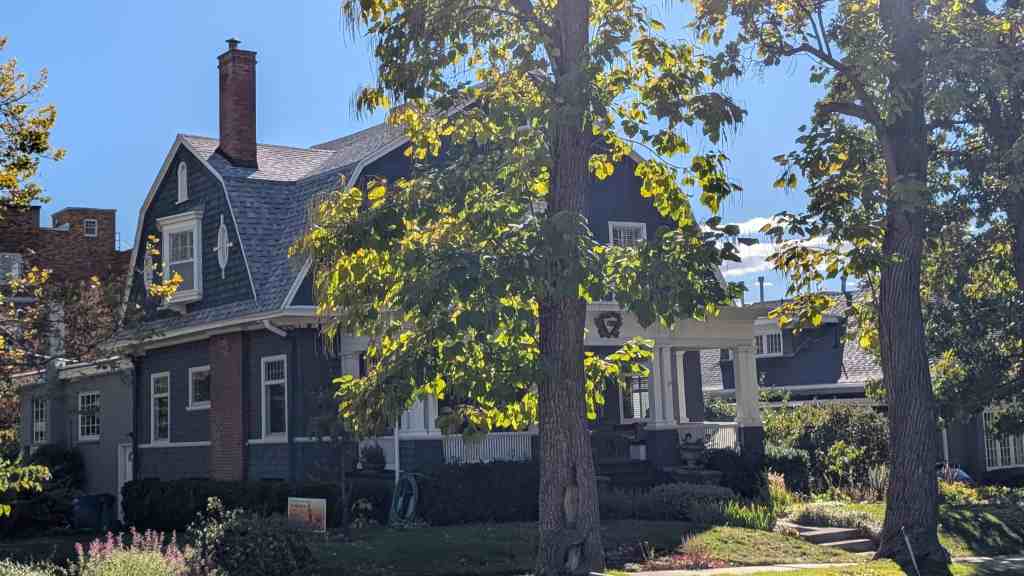
1184 East First Avenue in The Avenues of Salt Lake City, Utah
Walter Ware gained much of his early architectural experience working for the Union Pacific Railroad in Omaha, Nebraska, and Laramie, Wyoming. In the 1880s he began practicing architecture in Denver and about 1890 moved to Salt Lake City. He practiced in Salt Lake for more than a decade before Alberto O. Treganza joined him in 1901. Fifteen years Ware’s junior, Treganza (1876-1944) was born in Denver and studied architecture at Cornell University. He apprenticed with the firm of W. S. Hebbard and Irving Gill in San Diego and arrived in Salt Lake City about 1901. With the commencement of their partnership, Ware, earlier noted for his numerous works in Salt Lake City, assumed the business responsibilities of the firm including the writing of specifications, while Treganza worked on design. Despite their different roles and personalities, the firm was well known for maintaining high ethical standards and careful attention to construction supervision. Their commissions ranged from large club buildings and warehouses to numerous schools and large residences. Among the buildings that Ware designed were the First Presbyterian Church of Salt Lake, Salt Lake City’s University Club Building, the Aviation Club, the Commercial Club, the F. W. Woolworth Company store, Spelding Memorial Hall of St. Mark’s Episcopal Cathedral, St. John’s Evangelical Lutheran Church, Mt. Pleasant Presbyterian Church, Logan’s Presbyterian Church, St. Thomas Acquinas Catholic Church, Logan, St. Anthony Catholic Church in Helper, the University of Utah Health Center, and the Westminster College Gymnasium. He directed the remodeling of the present Salt Lake Tribune building and also the construction of the Salt Lake Tribune mechanical department building. Other business construction included the Salt Lake Hardware Company plants in Boise, Idaho, and Grand Junction, Colorado, and the Purity Bisquit Company plant in Salt Lake City.
On July 14, 1890, Mr. Ware married Jennie Hartley. She had been born in England in 1867, the daughter of Richard and Mary Dayton Hartley. She came to the United States with her parents in 1871. At the time of her marriage she was teaching school in Laramie, Wyoming. The couple soon moved to Salt Lake City where she became a prominent clubwoman.
Ware occupied the house until his death in 1951, after which it passed to his daughter, Florence, who was a well-known Utah artist. A one-time member of the University of Utah Department of Fine Arts, she studied at the Chicago Art Institute under Charles Hawthorne and graduated from the University of Utah, studying under J. T. Harwood. Primarily, a landscape artist, she also did costume and scenic design for the University of Utah Drama Department. A review of one of her exhibits gives an indication of her work. (Salt Lake Tribune, Oct. 30, 1966). “A painting exhibit from the hand of a sensitive artist is being shown at the ZCMI Tea Room. group of oils by Florence Ware covers the available space and it may requires one
Dryness, heat and a sense of quiet oppression are seen in the stringy bark of the parched juniper. The notion of dryness is conveyed in the way the earth is represented – grainy, loose, shifty. Tenuous skies relieve the intense heat tantalizingly aloof from the area of contest work, which completely eschews the sinister, bizarre, or ugly aspects of life, entertains the subject matter that can best be expressed by firmly- controlled color harmonies and textural adjuncts that complement refreshing aspects of visual experience.” (for another review of more of her work, see the Salt Lake Tribune, June 27, 1971.)
walking around to see it all, but it is well worth the effort. Miss Ware enjoys a solid reputation for competent handling of the oil medium. Her choices of subject matter–fields, stream, mountain landscapes, and portraits–deal with a pleasant, well-schooled sort of beauty that delights the eye with a consistently ordered and a highly controlled palette. The lighting on her landscape themes is gentle and friendly to the forms on which it falls. “Spring Blossoms” is representative of the element of seasonal delight that persists in the fragile aura of momentary change. study is poised between the fickle extremes of coolness and warmth. Soft edges of blossom and foliage yield against shadows of precisely calculated pigment with a deftness that enlists poetic fantasy from visual reality. Florence Ware thoroughly understands the painterly craft; knows what she wants from it and gets directly to the point. A small desert landscape, Battle for Survival, entertains the notion of struggle without violence.
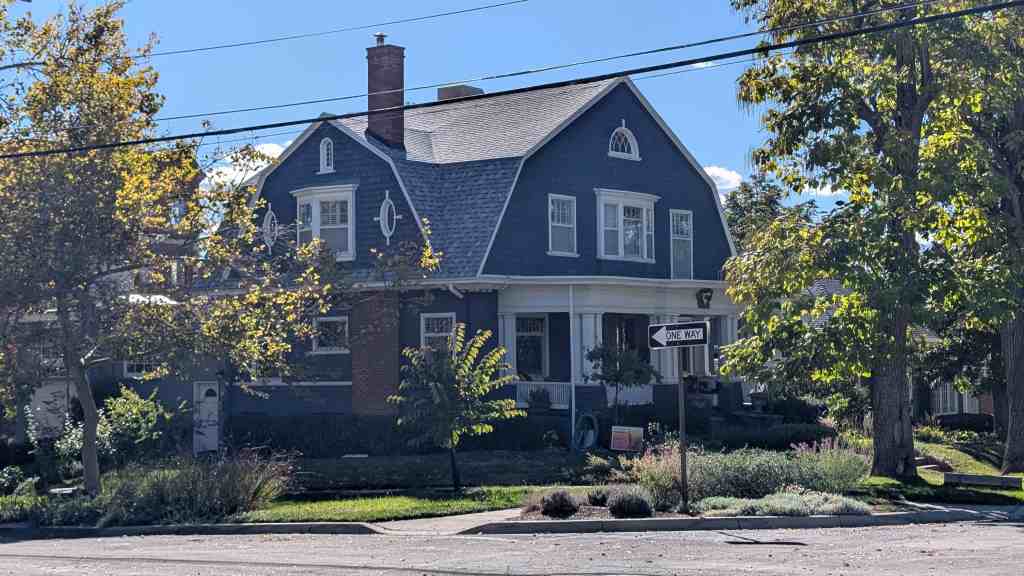
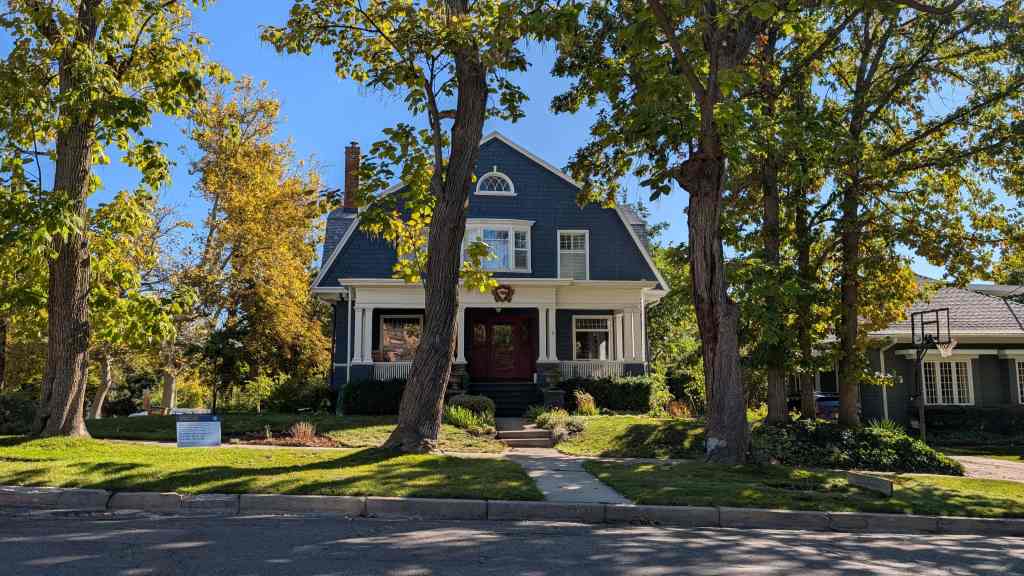
Architecturally the house is significant as a unique variant of the Colonial Revival style in Utah. Sophisticated early examples of Utah’s Colonial Revival style are very limited, and this is probably one of the three best documented extant examples of the style in Salt Lake City. Two other examples listed in the National Register include: the Mort Cheesman House, 2320 Walker Lane, built 1912-13, and listed in the National Register as an individual nomination in 1982 and the J. Leo Fairbanks House at 1228 Bryan Avenue in Salt Lake City, Utah.
Mentioned in the national register’s nomination form:
While they account for less than one percent of all residences, the very large, often architect-designed homes in the Eastlake, Queen Anne and Shingle styles, and later the Prairie and Craftsman styles greatly influence the visual character of the Avenues. Some of the state’s best examples of residential architectural styles were built there, including the William Barton house, 231 B Street, (vernacular/Gothic); the Jeremiah Beattie house, 30 J Street, (Eastlake); the David Murdock house, 73 G Street, (Queen Anne); the E.G. Coffin house, 1037 First Avenue, (Queen Anne); the N.H. Beeman house, 1007 First Avenue, (Shingle style); the Vto. Mclntyre house, 257 Seventh Avenue, (Classical Revival); the James Sharp house, 157 D Street, (Craftsman); and the W.E. Ware house, 1184 First Avenue, (Colonial Revival).
Pingback: Avenues Historic District | JacobBarlow.com
Pingback: William Barton House | JacobBarlow.com