
David Eccles
(1849-1912)
Western Industrialist and Utah’s First Multimillionaire
A Remarkable “Rags to Riches” Journey
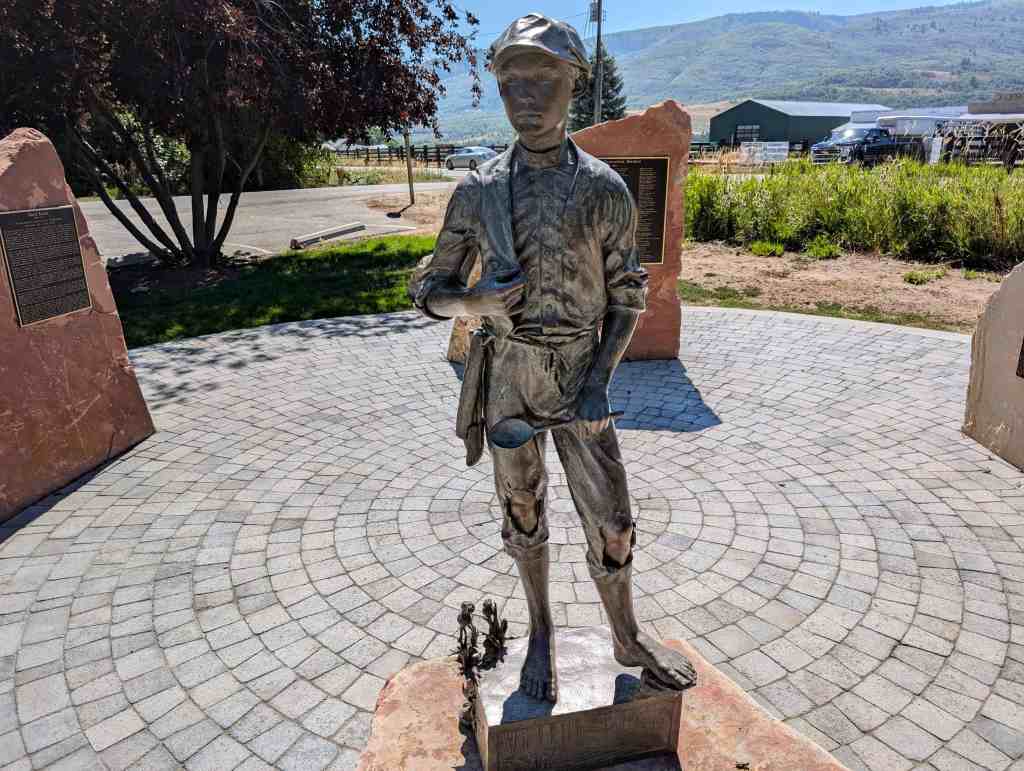
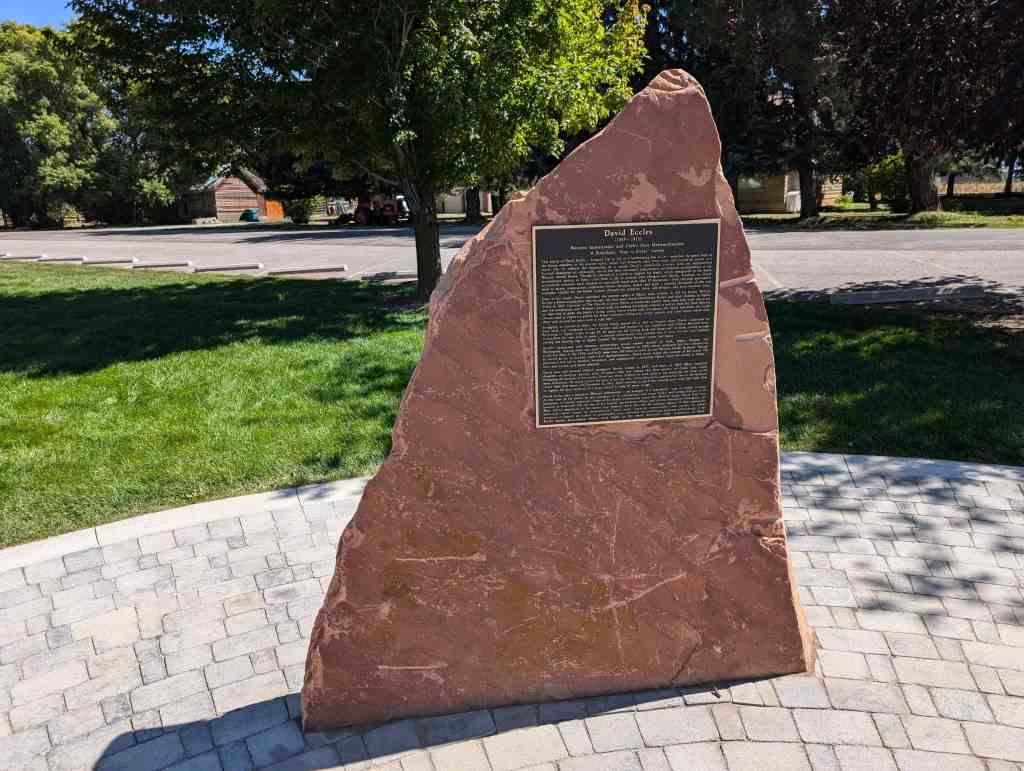
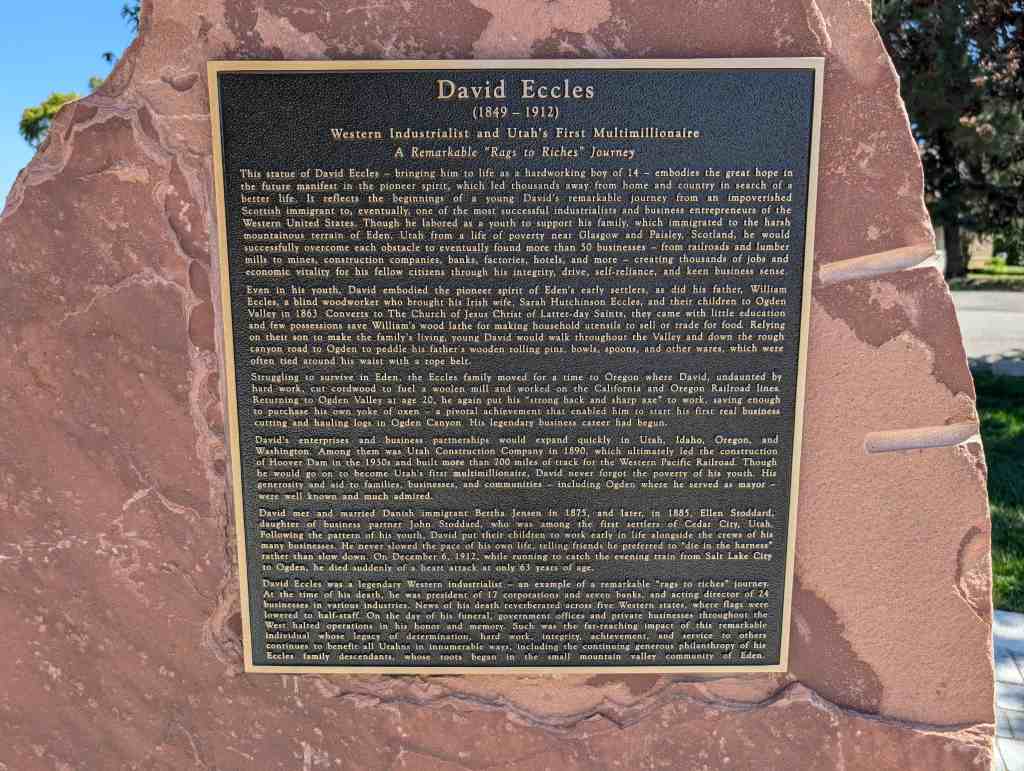
This statue of David Eccles – bringing him to life as a hardworking boy of 14 – embodies the great hope in the future manifest in the pioneer spirit, which led thousands away from home and country in search of a better life. It reflects the beginnings of a young David’s remarkable journey from an impoverished Scottish immigrant to, eventually, one of the most successful industrialists and business entrepreneurs of the Western United States. Though he labored as a youth to support his family, which immigrated to the harsh mountainous terrain of Eden, Utah from a life of poverty near Glasgow and Paisley, Scotland, he would successfully overcome each obstacle to eventually found more than 50 businesses from railroads and lumber mills to mines, construction companies, banks, factories, hotels, and more creating thousands of jobs and economic vitality for his fellow citizens through his integrity, drive, self-reliance, and keen business sense.
Even in his youth, David embodied the pioneer spirit of Eden’s early settlers, as did his father, William Eccles, a blind woodworker who brought his Irish wife, Sarah Hutchinson Eccles, and their children to Ogden Valley in 1863 Converts to The Church of Jesus Christ of Latter-day Saints, they came with little education and few possessions save William’s wood lathe for making household utensils to sell or trade for food. Relying on their son to make the family’s living, young David would walk throughout the Valley and down the rough canyon road to Ogden to peddle his father’s wooden rolling pins, bowls, spoons, and other wares, which were often tied around his waist with a rope belt.
Struggling to survive in Eden, the Eccles family moved for a time to Oregon where David, undaunted by hard work, cut cordwood to fuel a woolen mill and worked on the California and Oregon Railroad lines. Returning to Ogden Valley at age 20, he again put his “strong back and sharp axe” to work, saving enough to purchase his own yoke of oxen a pivotal achievement that enabled him to start his first real business cutting and hauling logs in Ogden Canyon. His legendary business career had begun.
David’s enterprises and business partnerships would expand quickly in Utah, Idaho, Oregon, and Washington. Among them was Utah Construction Company in 1890, which ultimately led the construction of Hoover Dam in the 1930s and built more than 700 miles of track for the Western Pacific Railroad. Though he would go on to become Utah’s first multimillionaire, David never forgot the poverty of his youth. His generosity and aid to families, businesses, and communities including Ogden where he served as mayor – were well known and much admired.
David met and married Danish immigrant Bertha Jensen in 1875, and later, in 1885, Ellen Stoddard, daughter of business partner John Stoddard, who was among the first settlers of Cedar City, Utah. Following the pattern of his youth, David put their children to work early in life alongside the crews of his many businesses. He never slowed the pace of his own life, telling friends he preferred to “die in the harness” rather than slow down. On December 6, 1912, while running to catch the evening train from Salt Lake City to Ogden, he died suddenly of a heart attack at only 63 years of age.
David Eccles was a legendary Western industrialist an example of a remarkable “rags to riches” journey. At the time of his death, he was president of 17 corporations and seven banks, and acting director of 24 businesses in various industries. News of his death reverberated across five Western states, where flags were lowered to half-staff. On the day of his funeral, government offices and private businesses throughout the West halted operations in his honor and memory. Such was the far-reaching impact of this remarkable individual whose legacy of determination, hard work, integrity, achievement, and service to others continues to benefit all Utahns in innumerable ways, including the continuing generous philanthropy of his Eccles family descendants, whose roots began in the small mountain valley community of Eden.

David Eccles
(1849-1912)
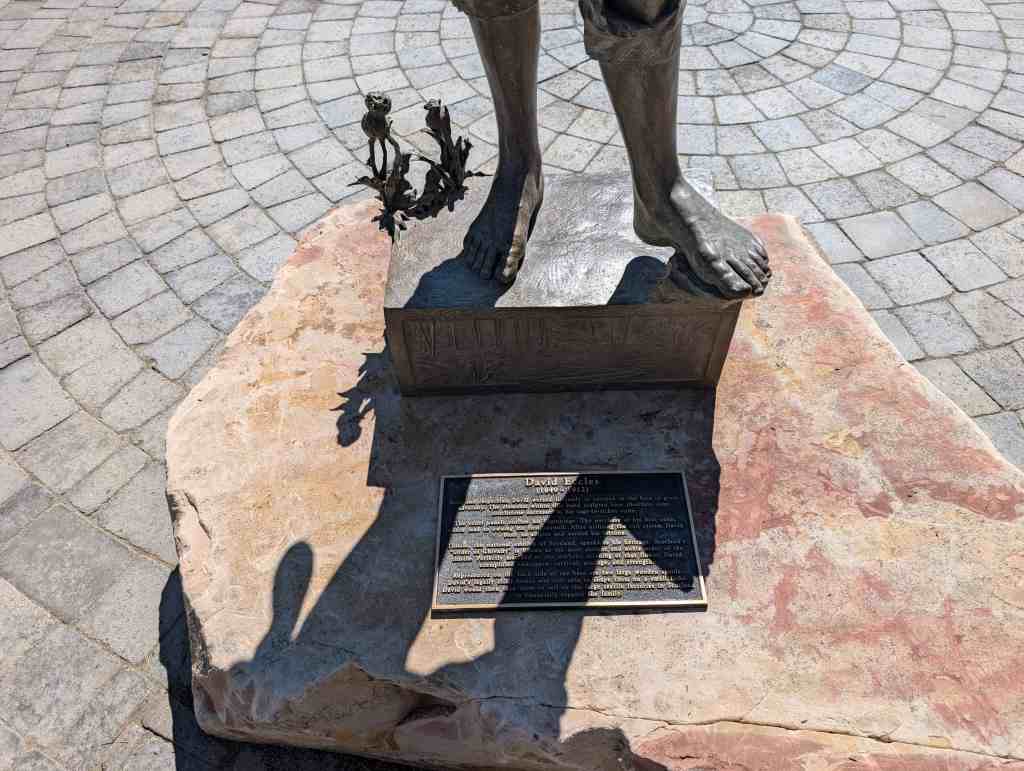
Bold and respectful David worked tirelessly to succeed in the face of great adversity. The elements within this hand sculpted base illustrate some touchstone successes in his rags-to-riches story.
The relief panels outline his beginnings. The purchase of his first oxen, which lead to owning his first sawmill. After utilizing the rail system David built an empire and earned his fortune.
Thistle, the national emblem of Scotland, speaks to his heritage. Scotland’s “Order of Chivalry” is known as the most ancient and noble order of the thistle Perfectly marched to the symbolic meaning of that flower, David exemplified endurance, survival, courage, and strength.
Represented on the back side of the base are two large wooden spools. David’s legally blind father was still able to shape them on a small lathe. David would then take them to sell to the large textile factories in Scotland to financially support the family,
Eden’s Founding
July 15, 1865
The first Anglo-european men to arrive in Ogden Valley were trappers led by Peter, Skene Ogden of the Hudson’s Bay Company. Most of Peter Skene Ogden’s trappers were Iroquois, known as Freemen an ironic misnomer since indebtedness to the Hudson’s Bay Company left Iroquois Freemen far from free. Local Shoshone also accompanied Ogden’s fur trapping brigade when entering this valley in May of 1825 Observing the valley to be untouched by any other trappers, Ogden dubbed the area New Hole a hole being a sheltered location such as a valley. It later took the name Ogden Hole. Soon, others followed their trails.
The first wagon came into the valley via the North Ogden pass in 1854 The group used ropes to ease their wagon down over the cliffs. The company was led by David Moore. Charles F. Middleton, who was also in the company, wrote, “The first wagon that was taken into the valley was taken by hand of man. No mules or oxen hauled that vehicle; I steered the wagon. The wheels were locked, and my companions held onto the vehicle with ropes to prevent it from breaking loose and dashing down the steep incline. The wagon was left in the valley.
In 1856, the valley was first used as a natural summer range for cattle, the valley’s ring of mountains serving as a natural corral with grass and water available for the summer herd.
The first home in Eden, a log cabin, was built in 1857 for summer herdsmen Erastus Bingham and Joseph Hardy. It was situated about 12 miles east of the formal settlement of Eden.
The first permanent settlers of Eden arrived via the North Ogden Canyon pass through Liberty. The party consisted of Joseph Grover, Sidney Teeples, Stephen Wilbur, Peter Geertsen, Josiah Ferrin, Francis Clark, Elisha Wilbur, the Moffets, the Farrells, and others.
The first informal community was established in 1859 when 15 families moved in, coming to Eden, again, from Liberty’s North Ogden pass. By 1863, the infant settlement had a population of 250; by 1870, 1,051.
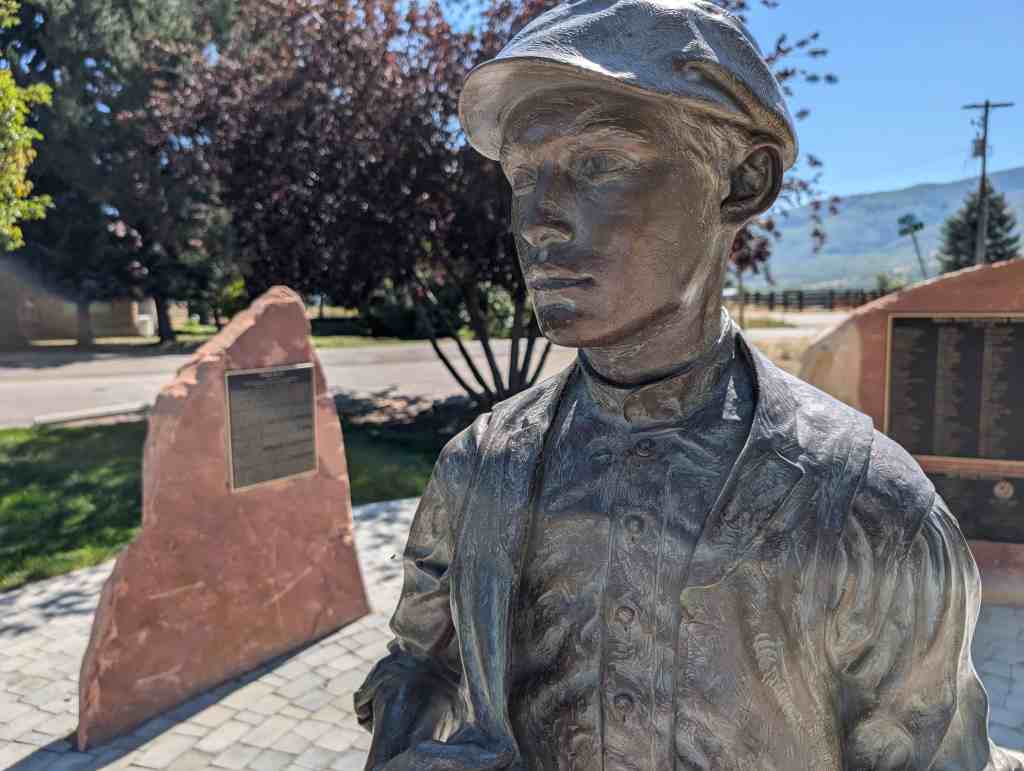
The year 1865 was an important year for the small group that had settled in this mountain valley. With the outbreak of Utah’s Blackhawk War in that year, pioneer leader President Brigham Young advised communities throughout the state to move their settlements closer together. The town of Eden was then surveyed. Consisting of nine blocks of six acres each, the blocks were divided into eight lots each, with a public square as the center. Today, the historic center block is known as Eden Park, where you now stand. The area was laid out under the direction of Richard Ballantyne and was given the name of Eden, taken from the biblical garden due to it’s beauty and “pleasant situation.” People moved in immediately. A large celebration with dedicatory activities marked the small community’s official founding, July 15, 1865.
Northwestern Shoshone–Early Sojourners of Ogden Valley
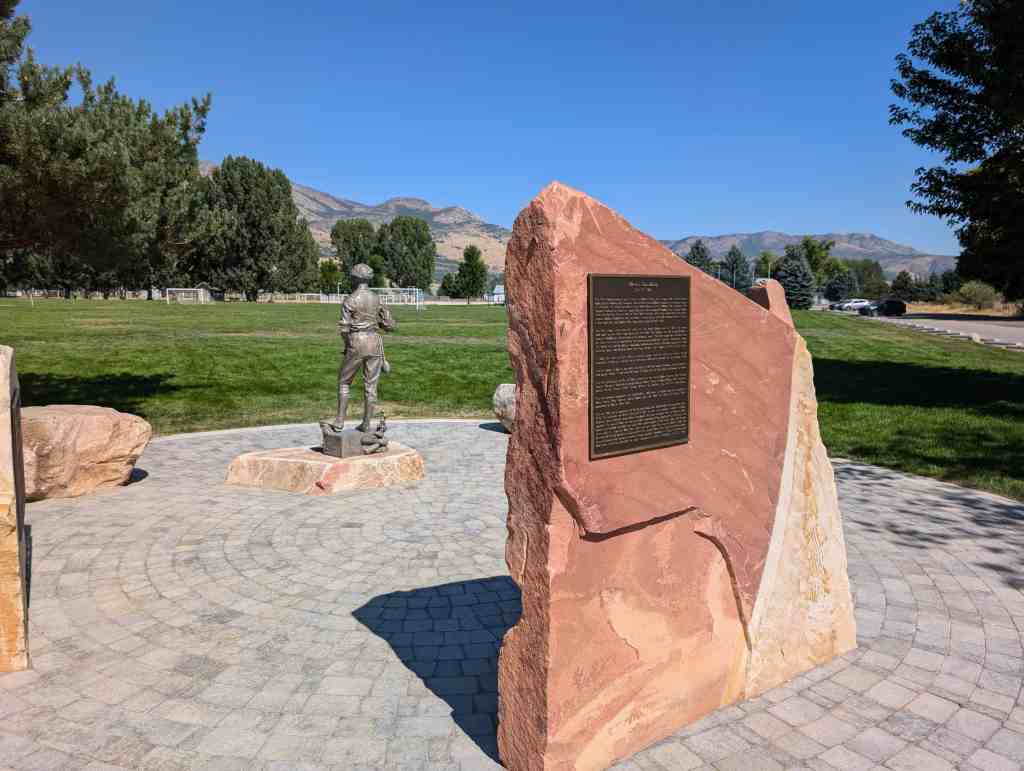
Prior to the permanent settlement of Ogden Valley, this was summer home to Northwestern Shoshone, the Newe people as they were known among themselves. Anga-we-ya-dye (where the red berries grow) was the Shoshone name describing this mountain valley hideaway. “Red berries” likely indicates the rich supply of life sustaining berries found here elder berry, currents, service berry and ever abundant choke cherry.
The Shoshone resided in portable, conically shaped shelters known as kahni-a (tipi) erected with interlocking pine poles wrapped in a buffalo-skin-covering. Tipis were carefully designed to set up and take down quickly. An entire Shoshone village could be packed up and ready to move within an hour.
In the first half of the 19th century, this valley fell within the territory of the Northwestern Shoshone which stretched from Davis County to Northern Idaho and Chief Little Soldier. Trappers and Wyoming to Nevada, led by Chief Sagwitch and explorers, including Peter Skene Ogden, Osborné Russell and Captain Howard Stansbury interacted with Shoshone in and around Ogden Valley during this time period. During the settlement years (1850-1900) of Eden, Huntsville, and Liberty, frequent encounters between settlers and Shoshone occurred, resulting in both trade and friendships.
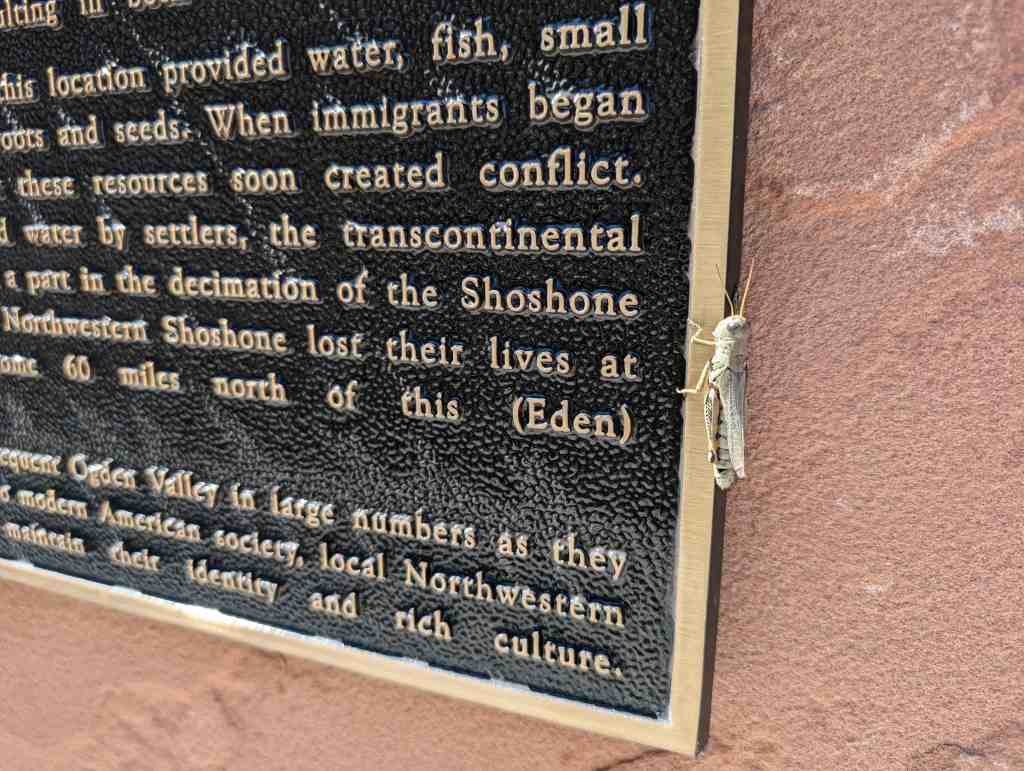
The Shoshone subsisted on critical resources this location provided water, fish, small and larger game, along with various berries, roots and seeds. When immigrants began soon created conflict. arriving in the mid 1800’s, competition for these resources Infectious disease, appropriation of land and water by settlers, the transcontinental railroad and consequent warfare each played a part in the decimation of the Shoshone population. On Jan 29, 1863, hundreds of Northwestern Shoshone lost their lives at the infamous Bear River massacre some 60 miles north of this (Eden) location near Preston, Idaho.
Today, Northwestern Shoshone no longer frequent Ogden Valley in large numbers as they once did. In spite of their assimilation into modern American society, local Northwestern Shoshone continue to preserve and maintain their identity and rich culture.
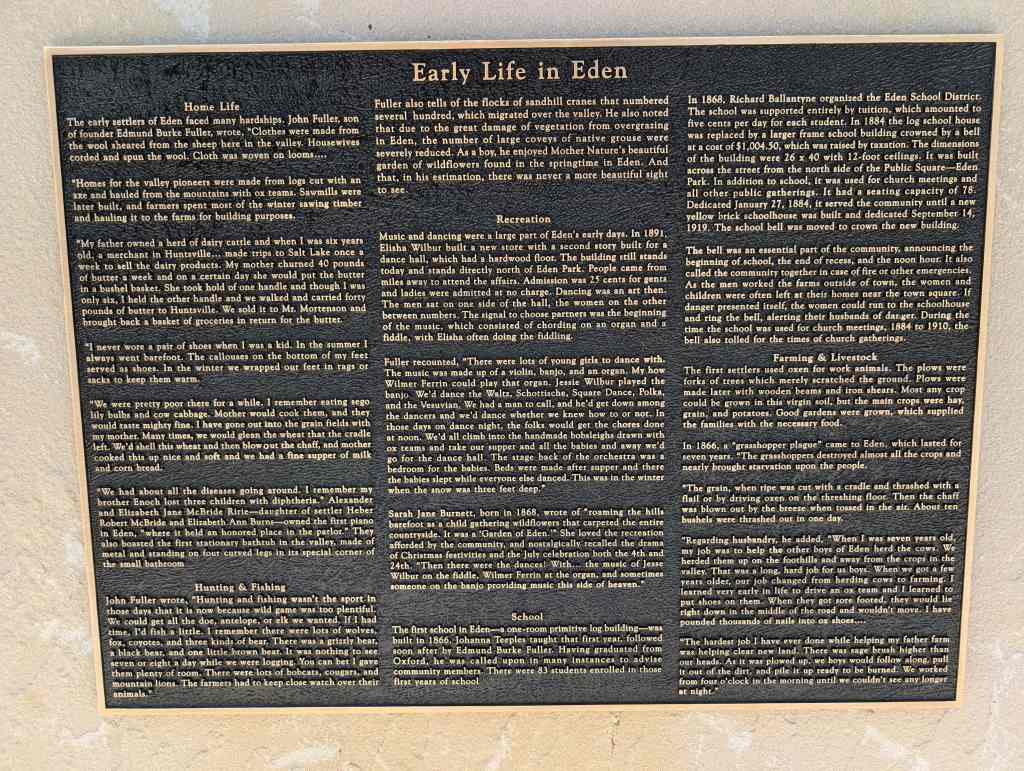
Early Life in Eden
Home Life.
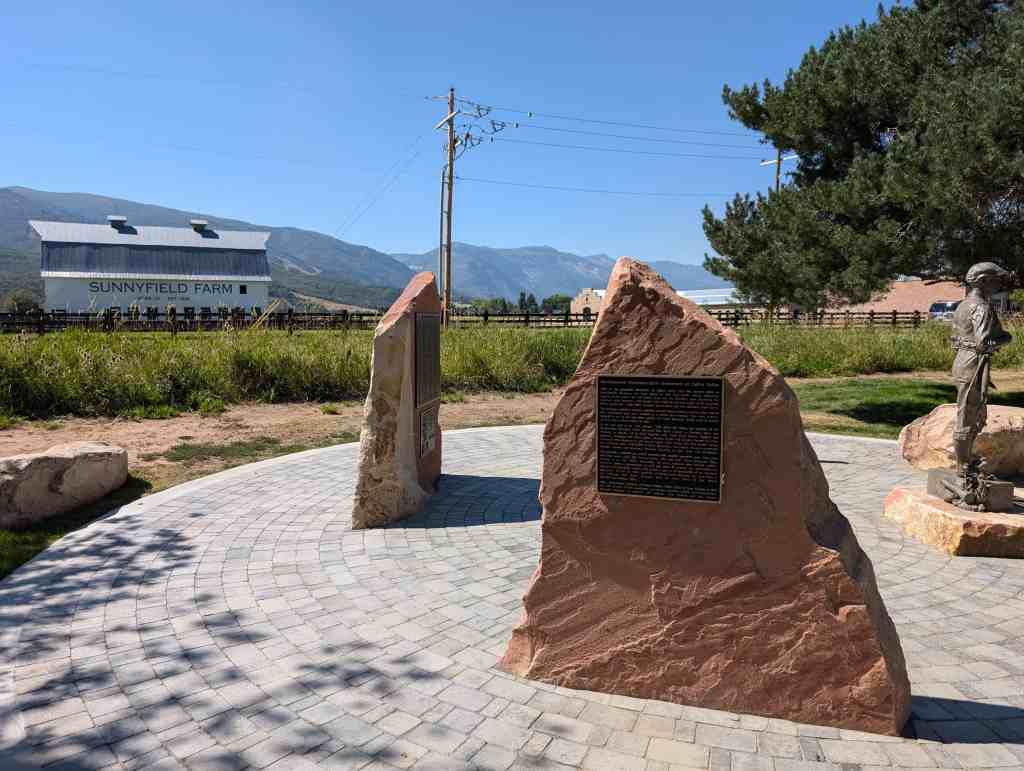
The early settlers of Eden faced many hardships. John Fuller, son of founder Edmund Burke Fuller, wrote, “Clothes were made from the wool sheared from the sheep here in the valley. Housewives corded and spun the wool. Cloth was woven on looms….
“Homes for the valley pioneers were made from logs cut with an axe and hauled from the mountains with ox teams. Sawmills were later built, and farmers spent most of the winter sawing timber and hauling it to the farms for building purposes.
“My father owned a herd of dairy cattle and when I was six years. old, a merchant in Huntsville… made trips to Salt Lake once a week to sell the dairy products. My mother churned 40 pounds of butter a week and on a certain day she would put the butter in a bushel basket. She took hold of one handle and though I was only six, I held the other handle and we walked and carried forty pounds of butter to Huntsville. We sold it to Mr. Mortenson and brought back a basket of groceries in return for the butter.
“I never wore a pair of shoes when I was a kid. In the summer I always went barefoot. The callouses on the bottom of my feet served as shoes. In the winter we wrapped our feet in rags or sacks to keep them warm.
“We were pretty poor there for a while. I remember eating sego lily bulbs and cow cabbage. Mother would cook them, and they would taste mighty fine. I have gone out into the grain fields with my mother. Many times, we would glean the wheat that the cradle left. We’d shell this wheat and then blow out the chaff, and mother cooked this up nice and soft and we had a fine supper of milk and corn bread.
“We had about all the diseases going around. I remember my brother Enoch lost three children with diphtheria.” Alexander and Elizabeth Jane McBride Ririe-daughter of settler Heber Robert McBride and Elizabeth Ann Burns-owned the first piano in Eden, “where it held an honored place in the parlor.” They also boasted the first stationary bathtub in the valley, made of metal and standing on four curved legs in its special corner of the small bathroom
Hunting & Fishing
John Fuller wrote, “Hunting and fishing wasn’t the sport in those days that it is now because wild game was too plentiful. We could get all the doe, antelope, or elk we wanted. If I had time, I’d fish a little. I remember there were lots of wolves, fox, coyotes, and three kinds of bear. There was a grizzly bear, a black bear, and one little brown bear. It was nothing to see seven or eight a day while we were logging. You can bet I gave them plenty of room. There were lots of bobcats, cougars, and mountain lions. The farmers had to keep close watch over their animals.”
Fuller also tells of the flocks of sandhill cranes that numbered several hundred, which migrated over the valley. He also noted that due to the great damage of vegetation from overgrazing in Eden, the number of large coveys of native grouse were severely reduced. As a boy, he enjoyed Mother Nature’s beautiful garden of wildflowers found in the springtime in Eden. And that, in his estimation, there was never a more beautiful sight to see.
Recreation
Music and dancing were a large part of Eden’s early days. In 1891, Elisha Wilbur built a new store with a second story built for a dance hall, which had a hardwood floor. The building still stands today and stands directly north of Eden Park. People came from miles away to attend the affairs. Admission was 25 cents for gents and ladies were admitted at no charge. Dancing was an art then. The men sat on one side of the hall, the women on the other between numbers. The signal to choose partners was the beginning of the music, which consisted of chording on an organ and a fiddle, with Elisha often doing the fiddling.
Fuller recounted, “There were lots of young girls to dance with. The music was made up of a violin, banjo, and an organ. My how Wilmer Ferrin could play that organ. Jessie Wilbur played the banjo. We’d dance the Waltz, Schottische, Square Dance, Polka, and the Vesuvian. We had a man to call, and he’d get down among the dancers and we’d dance whether we knew how to or not. In those days on dance night, the folks would get the chores done at noon. We’d all climb into the handmade bobsleighs drawn with ox teams and take our supper and all the babies and away we’d go for the dance hall. The stage back of the orchestra was a bedroom for the babies. Beds were made after supper and there the babies slept while everyone else danced. This was in the winter when the snow was three feet deep.”
Sarah Jane Burnett, born in 1868, wrote of “roaming the hills barefoot as a child gathering wildflowers that carpeted the entire countryside. It was a ‘Garden of Eden.”” She loved the recreation afforded by the community, and nostalgically recalled the drama of Christmas festivities and the July celebration both the 4th and 24th. “Then there were the dances! With… the music of Jesse Wilbur on the fiddle, Wilmer Ferrin at the organ, and sometimes someone on the banjo providing music this side of heaven.”
School
The first school in Eden- a one-room primitive log building-was built in 1866. Johanna Teeples taught that first year, followed soon after by Edmund Burke Fuller. Having graduated from Oxford, he was called upon in many instances to advise community members. There were 83 students enrolled in those first years of school
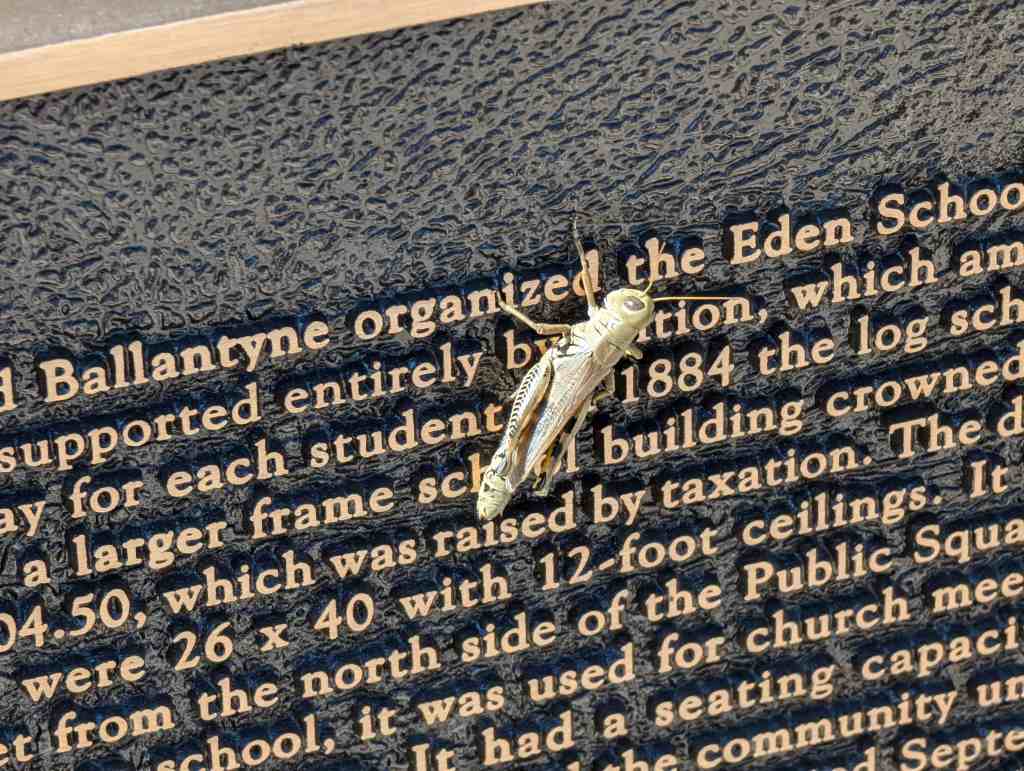
In 1868, Richard Ballantyne organized the Eden School District. The school was supported entirely by tuition, which amounted to five cents per day for each student. In 1884 the log school house was replaced by a larger frame school building crowned by a bell at a cost of $1,004.50, which was raised by taxation. The dimensions of the building were 26 x 40 with 12-foot ceilings. It was built across the street from the north side of the Public Square-Eden Park. In addition to school, it was used for church meetings and all other public gatherings. It had a seating capacity of 78. Dedicated January 27, 1884, it served the community until a new yellow brick schoolhouse was built and dedicated September 14, 1919. The school bell was moved to crown the new building.
The bell was an essential part of the community, announcing the beginning of school, the end of recess, and the noon hour. It also called the community together in case of fire or other emergencies. As the men worked the farms outside of town, the women and children were often left at their homes near the town square. If danger presented itself, the women could run to the schoolhouse and ring the bell, alerting their husbands of danger. During the time the school was used for church meetings, 1884 to 1910, the bell also tolled for the times of church gatherings.
Farming & Livestock
The first settlers used oxen for work animals. The plows were forks of trees which merely scratched the ground. Plows were made later with wooden beams and iron shears. Most any crop could be grown in this virgin soil, but the main crops were hay, grain, and potatoes. Good gardens were grown, which supplied the families with the necessary food.
In 1866, a “grasshopper plague” came to Eden, which lasted for seven years. “The grasshoppers destroyed almost all the crops and nearly brought starvation upon the people.
“The grain, when ripe was cut with a cradle and thrashed with a flail or by driving oxen on the threshing floor. Then the chaff was blown out by the breeze when tossed in the air. About ten bushels were thrashed out in one day.
“Regarding husbandry, he added, “When I was seven years old, my job was to help the other boys of Eden herd the cows. We herded them up on the foothills and away from the crops in the Ivalley. That was a long, hard job for us boys. When we got a few years older, our job changed from herding cows to farming. I learned very early in life to drive an ox team and I learned to put shoes on them. When they got sore footed, they would lie right down in the middle of the road and wouldn’t move. I have pounded thousands of nails into ox shoes….
“The hardest job I have ever done while helping my father farm was helping clear new land. There was sage brush higher than our heads. As it was plowed up, we boys would follow along, pull it out of the dirt, and pile it up ready to be burned. We worked from four o’clock in the morning until we couldn’t see any longer at night.”

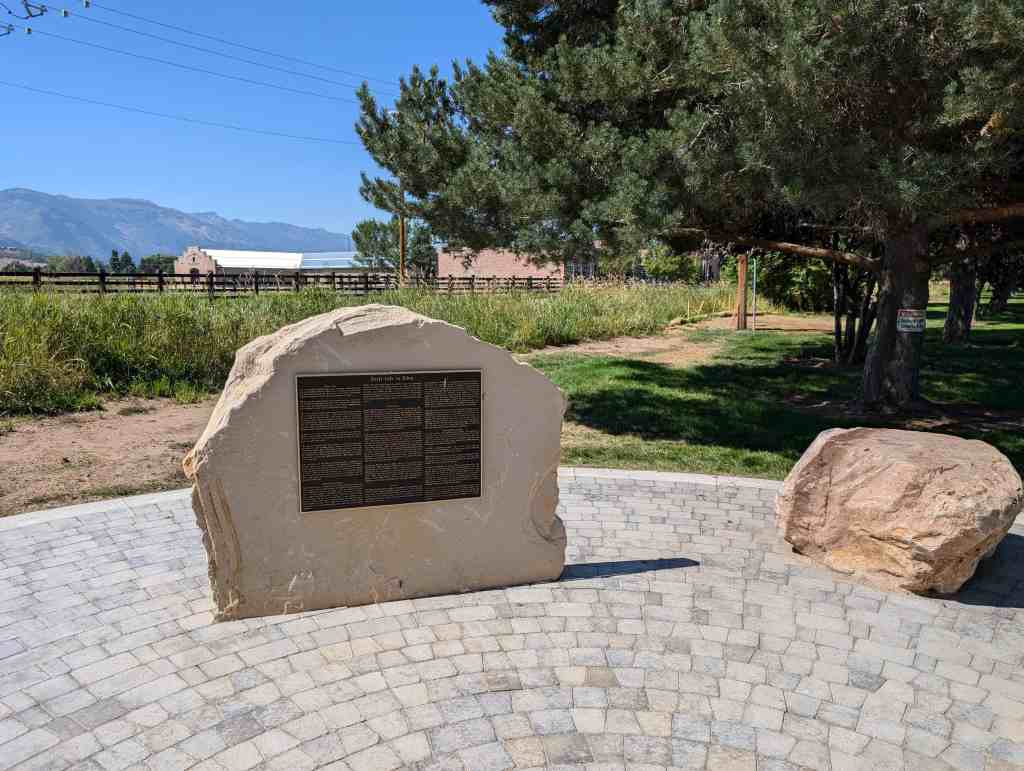
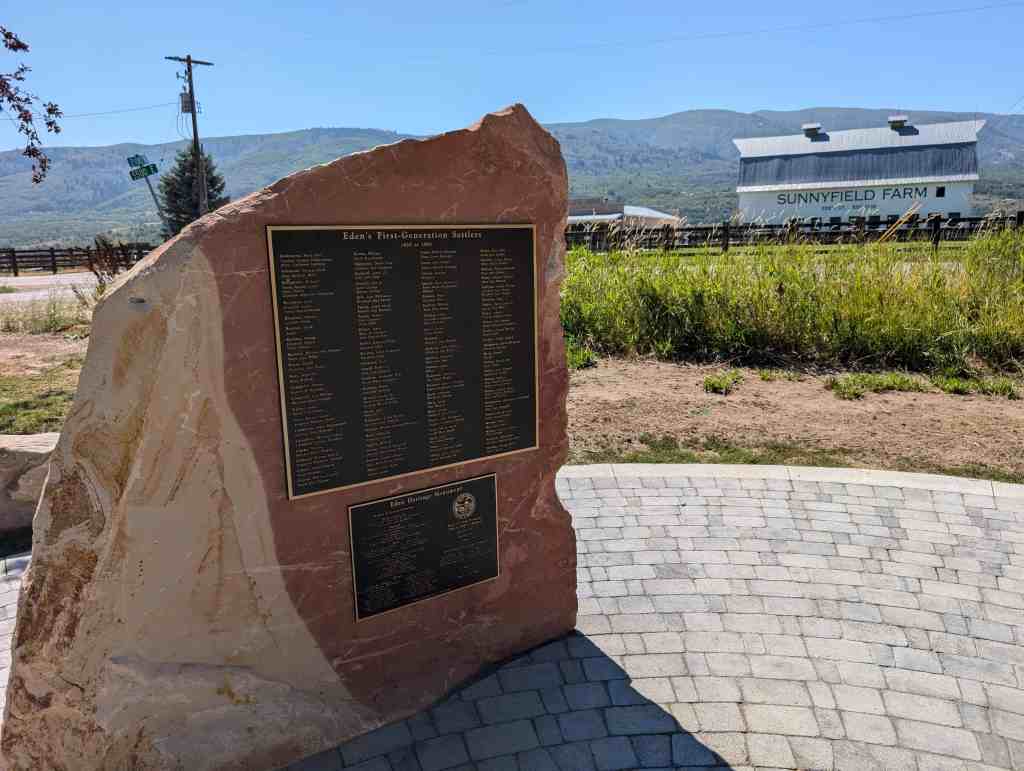
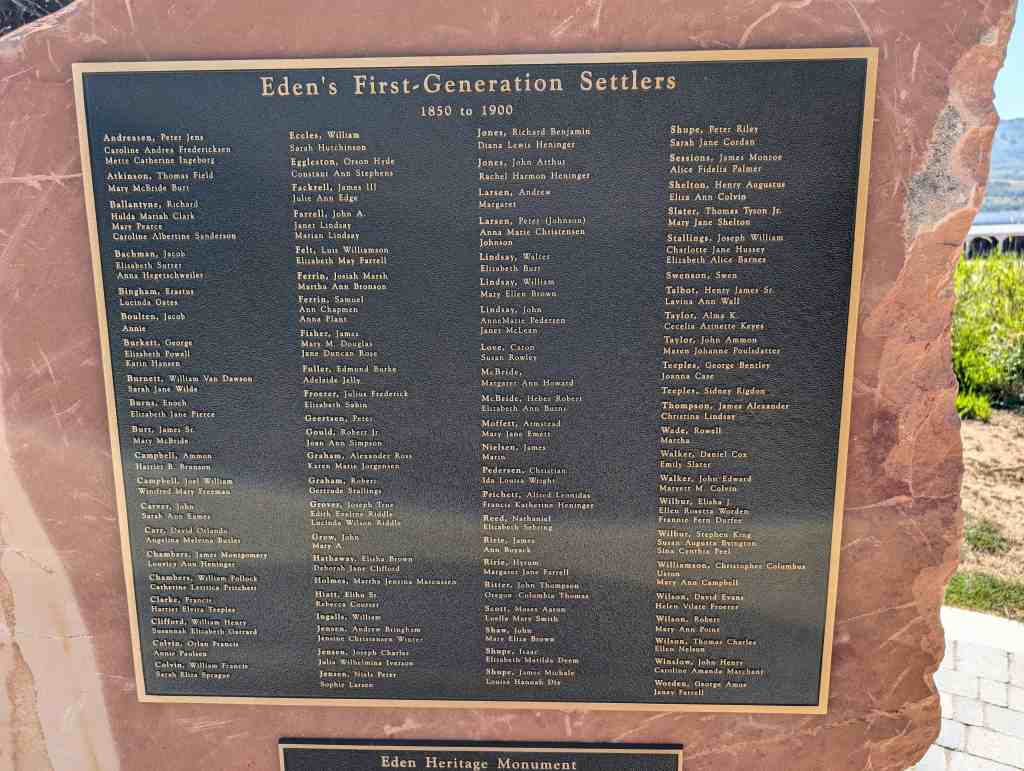
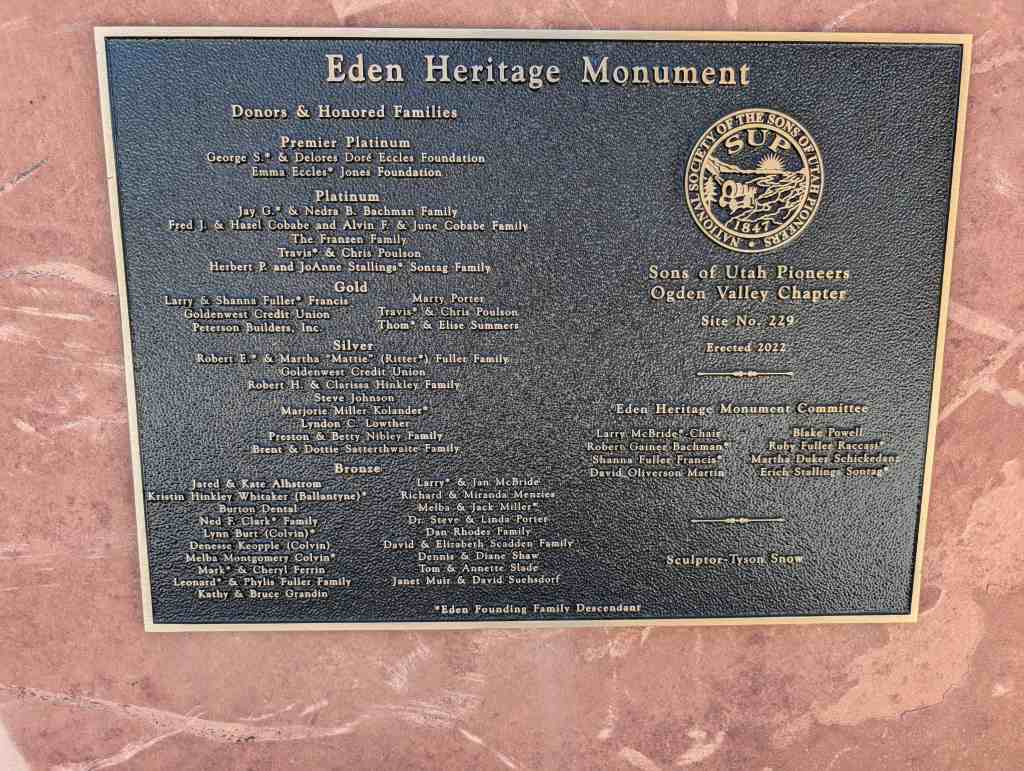


This memorial is located in the southwest corner of Eden Park which is at 5510 East 2100 North in Eden, Utah
Pingback: Eden, Utah | JacobBarlow.com
Pingback: Eden Park | JacobBarlow.com