The Thomas H. Carr Home
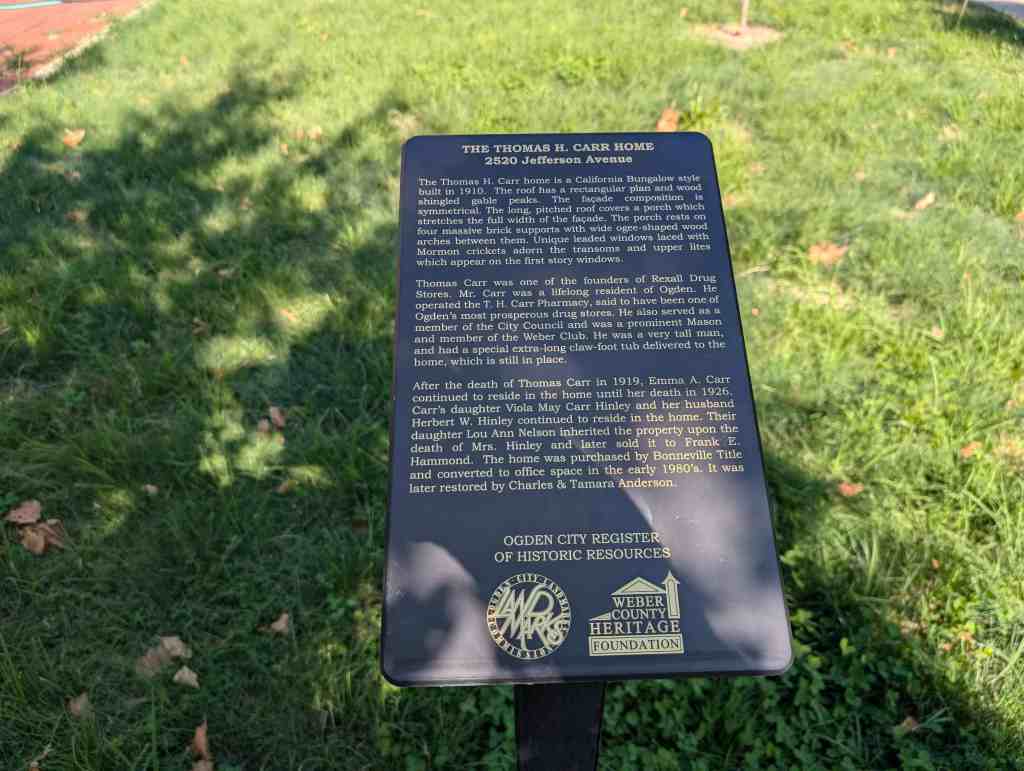
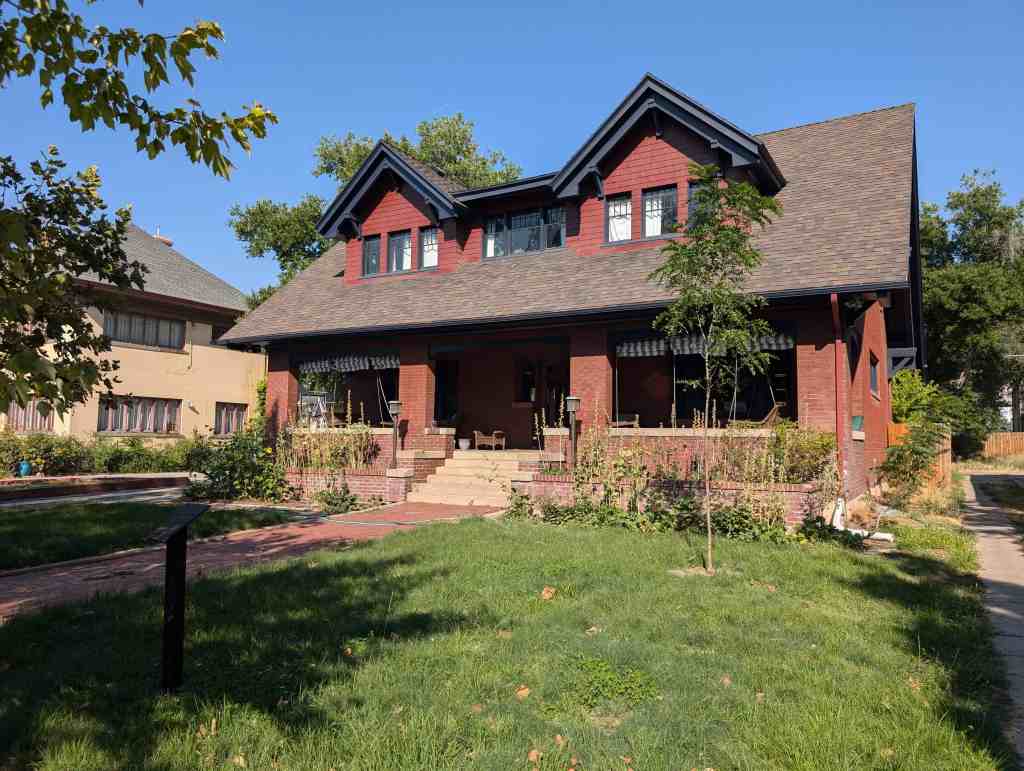
The Thomas H. Carr home is a California Bungalow style built in 1910. The roof has a rectangular plan and wood shingled gable peaks. The façade composition is symmetrical. The long, pitched roof covers a porch which stretches the full width of the façade. The porch rests on four massive brick supports with wide ogee-shaped wood arches between them. Unique leaded windows laced with Mormon crickets adorn the transoms and upper lites which appear on the first story windows.
Thomas Carr was one of the founders of Rexall Drug Stores. Mr. Carr was a lifelong resident of Ogden. He operated the T. H. Carr Pharmacy, said to have been one of Ogden’s most prosperous drug stores. He also served as a member of the City Council and was a prominent Mason and member of the Weber Club. He was a very tall man, and had a special extra-long claw-foot tub delivered to the home, which is still in place.
After the death of Thomas Carr in 1919, Emma A. Carr continued to reside in the home until her death in 1926. Carr’s daughter Viola May Carr Hinley and her husband Herbert W. Hinley continued to reside in the home. Their daughter Lou Ann Nelson inherited the property upon the death of Mrs. Hinley and later sold it to Frank E. Hammond. The home was purchased by Bonneville Title and converted to office space in the early 1980’s. It was later restored by Charles & Tamara Anderson.
2520 Jefferson Avenue in the Jefferson Avenue Historic District and in Ogden’s Central Bench Historic District in Ogden, Utah
- mentioned in Jefferson Avenue Historic District:
Thomas H. Carr (2520 Jefferson) was one of the founders of Rexall Drug Stores, and owned and operated a prosperous drug store on 25th Street.
also,
Beginning in 1906, the bungalow era arrived in the Jefferson District. The shift to the bungalow style of architecture in Utah was a reflection of the phenomenon sweeping the nation during this time: a trend toward efficient, affordable, and relatively simple homes. Bungalows replaced the Victorian cottage as the house for the middle class. Eight bungalows (2520 Jefferson, 2546 Jefferson, 2604 Jefferson, 2615-17 Jefferson, 2619 Jefferson, 2656 Jefferson, 2659-61 Jefferson, and 2687 Jefferson) were built between 1906 and 1915.