Utah Southern Railroad
On September 27, 1872, the first train chugged into Lehi to a cheering crowd and lively band. For the first time, many saw a steam locomotive with its shrieking whistle and blunderbuss smokestack. Days later, a train carrying 1,300 people to Salt Lake City could not make the steep grade at the Point of the Mountain, and passengers had to get out and push.
225 East State Street in Lehi, Utah


Utah Southern Railroad Depot
President Abraham Lincoln signed the Pacific Railway Act into law on 1 July 1862 while the country was embroiled in civil war. The transcontinental railroad, built by the Central and Union Pacific Railroads, linked their roads at Promontory Summit in Utah in 1869. The Mormon Church-owned Utah Central Rail Road Company started construction southward from Ogden one week after the driving of the “Golden Spike.” A year later Utah Central organizers incorporated the Utah Southern Railroad. A symbolic spike was driven by Brigham Young on 1 May 1871. The first train chugged into Lehi City on 27 September 1872.
The effect of the Utah Southern on Lehi was dramatic. For almost a year the town served as the terminus for the line. Teamsters and bullwackers transported goods to and from points south as well as timber and ore from the rich mines in American Fork Canyon and the Tintic District. Many local men found employment in the freighting and forwarding business. Dozens of saloons, boarding houses, and shops sprang up along State Street.
From 1872-73 the American Fork Railroad operated a narrow-gauge branch feeder line on the Utah Southern grade between American Fork and Lehi. In 1881 the Utah Central, Utah Southern, and Utah Southern Extension railroads were consolidated into the Utah Central Railway. In 1889 the line became part of Union Pacific’s Oregon Short Line & Utah Northern Railway Company. In 1897 the organization was renamed the Oregon Short Line Railroad. In 1902 it became part of the Los Angeles & Salt Lake Railroad. Since 1921 the line has remained part of the Union Pacific system.
This Utah Southern Railroad Depot, the oldest restored railroad building in Utah, and the only surviving depot of the Mormon railroad empire of the 1870s and 1880s, was restored in 2000 by the Lehi Historical Preservation Commission, a political sub- division of Lehi City Corporation. This station is listed on the National Register of Historic Places.


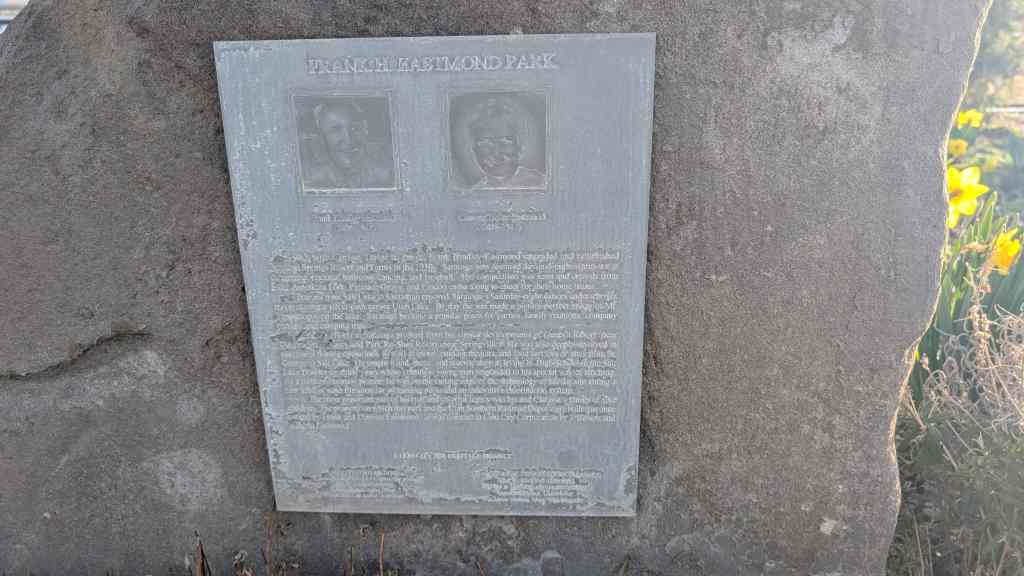
Frank H. Eastmond Park
Frank Hinsley Eastmond (1892-1961)
Clarissa Taylor Fastmond (1895-1961)
With wife Clarisse Tayler of Provo, Frank Hindley Eastmond upgraded and refurbished Saratoga Springs Resort and Farms in the 1930s Saratoga now featured day-and-night warm-water Suming regional ballroom dancing, and baseball. The competition was keen and crowds from Bebi American Fork. Pleasant Grove, and Lindon came along to cheer for their home teams.
Patrons from Sak Lake to Santaquin enjoyed Saratoga’s Saturday-night dances under a bright moon casting a silver path across Utah Lake By day the sun made a picture-perfect image of M Timpanogos on the lake. Saratoga became a popular place for parties. family reunions, company pientes and camping trips.
Franks efforts at Saratoga profited from his similar developments of Geneva Resort (near Geneva Steel Plant and Park Ro-Shea Resort (near Springville). He was also deeply involved in successful mining operations, as well as motel, outdoor theaters, and food services or sites from St George to Salt Lake. He taught wood, meta. and electric shop at Irving Jr. High School in the Sal Bake District for thirty years where countless young men responded to his special way of teaching As a modern business pioneer he was on the cutting edge of the technology of his day, inventing a new kind of sand filtration for swimming pools and an innovative chlorination system.
The most important part of his rich and colorful legacy was his and Clarissa’s family of five children: The property on which this park and the Utah Southern Railroad Depot were built was once wned by Frank and Clarissa Eastmond. It was donated to Lehi City Corporation by Jefferson and Alberta Lastmond