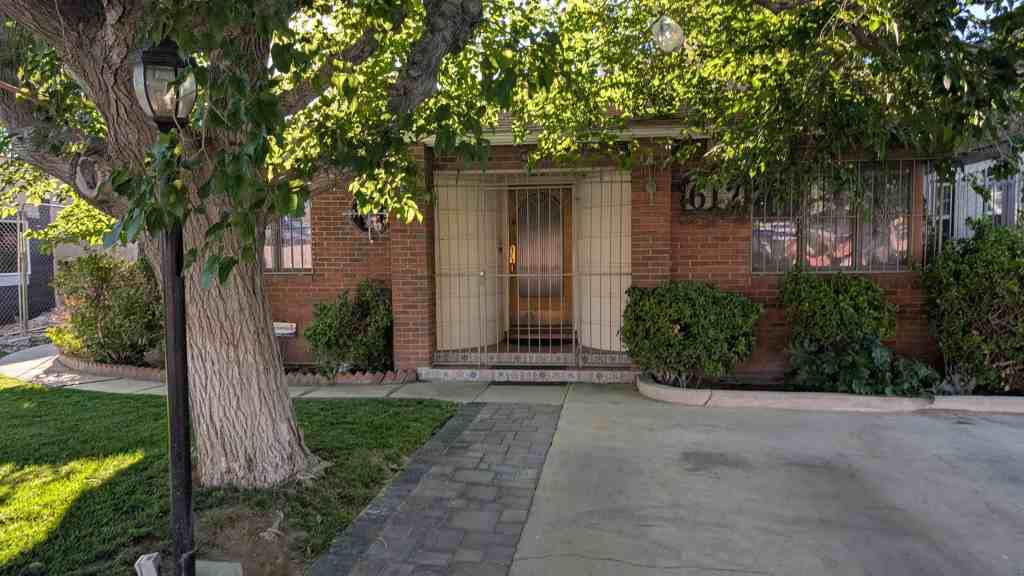
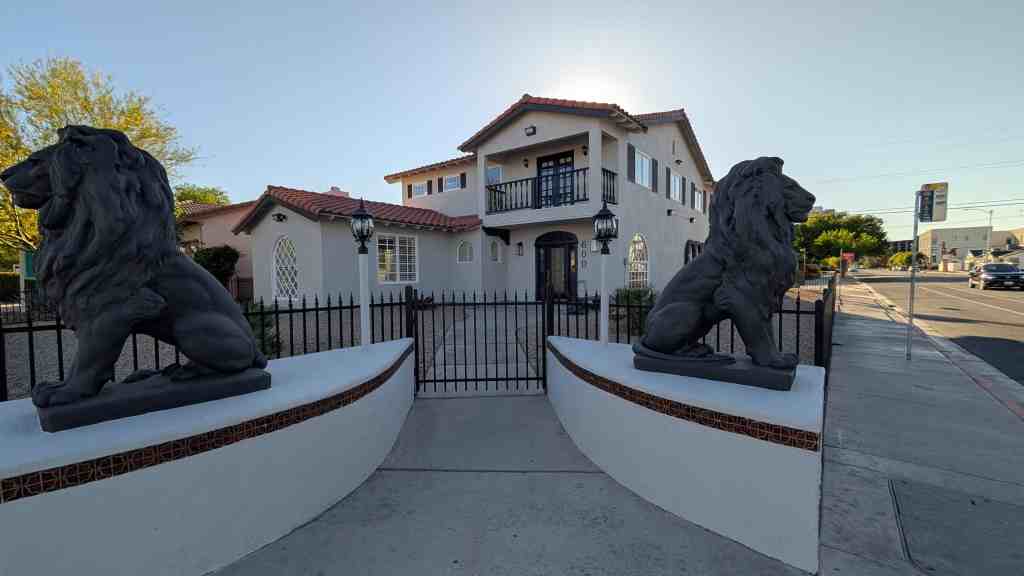
In 1911, this home was built for Mr. & Mrs. William Wright. The three homes (the Rowe, Larkin. and Morrell Homes) were originally built for three of the children of David Eccles. In 1918, the house and property was purchased by Dr. and Mrs. Joseph R. Morrell. (It is interesting to note that brother and sister (David and Bertha Eccles) married brother and sister (Julia Wright Eccles and William Wright) Dr. Morrell was a physician and surgeon in Ogden. He was head of the medical dispensary at the Defense Depot Ogden and served as surgeon for both the Union and Pacific Railroads. He was a member of the Utah Board of Health and the Utah Board of Medical Examiners, and was President of the Utah State Medical Society.*
The Canse/Weeks Home is a highly stylized American Foursquare built in 1910. The original owner of this house was J.M. Canse, who came to Ogden to be manager for the Eccles Lumber Company. The home was purchased from Mr. Canse in 1919 by Otis Weeks, who came to Ogden from Denver with his family. Otis Weeks graduated from the University of Nebraska in 1895 with a degree in civil Engineering, and later became the Engineer for the Salt Lake Division of the Southern Pacific Railroad (from 1913 until his retirement in 1940). Mrs. Weeks was extensively involved in community activities and was instrumental in establishing the Ogden YWCA. She also had an intense love of nature and beauty, which she expressed in her painting and weaving. Mrs. Weeks lived in the home until 1956.
This home was built at a cost of more than $100,000 in 1917 for LeRoy & Myrtle Eccles. Leslie Hodgson was the architect of this premier example of residential Italian Renaissance. LeRoy Eccles was powerful in the sugar industry and was vice-president and general manager of the Amalgamated Sugar Company. He was also involved with the Ogden, Logan & Idaho Railroad, the Sumpter Valley Railroad Company, the Empire Copper Company, and served as President and Director for the First National Bank and Ogden Savings Bank. The home was later sold after business reversals to E.G. Harness in 1928. Prior to his retirement, Mr. Harness was in the nursery business. He died in 1956 at the age of 96; Mrs. Harness died in 1942. A nephew, William C. Harness, owned the house after their deaths. In 1959, the home was sold to the Weber Club (a private club), at which time significant remodeling and improvements were made. Kier Corporation purchased the building in 1982 and remodeled it, pulling back much of the elegance of the original mansion. The building has been used as a restaurant, meeting rooms, wedding reception center, etc.*
Designed by Eber Piers, a student of Frank Lloyd Wright at the Chicago School of Design, and built in 1920 by Whitmeyr Construction, this home is of a classical Prairie Style. The dark brick, low-pitched gabled roof, ceiling height and windows are premier examples of this style. Born in Ogden in 1884, Royal Eccles, the son of the prominent David & Bertha Eccles, was educated in the Ogden City public schools, University of Michigan Law School and then served a mission for the LDS Church in Germany and Austria in 1909. In 1912 he took up the active practice of law. In 1920 he became the Chief Executive Officer of the Oregon Lumber Company. In 1930 he sold his corporate interests and retired to devote time to his personal affairs. He married Cleone Rich in the Salt Lake Temple, August 22. 1918. They had six children, two sons and four daughters. Royal Eccles died in 1963 and Cleone Eccles died in 1973.*
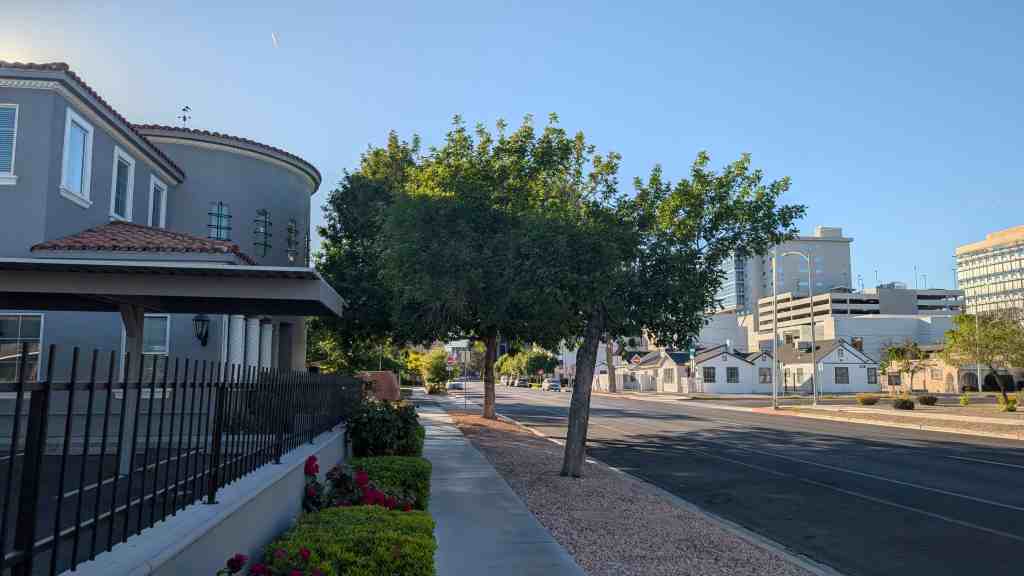
The Eccles Avenue Historic District is located in Ogden, Utah and is one of Utahās Historic Districts, it was listed on the National Register of Historic Places (#76001840) on December 12, 1976. It is located between 25th Street and 26th Street and Van Buren Avenue and Jackson Avenue.
The below text is from the nomination form for the national register:
Historical Significance: The historical significance of the Eccles Avenue Historic District is found in the prominence of the families who lived within the district’s boundaries. The Eccles, Browning, Wattis, Kiesel, Houtz and other families whose names are associated with the district’s homes were prominent in the business, civic and cultural affairs of Utah. There are few families who have made a greater contribution to the economic development of the Far West than the David Eccles family. Through the principles of hard work, thrift, and complete independency from outside capital, David Eccles, who came to the United States destitute, founded fifty-four separate businesses and earned the reputation of Utah’s “Wealthiest Citizen.” After the death of David Eccles in 1912, his son Marriner carried on in the same tradition as his father. Yet the depression of the early 1930’s brought a complete change in the economic philosophy of Marriner Eccles. Called to Washington and appointed Governor of the Federal Reserve System by Franklin D. Roosevelt, Marriner became perhaps the strongest leader of a revolution which produced an economic philosophy based on deficit spending during times of depression and government interference to manipulate the economy. This was obviously foreign to the individualistic laissez faire beliefs of his father’s generation. Perhaps the Victorian mansion of David Eccles west of the subdivision, constructed without the modernistic Wrightian characteristics of the Eccles Subdivision area, is symbolic of the difference in economic philosophies of the two Eccles.
Architectural Significance: The Eccles Avenue District is architecturally significant due to its early development of a regional form of the Prairie Style in the western states. Frank Lloyd Wright, protege of Louis Sullivan, purported “Father of Modern Architecture,” was the originator and master of the Prairie Style. “We of the Middle West,” wrote Wright, “are living on the prairie. The prairie has a beauty of its own and we should recognize and accentuate this natural beauty, its quiet level. Hence, gently sloping roofs, low proportions, quiet sky lines, suppressed heavy-set chimneys and sheltering overhangs, low terraces and out-reaching walls sequestering private gardens.”
Wright’s works were influenced by extra-regional Japanese and pre-Columbian architecture, though Wright was reluctant to acknowledge these precursors. The first Prairie houses, the Bradley and Hickox houses at Kankakie, Illinois, were designed by Wright in 1900. His first masterpiece in the style was the Willits House, designed in 1901 at Highland Park, Illinois. The Robie House (Chicago, 1908), the Beachey House (Oak Park, 1906) and Alien House (Wichita, 1917) were other exceptional Wrightian Prairie houses.
Concurrent with Wright’s work were the designs of several other Prairie School architects, many of whom had worked with Wright, but one of whom rivaled Wright in the mode although several did build some fine houses. Architects who had direct links with Chicago as well as builders who were impressed by Wrightian illustrations in the “Inland Architect” and other magazines quickly spread the Prairie Style throughout the country. Utah seems to have been particularly impressed with the style and indeed led the Western U.S. in adopting the new progressive house form. Architects such as Taylor Wooley, Clifford Evans, Miles Miller, Pope and Burton, and Ware and Treganza introduced Prairie Style buildings to Utah as early as 1909. The LDS Church was the only American religious group to make major ecclesiastical utilization of the style. The Dooley Building (1894, by L. Sullivan) excepted, the first example of modern architecture in Utah was the LDS Park First Ward, recently nominated to the National Register.
While several Prairie buildings were erected in Salt Lake City, the major impact of the style was felt in Ogden where numerous LDS churches and the David Eccles Subdivision composed of homes designed by Eber Piers and Leslie Hodgson, employed Prairie School architecture in a strikingly inno- vative regional manner. Together, these buildings represent the initial inroad of this significant American architectural mode in the Intermountain West.
History: The settlement of Ogden dates back to 1845 when Miles Goodyear built a log cabin on the Weber River, two miles above the Ogden River confluence to serve as a supply station for California-bound emigrants. In November 1847, James Brown purchased the Goodyear holdings amounting to nearly 225 square miles for $1,950.
In the early spring of 1848, Brown and his family moved to the Goodyear cabin site. They were soon followed by other settlers. Originally called Brown’s fort or Brownsville by the Mormon settlers, the settlement was incorporated into the city of Ogden established in 1850 between the forks of the Weber and Ogden Rivers. Ogden grew rapidly, especially after the coming of the railroad in 1869, and by 1910 Utah’s second largest city had a population of approximately 27,000.
In 1910, construction began on the first homes located on Eccles Avenue. Although not all of the thirteen homes identified as part of the district belonged to members of the David Eccles family, seven did and the remaining six were originally owned by friends and business associates of David Eccles.
David Eccles life could have been the theme for a Horatio Alger novel. Born May 12, 1849, near Glasgow, Scotland, Eccles was forced to begin his business career at an early age when his father, a wood turner by trade, suffered almost a complete loss of sight from double cataracts on his eyes. Supplied with kitchen utensils made by his father and resin sticks used to ignite coal fires, the eleven year old David journied to neighboring towns to peddle his wares. In 1863, at the age of fourteen, David Eccles and his family emigrated to Utah with help from the LDS Church Perpetual Emigration Fund. After working in Utah and Oregon sawmills, and the Almy Wyoming coal mine, David took a contract in 1872 to supply logs to a portable sawmill. This venture led to further investment in the lumber industry first in Utah then Idaho, and by 1887 in Oregon. His success in the lumber industry made possible other investments in railroads, beet sugar refineries, food processing enterprises, construction, coal, land, livestock, banks, and insurance companies. After his death in 1912, his estate was valued at over six million dollars. During his business career he had founded 54 different enterprises. His biographer, Leonard Arrington wrote:
To a poorly educated person from a family with no savings or social status, the only way out of poverty was hard work and careful use of time and resources. Eccles therefore concentrated his efforts toward the goal of accumulation. He did not expend his energies in “church activities,” nor in striving for social recognition, nor in unproductive political debate, nor in the pursuit of pleasure. Every moment, every ounce of energy, every expenditure had to count toward the goal of accumulation and profit. This was not a driving preoccupation but a pattern of life he knew was right. He was neither tense nor humorless; he enjoyed his work and his endeavors to turn a profit. He worked with gusto, relished the attempt to make business succeed, found pleasure in investing in new enterprises. But he was careful, prudent, and shrewd. This was habitual with him and not just a “show” to induce a spirit of economy among his employees. David Eccles, pp. 126-127
In keeping with the standard set by prominent men of good standing in the Mormon Church before 1890 David Eccles married two women. His first wife and her family lived in Ogden and their home, now known as the Bertha Eccles Art Center has been listed on the National Register of Historic Places. It was for three of the older children of Bertha that David built homes on Eccles Avenue in 1911. The other children of Bertha and Ellen had homes of their own or were not married before the death of David in 1912 and therefore did not receive the same wedding presents.
The Eccles family continued to play a significant role in the economic history of Utah, the west, and the nation after the death of David Eccles.
Two separate companies, representing the two families, were organized. The Eccles Investment Company, which represented the interests of Ellen and her children, was managed by the oldest son Marriner Eccles. Although his economic philosophy came to differ greatly with that of his father, Marriner proved his father’s equal and expanded the families inheritance in a manner reminiscent of his father. Under Marriner’s direction, the Eccles Investment Company soon became much more successful than the David Eccles Company. In the settlement of the David Eccles estate, Bertha and her children received approximately 5/7’s of the estate while Ellen and her children only 2/7’s. This led to an apparent rivalry between the two family companies, at least in the eyes of Marriner. On one occasion Marriner visited David C. Eccles, his oldest half brother, to discuss a change in policies for the Oregon Lumber Company, in which both families had an interest. Marriner recounted the discussion in the following manner. “He [David] went on to say that he was getting sick and tired of my interference and he wished I would mind my own business. I was a damned nuisance, he said, and he didn’t want me to cause him anymore trouble. This was climaxed by an invitation to get out of his office at once.” (Eccles, Beckoning Frontiers, p. 46.)
Despite the strained business relations, personal and family relations between the Ogden and Logan group were much more tolerable. In 1923, when Marriner moved from Logan to Ogden, he purchased a house just west of Eccles Avenue. In 1922, Marriner Eccles and Marriner Browning, who lived at 2565 Eccles Avenue and was the nephew of the important Ogden gun manufacturer, John Moses Browning, pooled the Eccles and Browning family resources to form what became the first Security Bank of Utah. It was his experience in this enterprise which trained Marriner for his position as Governor of the Federal Reserve Board and the author of many major New Deal Banking Reforms. Marriner inherited an economic philosophy from his father in which the elder Eccles “ā¦produced his own capital for all his ventures, saying that a business, like an individual, could remain free only if it kept out of debt, and that the west itself could remain free only if it kept out of debt to the East.” (Eccles, Beckoning Frontiers, p. 20.)
The Marriner Eccles home on Van Buren Street was originally one of three homes comprising the Wattis compound. The compound included the home of E.G. Wattis and two matching houses built on adjoining properties for his daughters, Mrs. E.R. Dumke and Mrs. Roscoe Gwilliam. E.O. Wattis, along with his brother William H. Wattis, were owners and business partners of David Eccles and later Marriner Eccles in the Utah Construction Company. The company was responsible for the construction of the Western Pacific Railroad line from Salt Lake City to Groville, California, in the first decade of the 20th Century. In the 1930 Ts the Utah Construction Company formed the nucleus of a six company consortium which built the Hoover Dam on the Lower Colorado River.
The Eccles Avenue Subdivision was created in 1909 by David Eccles who deeded lots to his family and selected other Ogden families. Two Ogden architects, Leslie O. Hodgson and Eber F. Piers, practiced independently but cooperated and coordinated their efforts in the planning and designing of the unique neighborhood. Each architect had previously been attracted to and enamored with the contemporary Prairie Style and the two determined to make the new residential style the dominating architectural theme of the project. The prairie-like setting of the subdivision was appropriate and the selected owners were pleased that the subdivision would have a certain unity and progressiveness designed into it to set it apart from surrounding neighborhoods and their eclectic architecture. Each architect designed approximately half of the significant structures and both proved capable of working within the chosen motif.
Leslie O. Hodgson was a native son of Utah, born in Salt Lake City on December 18, 1879. His father, Oliver Hodgson, a Mormon convert and Utah pioneer of 1850, was a leading builder and contractor in Salt Lake City and introduced his son, Leslie, to the architectural trade. Leslie studied architecture as a draftsman in the offices of two of Utah’s most prominent architects, Samuel C. Dallas and Richard K.A. Kletting. Hodgson then gained valuable exposure to modern residential trends as chief draftsman with the firm of Hebbard and Gill in San Diego, California. Irving Gill had worked in the Chicago office of Adler and Sullivan before moving to San Diego in 1893 and was undoubtedly acquainted with Frank Lloyd Wright who had also worked closely with Sullivan. Upon returning to Ogden to establish his own practice in 1905, Hodgson was well exercised in designing buildings in contemporary American styles. In 1906 Hodgson became the partner of Julius A. Smith, of Ogden. Young Eber F. Piers later became a draftsman for the firm. The firm of Smith and Hodgson was very prolific until its dissolution in 1910, the year the Eccles Subdivision began to materialize. During the initial year of Smith and Hodgson’s existence, the firm published a book, Architecture of Ogden; J.A. Smith and Leslie S. Hodgson, Architects, 1906-07.
The publication displayed photographs of the major works of the firm including Hotel Bigelow (now Ben Lomond Hotel), Peery’s Egyptian Theatre, Union Stock Yards, Elk’s Lodge, Washington School, Lorin Farr School, and numerous other public, commercial, religious and residential buildings. Many of Hodgson’s designs showed a flare for the Prairie Style. The Prairie Style residences designed by Hodgson in the Eccles Subdivision were those for James Canse (1914), John S. Houtz (1910), LeRoy Eccles, later Elijah A. Larkin house (1911), LeRoy Eccles, later Weber Club (1917), William Wright (1911), Hugh M. Rowe (1911), and Patrick Healy, Jr. (1920).
Leslie S. Hodgson was a versatile architect and designed comfortably in several styles. He worked with Neo-Classical Revival, Western Stick Style, Bungaloid and Modernistic (Art Deco) designs. He was the leader in introducing Art Deco to the Intermountain region. His Ogden City and County Building, Ogden High Schook, Regional Forest Service Administration Building, and Tribune Building remain the most significant monuments of the Modernistic Style in Utah. The Healy house on Eccles Avenue was a sensitive “Old English Cottage” design.
Hodgson also employed the Prairie Style in religious and commercial buildings, the LDS Deaf Branch and Nye Building being the best extant examples. Official architect for the Ogden School Board and architect for federal agencies during World War II, as well as for the Eccles and Scowcroft families and their vast financial empires, Hodgson obtained the largest and most prestigious design commissions of his day. As a consequence, much of the modern appearance of Ogden and northern Utah may be attributed to this significant architect. Hodgson served as President of the Utah Chapter of the American Institute of Architects. He died in Ogden the 26th of July, 1947.
Eber F. Piers had only recently entered the architectural profession when he began designing residences in the Eccles subdivision. Piers was not listed as an architect in Ogden business directories until 1910, the year of commencement of buildings in the subdivision. Piers designed homes for Edmund O. Wattis (1914), Mrs. Ruth Wattis Gwilliam (1917), Ezekiel Dumke (1917), Virginia Houtz Green (1914), Royal Eccles (1920), and Marriner Adams Browning (1914). Piersr homes were all completed after 1913, making him a latecomer to the project. Nevertheless, his designs were harmonious with Hodgson*s earlier works and were, in fact, more properly Wrightian or Prairie Style.
A comparison of the works of the two architects seems worthwhile. Hodgson’s homes, while essentially Prairie Style, were often heterogeneous in design. The Houtz residence has, in addition to Wrightian decorative vocabulary, classical brackets in large and small sets under the eaves of the porch, main roof and dormers.
The Week’s house is sheathed with clapboard on the first story and shingles on the second story^ making it the only all-wood residence on Eccles Avenue. The home is devoid of special decoration, is box-like in massing and is only mildly suggestive of Wrightian influence.
The home of LeRoy Eccles is one of the largest structures in the subdivision and later became the house for the Weber Club, a private Men’s Club. The building has Prairie Style features but again deviates from the norm with its tile roof, Tuscan columned front porch and porte cochere, and classically bracketed frieze. The art glass windows with Mediterranean scenes and Roman arched bays also reflect classicist ornamentation.
The William Wright house is a brick structure due south of and nearly identical in design to the Week’s residence. The home is unpretentious, straightforward and common in appearance.
The older LeRoy Eccles home, later the Elijah Larkin House, is one of the oldest and most eclectic residences in the district. It appears to be a hybrid mix of Neo-Classical Revival, Southern Colonial and perhaps Prairie Style. Due to its individualistic expression, the home seems out of character but does not distract from the district. Rather, it enhances the visual variety of the area and provides interesting contrast to buildings such as the Hugh M. Rowe home, the Hodgson design which most closely resembles a Wrightian Prairie Style dwelling.
The one home that definitely seems out of place is the Patrick Healy, Jr. residence, now the Real Estate Exchange Offices. The last home built in the subdivision, the Healy residence has been described by architect, John Piers (son of Eber Piers) in glowing terms: “The Healy home is a masterful work in the development of Old English (Cottage Style) architecture. The house has a high pitched roof punctuated by a series of dormer windows, successfully contrasted with a stucco base to form an attitude of restful domesticity. The rounded arches, the tapered brick chimney, and a canopied entrance door are remindful of an era of English Art Nouveau. This is one of the most sensitive designs in Ogden.”
It is apparent that while Hodgson set the general theme for architectural design in the Eccles Subdivision, he was not intent on copying Wright or following the Prairie Style theme to a fault. His interest seems to have been to provide beautiful, livable homes which, though varied in design, had a familial resemblance. It was left to Eber F. Piers to really give the subdivision its distinct Prairie Style flavor.
Piers approached the task of continuing the thread of Hodgson’s Prairie Style format with greater commitment to stylistic purity than his prede- cessor. None of Pier’s designs were greatly diluted or “enhanced” with Neo-Classical Revival or other alien details. His designs were characteristically Wrightian, featuring two storied, low-hip roofed masses with single- story wings, porches and carports reaching out in several directions, deep eaves, emphasis on the horizontal, (especially through brick banding), oblong chimneys, ribbon windows with wooden casements, 2/3 to 1/3 height relationship of ground story to second story, brick bottom stories and plaster upper stories, heavy rectangular piers supporting porch roofs and verandas, occasional prow roofs on smaller homes, etc. Piers was also fond of Wrightian pier ornamentation and used it tastefully. A few dormers which have been added since initial construction are the only intrusions upon Piers’ carefully conceived Prairie Style designs. Yet his homes were not purely imitative; they were unique in their own ways. The plans, for example, were not as open as Wright’s were. Cantilevered concrete construction and other technological features were not employed. Piers’ architecture met the needs of his clients, as did Hodgson’s. Their contribution was one of regional introduction and development of one of America’s important architectural movements.
Robert Turner purchased the undeveloped corner lot from Silas Hanchett in 1885 and construction began several months later. The building was completed during the early spring of 1886 and was the pride of the town. The Roberts Brothers Grocery Store occupied the first floor from 1886 until 1917. The second floor was often used for meetings, fancy dress balls and dances. The Bank of Idaho Springs moved into the Turner Building during the summer of 1918 and changed its name to First State Bank in 1944.
mentioned in University Neighborhood Historic District: Representative examples of the Period Revival styles include the house at 1219 East 400 South that was built in 1929, probably as a speculative house, by Henning Henderson. The steep gable entrance and tudor arched doorway in this brick house is typical of the English Cottage. The one-story house at 1155 East 400 South is another model of a English Cottage that has included decorative brickwork on the bottom wall courses and brick lintels. It was built c.1932 by Tressa A. Dontre. The house at 175 South 1200 East is a one-and-one-half story version of the Tudor Revival style. The builder and first resident of this house was Glenn R. Bothwell, a developer who also built several other residences in the neighborhood.