
Tags

The Womans Tonic. Dr. Pierce’s Favorite Prescription.
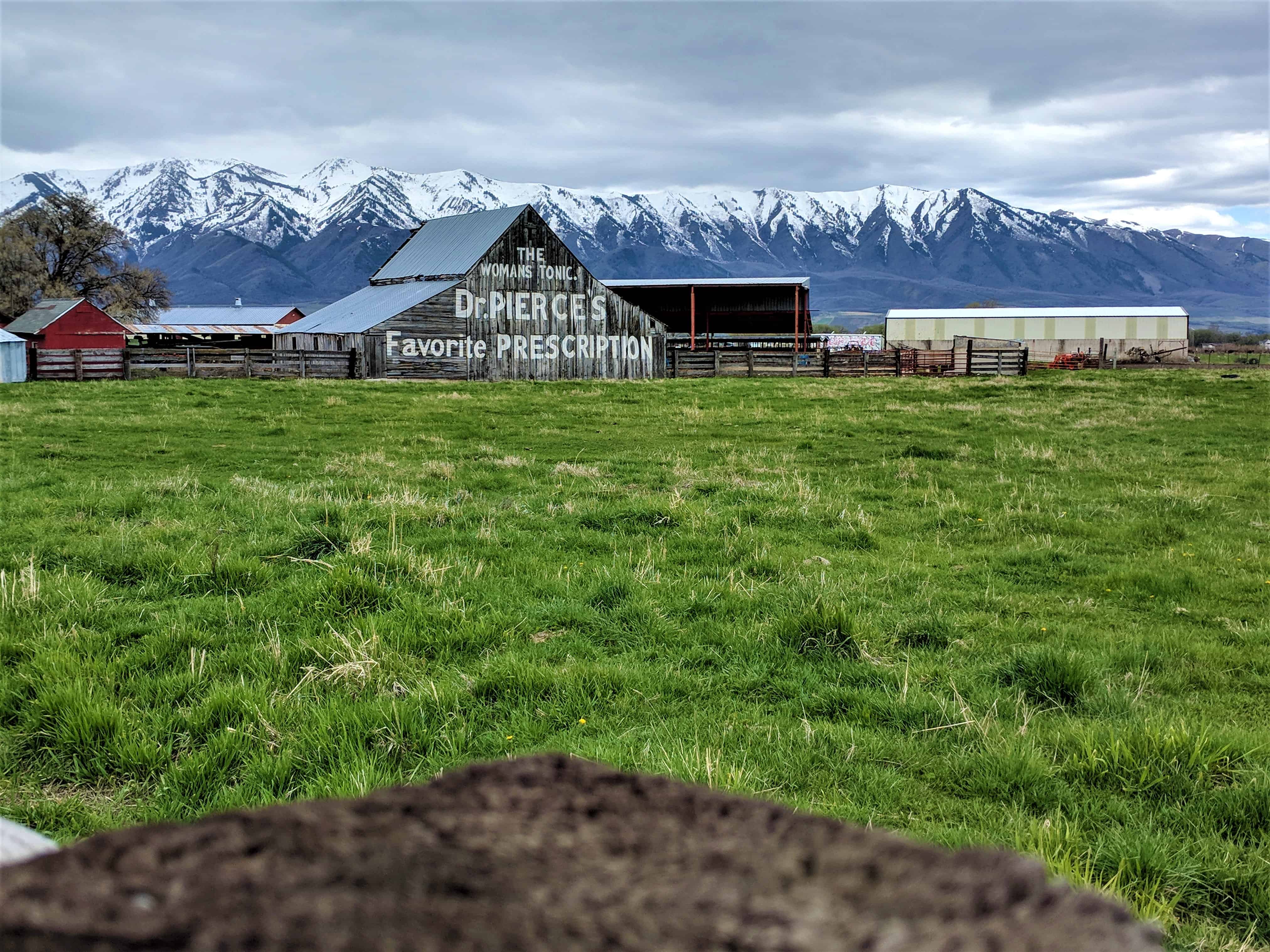
Off the highway in College Ward when you’re leaving Logan and heading toward the canyon to go up and over the pass to Brigham City you can see off to the right an add for “The Womans Tonic. Dr. Pierce’s Favorite Prescription.” on the side of a barn.
I’ve always loved the old look of it, I wondered if it was real for many years but after looking into it I found it it was a very popular product that sold millions of bottles through the mail and claimed to instantly cure any problem a women had.
Over 100 years ago the add was painted on the barn and $10 a year was paid for some time. The company went out of business in the 1940s but the add still stands.

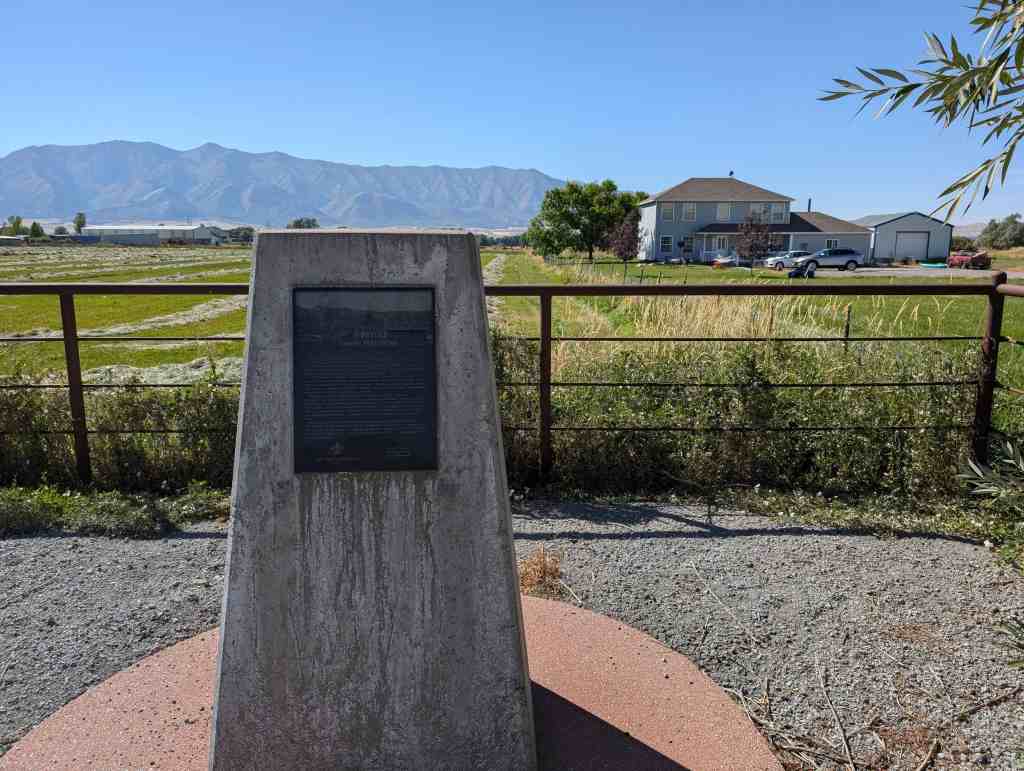
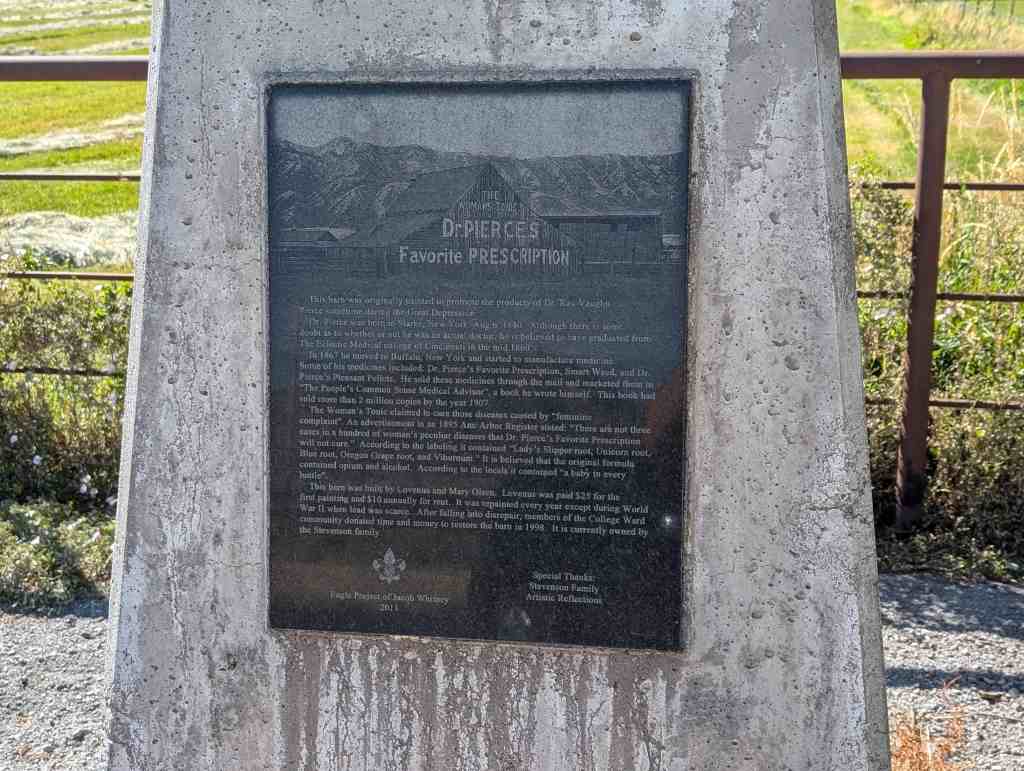
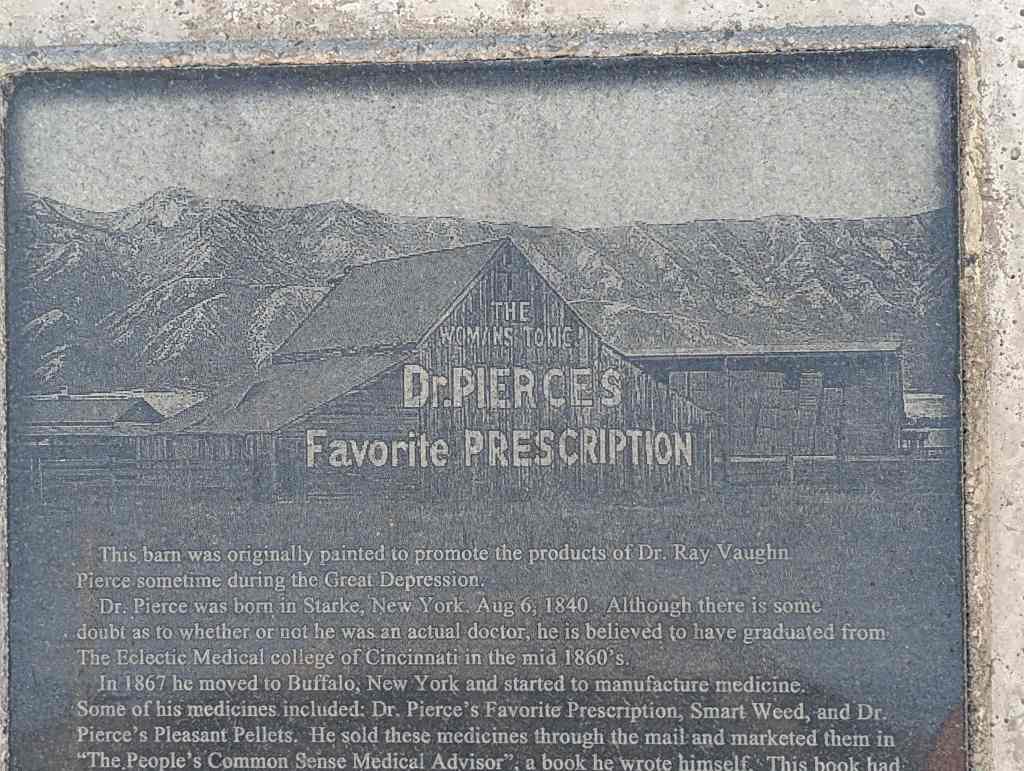
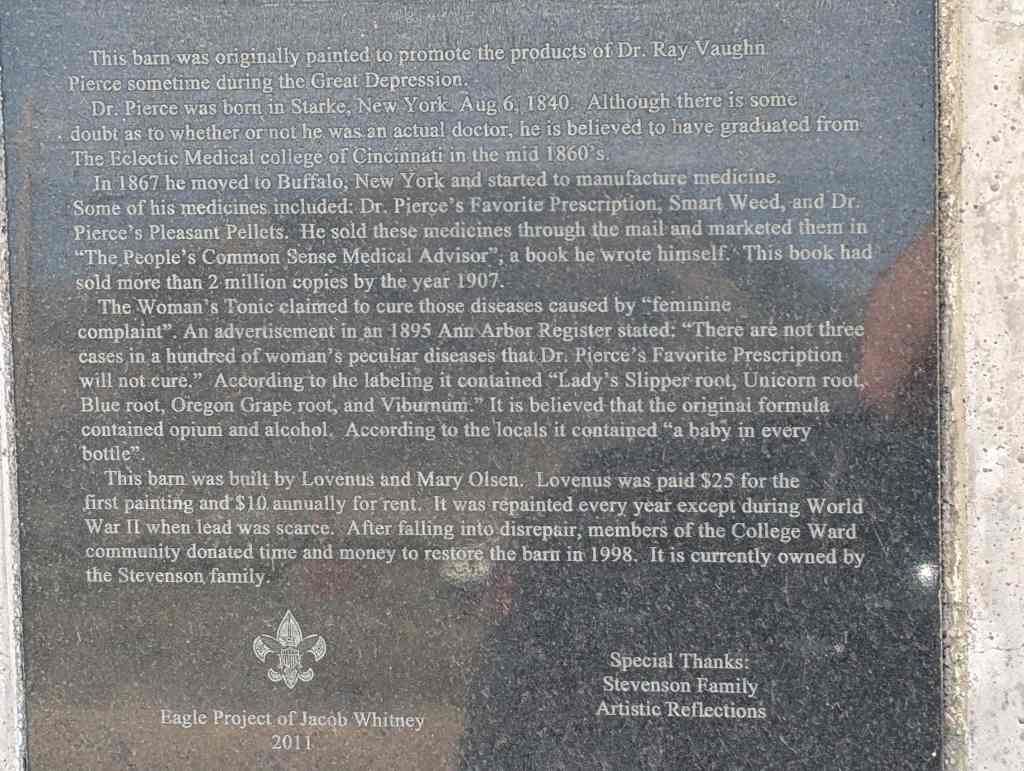
A 2011 Eagle Project of Jacob Whitney is a monument stating:
This barn was originally painted to promote the products of Dr. Ray Vaughn Pierce sometime during the Great Depression.
Dr. Pierce was born in Starke, New York. Aug 6, 1840. Although there is some doubt as to whether or not he was an actual doctor, he is believed to have graduated from The Eclectic Medical college of Cincinnati in the mid 1860’s.
In 1867 he moved to Buffalo, New York and started to manufacture medicine. Some of his medicines included: Dr. Pierce’s Favorite Prescription, Smart Weed, and Dr. Pierce’s Pleasant Pellets. He sold these medicines through the mail and marketed them in “The People’s Common Sense Medical Advisor”, a book he wrote himself. This book had sold more than 2 million copies by the year 1907.
The Woman’s Tonic claimed to cure those diseases caused by “feminine complaint”. An advertisement in an 1895 Ann Arbor Register stated: “There are not three cases in a hundred of woman’s peculiar diseases that Dr. Pierce’s Favorite Prescription will not cure.” According to the labeling it contained “Lady’s Slipper root, Unicorn root, Blue root, Oregon Grape root, and Viburnum.” It is believed that the original formula contained opium and alcohol. According to the locals it contained “a baby in every bottle”.
This barn was built by Lovenus and Mary Olsen. Lovenus was paid $25 for the first painting and $10 annually for rent. It was repainted every year except during World War II when lead was scarce. After falling into disrepair, members of the College Ward community donated time and money to restore the barn in 1998. It is currently owned by the Stevenson family.




Historic Barns (College Ward)*
“Dr. Pierce’s” Barn
College Ward, 1904
This Intermountain style barn was built by Lovenus and Mary Olsen, Swiss Mormon farmers. Work horses were sheltered in the west lean-to. The east leanto was added in the 1940s when Ike Olsen began dairying. There is no loft—hay was stacked on the ground in the center part of the barn.
The “Dr. Pierce’s Favorite Prescription” sign was painted sometime during the Great Depression. The landowner was paid $25 at the time of the first painting and $10 per year thereafter for use of the side of the barn as a billboard. Now, because it has become a beloved landmark, the sign has been periodically repainted.
In 1998, a group of neighbors in the area, with the owners and several local businesses who donated materials, straightened the barn and reinforced it. The farmers of College Ward feel that this barn belongs to the community, and they did not want to see it fall down. Further stabilization work was done in 2002 by the Utah Conservation Corps and the Bear River Association of Governments.
Dr. Pierce’s Favorite Prescription was a patent medicine of the time. According to labeling on old packages, the concoction contained no alcohol or opium, but did contain “Lady’s Slipper root (cimicifuga Racemosa), Unicorn root (Helonias Dioica), Blue Cohosh root (Caulophylloum Thalictroides), Oregon Grape root (Berberis Aquifolium), Viburnum.”
Location: 2595 S. Highway 89/91, north of Wellsville Viewing directions: Either pull off at the side of Highway 89/91, or turn west onto the side road that is just north of the barn (1600 West).
Pingback: College Ward, Utah | JacobBarlow.com
hello I live there so yeah Im the kid
I bought a publication that has a lot of content about how wonderful the product is. From 1898.