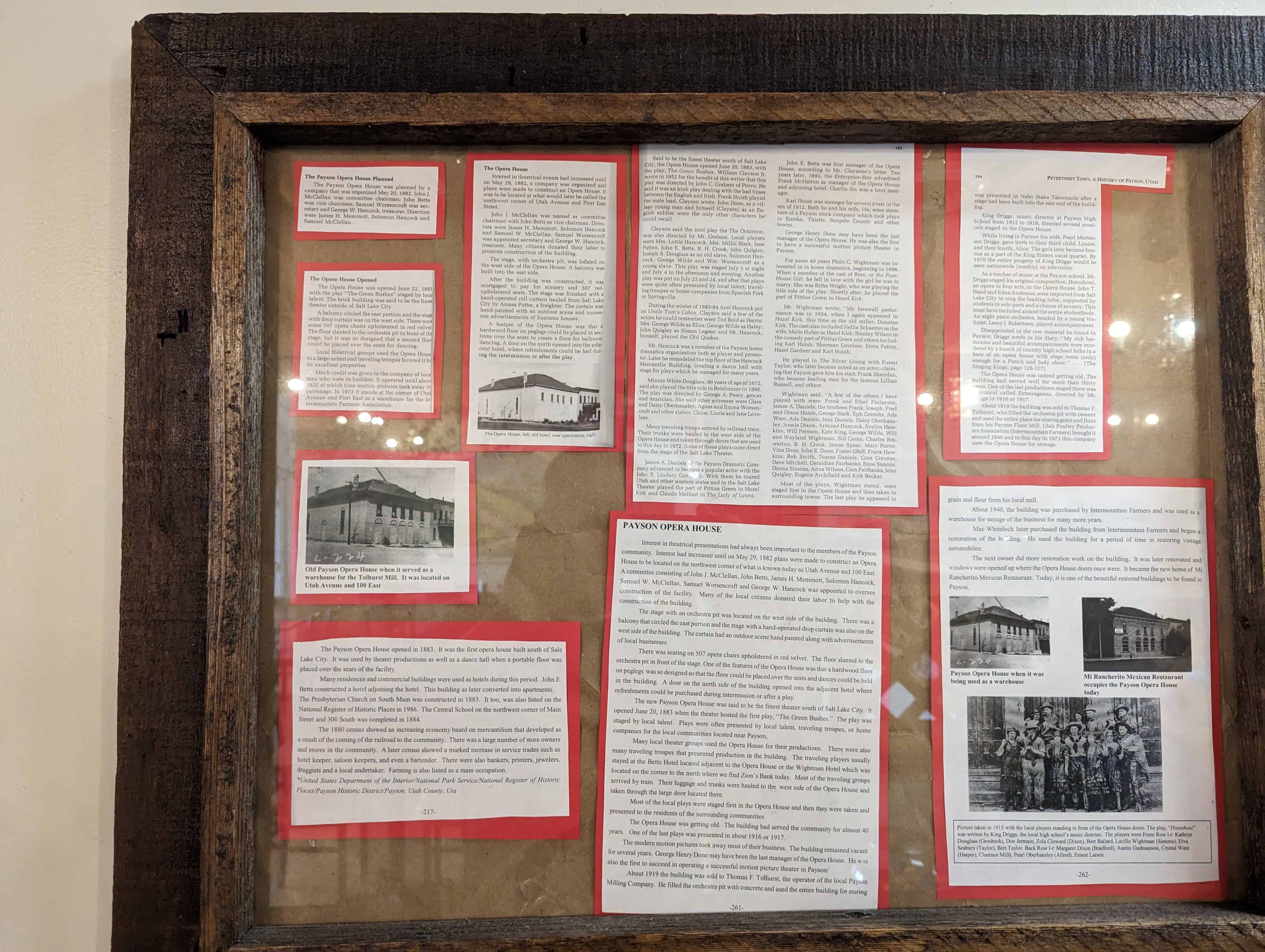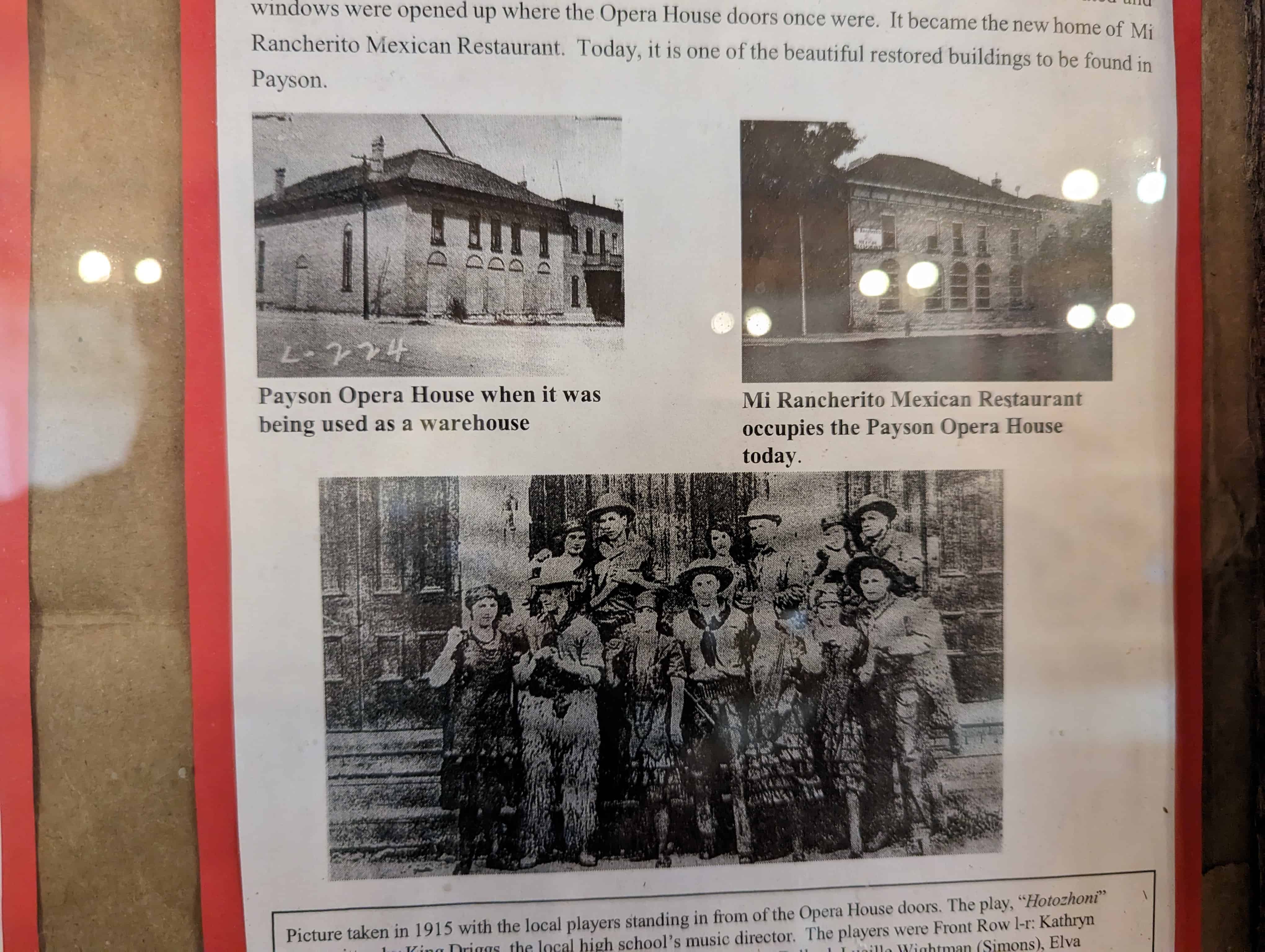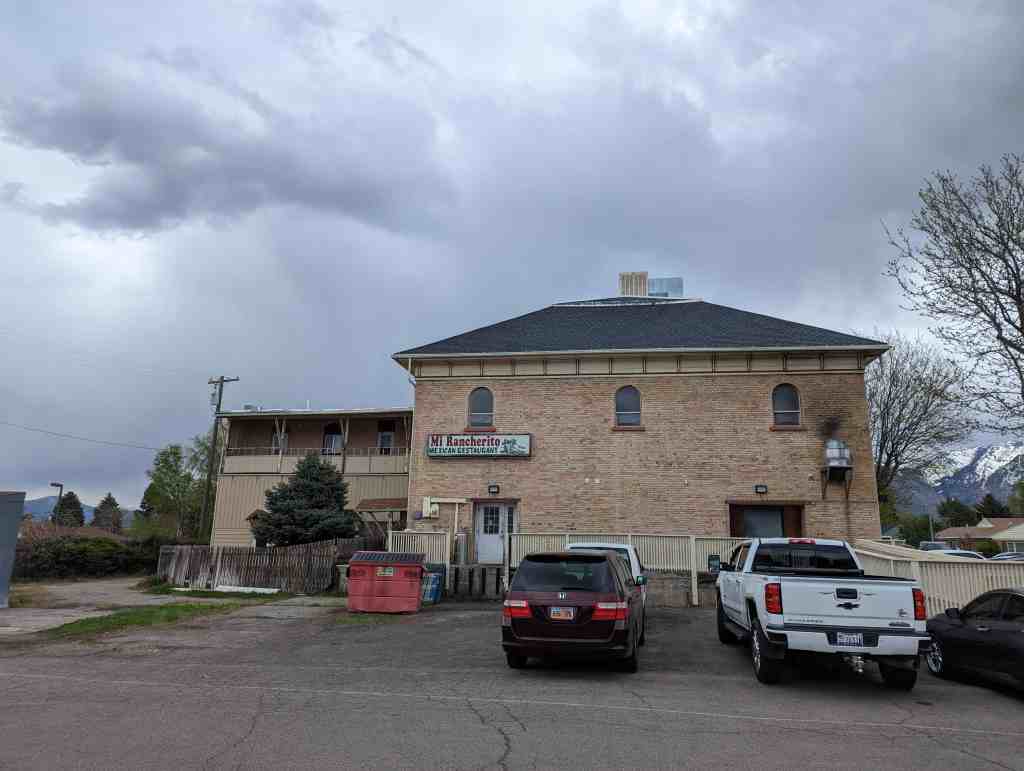
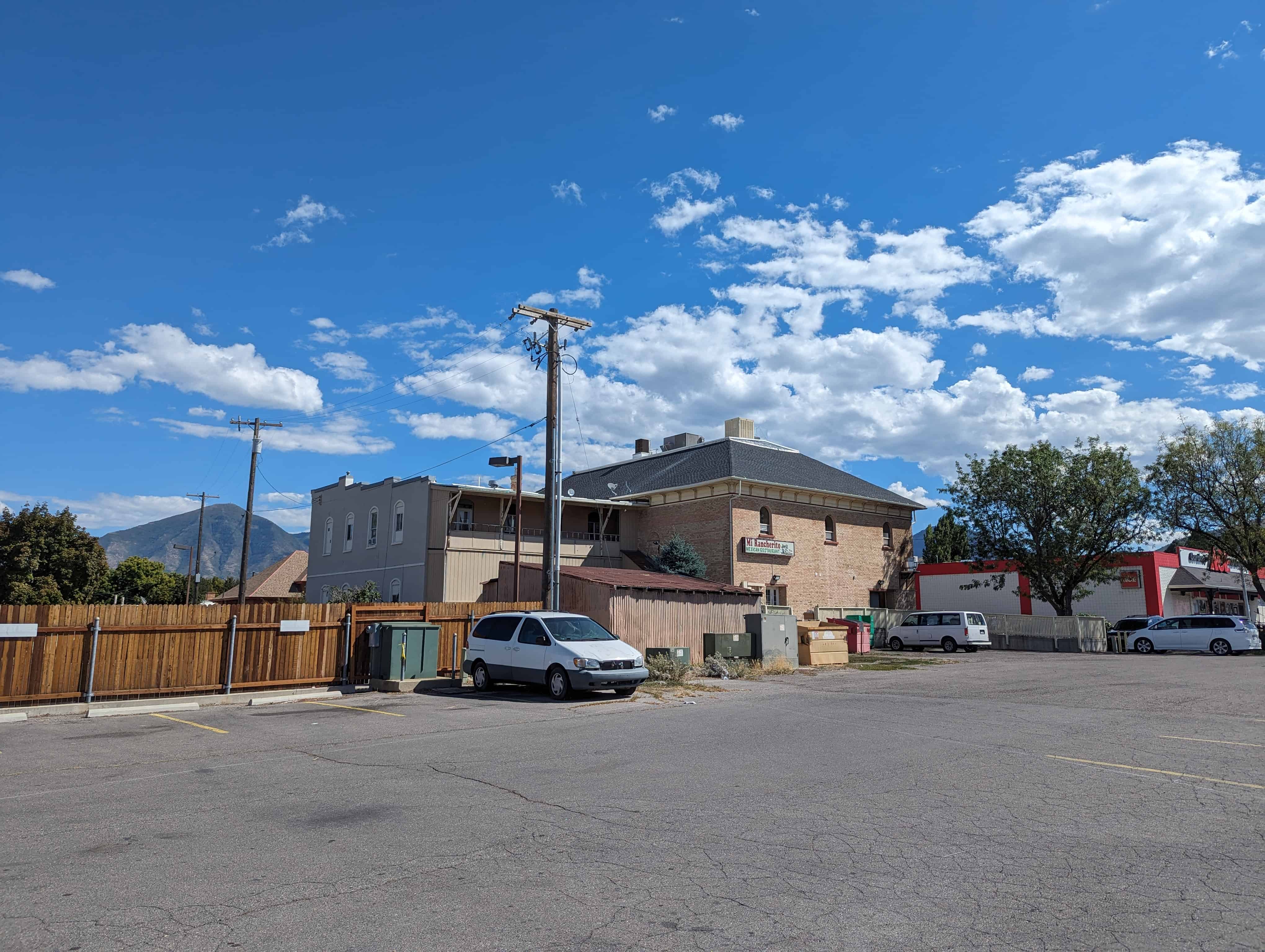
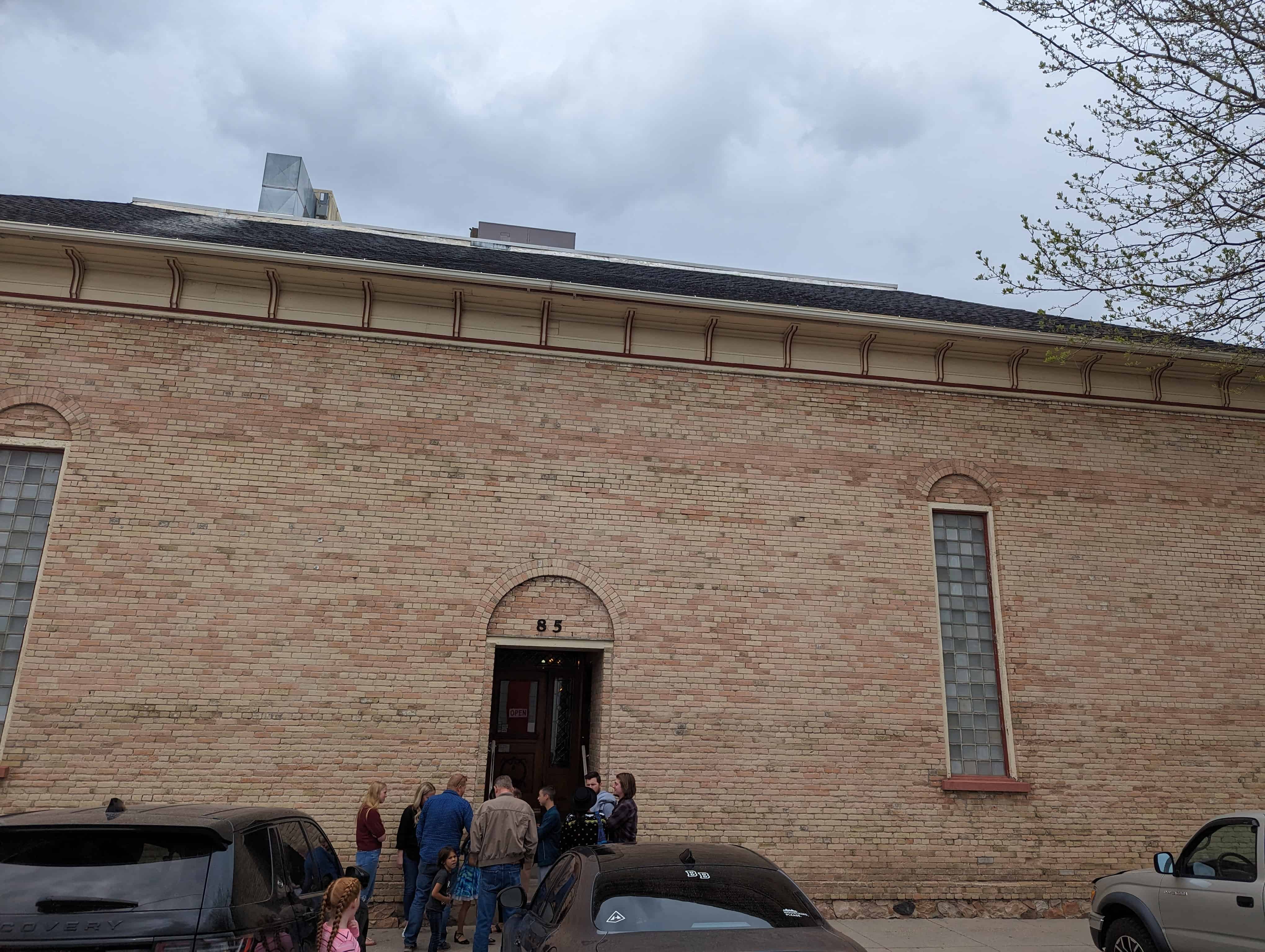
The Payson Opera House, located at 85 E Utah Ave in Payson, Utah was built in 1883.
It has been a hotel and other things and is currently Mi Rancherito Mexican Restaurant.
See other historic opera houses and amusement halls on this page.

The text below is from papers posted on the wall in the building:
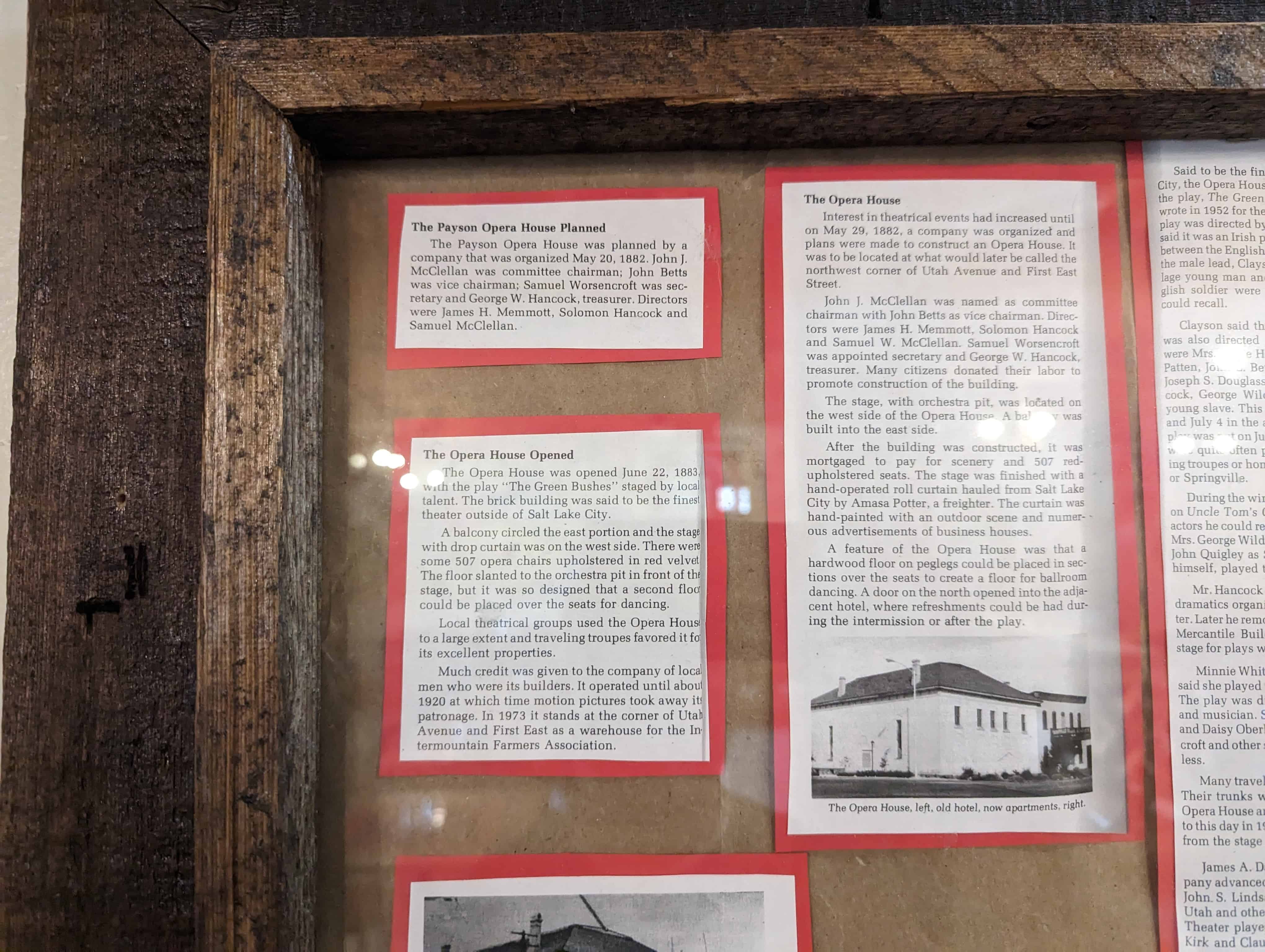
The Payson Opera House Planned
The Payson Opera House was planned by a company that was organized May 20, 1882. John J. McClellan was committee chairman; John Betts was vice chairman; Samuel Worsencroft was secretary and George W. Hancock, treasurer. Directors were James H. Memmott, Solomon Hancock and Samuel McClellan.
The Opera House Opened
The Opera House was opened June 22, 1883, with the play “The Green Bushes” staged by local talent. The brick building was said to be the finest theater outside of Salt Lake City.
A balcony circled the east portion and the stage with drop curtain was on the west side. There were some 507 opera chairs upholstered in red velvet The floor slanted to the orchestra pit in front of the stage, but it was so designed that a second floor could be placed over the seats for dancing.
Local theatrical groups used the Opera House to a large extent and traveling troupes favored it fo its excellent properties.
Much credit was given to the company of local men who were its builders. It operated until about 1920 at which time motion pictures took away its patronage. In 1973 it stands at the corner of Utah Avenue and First East as a warehouse for the Intermountain Farmers Association.
The Opera House
Interest in theatrical events had increased until on May 29, 1882, a company was organized and plans were made to construct an Opera House. It was to be located at what would later be called the northwest corner of Utah Avenue and First East Street.
John J. McClellan was named as committee chairman with John Betts as vice chairman. Directors were James H. Memmott, Solomon Hancock and Samuel W. McClellan. Samuel Worsencroft was appointed secretary and George W. Hancock, treasurer. Many citizens donated their labor to promote construction of the building.
The stage, with orchestra pit, was located on the west side of the Opera House. A balcony was built into the east side.
After the building was constructed, it was mortgaged to pay for scenery and 507 red- upholstered seats. The stage was finished with a hand-operated roll curtain hauled from Salt Lake City by Amasa Potter, a freighter. The curtain was hand-painted with an outdoor scene and numerous advertisements of business houses.
A feature of the Opera House was that a hardwood floor on peglegs could be placed in sections over the seats to create a floor for ballroom dancing. A door on the north opened into the adjacent hotel, where refreshments could be had during the intermission or after the play.
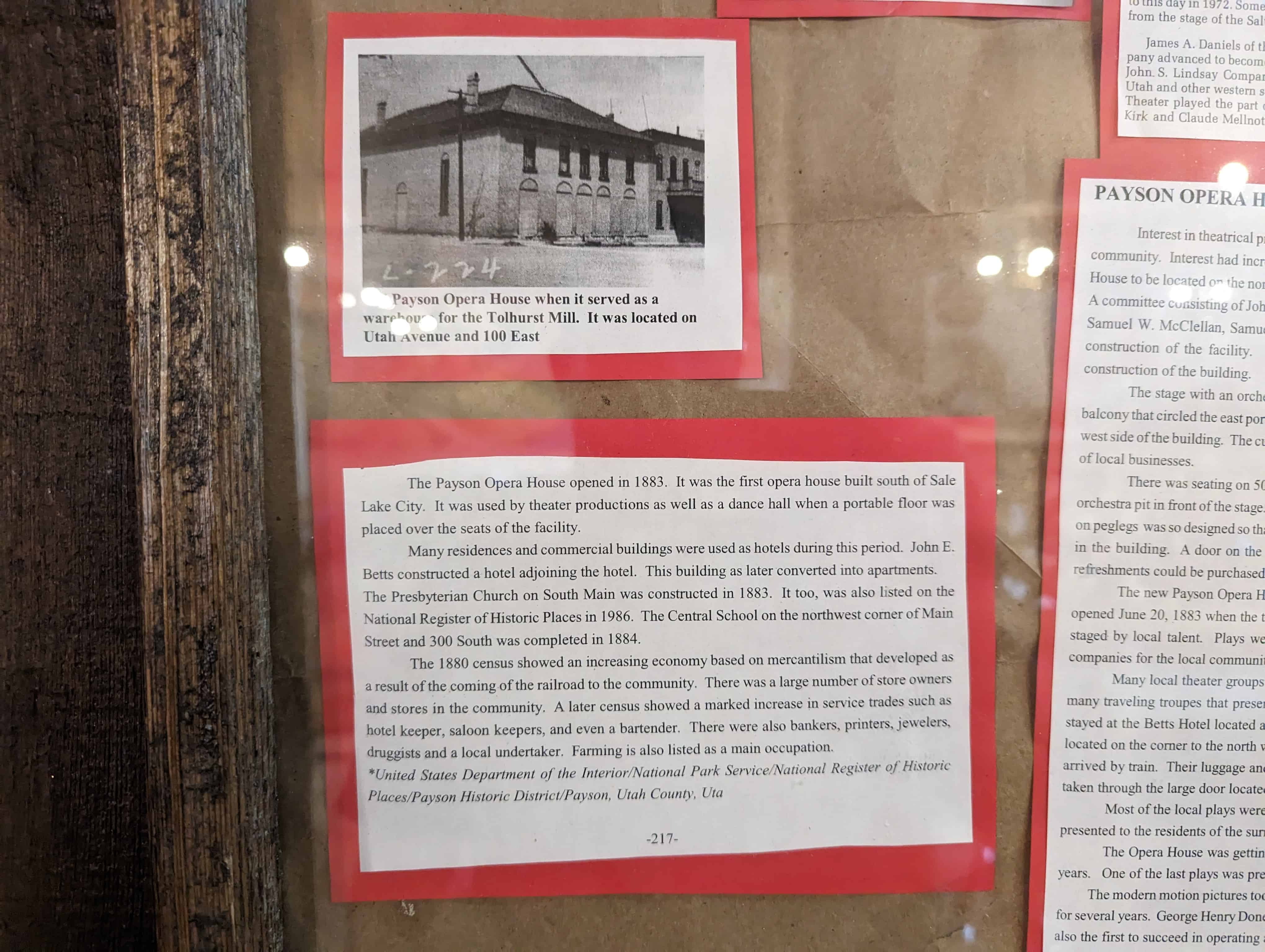
The Payson Opera House opened in 1883. It was the first opera house built south of Sale Lake City. It was used by theater productions as well as a dance hall when a portable floor was placed over the seats of the facility.
Many residences and commercial buildings were used as hotels during this period. John E. Betts constructed a hotel adjoining the hotel. This building as later converted into apartments. The Presbyterian Church on South Main was constructed in 1883. It too, was also listed on the National Register of Historic Places in 1986. The Central School on the northwest corner of Main Street and 300 South was completed in 1884.
The 1880 census showed an increasing economy based on mercantilism that developed as a result of the coming of the railroad to the community. There was a large number of store owners and stores in the community. A later census showed a marked increase in service trades such as hotel keeper, saloon keepers, and even a bartender. There were also bankers, printers, jewelers, druggists and a local undertaker. Farming is also listed as a main occupation.
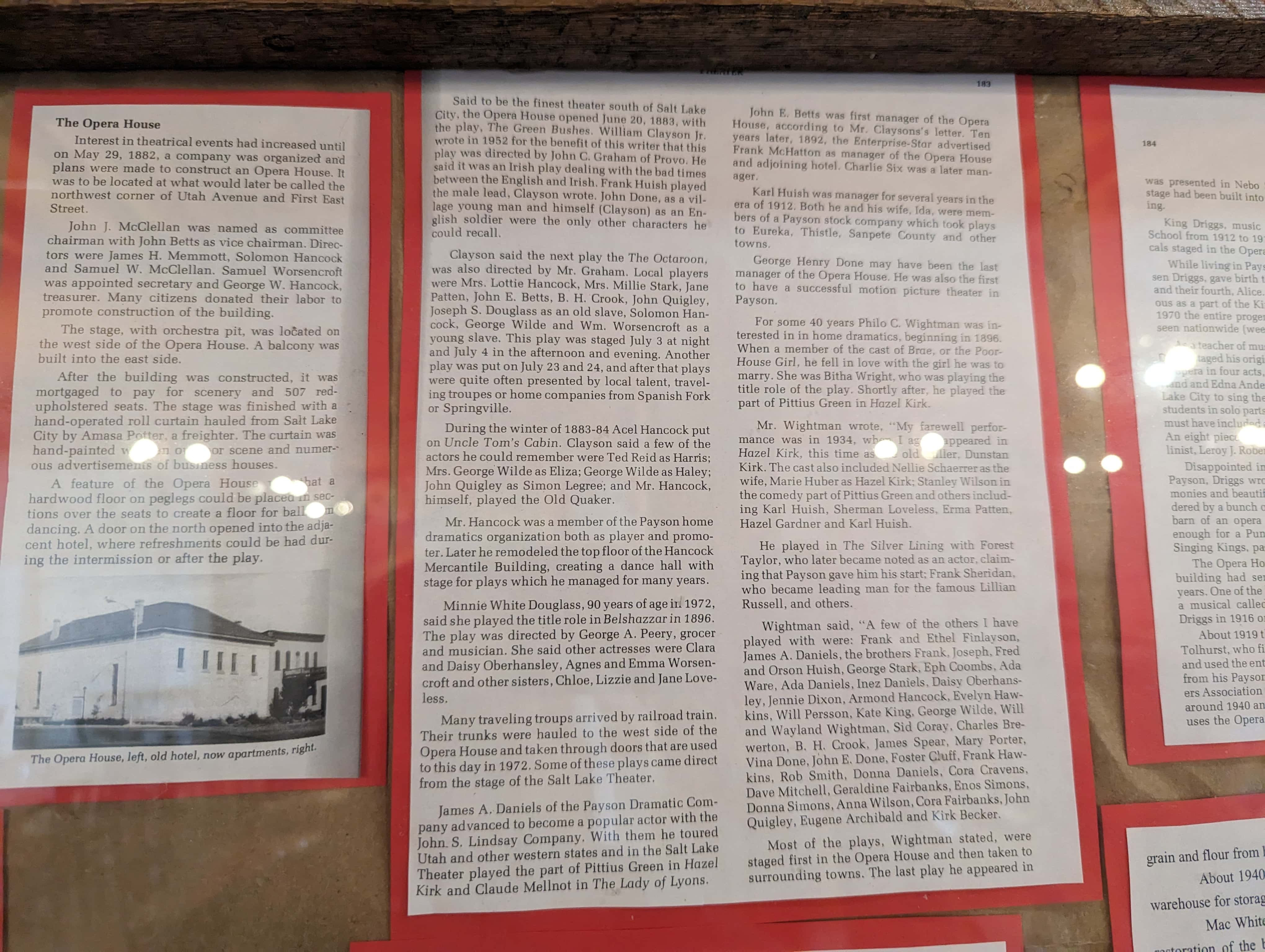
Said to be the finest theater south of Salt Lake City, the Opera House opened June 20, 1883, with the play, The Green Bushes. William Clayson Jr. wrote in 1952 for the benefit of this writer that this play was directed by John C. Graham of Provo. He said it was an Irish play dealing with the bad times between the English and Irish. Frank Huish played the male lead, Clayson wrote. John Done, as a village young man and himself (Clayson) as an English soldier were the only other characters he could recall.
Clayson said the next play the The Octaroon, was also directed by Mr. Graham. Local players were Mrs. Lottie Hancock, Mrs. Millie Stark, Jane Patten, John E. Betts, B. H. Crook, John Quigley, Joseph S. Douglass as an old slave, Solomon Han- cock, George Wilde and Wm. Worsencroft as a young slave. This play was staged July 3 at night and July 4 in the afternoon and evening. Another play was put on July 23 and 24, and after that plays were quite often presented by local talent, traveling troupes or home companies from Spanish Fork or Springville.
During the winter of 1883-84 Acel Hancock put on Uncle Tom’s Cabin. Clayson said a few of the actors he could remember were Ted Reid as Harris; Mrs. George Wilde as Eliza; George Wilde as Haley; John Quigley as Simon Legree; and Mr. Hancock, himself, played the Old Quaker.
Mr. Hancock was a member of the Payson home dramatics organization both as player and promo- ter. Later he remodeled the top floor of the Hancock Mercantile Building, creating a dance hall with stage for plays which he managed for many years.
Minnie White Douglass, 90 years of age in 1972, said she played the title role in Belshazzar in 1896. The play was directed by George A. Peery, grocer and musician. She said other actresses were Clara and Daisy Oberhansley, Agnes and Emma Worsen- croft and other sisters, Chloe, Lizzie and Jane Loveless.
Many traveling troups arrived by railroad train. Their trunks were hauled to the west side of the Opera House and taken through doors that are used to this day in 1972. Some of these plays came direct from the stage of the Salt Lake Theater.
James A. Daniels of the Payson Dramatic Company advanced to become a popular actor with the John. S. Lindsay Comp: y. With them he toured Utah and other western states and in the Salt Lake Theater played the part of Pittius Green in Hazel Kirk and Claude Mellnot in The Lady of Lyons.
John E. Betts was first manager of the Opera House, according to Mr. Claysons’s letter. Ten years later, 1892, the Enterprise-Star advertised Frank McHatton as manager of the Opera House and adjoining hotel. Charlie Six was a later manager.
Karl Huish was manager for several years in the era of 1912. Both he and his wife, Ida, were members of a Payson stock company which took plays to Eureka, Thistle, Sanpete County and other towns.
George Henry Done may have been the last manager of the Opera House. He was also the first to have a successful motion picture theater in Payson.
For some 40 years Philo C. Wightman was interested in in home dramatics, beginning in 1896. When a member of the cast of Brae, or the Poor- House Girl, he fell in love with the girl he was to marry. She was Bitha Wright, who was playing the title role of the play. Shortly after, he played the part of Pittius Green in Hazel Kirk.
Mr. Wightman wrote, “My farewell performance was in 1934, when I again appeared in Hazel Kirk, this time as the old miller, Dunstan Kirk. The cast also included Nellie Schaerrer as the wife, Marie Huber as Hazel Kirk; Stanley Wilson in the comedy part of Pittius Green and others including Karl Huish, Sherman Loveless, Erma Patten, Hazel Gardner and Karl Huish.
He played in The Silver Lining with Forest Taylor, who later became noted as an actor, claiming that Payson gave him his start; Frank Sheridan, who became leading man for the famous Lillian Russell, and others.
Wightman said, “A few of the others I have played with were: Frank and Ethel Finlayson, James A. Daniels, the brothers Frank, Joseph, Fred and Orson Huish, George Stark, Eph Coombs, Ada Ware, Ada Daniels, Inez Daniels, Daisy Oberhansley, Jennie Dixon, Armond Hancock, Evelyn Hawkins, Will Persson, Kate King, George Wilde, Will and Wayland Wightman, Sid Coray, Charles Brewerton, B. H. Crook, James Spear, Mary Porter, Vina Done, John E. Done, Foster Cluff, Frank Hawkins, Rob Smith, Donna Daniels, Cora Cravens, Dave Mitchell, Geraldine Fairbanks, Enos Simons, Donna Simons, Anna Wilson, Cora Fairbanks, John Quigley, Eugene Archibald and Kirk Becker.
Most of the plays, Wightman stated, were staged first in the Opera House and then taken to surrounding towns. The last play he appeared in was presented in Nebo Stake Tabernacle after a stage had been built into the east end of the building.
King Driggs, music director at Payson High School from 1912 to 1918, directed several musicals staged in the Opera House.
While living in Payson his wife, Pearl Mortensen Driggs, gave birth to their third child, Louise, and their fourth, Alice. The girls later became famous as a part of the King Sisters vocal quartet. By 1970 the entire progeny of King Driggs would be seen nationwide (weekly) on television.
As a teacher of music at the Payson school, Mr. Driggs staged his original composition, Hotozhoni, an opera in four acts, in the Opera House. John T. Hand and Edna Anderson were imported from Salt Lake City to sing the leading roles, supported by students in solo parts and a chorus of seventy. This must have included almost the entire studentbody. An eight piece orchestra, headed by a young violinist, Leroy J. Robertson, played accompaniment.
Disappointed in the raw material he found in Payson, Driggs wrote in his diary, “My rich harmonies and beautiful accompaniments were murdered by a bunch of country high school folks in a barn of an opera house with stage room (only) enough for a Punch and Judy show.”… (The Singing Kings, page 126-127)
The Opera House was indeed getting old. The building had served well for more than thirty ears. One of the last productions staged there was musical called Extravaganza, directed by Mr. Driggs in 1916 or 1917.
About 1919 the building was sold to Thomas F. Tolhurst, who filled the orchestra pit with cement and used the entire place for storing grain and flour from his Payson Flour Mill. Utah Poultry Producers Association (Intermountain Farmers) brought it around 1940 and to this day in 1973 this company uses the Opera House for storage.
Payson Opera House
Interest in theatrical presentations had always been important to the members of the Payson community. Interest had increased until on May 29, 1882 plans were made to construct an Opera House to be located on the northwest corner of what is known today as Utah Avenue and 100 East. A committee consisting of John J. McClellan, John Betts, James H. Memmott, Solomon Hancock, Samuel W. McClellan, Samuel Worsencroft and George W. Hancock was appointed to oversee construction of the facility. Many of the local citizens donated their labor to help with the construction of the building.
The stage with an orchestra pit was located on the west side of the building. There was a balcony that circled the east portion and the stage with a hand-operated drop curtain was also on the west side of the building. The curtain had an outdoor scene hand painted along with advertisements of local businesses.
There was seating on 507 opera chairs upholstered in red velvet. The floor slanted to the orchestra pit in front of the stage. One of the features of the Opera House was that a hardwood floor on peglegs was so designed so that the floor could be placed over the seats and dances could be held in the building. A door on the north side of the building opened into the adjacent hotel where refreshments could be purchased during intermission or after a play.
The new Payson Opera House was said to be the finest theater south of Salt Lake City. It opened June 20, 1883 when the theater hosted the first play, “The Green Bushes.” The play was staged by local talent. Plays were often presented by local talent, traveling troupes, or home companies for the local communities located near Payson.
Many local theater groups used the Opera House for their productions. There were also many traveling troupes that presented production in the building. The traveling players usually stayed at the Betts Hotel located adjacent to the Opera House or the Wightman Hotel which was located on the corner to the north where we find Zion’s Bank today. Most of the traveling groups arrived by train. Their luggage and trunks were hauled to the west side of the Opera House and taken through the large door located there.
Most of the local plays were staged first in the Opera House and then they were taken and presented to the residents of the surrounding communities.
The Opera House was getting old. The building had served the community for almost 40 years. One of the last plays was presented in about 1916 or 1917.
The modern motion pictures took away most of their business. The building remained vacant
for several years. George Henry Done may have been the last manager of the Opera House. He was
also the first to succeed in operating a successful motion picture theater in Payson.
About 1919 the building was sold to Thomas F. Tolhurst, the operator of the local Payson Milling Company. He filled the orchestra pit with concrete and used the entire building for storing grain and flour from his local mill.
About 1940, the building was purchased by Intermountain Farmers and was used as a warehouse for storage of the business for many more years
Mac Whitelock later purchased the building from Intermountain Farmers and began a restoration of the building. He used the building for a period of time in restoring vintage automobiles.
The next owner did more restoration work on the building. It was later renovated and windows were opened up where the Opera House doors once were. It became the new home of Mi Rancherito Mexican Restaurant. Today, it is one of the beautiful restored buildings to be found in Payson.