
Tags
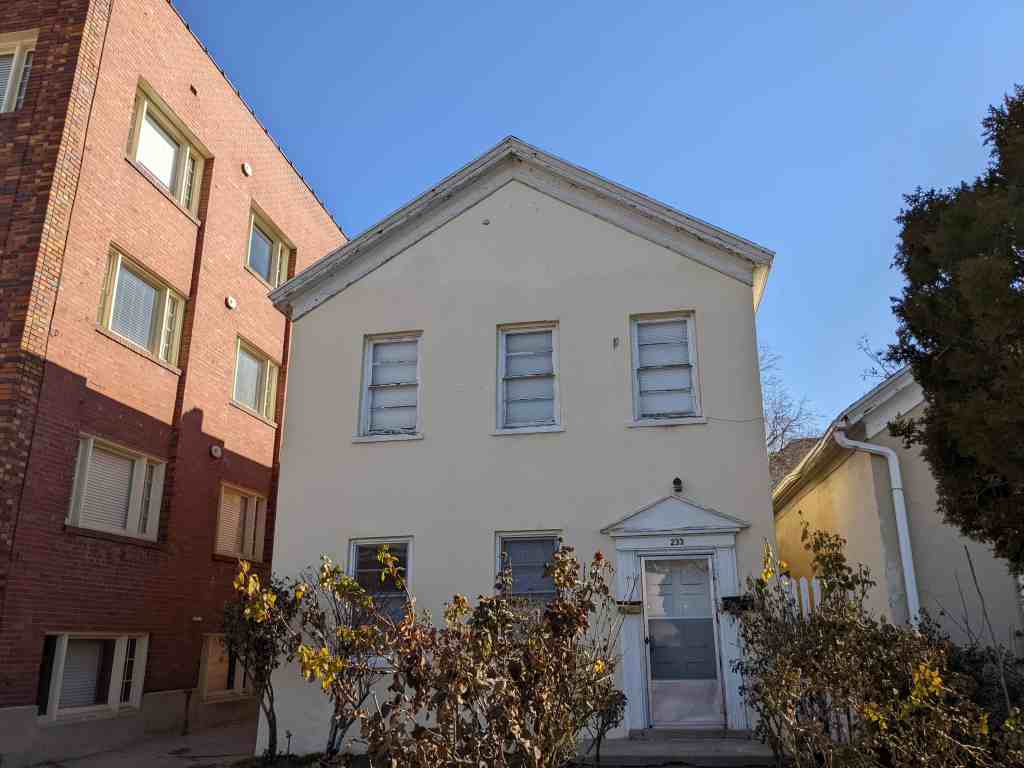
Millard F. Malin House
The Malin House, built as investment property in 1889 by Millard F. Malin, a carpenter/builder, is significant as one of only nine documented Utah examples of the Greek Revival inspired temple-form vernacular house type. The temple-form house originated in the Greek Revival period of American building, and typically has its short end to the street and a pedimented gable façade in imitation of monumental classical buildings. In its most common form, the house had symmetrical fenestration with a door placed to the side of center, and an opening leading to a side passage containing the staircase. Popularized by such books as Asher Benjamin’s Builder’s Companion and Minard Lafever’s Modern Builder’s Guide, it became one of the traditional house forms in New England and in the upper Midwest. The temple-form house migrated to Utah with the members of The Church of Jesus Christ of the Latter Day Saints in the years after 1847. The temple-form house type is important because it is one of several early house types in the state, and because it is a type traceable to a New England cultural hearth, it documents the important New England heritage of the early Mormon movement. It is one of seven basic house types that were found in Utah during the early years of settlement. These types are all traditional and include: the square cabin; the rectangular cabin; the hall and parlor house; the central passageway house; the pair-house; and the double pen house. The temple-form house was popular in early Salt Lake City. This fact is supported by early Sanborn Paris insurance maps, early photographs, and a surprisingly accurate “bird’s eye view” rendering of the city in 1870. The temple-form is a rare Utah house type today because most were located in what is now the central business district of Salt Lake City. As the business center grew, most of the homes were razed to make way for development. The basic temple-form type, exemplified by the Malin House, was easily expanded by adding one or two wings to the sides of the house. The most commonly encountered variant is referred to as a “modified” temple-form house and is characterized by the placement of the principle entrance in the side wing. Another variant of the house type has the door centered on the gable façade, does not have a side passage, and may or may not have side wings. The Malin House is a good example of the basic form from which these other variants were generated.
Located at 233 South 400 East in Salt Lake City, Utah and added to the National Historic Register (#83003173) on July 7, 1983. The text on this page is from the nomination form from when it was added to the register.
The Millard F. Malin House was built ca. 1889 as investment property by Millard Fillmore Malin on property he had purchased from his father, Samuel, in 1889. His father’s home, the Malin family home, was adjacent at 225 South 400 East (demolished), and on the other side was the home of his brother, Council B., 237 South 400 East, which Millard had built for him. Millard or “Phil”, and his wife, Annie, lived at 458 South 600 East for many years and rented out this house until 1933 when he turned the property over to his daughter, Laura Malin Everett, who also rented it out until selling it in 1937. Subsequent owners up to the present have continued to use the house as income property.
Millard Fillmore Malin was born in 1852 to Samuel and Mary Ann Bosely Malin and worked as a carpenter/builder his entire life. He performed all the construction tasks himself, including the shaping and laying of the foundation stones, the brickwork, and the rough and finish carpentry. His father was a stonecutter and mason and no doubt taught Millard much about the construction business.
“Phil” constructed many other houses in the city, most of which were modest, single-family residences which generally conformed to local building types and styles. This house is an excellent, but later, example of the temple-form, side hall plan house, which was a popular house style in the early decades of settlement in Utah.
Pingback: Salt Lake by Address (east) | JacobBarlow.com