
Tags

Robert & Elizabeth Johnson Home
This two-story hall and parlor house, built by Robert Johnson in 1860, is significant as an example of early Sanpete Valley domestic vernacular design. Robert and wife Elizabeth, England natives and converts to the LDS Church, immigrated to Utah in 1853. By 1854 the Johnson’s were living in Manti and Robert was engaged in farming and adobe-making. By 1860, the year the home was built, Mr. Johnson had become a prosperous farmer. The Johnson family owned the property for several decades.
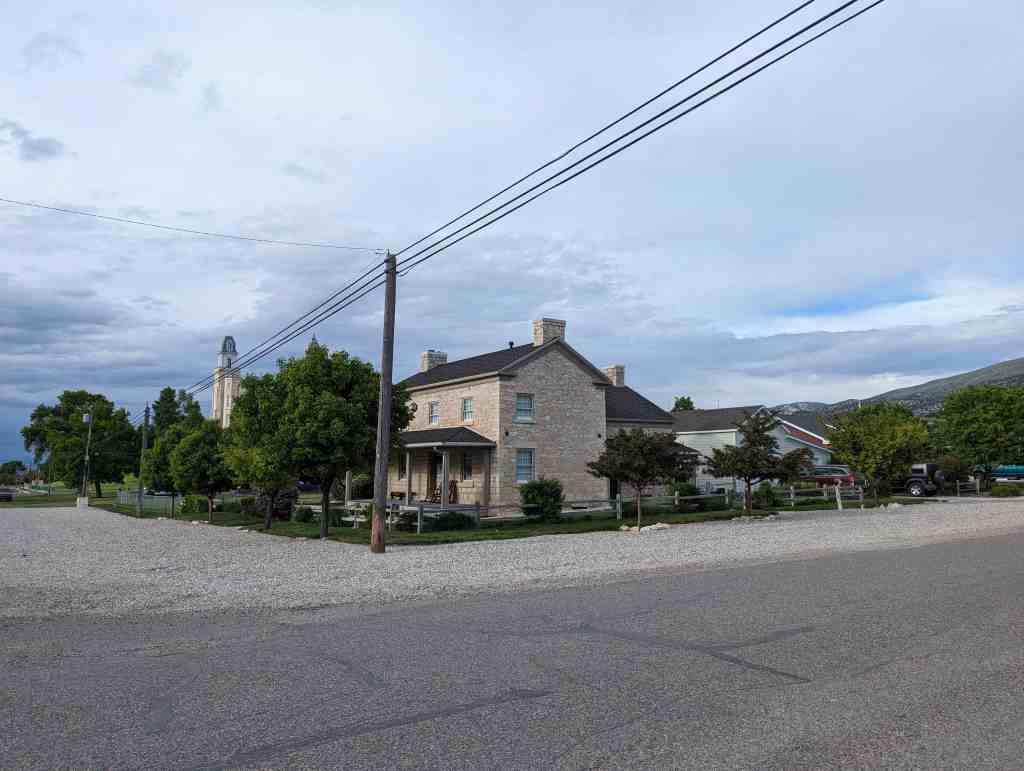

The Robert Johnson house is significant architecturally as an example of early Sanpete Valley domestic vernacular design. This two-story hall and parlor house, often termed an “I” house by folklife specialists, was a symbol of local economic and political achievement. Within the range of vernacular house types, there were serious economic divisions. The family of modest income might have a single room house, or a one-story two room hall and parlor house. Those more affluent would often choose this full two story type both for it s extra room and it s social status. The Robert Johnson house remains virtually unaltered and is one of the most striking monuments to early pioneer technology extant in Sanpete today. The house served to delimit one end of the economic spectrum in vernacular building and historically points to the basic discrepancy of wealth within the Mormon “village” community.
Robert Johnson, born in Chester, England in 1823, offers a nice illustration of the opportunities, both religious and economic, which the Church of Jesus Christ of Latter-day Saints offered it s converts. Johnson’s family was poor and as a youngster he was forced into factory work. Baptized into the Mormon Church, Johnson emigrated to Utah in 1853 with practically nothing. Living in Manti by 1854 Johnson engaged in making adobes and other odd jobs until he could secure a farm. By 1860 he could list himself as a prosperous farmer with holdings of about $750. Probably about 1860 he constructed the large stone house for his family. The house became a tribute to the American dream he shared with his fellow Mormon kingdom builders. The house belonged to the Johnsons until the 20th century when it was acquired by the Ernest Braithwaite family.
Located at 103 East 300 N in Manti, Utah and added to the National Historic Register (#80003949) on October 14, 1980.
The Robert Johnson house is a two-story stone “hall and parlor” folk/vernacular house type. There is a one story rear ‘T’ extension which was built as a part o£ the original house. The west two-story section is basically two-rooms over two-rooms with the south section the largest and containing the staircase. The stair’s are the open, banistered type and lead up directly behind the front door. A rear staircase, perhaps a later addition, runs up from the room in the rear. There are large fireplaces in each of the roans. The roof is gabled and stone internal wall chimneys are found at each end of the house.
The house is built of oolite limestone taken from the nearby “temple hill quarry”. The walls are coursed ashlar with the mortar incised to emphasize the geometric patterning of the stonework. The house has a symmetrical three-over-three opening façade. Lintels and sill s are cut stone and extra attention has been given to dressing the comer stones in order to highlight the quoins. Decorative details are sparse and relegated to single cornice and Greek revival gable returns.
The house remains in excellent condition and virtually unaltered externally. In the later 19th century a portion was added to the larger downstairs room to effect a central passageway.