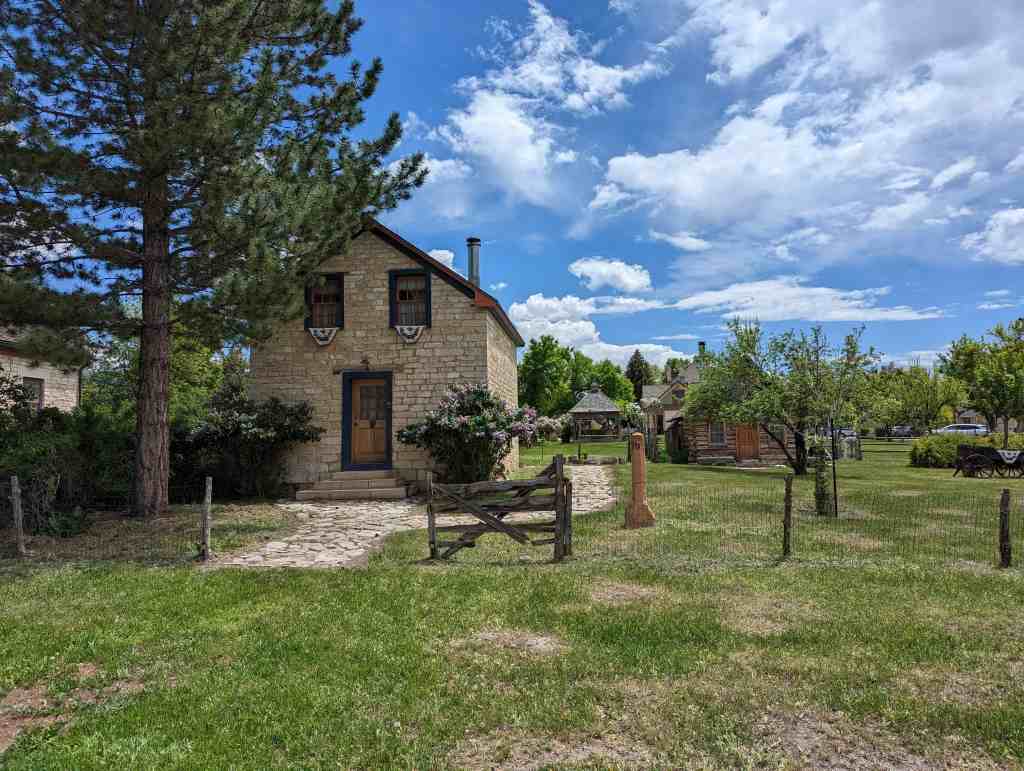
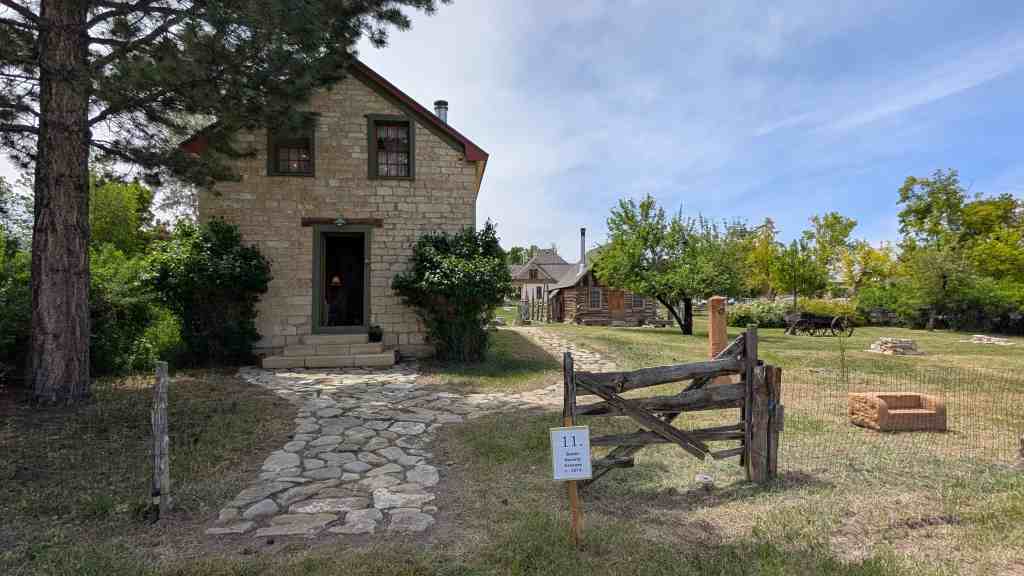
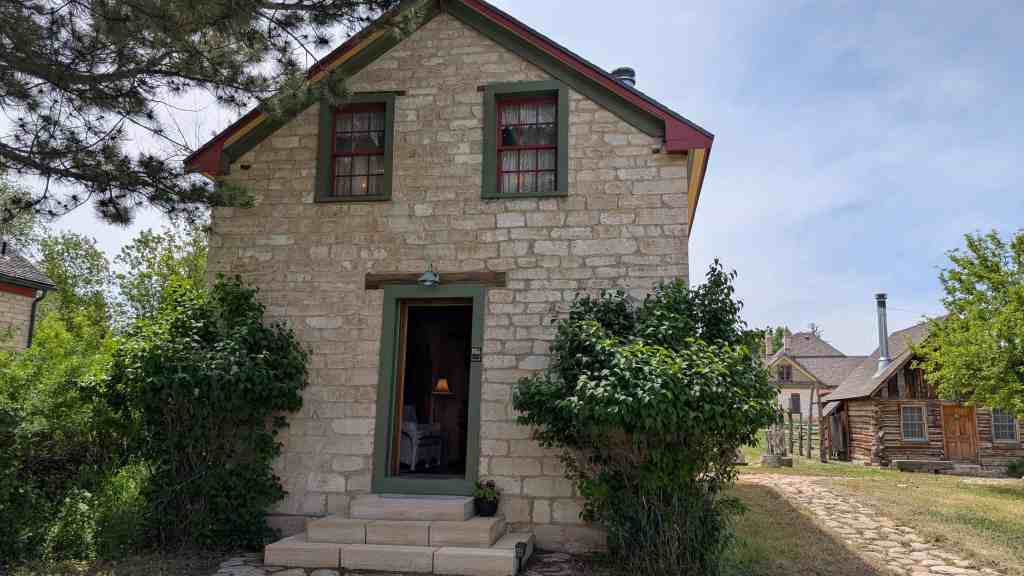
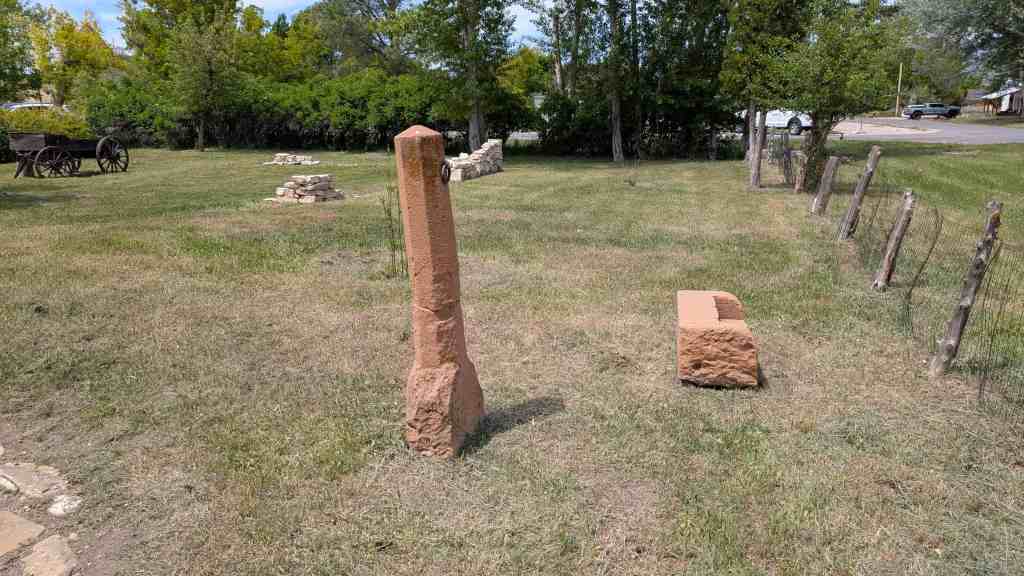
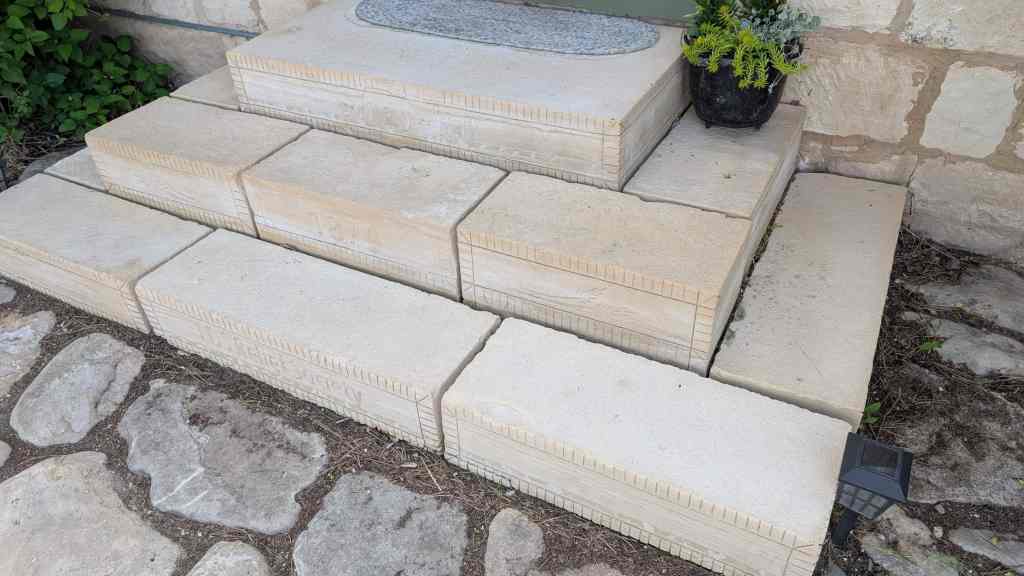
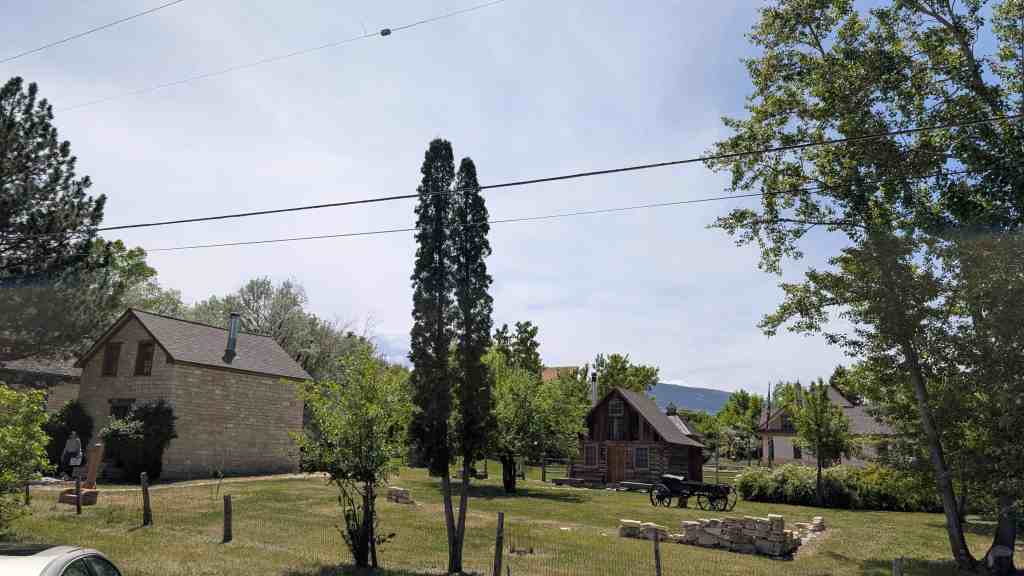
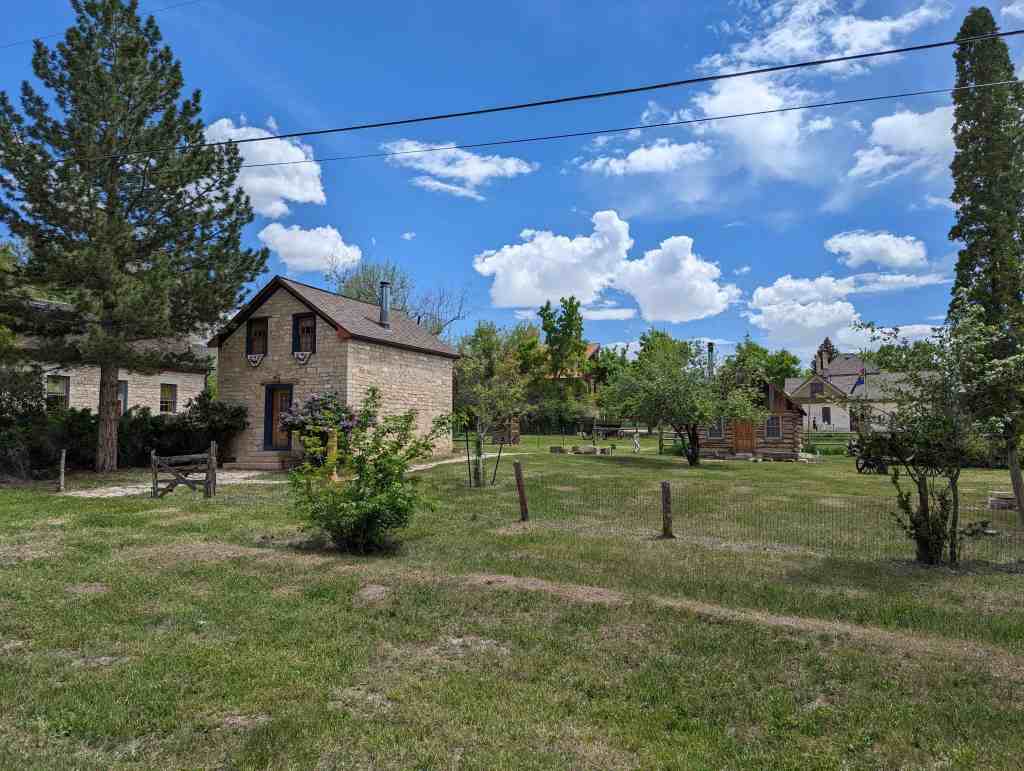
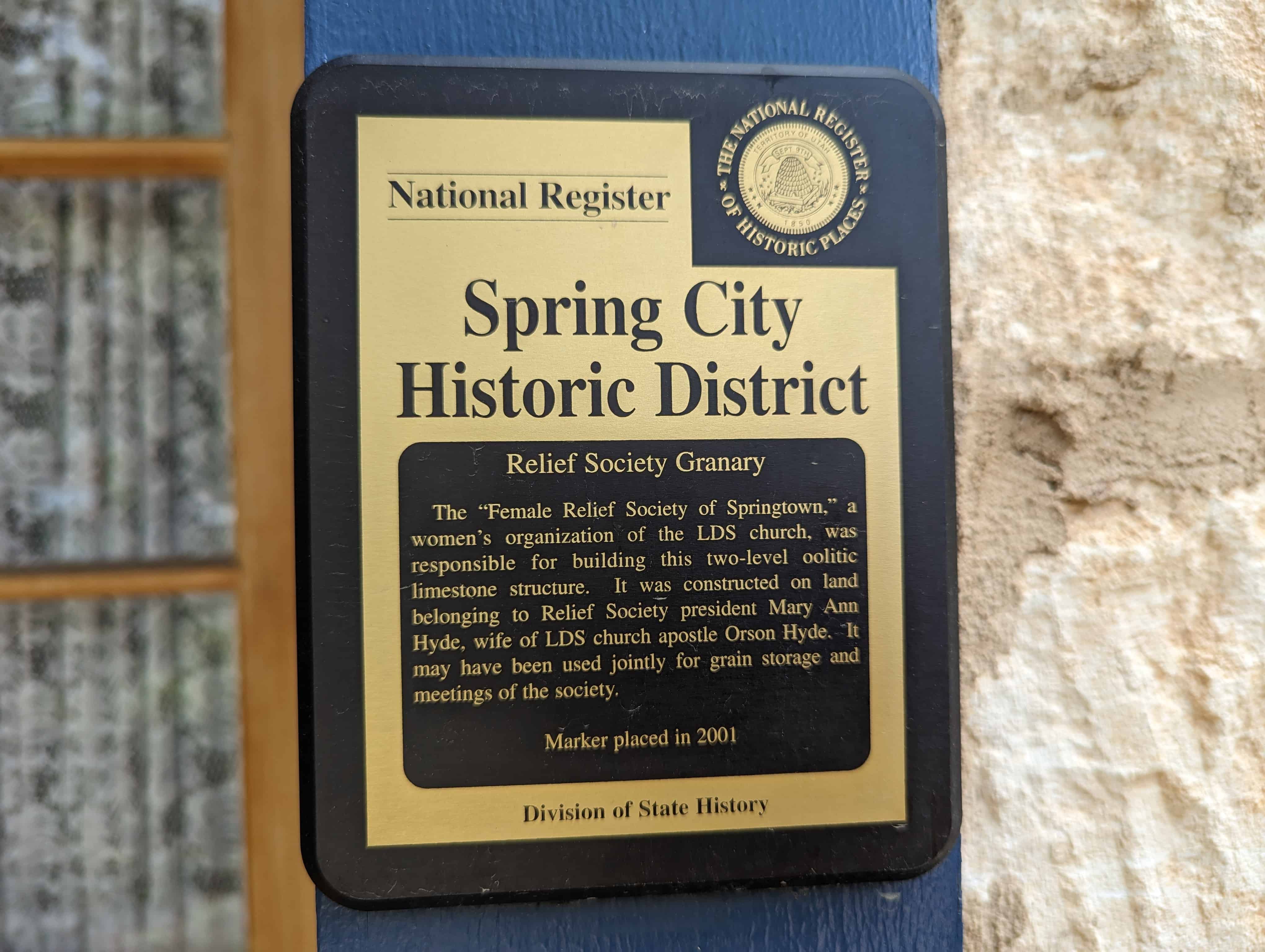
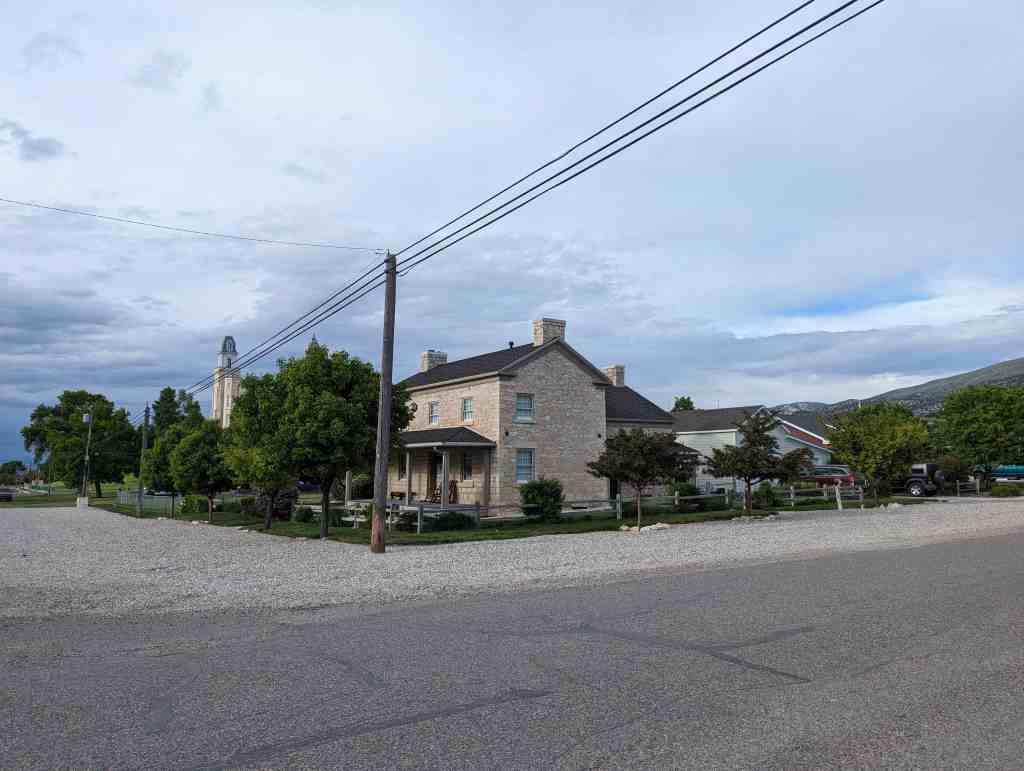
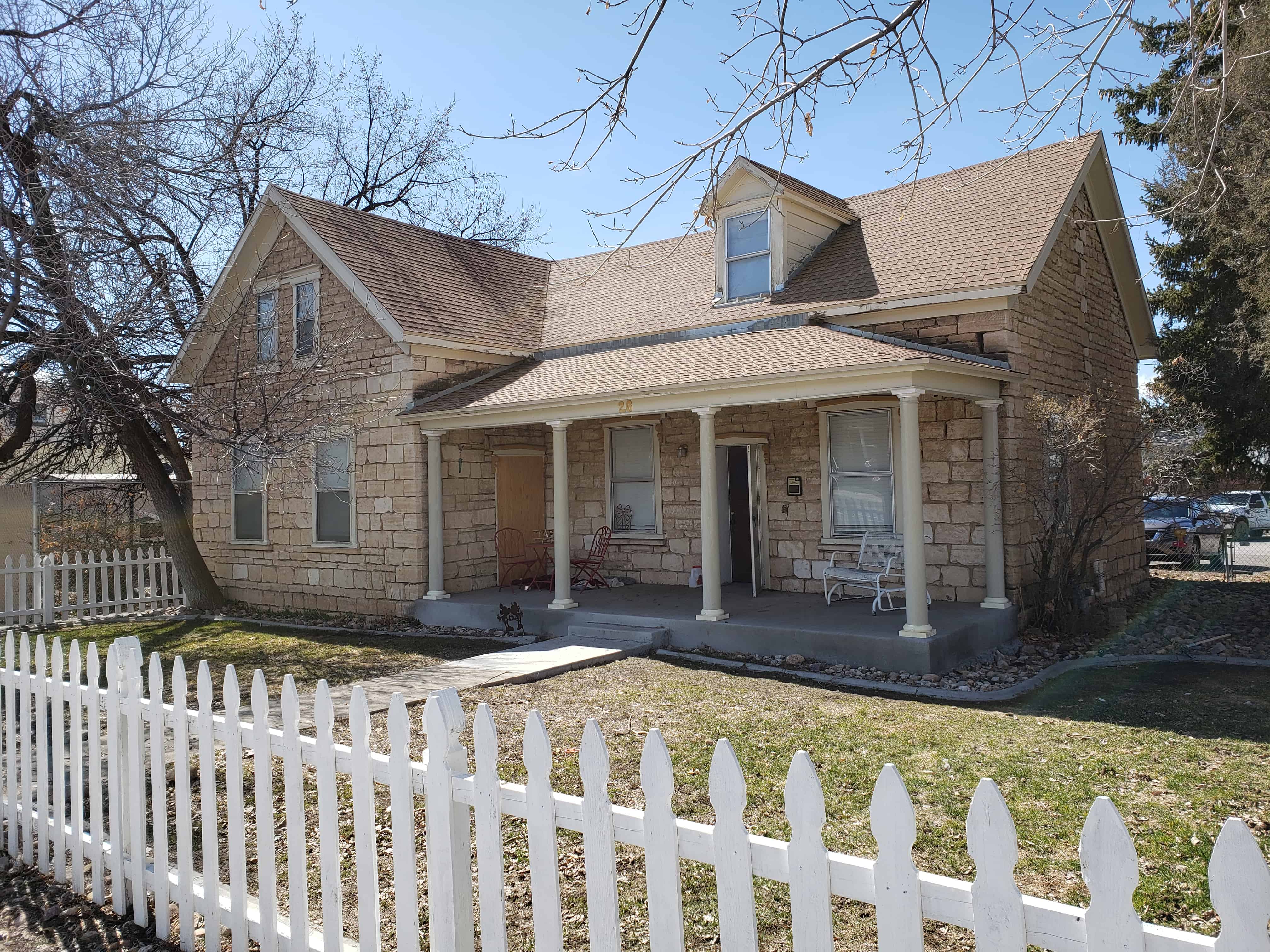
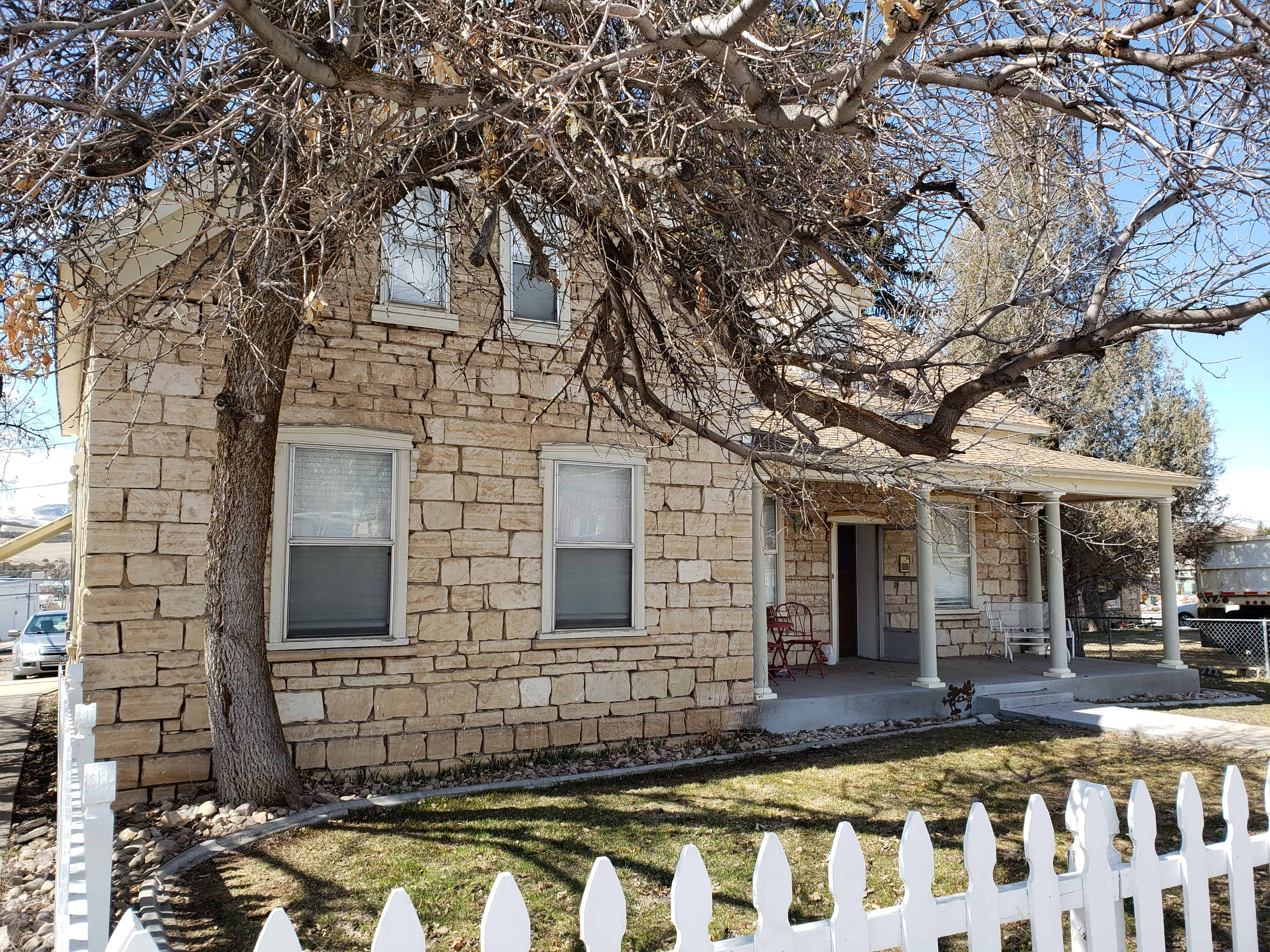
The “Female Relief Society of Springtown,” a women’s organization of the LDS church, was responsible for building this two-level oolitic limestone structure. It was constructed on land belonging to Relief Society president Mary Ann Hyde, wife of LDS church apostle Orson Hyde. It may have been used jointly for grain storage and meetings of the society.
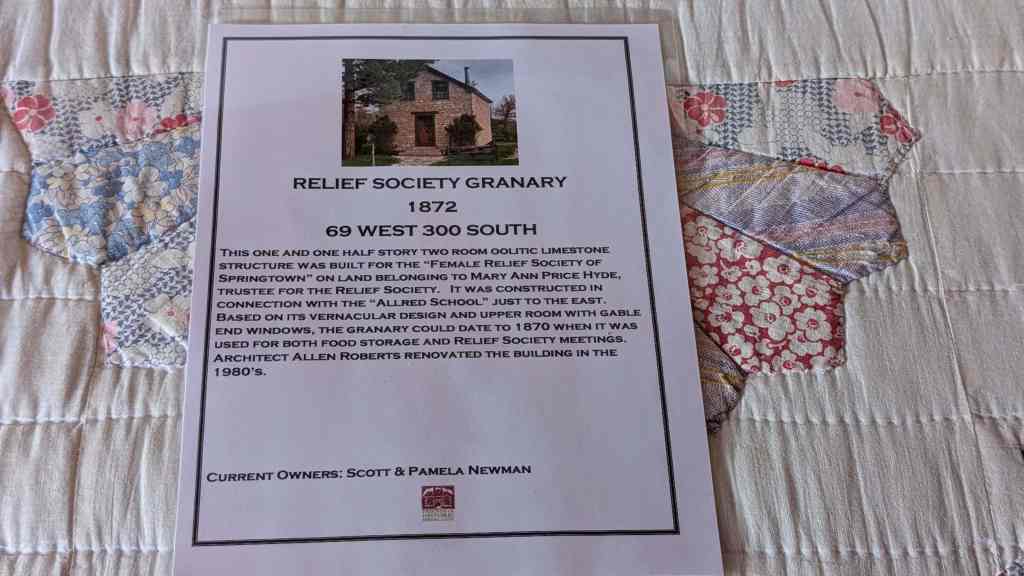
This one and one half story two room oolitic limestone structure was built for the “Female relief society of springtown” on land belonging to Mary Ann price hyde, trustee for the relief society. It was constructed in connection with the “Allred school” just to the east. Based on its vernacular design and upper room with gable end windows, the granary could date to 1870 when it was used for both food storage and relief society meetings. Architect Allen Roberts renovated the building in the 1980’s.
The two-story limestone home built by John Patten, Jr., c. 1854 is a well-preserved example of early vernacular Mormon architecture in Utah. Patten played a prominent role in the settlement of Manti, established in 1849 as one of the earliest of approximately 400 colonies in the “Mormon Corridor.”
Located at 84 West 300 N in Manti, Utah and added to the National Historic Register (#77001315) on August 22, 1977.
John Patten was born in Fairplay, Green County, Indiana, June 20, 1825. His family was among the earliest converts to the Church of Jesus Christ of Latter-day Saints (Mormon Church). As John grew up, he experienced the many persecutions of the Mormons in Missouri and in 1839 was among those to sign a covenant of protection and removal, authored by Brigham Young in response to an order of extermination by General Clark of Missouri. Patten came to Utah in 18SO and located in Manti, one of Utah’s oldest cities, where he assisted in building the first fort in 1852. He took an active part in the Walker and Black Hawk wars and was one of three witnesses to receive a treaty of peace and deed to Sanpete County from Arapine, Chief of the Ute Indians, May, 1855. Patten was prominent in civic activities, serving as a representative to the Territorial Legislature, Sheriff of the county and member of the City Council. He was married in Manti to Candace Smith who later died, leaving two sons and three daughters. He was married again to Emily, a widow and sister of his first wife. She had three sons and two daughters.
Patten was a farmer by occupation. He built the Patten Reservoir and Patten Ditch, an irrigation system still in use which runs water to farmland five miles north of Manti. Somewhat of an inventor, Patten is credited with constructing the first “go-devil,” a device used to lay off furrows for irrigation flow in farm fields. As a sideline, he also tried to develop a “perpetual motion” machine.
John Patten built his two-story limestone home c. 1854 after living next to the oolitic limestone quarry for a few years. The vernacular style home represents the earliest and most primitive form of stone masonry construction in pioneer Utah. The walls of the home were laid in coursed rubble using crude mud mortar, most of which has washed away. Local residents call this mode of construction “dry wall.” The two-over-two plan with dirt floor cellar also documents a typical early Mormon pioneer plan type. Although some alterations and small additions of brick and wood have been made, the John Patten Home is basically well-preserved. The home was lived in continuously until 1975 when it became a museum for the Daughters of the Utah Pioneers.
The John Patten Home is a primitive vernacular residence, constructed of native oolitic limestone and red pine in about 1854. The home has a 2/2 plan over a full basement cellar. The basement has a pressed dirt floor, contains two rooms and has access from an outside door on the west and from stairs under a trap door in the floor of the northern room above. The stone walls in the basement are exposed, as are the large split-log puncheons which support the first floor. In the northern basement room is a large stone table used for butchering and processing food.
Built in three compatible stages between the 1850’s and 1880’s, the Tuttle-Folsom Home was the residence of several of Manti’s and Utah’s significant historical figures. The original owner is unknown, but Luther T. Tuttle, the first known owner, was two term mayor of Manti and the mayor who received title to all of surveyed Manti from President U. S. Grant in 1872. Tuttle was also a leading merchant, banker, livestock raiser and served four terms as a territorial legislator. In 1880, Tuttle sold his home to William H. Folsom who had been called to Manti to be architect for the Manti Temple. While living in the home, Folsom designed other notable structures including tabernacles in Manti, Provo and Moroni, the Provo Opera House and many important residences. In 1890, John C. Witbeck, known for his development of the controversial Kofod or Ancient Mound wheat, purchased the home. He sold it in 1895 to John E. Metcalf, a prominent merchant and stockraiser who partitioned off some of the rooms and converted the home into an hotel known as “the Metcalf House.” The partitions were removed and the original plan restored by Mr. and Mrs. Clarence Miller, owners for 40 years prior to the recent purchase of the home by Historic Utah, Inc.
Built of native oolitic limestone, the home is in nearly original condition today and documents craftsmanship and design typical of early vernacular masonry architecture in Manti.
Located at 195 West 300 N in Manti, Utah and added to the National Historic Register (#77001316) on July 21, 1977.
A comparative study of Manti architecture and building technology indicates that the earliest portions of the Tuttle-Folsom home was constructed in the 1850’s, although no known records show original ownership or date of construction. Property records from 1872 show that when Luther T. Tuttle, then mayor of Manti, received title to Manti through a land patent from President Ulysses S. Grant, the home he deeded to himself is the Tuttle-Folsom home here discussed.
Luther T. Tuttle was born November 19, 1825 in New York City and came to Utah in October, 1847, as a member of the Mormon Battalion. After serving with the battalion, Tuttle engaged in fur trading as an agent for Peter A. Sharpey of the American Fur Company. A Mormon convert, Tuttle settled permanently in Manti, Utah, in 1863. Tuttle soon became a leading citizen. He was elected mayor for two terms (1867-1873) and became a prominent merchant, banker and sheepraiser. Upon arriving in Manti, Tuttle opened a general store under the firm name of Tuttle and Fox. After selling out to the local co-op, Tuttle entered the general merchandise and lumber business with Harrison Edwards. As the firm grew, it erected the Tuttle Block in 1894, a large two story commercial building with an iron front. In 1890 Tuttle organized and was president of the Manti Savings Bank. He also owned 3500 head of sheep and was a major stockholder in the Co-op Roller Mills.
In addition to being mayor of Manti, Tuttle served several terms on the Manti City Council and four terms on the Territorial Legislature. He was a prominent church man, holding a position on the High Council of the Sanpete Stake.
In 1880 Luther T. Tuttle sold his home to William H. Folsom who owned the home for the next ten years. Folsom, considered by many to be Utah’s most accomplished pioneer architect, came to Manti in 1877 to supervise construction of the Manti Temple. Folsom was born March 25, 1815 in Partsmough, New Hampshire, the third child of a carpenter. He learned carpentry from his father and worked on the Mormon temple in Nauvoo, Illinois, after accepting the Mormon faith in 1843. After a notable career in building, which saw Folsom construct the forty foot tall Corinthian columns for the territorial capitol in Omaha, the builder/architect moved to Salt Lake City. His significant achievements prior to moving to Manti included the Salt Lake Theatre (1860), Council House (1864, NR), Amussen’s Jewelry (1869, NR), Gardo House, Devereaux House addition (1874, NR), and Z.C.M.I Department Store (1875-1876, NR). He also worked on the tabernacle and temple on Temple Square (1867, 1852-1893 resp., NR)
Through the Manti Temple Association, Folsom, as superintendent, was acquainted with Luther Tuttle, the chairman. After living in the Manti Fort since 1877 Folsom purchased Tuttle’s home in 1880 and thereafter added the 2 story, 4 bedroom wing to accommodate two of his three polygamous families. While working on the Manti Temple (1879-1888, NR) Folsom also prepared plans for several local Mormon tabernacles, public buildings, and homes. Among his more noteworthy designs during his Manti period were the tabernacles in Moroni (1879), Manti (1878-1882, SR) and Provo (1882-1896, NR).
While in Manti, Folsom experienced much persecution as a result of his practice of polygamy. The addition to his home included a secret hiding place in the back of a closet under the stairs (hideout still intact). Once he had to flee from the county disguised as a prospector in order to avoid capture by federal marshals. Folsom was eventually captured and convicted of violating the Edmunds-Tucker Act and was forced to sell his Manti home in 1890 to pay the fine for his conviction.
John C. Witbeck next owned the home. Witbeck gained local fame through his involvement with Amasa Potter who reportedly discovered a stone box filled with ancient wheat, along with two skeletons of early Indians. The “Ancient Mound” wheat was planted and grew. With Witbeck, Potter distributed the wheat throughout the territory and, by one account, “it proved to be the best dry land wheat that they ever tried, and a greater yielder.” Although this story is challenged as being mythical, dry farming wheat bearing the name Kofod or Ancient Mound is still used locally. In 1895 Witbeck sold his home to John E. Metcalf.
John Metcalf was born in England in 1839. After joining the Mormon Church in 1849 he came to Utah with his family in 1853. John engaged in farming and stock raising before moving to Gunnison in 1876 where he operated the local co-op store. After serving as a Mormon missionary in the Southern states, Metcalf came to Manti in 1891. He leased the Temple House, a large hotel built to house men working on the temple. In 1895 Metcalf purchased the Tuttle-Folsom Home, naming it the Metcalf Hotel, and became its proprietor.
The Metcalf family sold the home to Mr. and Mrs. Clarence Miller, ranchers, who removed the extraneous partitions added by Metcalf. In 1976 the Tuttle-Folsom Home was purchased by Historic Utah, Inc., a private preservation association.
Architecturally, the Tuttle-Folsom Home is important for its documentation of pioneer craftsmanship and design. Due to its excellent state of preservation, early building technology in Utah can be appreciated in the home. The exposed puncheon beams, primitive stone cutting and painting, early 6 over 6 double-hung sash windows, porch, roof framing and low ceilings in the oldest part of the home attest to the limitations of pioneer construction methods in the 1850’s. The Folsom addition, however, with its high ceilings, plaster centerpieces and decorative trim, show the advances made in building by the 1880 f s.
This two-story hall and parlor house, built by Robert Johnson in 1860, is significant as an example of early Sanpete Valley domestic vernacular design. Robert and wife Elizabeth, England natives and converts to the LDS Church, immigrated to Utah in 1853. By 1854 the Johnson’s were living in Manti and Robert was engaged in farming and adobe-making. By 1860, the year the home was built, Mr. Johnson had become a prosperous farmer. The Johnson family owned the property for several decades.
The Robert Johnson house is significant architecturally as an example of early Sanpete Valley domestic vernacular design. This two-story hall and parlor house, often termed an “I” house by folklife specialists, was a symbol of local economic and political achievement. Within the range of vernacular house types, there were serious economic divisions. The family of modest income might have a single room house, or a one-story two room hall and parlor house. Those more affluent would often choose this full two story type both for it s extra room and it s social status. The Robert Johnson house remains virtually unaltered and is one of the most striking monuments to early pioneer technology extant in Sanpete today. The house served to delimit one end of the economic spectrum in vernacular building and historically points to the basic discrepancy of wealth within the Mormon “village” community.
Robert Johnson, born in Chester, England in 1823, offers a nice illustration of the opportunities, both religious and economic, which the Church of Jesus Christ of Latter-day Saints offered it s converts. Johnson’s family was poor and as a youngster he was forced into factory work. Baptized into the Mormon Church, Johnson emigrated to Utah in 1853 with practically nothing. Living in Manti by 1854 Johnson engaged in making adobes and other odd jobs until he could secure a farm. By 1860 he could list himself as a prosperous farmer with holdings of about $750. Probably about 1860 he constructed the large stone house for his family. The house became a tribute to the American dream he shared with his fellow Mormon kingdom builders. The house belonged to the Johnsons until the 20th century when it was acquired by the Ernest Braithwaite family.
Located at 103 East 300 N in Manti, Utah and added to the National Historic Register (#80003949) on October 14, 1980.
The Robert Johnson house is a two-story stone “hall and parlor” folk/vernacular house type. There is a one story rear ‘T’ extension which was built as a part o£ the original house. The west two-story section is basically two-rooms over two-rooms with the south section the largest and containing the staircase. The stair’s are the open, banistered type and lead up directly behind the front door. A rear staircase, perhaps a later addition, runs up from the room in the rear. There are large fireplaces in each of the roans. The roof is gabled and stone internal wall chimneys are found at each end of the house.
The house is built of oolite limestone taken from the nearby “temple hill quarry”. The walls are coursed ashlar with the mortar incised to emphasize the geometric patterning of the stonework. The house has a symmetrical three-over-three opening façade. Lintels and sill s are cut stone and extra attention has been given to dressing the comer stones in order to highlight the quoins. Decorative details are sparse and relegated to single cornice and Greek revival gable returns.
The house remains in excellent condition and virtually unaltered externally. In the later 19th century a portion was added to the larger downstairs room to effect a central passageway.
This house was the first home in Manti to have electricity. It was built in 1851 by Ezra Shomaker. The east addition was added around 1900. Shomaker served as Manti mayor twice. the house was recently rescued from demolition and is being restored by Shannon and Jim Miller.
The house is the 2nd oldest home still standing on its original foundation in Utah (after the Fielding Garr Ranch House).
It is located at 194 West 400 North in Manti, Utah and was added to the National Historic Register (#14000864) on October 15, 2014.
The Ezra and Abigail Tuttle Shomaker House, is a 1½-story stone and brick house, located at 194 W. 400 North in Manti, Sanpete County, Utah. The Greek Revival and Victorian Eclectic-style house was built in three major phases between 1866 and 1895. The earliest section of the house is a 1½-story Greek Revival-style hall-parlor house built of cream-colored limestone circa 1866. Around 1880, a one-story stone ell was built on the rear. The final wing was built of brick circa 1895, and modified the floor plan to a double cross wing or H plan. The north porch was enclosed a few years later, and later rebuilt in 2010. The house is built on a stone foundation with some areas of newer concrete. The roof was resheathed with small grey fiberglass shingles in 2004. The Shomaker House sits on the southwest corner of a one-acre lot with new landscaping. The property includes a non-contributing altered stone garage, and a contributing group of small, connected agricultural structures. A non-contributing garage and workshop was built behind the house in 2007. The current owners, who purchased the house in 2002, have completed a substantial eight-year rehabilitation of the house. The 2003 to 2011 rehabilitation has reversed a considerable amount of damage and alteration to the property that occurred during in the 1980s and 1990s, and has modified the interior plan.
The Shomaker house faces west. The walls of the hall parlor (west wing) are built of a cream-colored oolite limestone laid in coursed ashlar. The blocks are finished to various lengths but trimmed to a uniform height to allow for even courses. The surface of the stones is only lightly tooled. The mortar was later replaced with a Portland cement mix, but the current owners have recently removed the concrete and replaced it with a lime-based mortar. The foot print of the west wing is approximately 36 feet by 19 feet. The ridgeline of the simple gable roof runs parallel to 200 West. The façade (west elevation) of the hall parlor is symmetrical with a full-width porch. The porch deck is a circa 1950s concrete replacement for the original wood deck. The porch roof is hipped and supported on square columns featuring paneled-box capitals and plinths. There are four full columns and two engaged columns with slender arched brackets between them. This Victorian Eclectic-style porch was probably added to the house circa 1895. A similar porch is found on the south elevation of the ell. The porch elements were rehabilitated and missing pieces replicated during the recent rehabilitation. The porch wood is painted white.
Around 1920, the front porch was altered to add a sleeping-porch dormer to the center of the façade. The sleeping porch had screened windows and a shingled base. The screens were replaced with aluminum windows in the 1970s. During the recent rehabilitation, the heavily damaged dormer was retained, but rebuilt to be open with simpler style to complement the classical elements of the façade. The dormer is sheathed with narrow boards. It has a new door flanked by two double-hung windows. The pedimented dormer roof is supported by columns similar to the main porch, and a wood balustrade with simple square balusters runs between each of the columns. The west-facing principal façade is symmetrically composed, with a center door flanked by a pair of double-hung vinyl windows on the main floor with false muntins in a nine-over-nine pattern. The original wood casings were retained to frame the window openings. The limestone stone lintels and sills are dressed, and also serve as a decorative element for all the window openings.
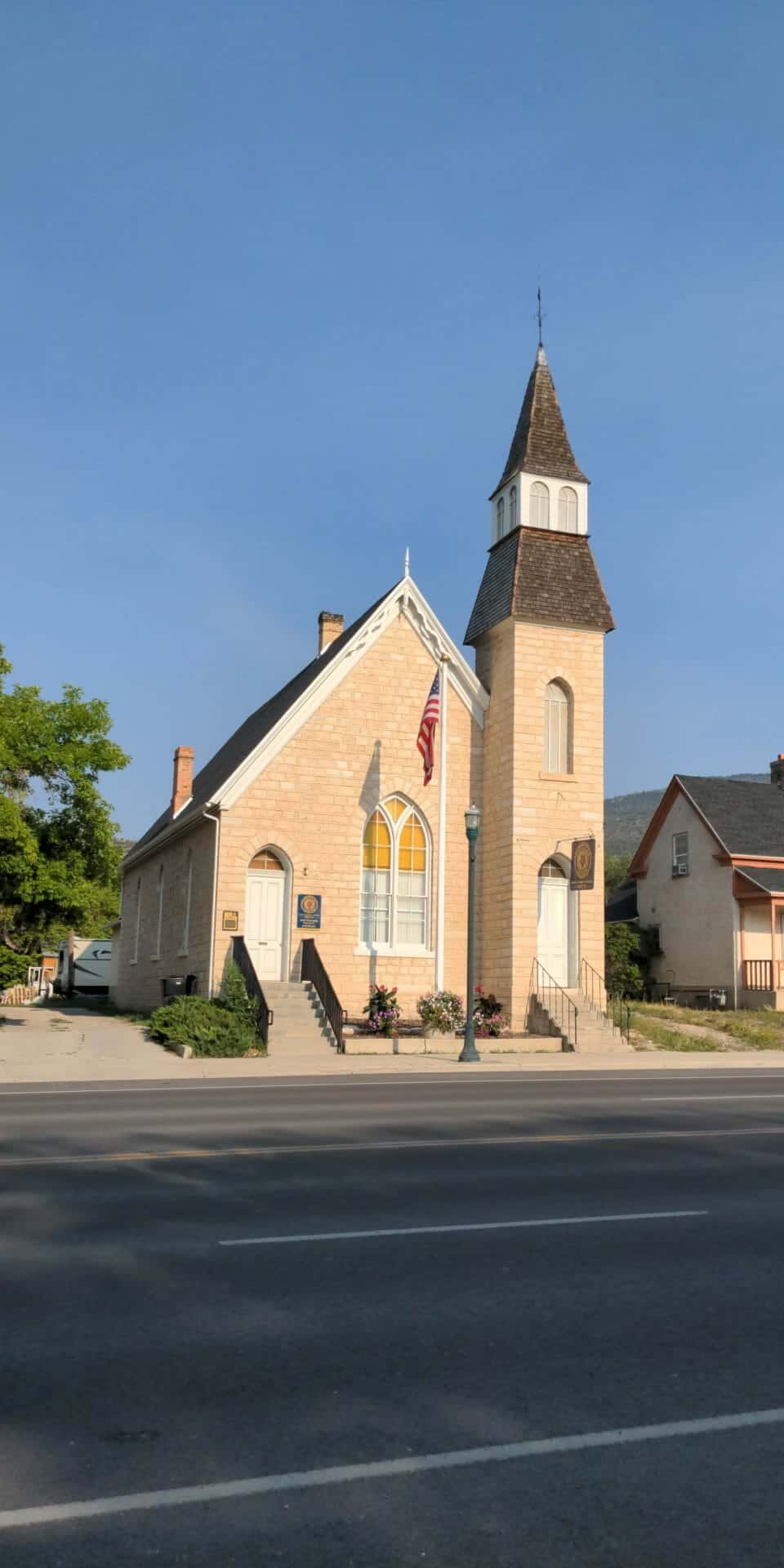
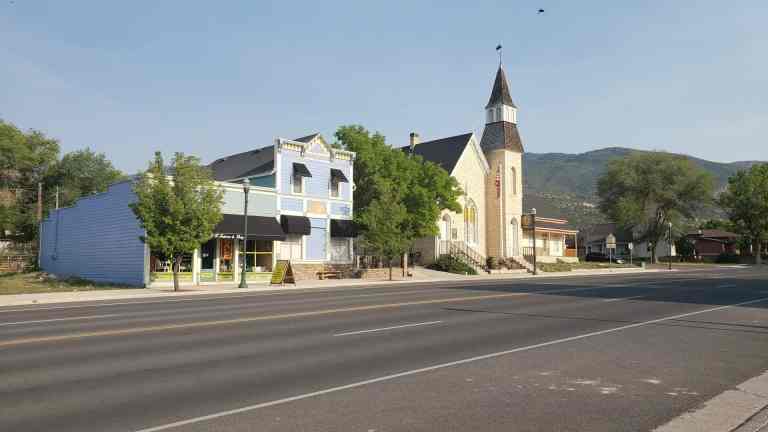
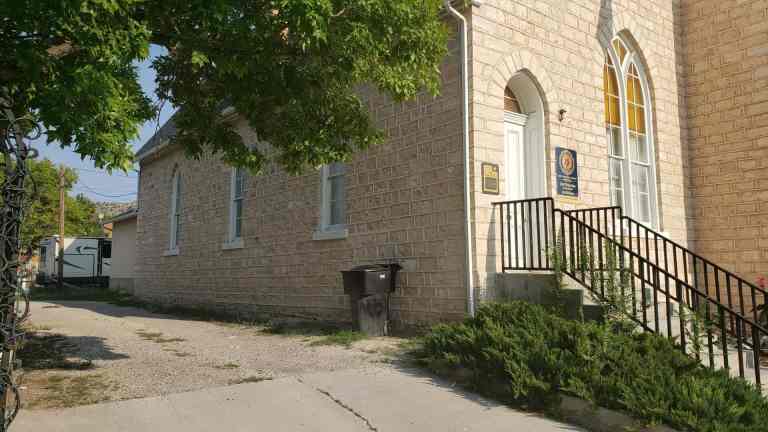
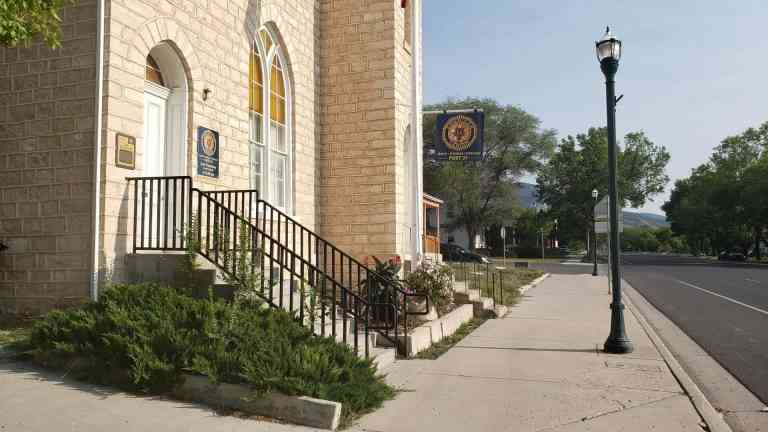
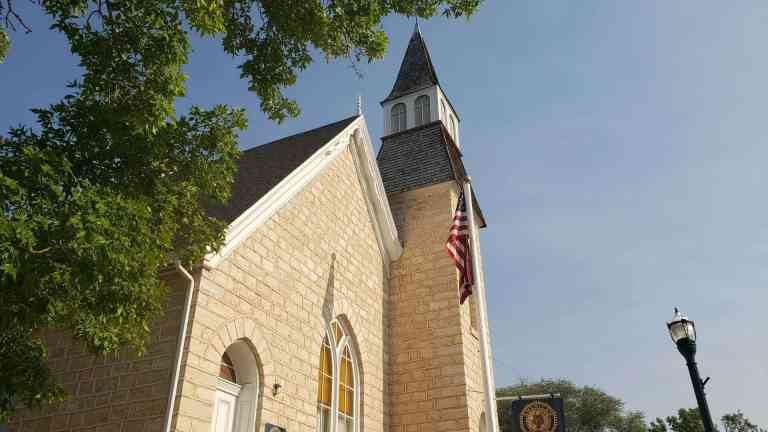
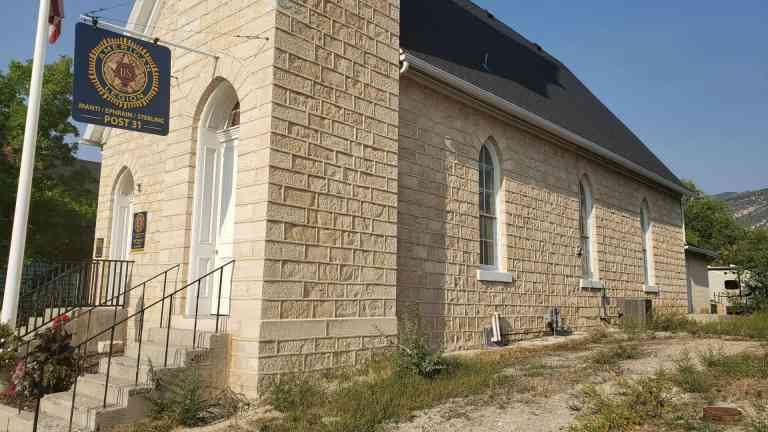
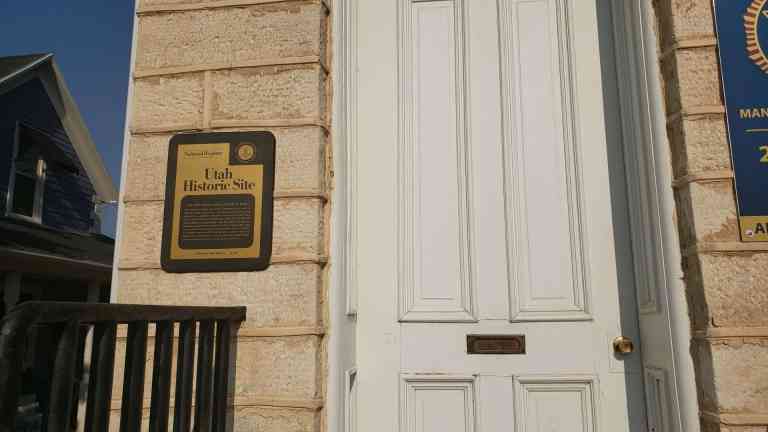
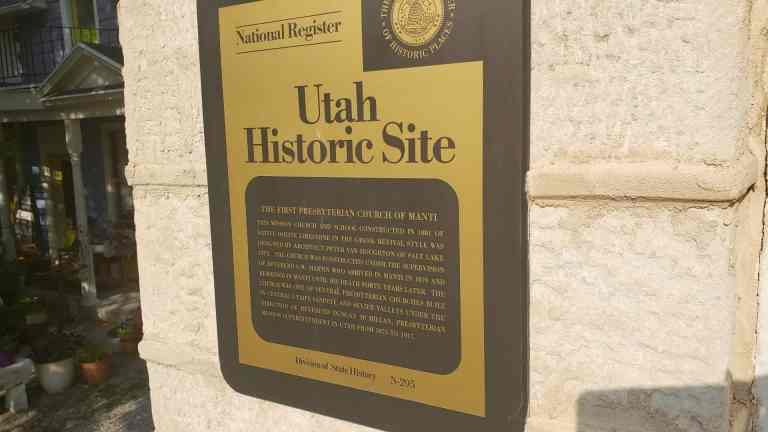
This mission church and school constructed in 1881 of native oolite limestone in the Greek Revival style was designed by architect Peter Van Houghton of Salt Lake City. The church was constructed under the supervision of Reverend G.W. Martin who arrived in Manti in 1879 and remained in Manti until his death forty years later. The church was one of several Presbyterian churches built in central Utah’s Sanpete and Sevier Valleys under the direction of Reverend Duncan McMillan, Presbyterian Mission Superintendent in Utah from 1875 to 1917.
Located at 165 South Main Street in Manti, Utah and added to the national register of historic places (#80003951) on March 27, 1980.
From the national register’s nomination form: The First Presbyterian Church of Manti is significant because it documents the important role of a non-Mormon religious organization in stimulating improved educational opportunities in Utah and because the circumstances surrounding its being brought into existence place aspects of Mormon settlement into a new perspective. The building is a distinguished addition to the built environment of Manti.
Presbyterianism was established in Utah on June 11, 1869, with the arrival of the Reverend Melancthon Hughes to begin a pastorate in Corinne, Utah. Although begun with work in a Gentile boom town, Presbyterianism in Utah quickly became a determined missionary and youth education program aimed principally at converting Mormons.
As a religion whose own beliefs demanded an educated understanding of Christian doctrine, and whose style of religious organization was democratic, Presbyterians perceived Mormonism as a perversion, “a sort of cross between Roman Catholicism and Protestantism with vestigal marks of paganism, too eclectic to be evangelical and yet too evangelical to be wholly non-Christian.”1 Similarly, the authoritarian nature of the Mormon Church and its internal discipline was seen as “despotic suppression of liberty among its votaries and victims.” Convinced that Mormonism was both false and un-American, and, strengthened by the resolve that “Christianity and patriotism are natural allies … the Presbyterian Church discovered that it had mission work in Utah requiring intellectual strength, fervent piety, and executive ability.”
The missionary who epitomized these qualities, the Reverend Duncan McMillan, was also the man who brought into being the Presbyterian missionary strategy in Utah of offering superior educational facilities that would in time create an educated populace who would turn away from Mormonism. McMillan’s first venture demonstrated his ability to capitalize on available opportunities. Hearing of a group of disaffected Mormons in Sanpete County, he received permission from the Presbytery of Utah to proceed to Mt. Pleasant.
When he arrived on March 3, 1875, the Reverend McMillan found a group of potential converts in the Mt. Pleasant Liberal Club. These people were former members of the Mormon Church, either apostate or excommunicated, who had been growing in number since 1862 when a rift in the local Mormon Church organization had produced the defection of a sizeable number of Swedes. They had been joined over the years by others, Anglo-American and from the other Scandinavian groups, whose common bond was that they were now no longer Mormon. Politically they supported the Liberal Party against the People’s (Mormon) Party in territorial politics, but religiously they were adrift.
Since they had progressed far enough in organization to have completed a Liberal Hall just the year before, the situation for the Reverend McMillan was well-nigh perfect … to have both a congregation and a meeting place.
The other situation from which the Reverend McMillan was able to profit was the poor quality of public schools in Utah. While Mormon communities had generally established schools as among their settlement priorities, the nature and product of this schooling left much to be desired. Lack of trained teachers and an irregular and often-interrupted school year meant that most children received an indifferent education at best, but often, none at all. Fashioning benches with his own hands, McMillan opened his first school in Mt. Pleasant on April 20, 1875, with 35 students in attendance.
After overcoming some initial financial problems and with the help of other ministers and a corp of dedicated female Presbyterian missionary teachers, McMillan would establish congregations or schools throughout Sanpete and Sevier counties and in other parts of Utah territory. His school at Mt. Pleasant would become the Wasatch Academy, still operating and listed on the National Register.
In 1877 two former Mormon missionaries, Andrew Jenson and Andrew Nelson, called on McMillan and invited him to start a school in Manti. McMillan quickly called upon his brother and sister-in-law to undertake the project The school grew to 122 pupils, the largest of any school in Sanpete County,’ and a congregation was begun with twelve new Presbyterian converts. The most active elder of the new church was Andrew Nelson, a polygamist with four wives, 24 children, and 118 grandchildren. In order to accommodate to his new Presbyterian sensibilities, Nelson abandoned three of the wives.
McMillan, always sensitive to charges levelled by other Presbyterians that the Utah mission to the Mormons was inordinately expensive, triumphantly reported:
there are more converted Mormons in that one church than in all the churches of Salt Lake City put together …. Now I should like those pious economists to know that our noble, wealthy, Presbyterian Church has “wasted” only $75.00 in the conversion of those ten families, and the planting of Presbyterianism in the midst of this wilderness of sin.
The First Presbyterian Church of Manti had been firmly established by the time the Reverend G. W. Martin and family arrived in 1879 to take up the post of minister. The Reverend Martin would remain at his post in Manti for over forty years, and during that time would witness both the first flush of success as Presbyterian schools and churches sprang up in Sanpete and Sevier county under the prodding of the dynamic McMillan and, sadly, he also witnessed the gradual stagnation of Presbyterian effort. Because the Presbyterian schools had offered solid curricula and able, well qualified teachers, Mormon parents had rarely hesitated to take advantage of this educational opportunity for their children. But by the mid-1890s Mormon Stake Academies and the improved public education system made the Presbyterian schools less attractive, and gradually with the exception of Wasatch Academy the mission schools went out of existence. Proselyting, after the first harvest of Mormon dissidents, became increasingly difficult and conversions were slow. The Manti congregation dwindled through migration and reconversion to Mormonism, and when the Reverend McMillan died in 1917 the Presbyterian Church in Manti died with him. However, unlike some of his firey colleagues, the Reverend Martin was held in considerable esteem by the Mormon community of Manti. They valued his educated (a B.A. from the University of Ohio and a B.D. from Union Theological College) commitment to civic affairs in their community, and his consistently friendly and broad-minded attitude toward Mormonism. His funeral, in the church he had built and served for forty years, was attended by dignitaries of the Mormon Church who had offered the Manti Tabernacle to accommodate the large crowd who attended the service.
Subsequently the First Presbyterian Church of Manti, with its bell that had once rung for city curfews as well as church services, fell into disuse and disrepair. It is currently operated as a lodge hall.
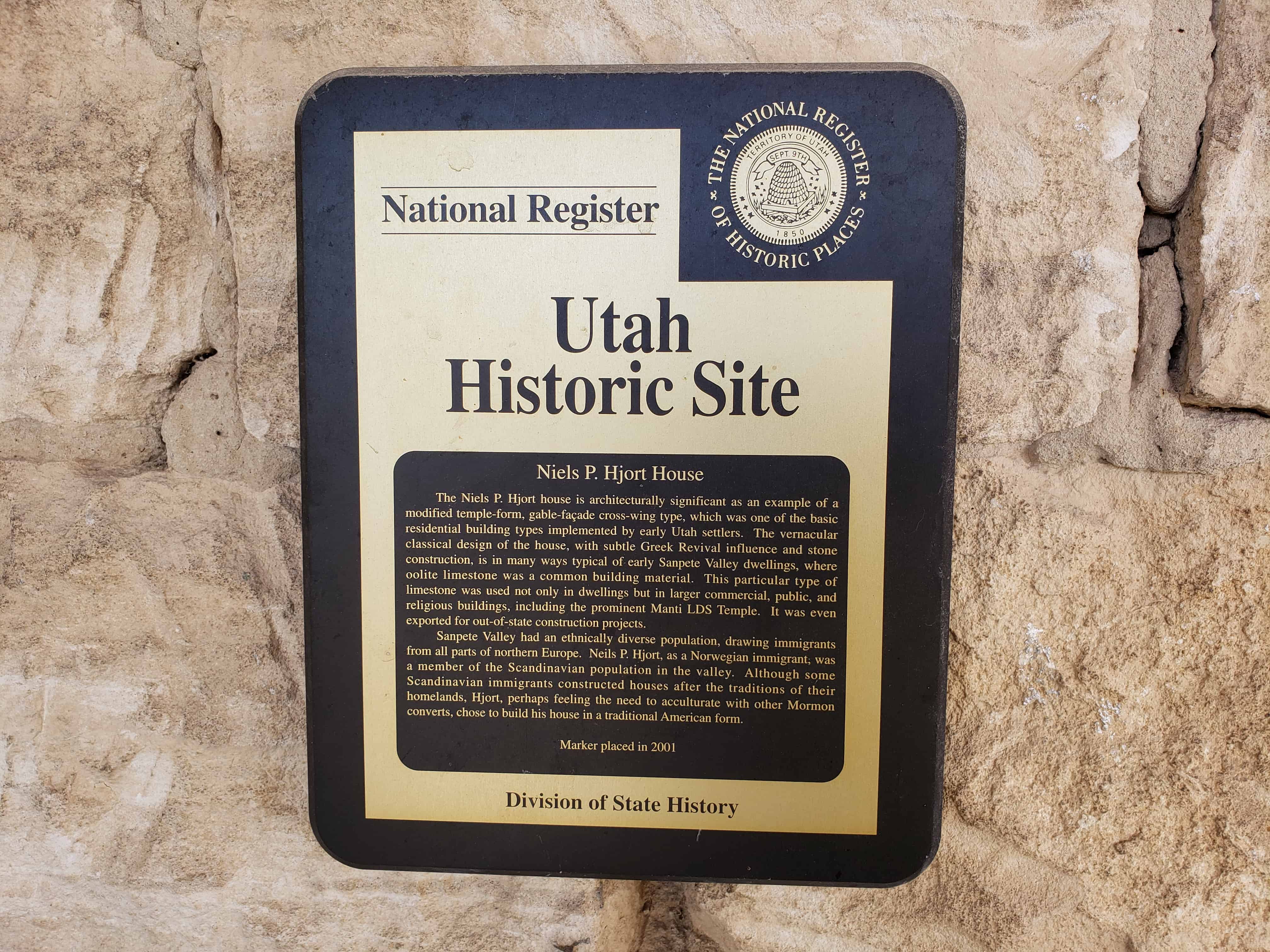
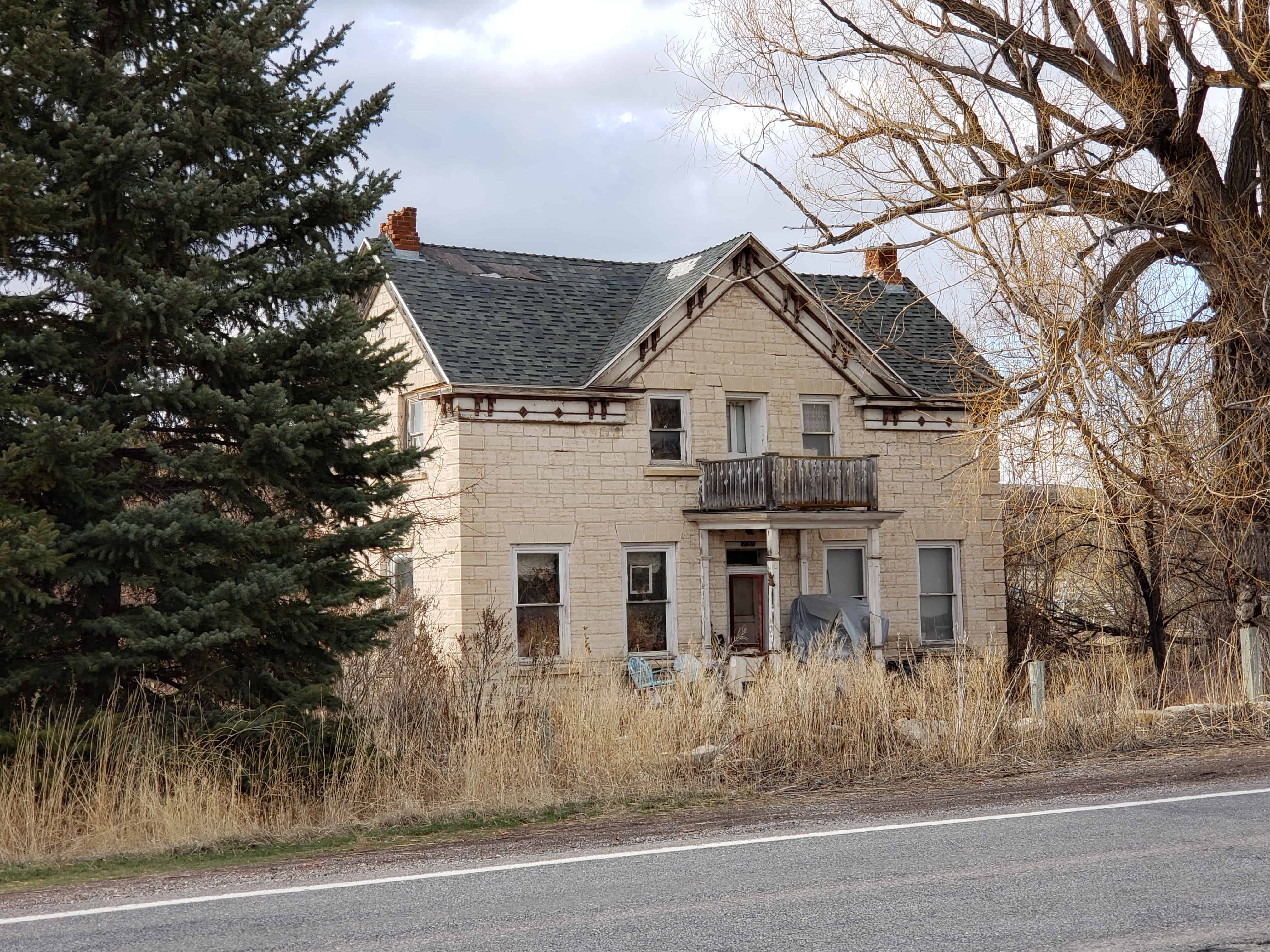
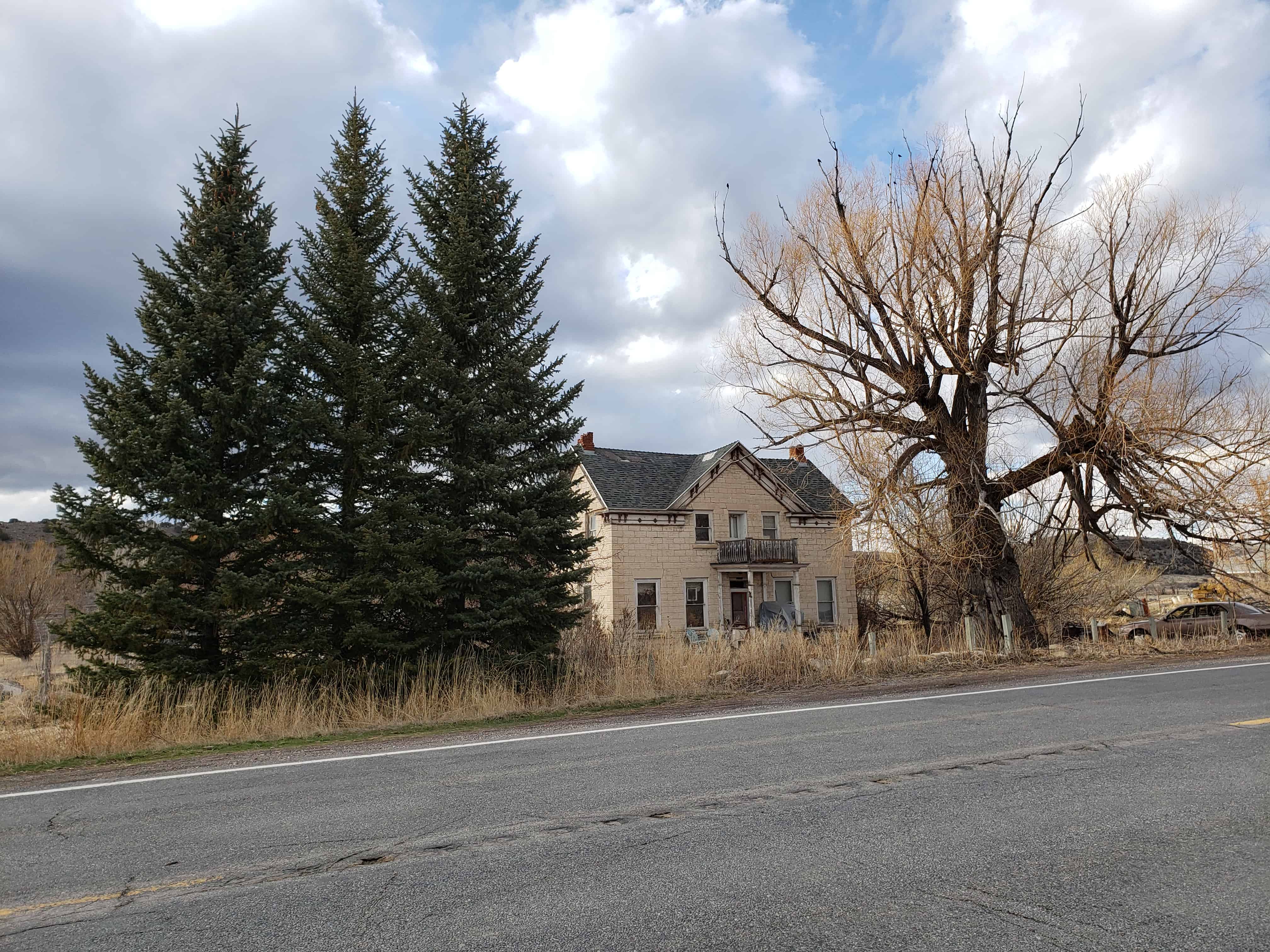
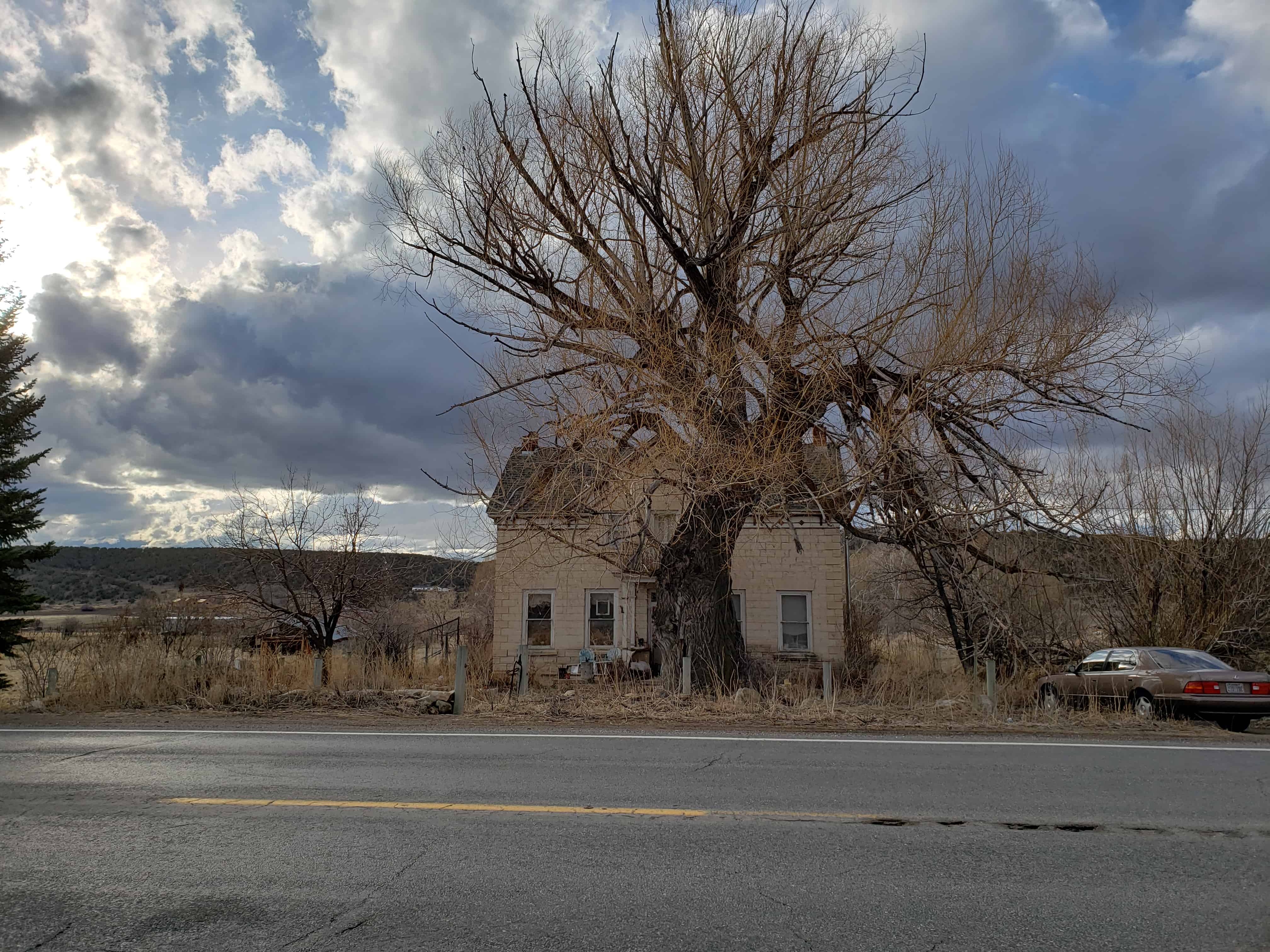
The Niels P. Hjort house is architecturally significant as an example of a modified temple-form, gable-facade cross-wing type, which was one of the basic residential building types implemented by early Utah settlers. The vernacular classical design of the house, with subtle Greek Revival influence and stone construction, is in many ways typical of early Sanpete Valley dwellings, where oolite limestone was a common building material. This particular type of limestone was used not only in swellings but in larger commercial, public, and religious buildings including there prominent Manti LDS Temple. It was even exported for out-of-state construction projects.
Sanpete Valley had an ethnically diverse population, drawing immigrants from all parts of northern Europe. Neils P. Hjort, as a Norwegian immigrant, was a member of the Scandinavian population in the valley. Although some Scandinavian immigrants constructed houses after the traditions of their homelands, Hjort, perhaps feeling the need to acculurate with other Mormon converts, chose to build his house in a traditional American form.
Located at 2783 N State Street in Mt Pleasant, Utah – the Henry Martin Bohne and Juiett Day Bohne home stands out as one of the few on the highway between Mt Pleasant and Fairview. It was built in 1896 from hand chipped white oolite stone.
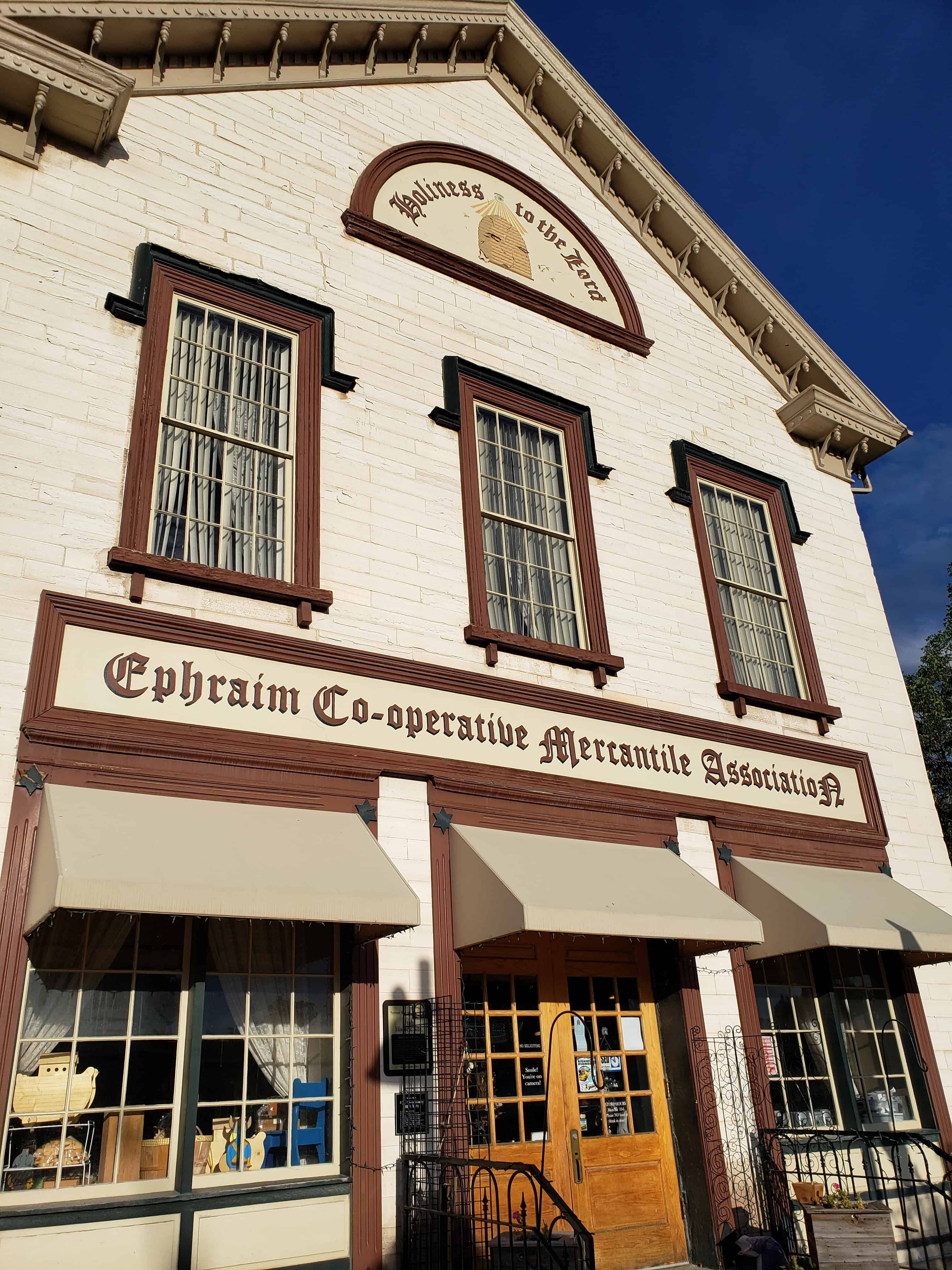
Constructed in 1871-72 of local oolitic limestone, this Greek Revival style building is one of the remaining examples of the more than 120 cooperative mercantiles that were established by the LDS church between 1868 and 1878. The first floor was a strong part of Ephraim’s economy beginning as a co-op, then as a United Order store, later used for farm implement sales, a car repair garage, and finally as part of Ephraim Roller Mill when a new addition connected it to the Relief Society granary to the south. That use continued into the 1950s, then, after decades of neglect, the building was restored in 1989-90. The second floor also served many purposes including a social hall, theater, Relief Society hall, and the first home of Sanpete Stake Academy, predecessor of Snow College when it began in 1888.
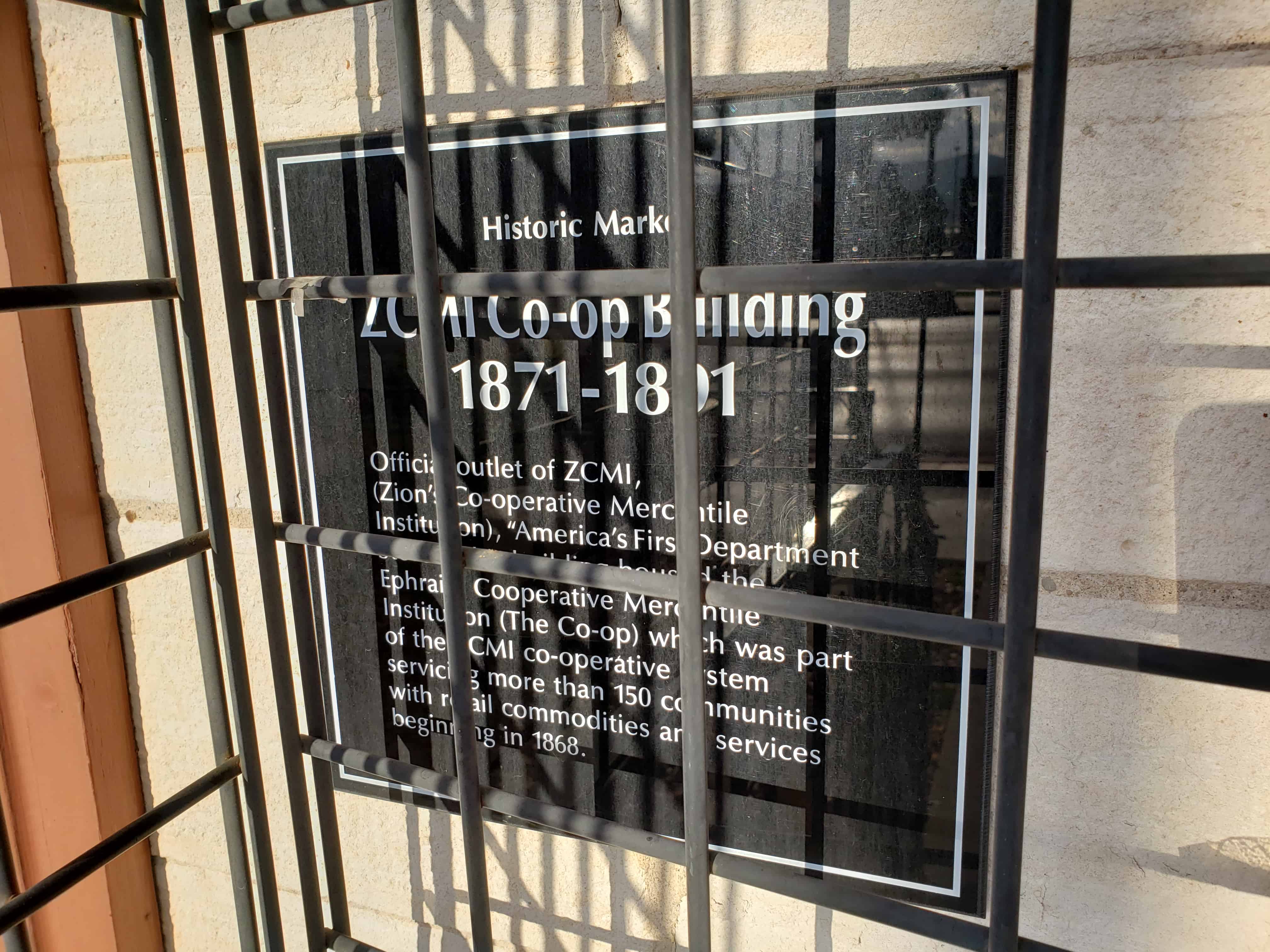
ZCMI Co-Op Building 1871-1891
Official outlet of ZCMI (Zion’s Co-operative Mercantile Institution), “America’s First Department Store”. This building housed the Ephraim Cooperative Mercantile Institution (The Cop-op) which was part of the ZCMI co-operative system servicing more than 150 communities in the intermountain area with retail commodities and services beginning in 1868.
The Ephraim United Order Cooperative Building is located at 96 North Main Street in Ephraim, Utah and was added to the National Historic Register (#73001862) March 20, 1973.
In the late 1860’s Mormon communities were faced with the challenge of an ever increasing number of “gentile merchants” settling in Zion. The coming of the railroad in 1869 threatened to enslave the Mormons with an economic bondage that had not been possible before. In response to these challenges church officials developed plans which culminated in the cooperative movement. The basic philosophy of this movement was that Latter-day Saints should not trade with “outsiders” but instead with local cooperative establishments which would be supplied by a “Parent Institution.”
The first step in the cooperative movement was the organization of the Parent Store in Salt Lake City, Zion’s Co-operative Mercantile Institution, on October 24, 1868. Within the next ten years more than 150 local cooperatives were founded.
Perhaps the best remaining example of a local cooperative store is the old Ephraim United Order Go-operative Building. Construction on the building began in 1871 and was completed in 1872. The building was constructed of Sanpete oolitic limestone and its front had two distinguishing features which branded it as a co-op store. The name “Ephraim U. O. Mercantile Institution” and a beehive encircled by the words, “Holiness to the Lord.” Signs for the parent establishment in Salt Lake City contained the inscription “Holiness to the Lord.” Nearly all of the local co-op stores used the name “Cooperative Mercantile Institution” in association with the name of the location.
The cooperative movement, as symbolized by the Ephraim Cooperative Building, was an important part of the Mormon story. According to Leonard Arrington, prominent Mormon historian, “Cooperation, it was believed, would increase production, cut down costs, and make possible a superior organization of resources. It was also calculated to heighten the spirit of unity and ‘temporal oneness’ of the Saints and promote the kind of brotherhood without which the Kingdom could not be built.” (Leonard Arrington, Great Basin Kingdom, p. 309.)
The cooperative store occupied the first floor of the two-story structure. The second floor was constructed as a recreation hall and as a Relief Society meeting hall. Dances and parties were held in the second story. The building became not only an economic but also a social center for the community.
In 1888 plans were made for the establishment of the Sanpete Stake Academy. Funds were not available for the construction of a building and so the Relief Society Hall above the Co-op store was secured. Furniture and equipment were purchased and on November 5, 1888 the Sanpete Stake Academy was opened. The hall was used by the Sanpete Stake Academy until about 1900. In 1902 the name Sanpete Stake Academy was changed to the Snow Academy. This was in turn changed to Snow Normal College in 1917. As the first home of the school which be came Snow College, the old Co-operative Building is also of important historical significance.
The Utah Governor’s Mansion is the official residence of the Governor of Utah and family. It is located in the South Temple Historic District in the Avenues neighborhood at 603 East South Temple in Salt Lake City, Utah.
Thomas Kearns rose from modest beginnings to become a successful financier and United States Senator. He was born on April 11, 1862, on a farm in Ontario, Canada, the son of Margaret and Thomas Kearns. His family moved to Nebraska when Thomas was seven. At the age of 17 he went to South Dakota when gold was discovered in the Black Hills» After that he went to Arizona where he worked as a miner and a teamster. In 1883 he arrived in Utah and secured employment with the Denver Rio Grande Railroad. He went to Park City, Utah, in the summer of 1883 and worked in the mines. Working in the Ontario Mine, Kearns met his lifelong friend and advisor, David Keith. By 1892 Kearns, Keith, John Judge and others, leased mining property in Park City and formed the Silver King Mining Company. The profits from this mine were great, and the land holdings of this company increased. In 1907 the Silver King Coalition Mines Company was formed with Kearns as vice-president and Keith as President. In 1901 he acquired the Salt Lake Tribune. He was a noted philanthropist, and erected St. Anne f s Orphanage in Salt Lake City and gave generously to Catholic charities. He was a staunch Republican and was elected to the United States Senate in 1901. In Washington he became a close friend of Theodore Roosevelt.
He married Jennie Judge, of New York, in 1890. They had two sons and two daughters. Kearns died in October 1918. The home remained in the family until 1937 when Mrs. Judge donated it to the State of Utah. It was used as the governor’s mansion from 1937 to 1957, when it became the offices ‘of the Utah State Historical Society. In 1978 the home was vacated for a massive renovation and restoration project. After it was completed it started being used as the governor’s mansion.
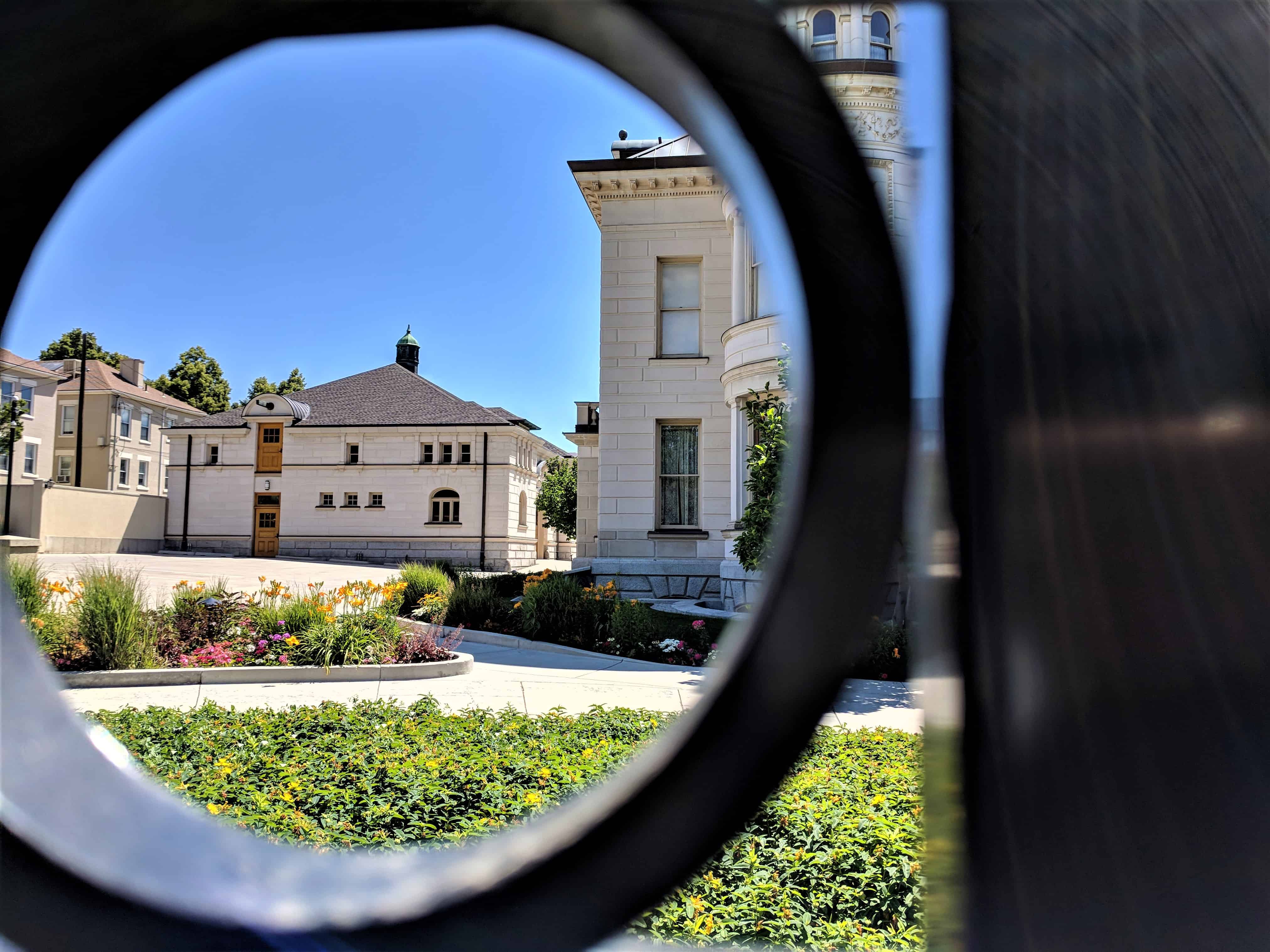
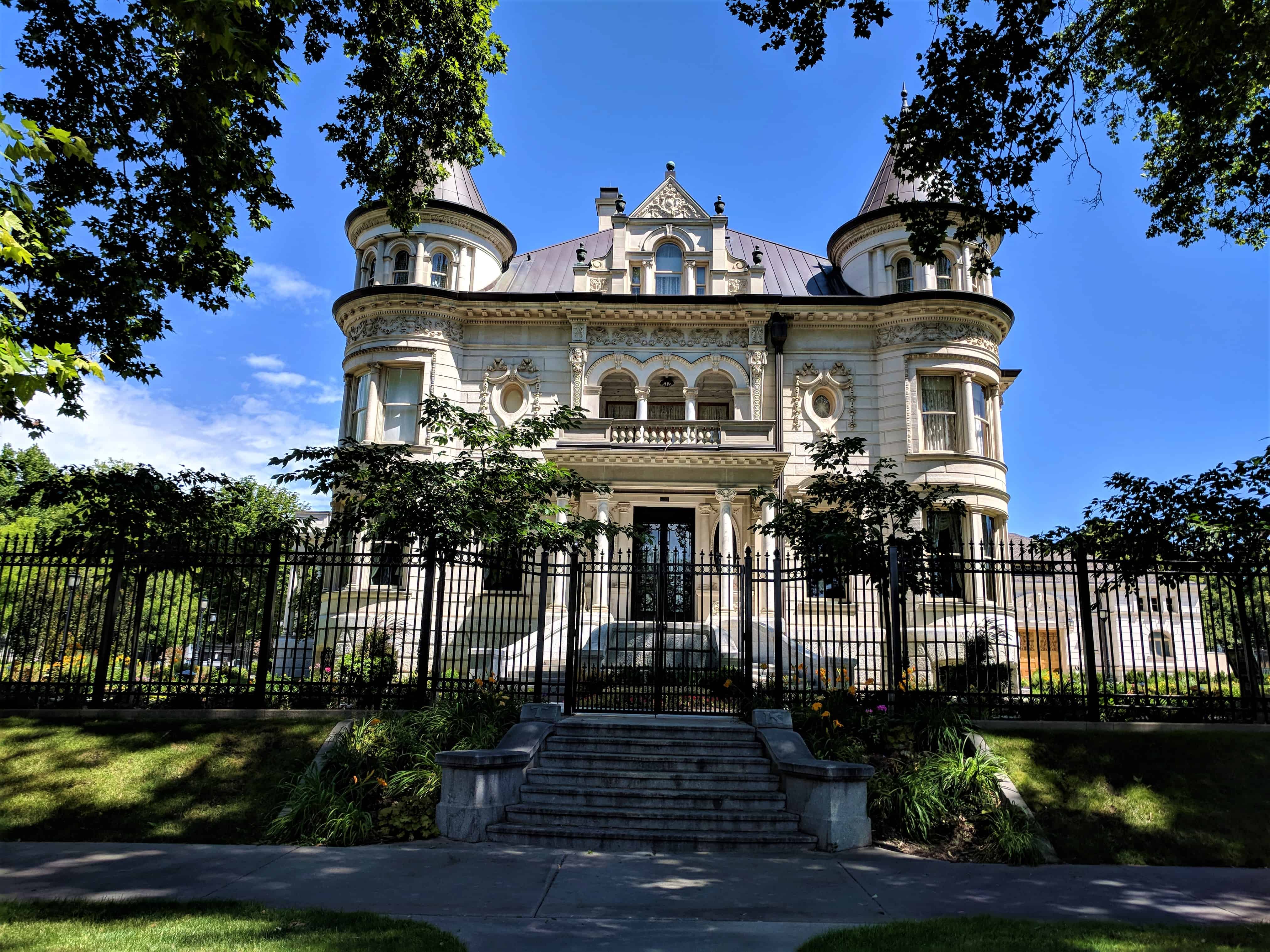
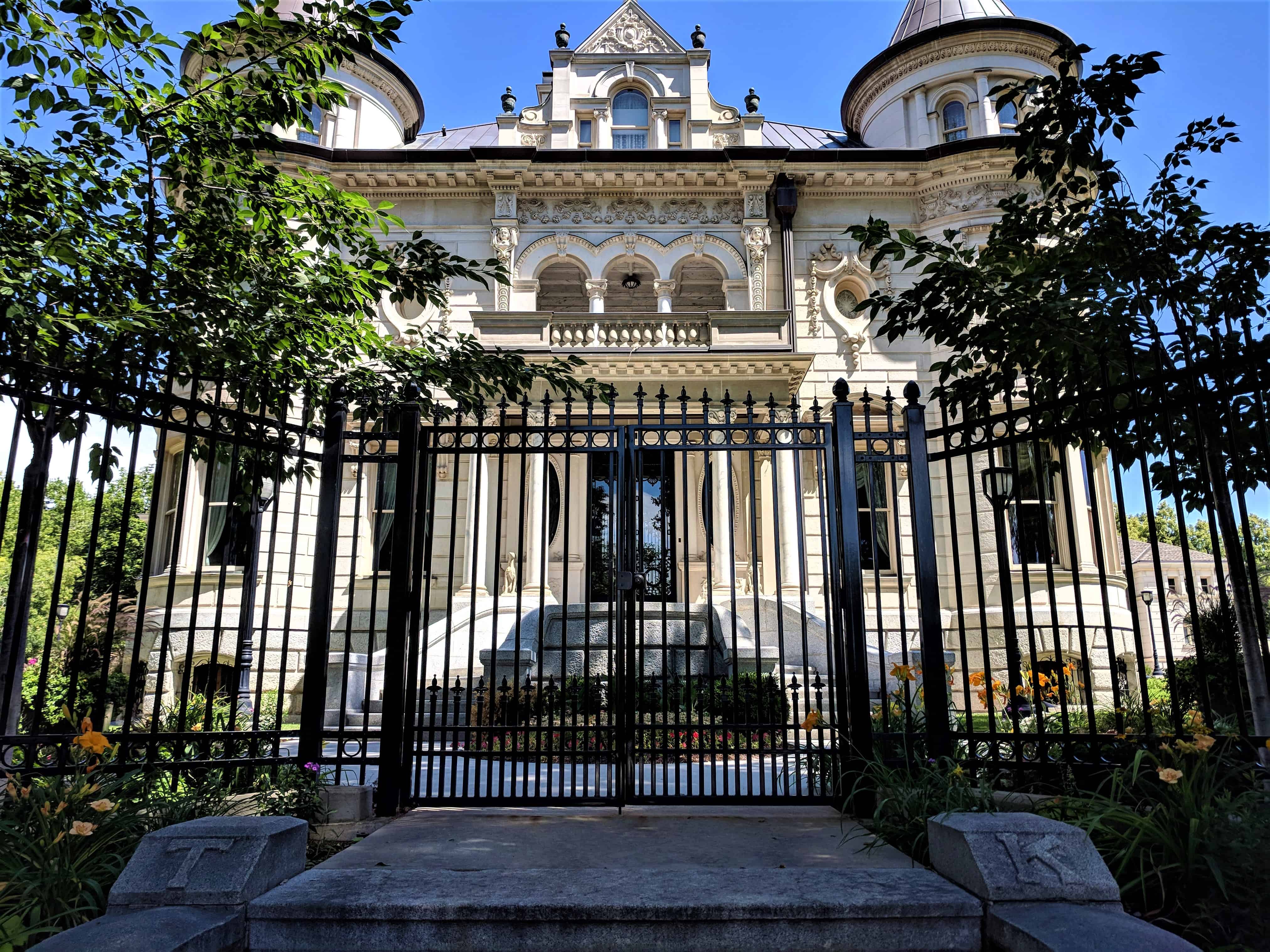
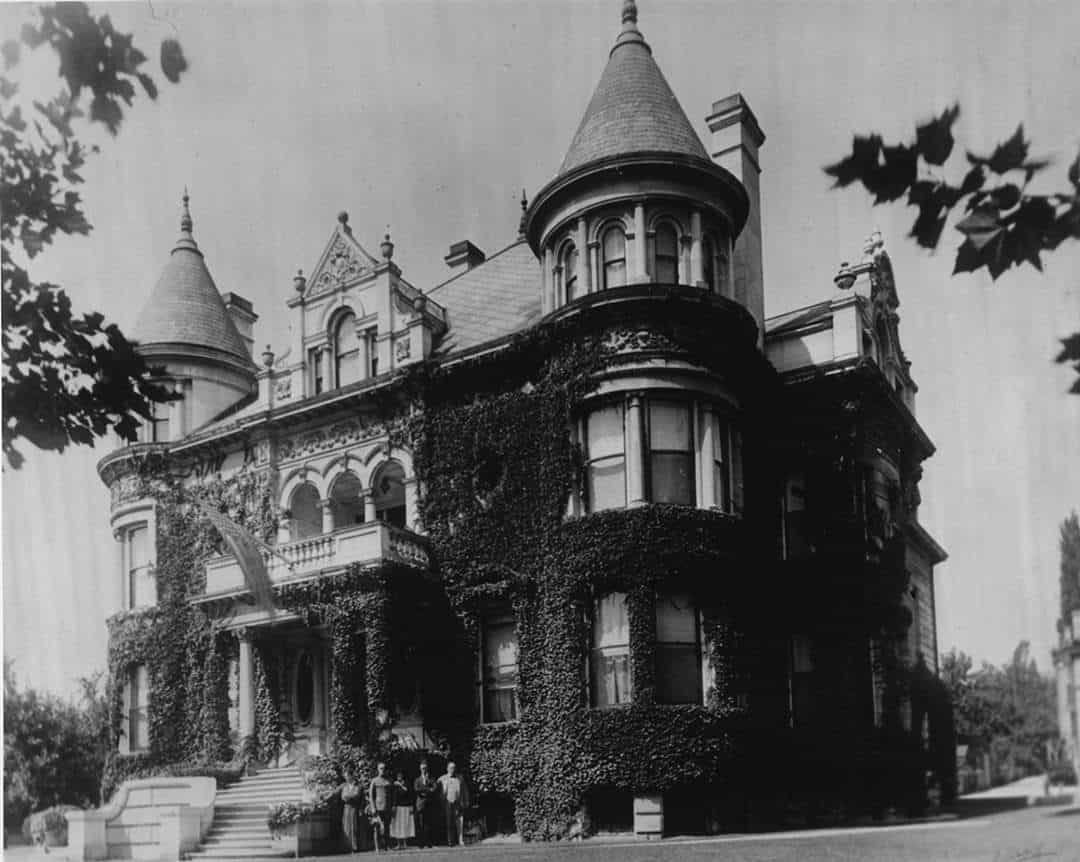
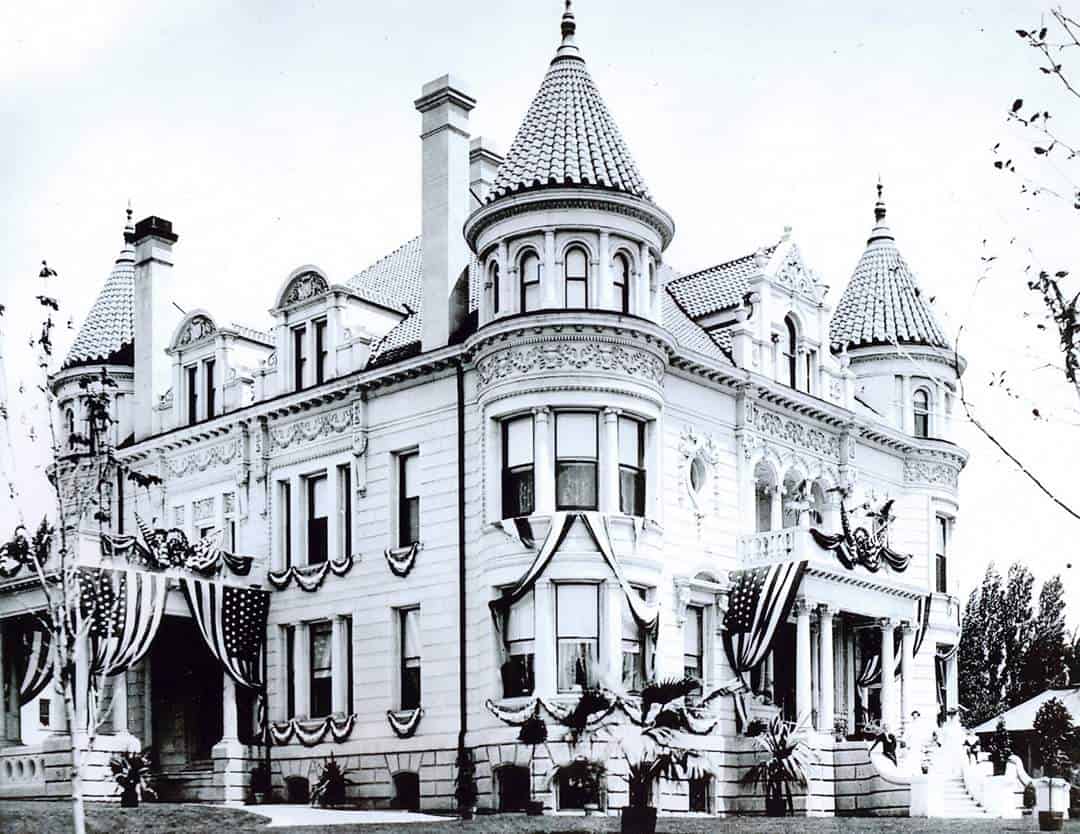
The Kearns Mansion has a stone exterior richly detailed with round towers at three of its four corners.
At the time of the building, the mansion contained 28 rooms: 6 baths, ten fireplaces (of which nine remain), an all-marble kitchen and bathroom, a bowling alley, ballroom, billiard room, two parlors, two dining rooms, and three vaults (one for silver, one for wine, and one for jewelry). Cost of construction was approximately $250,000.00.
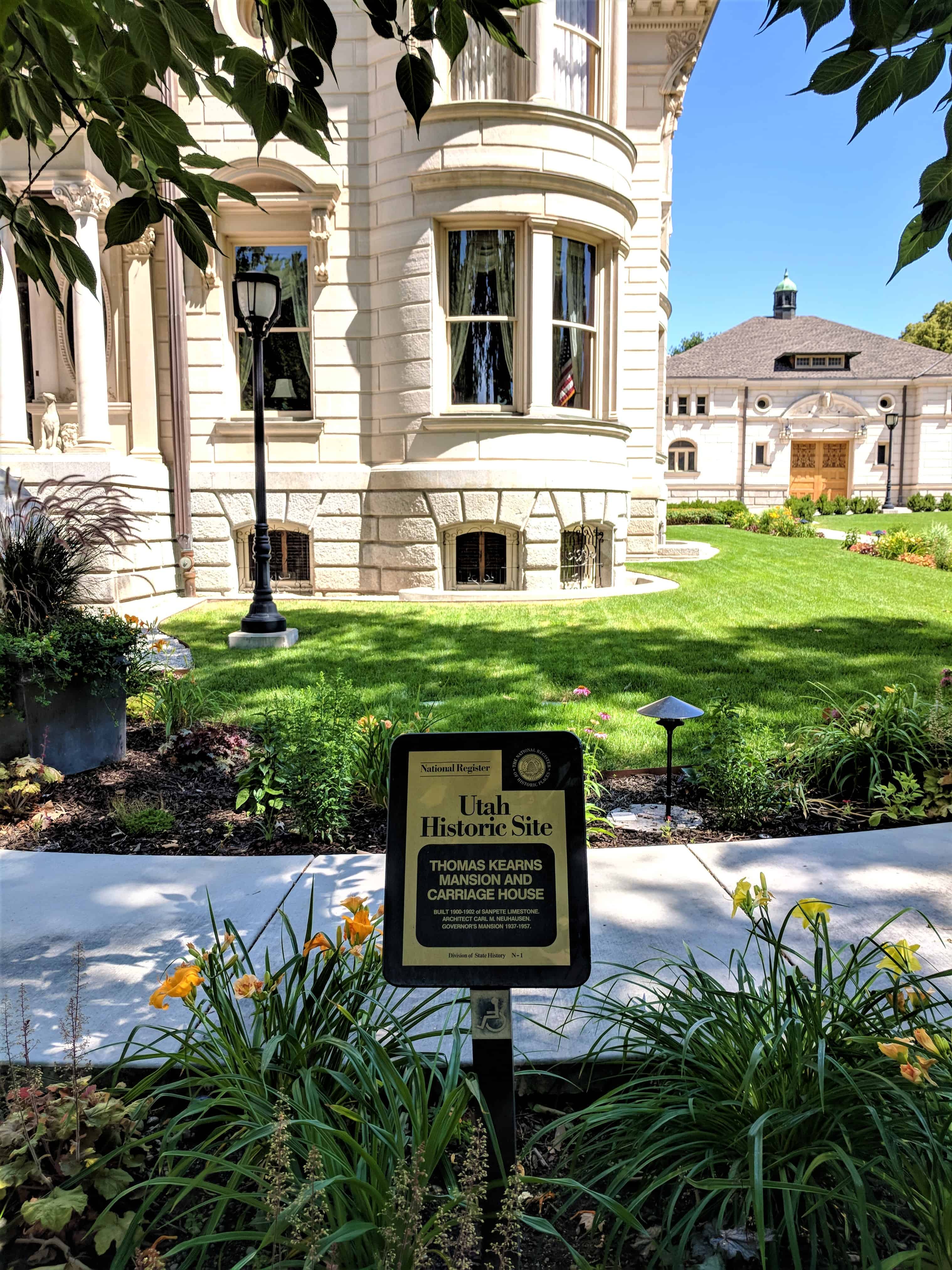
The carriage house is one of Utah’s most elaborate and best preserved carriage houses. It was built to serve-the Kearns Mansion, built by mining magnate Thomas Kearns. For many years it was the home of the Utah State Institute of Fine Arts. In 1978 the Institute moved next door to 617 East South Temple.
The Thomas Kearns Mansion and Carriage House was added to the National Register of Historic Places (#70000631) on February 26, 1970, it is located at 603 East South Temple in the South Temple Historic District of Salt Lake City, Utah – the text below is from the nomination form from the register:
The Kearns Mansion was designed by Architect Carl M. Neuhausen for millionaire mining magnate Thomas Kearns. It is a part of the national culture that shows up in this area. The foundation was laid in the spring of 1900 and the building completed in 1902.
Thomas Kearns came to Utah in 1883 as a young man working on the Denver and Rio Grande Railroad. He gravitated to the mines in Park City where he soon became part owner of the Silver King Coalition Silver Mines. His partner was David Keith. With his newly acquired wealth, Kearns built his lovely mansion on Brigham Street (later South Temple Street) in 1902.
The building itself is a work of art, made of oolite marble, and richly furnished interiors of wood, tile and marble. It reflects the quality that affluence could demand in the new twentieth century.
Thomas Kearns became a millionaire before he was 28 years old and a United States Senator from Utah by the age of 40 (1901-1905). He also was a noted philanthropist, erecting the Kearns St. Ann’s Orphanage, now St. Ann’s School. He became the publisher of the Salt Lake Tribune. Today the Kearns Building, Kearns Corporation, and Kearns, Utah, perpetuate his name.
The Kearns family lived in the mansion for over thirty-five years. In it many distinguished guests were entertained, including two presidents: Theodore Roosevelt and William Howard Taft. President Roosevelt watched a parade on South Temple from the marble loggia on the second floor.
Thomas Kearns died in 1918, but the home remained in the possession of the family until 1937, when Mrs. Jennie Kearns donated it to the state to be used as a governor’s mansion. Three Utah governors lived in the mansion; Henry H. Blood, Herbert B. Maw, and J. Bracken Lee. In 1957 the mansion became the home of the Utah State Historical Society. It is the intention of the Society that this lovely building be preserved and kept open to the public to provide a show place depicting the genteel life that Utah’s mineral resources produced for one of the state’s foremost families.
The Kearns Mansion has a stone exterior richly detailed with round towers at three of its four corners.
At the time of the building, the mansion contained 28 rooms: 6 baths, ten fireplaces (of which nine remain), an all-marble kitchen and bathroom, a bowling alley, bal1 room, fail Hard room, two parlors, two dining rooms, and three vaults (one for silver, one for wine, and one for jewelry). Cost of construction was approximately $250,000.00,
The main entrance on the south leads into a hallway with a floor of handset ceramic tile, one of the few in Utah. The wood-panelled walls and the floating staircase are made of French oak, hand carved by artisans imported from Europe. In the main hallway are two columns carved with allegorical scenes: “The Rape of the Sabines” and “Botticelli’s Graces”. At the end of the main hall (south) are the massive iron and glass doors. The foyer is of African and Roman marble. Above the main hall is a graceful oval ceiling well. To the west of the front hall is the state drawing room converted early in the history of the mansion from two parlors: the Louis XVI and the Moorish parlors.
The first room east of the front hall is the den. The Flemish oak paneling is stained black. North of the den is the state dining room of red stained mahogany. Reportedly all the wood in this room came from the mahogany trees in the Ural Mountains of Russia. Dominating the room, above the table, is a large bronze chandelier. The figures on the newel posts at the foot of the stairs were done by the French sculptor Moreau and were brought from the Paris Exposition of 1900 by Senator Kearns.
Off the main hall of the second floor were the bedrooms and guest rooms of the Kearns family and later the governors. The former bedrooms of the Kearns family and the governors were in the southeast corner of the second-floor, now the library. Across the hall were other bedrooms now housing the picture collections, and the librarian’s office. The director’s office was formerly the nursery. The marble bathroom is in the northeast portion of this floor. At the south end of the hallway on the second floor doors open to a marble loggia.
The third floor contains the ballroom or gymnasium and the billiard room. These rooms now serve as galleries Overlooking the circular hallway on this floor is the beautiful ceiling well which crowns this stately mansion.
In the basement was a two-lane bowling alley and wine vault. This area is now used to house the library’s extensive collections. Only slight alterations have been made to the building; both the grandeur and affluence of its builder and owner remain.
Outside and to the rear of the mansion (north) is the carriage house, also of oolite marble, which now houses the Utah Institute of Fine Arts. This exterior has not been modified; however, the interior has undergone major alterations.
(from Preservation Utah’s walking tour) Thomas & Jennie Kearns Mansion (Utah Governor’s Mansion) 603 E. South Temple 1900- 1902, Carl M. Neuhausen, SLC Tours available April-November on Tuesdays & Thursdays from 2-4 pm.
Thomas Kearns, with his partner David Keith (see entry #12), made a fortune on the silver flowing out of Park City mines. Kearns’ wealth enabled him to become one of Utah’s most influential men. He served a term in the United States Senate (1901-1905) and co-owned the Salt Lake Tribune with Keith.
Every feature of the Chateauesque mansion built for Kearns and his wife, Jennie, speaks of eloquence and opulence. Utilizing the finest craftsmen and materials available, the Kearnses created a residence comparable in quality and style to mansions built by the Vanderbilts and Carnegies in the East. The Kearns Mansion became the dazzling center of Utah’s elite social life. President Theodore Roosevelt, a personal friend of the Kearnses, dined here in 1903.
The Kearns Mansion began a new phase in its history in 1937 when Jennie Kearns donated it to the state for use as Utah’s first official governor’s residence. Between 1937 and 1957, three Utah first families lived in the mansion. In 1957,the state legislature funded the construction of a new governor’s residence and the Utah State Historical Society moved into the building. After a renovation project spearheaded by Governor Scott and Mrs. Norma Matheson, the Kearns Mansion became the Governor’s Mansion once again in 1980.
The Kearns Mansion began a new phase in its history in 1937 when Jennie Kearns donated it to the state for use as Utah’s first official governor’s residence. Between 1937 and 1957, three Utah first families lived in the mansion. In 1957,the state legislature funded the construction of a new governor’s residence and the Utah State Historical Society moved into the building. After a renovation project spearheaded by Governor Scott and Mrs. Norma Matheson, the Kearns Mansion became the Governor’s Mansion once again in 1980.