
Tags
Cottonwood Canyon Cliff Dwelling (42Ka1504) was first recorded by Neil M. Judd in 1919 (see Judd 1926}. Judd did not excavate any of the site, although he did note some deterioration due to weather and cattle but the impact was- apparently small. Judd labelled this cliff dwelling “Cave 6,” one of more than twenty which he noted in Cottonwood, Indian and Farm Canyons. In October 1973, Michael Bunker of the Bureau of Land Management-Kanab recorded the site for the Kanab District Archeological site inventory, There have been no subsequent archeological activities at this site. However, during July 1966 Utah State University contracted with the BLM to stabilize portions of the site. Presently additional stabilization is being considered.
The BLM survey analyzed the cliff dwellings as being affiliated with the Virgin branch of the Anasazi culture area. The site is a Pueblo II-type and has been dated to A.D. 1100-1200. It is unknown at this time whether earlier components exist at the site, but excavations at another cliff dwelling in Cottonwood Canyon (42Ka1170; Judd 1926) did indicate Basketmaker occupation.
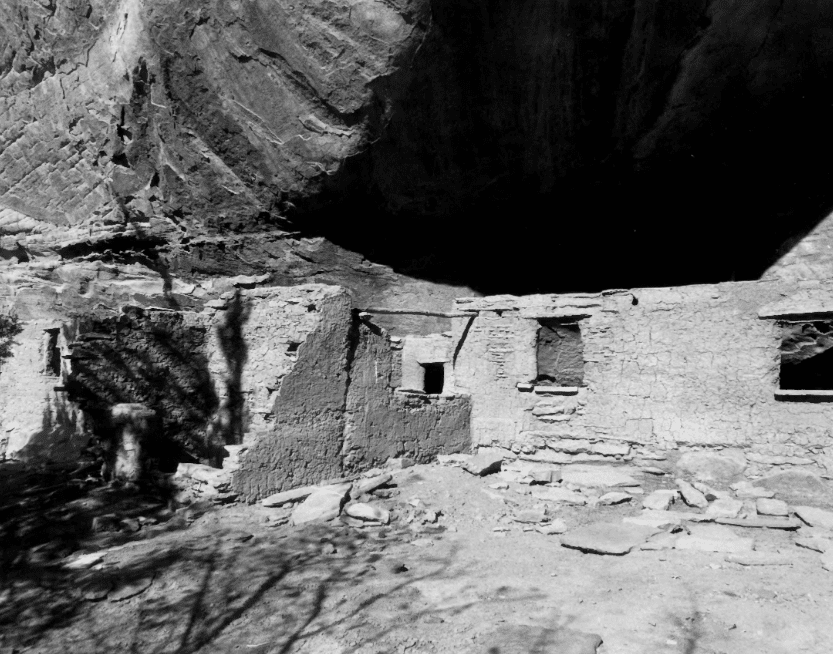
Ten to twelve structures were identified as probable living and storage structures by the BLM survey. (Judd had recorded nearly twenty structures.) This makes Cottonwood Canyon Cliff Dwelling the largest site in the drainage, and one of the largest in the Kanab vicinity. Cultural material observed by the BLM include: gray and corrugated ceramics; ashes, fire-cracked rocks and smoke-stained ceilings indicating hearths; and structure walls standing to a height of five feet. Other sites in Cottonwood Canyon have yielded cedar bark, corn stalks, a mountain goat-hair bag, stone slabs, sandals, digging sticks, basketry fragments, rabbit skin, corn kernals, beans and black-on-white ceramics. (Judd 1926)
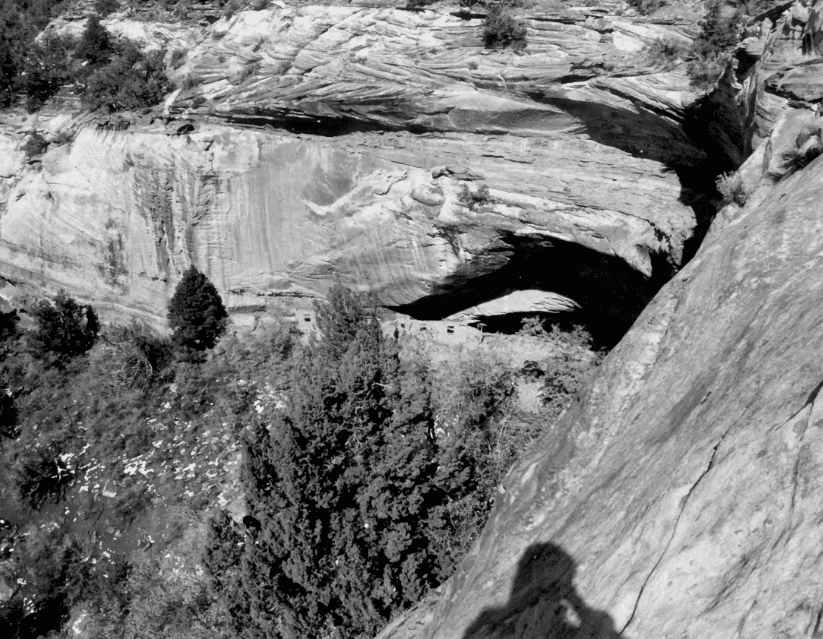
The cliff dwelling, is located under a semicircular overhang, 53 m long and 12 m deep, in the low enclosed sandstone cliff at the head of an unnamed eastern tributary of Cottonwood Canyon. The midden area which spills down the slope in front of the rock shelter is 530 m square. A spring flowed at the north end of the overhang at one point. Vegetation outside, the shelter currently consists of oak, cedar and pinion pine.
Intrusions at the site consist of pot holes adjacent to several structures. However, it is the opinion of the BLM survey that the majority of the site is undisturbed.
Although smaller cliff dwellings and other sites exist in the Cottonwood Canyons, the large size of 42Ka1504 makes it unique and significant in its own right. A “district” nomination of the entire Cottonwood drainage does not seem warranted at this time as no systematic survey of the area has been made. That should not detract from the integrity and importance of this site, alone. Unfortunately, although the Cottonwood Canyon Cliff Dwelling did not function in isolation and should not be considered so, insufficient data exists to nominate the canyon as a whole.
The following are elements of the site’s significance:
Integrity – Where twenty or more rock shelters were noted by Judd in 1919, only 9 are officially recorded today. Some of these are not duplicates. Cottonwood Canyon Cliff Dwelling (42Ka1504) is one of the few listed in “good” condition. A comparison of photo- graphs from 1919 and 1978 indicates that little deterioration has occurred. The site’s condition, its proximity to Kanab and its accessibility would provide an excellent opportunity for public education. However, these same factors make it a prime candidate for looting.
Site – Most all other archeological structures in the Kanab vicinity are small storage units or rock art panels. This site combines both dwelling and storage units. According to present knowledge, there are. only two other sites similar to this one in the area. One is in a tributary to Johnson Canyon, which is approximately ten miles east of Kanab. The other is located on private ground a few miles farther up Cottonwood Canyon. This site, 42Kall40, completely excavated in 1919, contained only a few structures. Clearly, 42Ka1504 is unusually large. Even Judd (1926:114), a man well-acquainted with many Southwestern archeological sites, called it the “largest Cliff-dweller settlement visited by the writer during his archeological observations north of the Rio Colorado.”
Research Potential – Research questions would revolve around this problem of size. Because of its unique size, we would expect that Cottonwood Canyon Cliff Dwelling should exhibit unique intrasite spatial patterning indicative of a special political and social development. Additionally, there is the question of the specific culture history of the site itself. Should earlier component exist at this cliff dwelling as existed at other Cottonwood Canyon sites, then information concerning culture change could be recovered.
Cottonwood Canyon Cliff Dwelling would be a focal point in regional studies as it must have been a focal point in prehistoric regional activity. Its large size indicates that the site may have been an economic or political center for the Cottonwood canyons. What was the settlement pattern within the drainage? What was the relationship between this unusual site and other, more typical sites in the canyons? Answers to these questions could answer questions on settlement and organizational patterns in the Virgin Anasazi subarea as a whole.