Tags
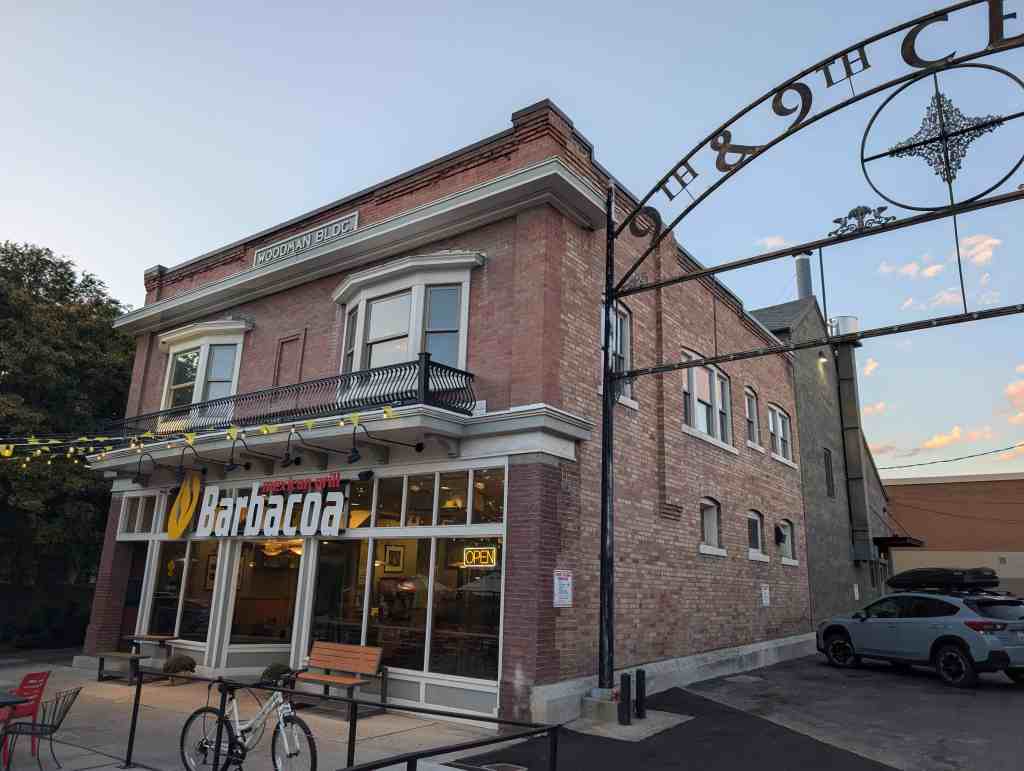
Lefler-Woodman Building
The Woodman Building is architecturally significant as a well-preserved example of moderate-sized, late-Victorian commercial architecture as employed in stores built throughout Salt Lake City before the age of large shopping facilities. This building type was rarely built outside of the urban center and represents early efforts to develop outlying commercial nodes as the city’s residential areas expanded after the turn of the center. The c. 1878 Lefler Mill, although altered, is a rare surviving example of mid-to-late-19th century mills and industrial architecture in the Salt Lake Valley — only a very few mills exist from this period in the city. Although added to in 1911 and converted to adaptive uses thereafter, the basic form and interior spaces of this vernacular structure remain apparent. The mill was the first of several small structures which eventually composed an early 20th century commercial node at the intersection of 900 South and 900 East. The scale and commercial activity of the early suburban corner continue to the present, with little modification having occurred after 1920. Of the dozen buildings erected along this intersection, the Lefler Mill is the oldest and the Woodman Building is the best preserved and most architecturally significant. Together, they present a structure of both historic and architectural significance.
Located at 859 East 900 South in the 9th and 9th neighborhood of Salt Lake City, Utah and added to the National Register of Historic Places (#92001687)
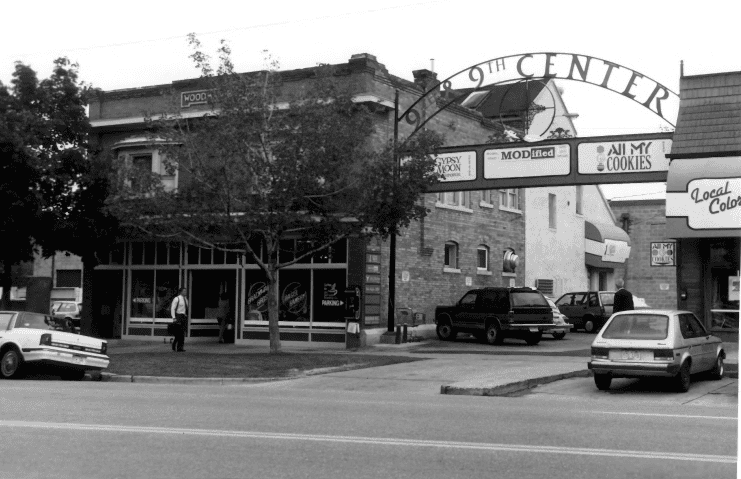
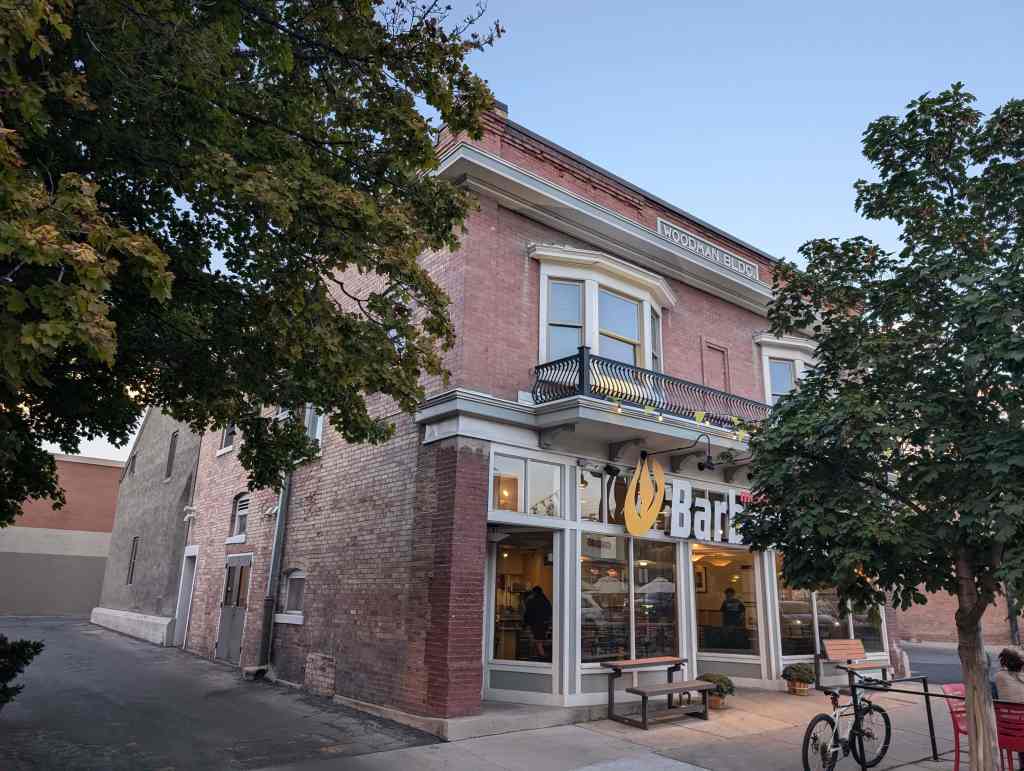
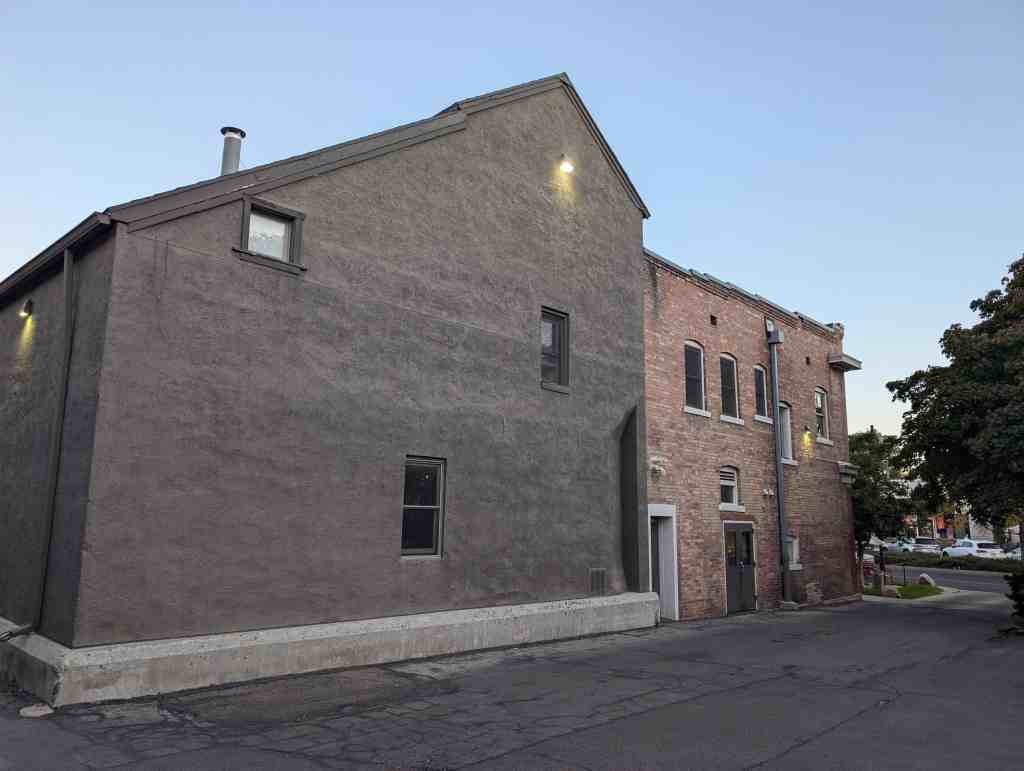
The Lefler-Woodman Building consists of two joined buildings: the c. 1878 Lefler Flour Mill and the 1911 Woodman Building, which was built on the front of the mill. The mill is an example of vernacular industrial architecture in late-19th century Utah, while the Woodman Building is representative of medium-sized, late Victorian commercial architecture built during the early 20th century.
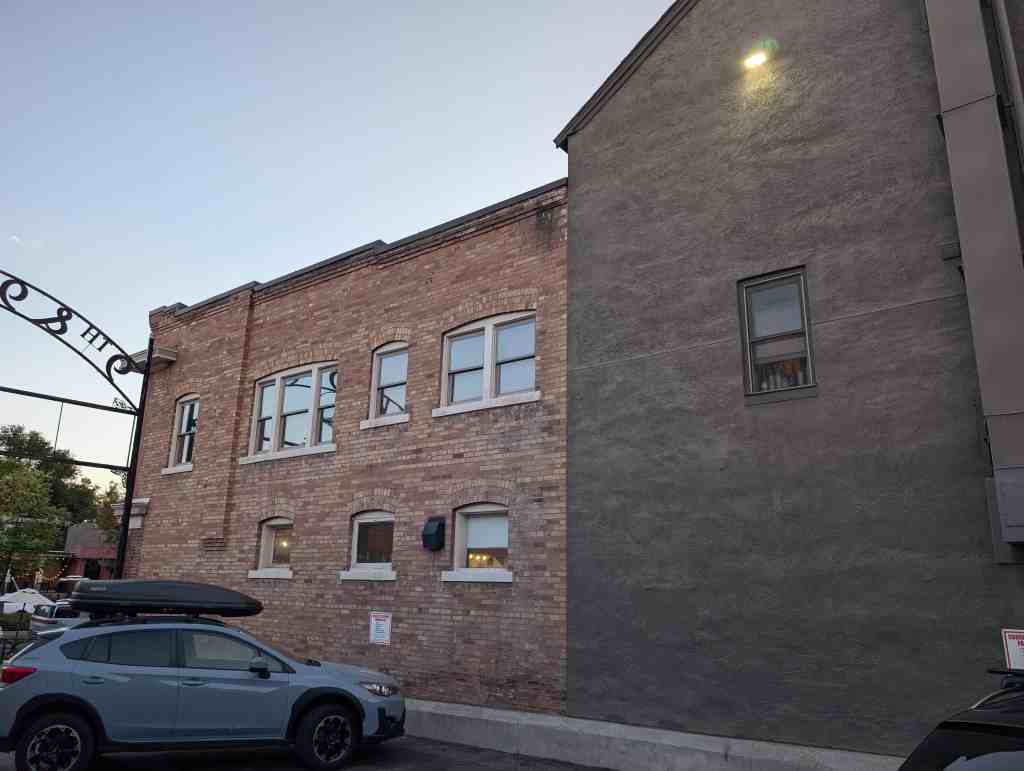
The Lefler Mill is two stories tall and may have had a partial basement, plus the present open attic, when in operation as a flour mill. Each full story is twelve feet high. In section or profile, the building is a saltbox with the taller, gabled section in the front and the long shed-roofed section to the rear. The exterior walls are made of brick which has been stuccoed. Stucco also covers the original sandstone foundation. The stuccoing was done due to the deterioration and cracking of the foundation and walls. The mill has two windows on its west side and three windows and a door on its east side. Some window openings were covered when the stucco was installed. The tall, flat-arched openings, historically with three-over-one double hung windows, retain wood lintels and sills.
The mill has been converted to a retail store on its second floor and a single office on the first floor. Alterations include removal of the milling equipment, plastering of the walls and ceilings, adding a new stairway from the second floor store to the attic loft, new doors and repaired or modified windows. The original full-width front (south) porch was replaced c. 1898 by a large warehouse and loading dock. This addition was removed in about 1911 when the Woodman Building was built along the front masonry wall of the mill.
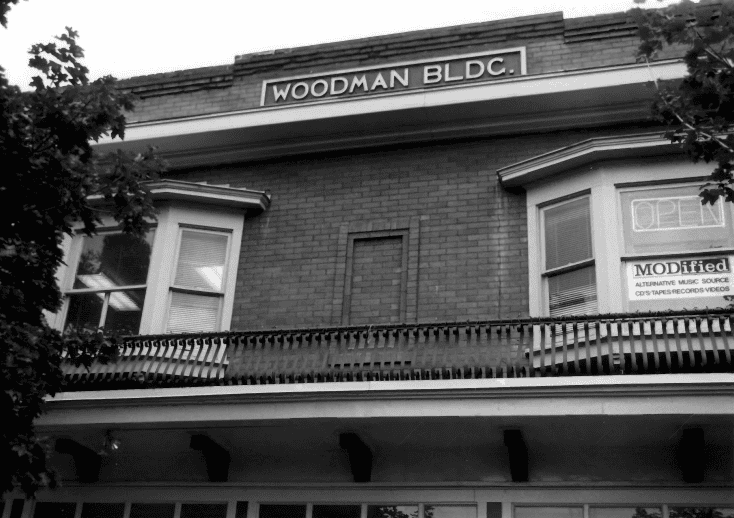
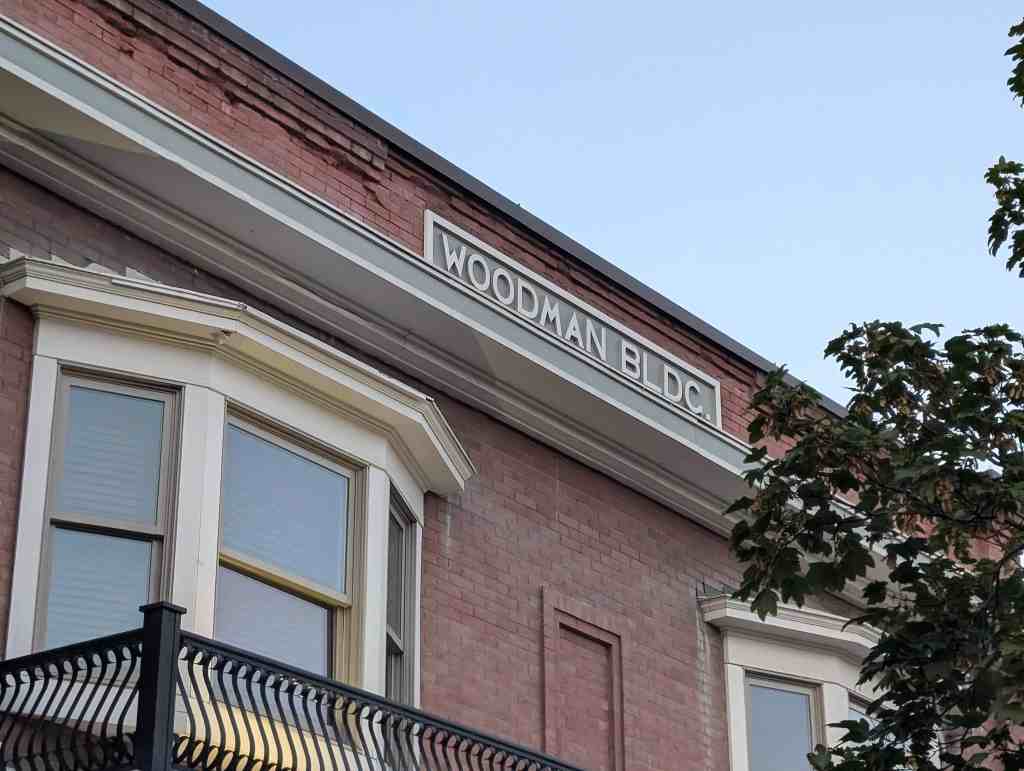
The Woodman Building is a two-part block with a rectangular floor plan. Its exterior walls are exposed red and tan brick and the roof is flat with brick parapets. The front facade faces south and features two bay windows with slanted sides and a stamped metal cornice in the upper level. Main level features include a central, recessed entry, large storefront windows, bulwark panels above the sidewalk and a transom window band below a projecting balcony located where a first story cornice might normally appear. The balcony has the appearance of being supported by large, ornamental brackets. The original balcony railing has metal newel posts and curved metal balusters. The main level façade has been restored to remove previously intrusive alterations, with the intent of returning this part of the façade to its original appearance. The upper part of the facades has never been altered. In the center of the front brick parapet is an inscription panel with the words “WOODMAN BLDG.” To remove white paint, the lower level brick piers have been lightly sandblasted, although the remainder of the masonry has been left unpainted and is in very good condition.
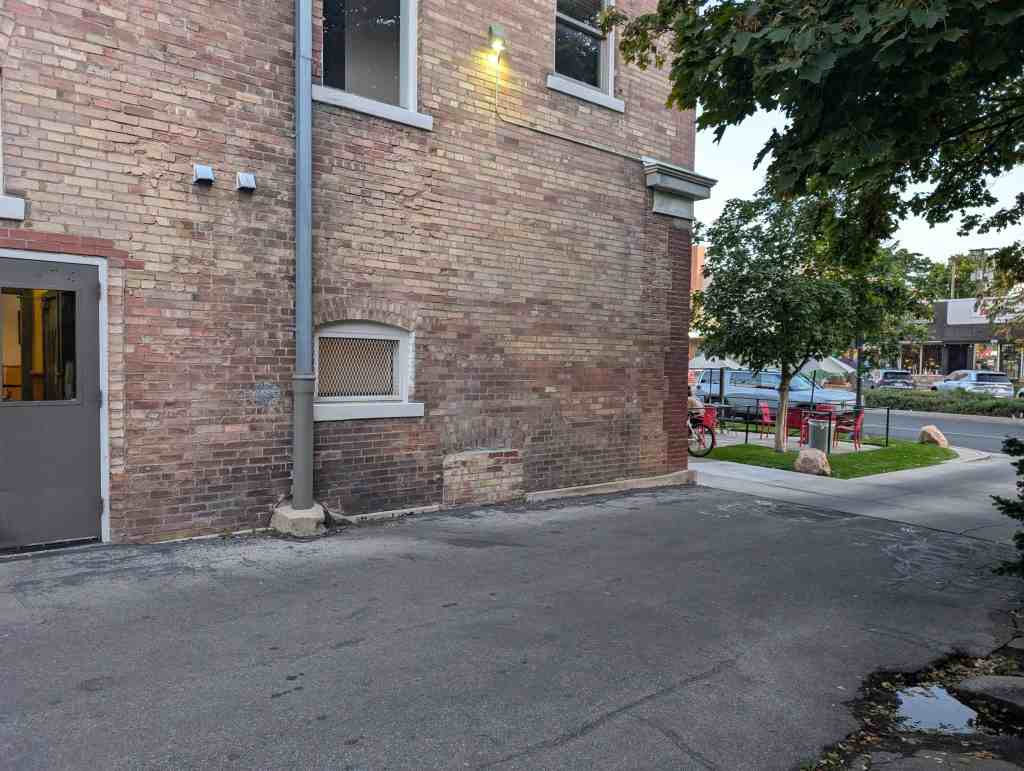
The interior of the Woodman Building has been slightly altered to accommodate new commercial uses. The main first story space, now occupied by a restaurant, remains tall and open with its wood floors, a walk-in cooler, and stairways to the upper floor and basement probably remaining as original features. The second story interior, originally built as a residence, retains its basic spatial layout. Original rooms, hallway, doors and trim are still mostly intact, though the spaces now house offices. The second floor hallway has been extended to the rear of the building to connect with a new stairway in the mill building. Overall, the three visible sides of the Woodman Building, including the front façade, are architecturally intact, as is much of the interior.

The beginning of the development of the “9th and 9th” intersection as a suburban commercial node began when John Marshall Lefler (also spelled Leffler) built his flour mill there in 1878 or 1879. Lefler (1837-1915) had come to Salt Lake City from his birthplace in western Canada in 1872. He was an experienced miller, having worked in a sawmill in Mill Creek Canyon, the Gordon Mill on State Street, the Crisman (later Husler’s) Mill, and the Pyper Mill in Sugar House. He was the last miller to operate the Chase Mill (listed in the National Register) located a few blocks to the west in what is now Liberty Park. Following the closing of that mill in c.1878-79, Lefler built this mill. Lefler was known as an efficient miller and his flour was popular with local bakery and restaurant owners.
Like most mills of the time, Lefler’s new mill was located away from the population and business centers of the valley. Unlike other mills which mostly relied on water power, Lefler’s mill was apparently powered only by a steam engine. The Chase Mill had been closed due to lack of water and Lefler knew that he could not rely on water in his new location only a few blocks from the abandoned mill. The new mill likely employed the older method of using burr grind stones, perhaps salvaged from the Chase Mill, until about 1888 when the mill was enlarged and a newer roller system was installed. For a year or two after that, it was known as the Liberty Park Roller Mills.
Among the few remaining mills in the Salt Lake Valley, the Lefler Mill clearly represents the development of industry on the then-current edge of more developed Salt Lake City. (Immediately south across 9th South was outside of the original plat, and was known as the “Big Field.”) Another example of an early flour mill is the Gardner Mill, built by Archibald Gardner in 1877 in West Jordan, about thirteen miles south and west of the Lefler Mill. The Gardner Mill (listed on the National Register) was a water-powered flour and grist mill which served the then-remote settlements in the south end of the Salt Lake Valley.
The location of the Lefler Mill proved to be well suited because in 1888, the Salt Lake and Fort Douglas Railroad, a small local railway, completed its line which passed in front of the mill with a spur branching off to the mill itself. In 1890, the first major, north/south streetcar line in the area was installed on 9th East, further encouraging the developing neighborhood commercial activity at the 9th South intersection. Additional commercial neighborhood nodes were developing during this broad period of growth and expansion in Salt Lake City near the turn of the century. Among these are the 13th East/2nd South area near the University of Utah, several nodes along South State Street, the smaller node at 9th East and 13th South, the later small commercial area at 15th East and 15th South, and the major commercial area in Sugarhouse (21st South and 11th East). Of these, the “9th and 9th” area best represents the commercial neighborhood nodes that developed to support new or expanding neighborhoods further from the city center.
In 1888, Lefler sold the mill to Creighton and Riega Haawkins, but stayed on as miller. Lefler and his family lived near the mill at 873 (and later 839) East 900 South from about 1878 to 1909. His son, William, helped operate the mill during most of that time. In 1893, when the mill was sold to Sylvester Vowles, the mill’s name was changed once again to the Utah Milling Company or Utah Roller Mills, which it remained until it closed down in about 1904.
In 1904, Alma F. Thornberg bought the building to house his business, the Thornberg Steam Carpet Cleaning Works, which operated there until 1923. However, in 1911 he sold the building to John A. and Frank H. Woodman, both miners and nephews of his wife, Lettie Higginbotham. In the same year, the Woodmans had the commercial building which bears their name constructed across the front of the old mill, removing the dock and warehouse addition to the mill in the process.
George S. Walker, a relatively unknown architect who practiced in the city only between 1911 and 1912, designed the building. Walker, who had come to Salt Lake City in 1902, had previously worked as a stone cutter at Walker Bros. Stone Company (his family’s business) and as a draftsman for the Oregon Short Line Railroad. He apparently left the area for California in about 1913. The building contractor was E. (Enoch?) Smith.
At the time the Woodman Building was constructed the residential neighborhoods of Salt Lake City had expanded outward in every direction from the early city plats. The area around 900 East and 900 South began to fill in, first with late Victorian houses and later with bungalows and period revival residences. As the neighborhood matured, the corner filled in with commercial buildings, a gas station, and a theater, most of which were constructed before 1920. These buildings remain, but only one of twelve of these per-1920 buildings is still architecturally intact.
Alma Thornberg continued as a tenant of the building after it was sold to the Woodmans. In addition to his carpet cleaning business in the mill, Thornberg used part of the Woodman Building for a new grocery store, the Sand Crest Meat and Grocery. Thornberg used the second floor as a residence for a few years before moving to 661 East 2100 South. Clarence E. Herrick took over operation of the grocery store in about 1915 and also lived in the second story apartment. In 1927, Herrick purchased the building and continued his grocery business there until 1938. This arrangement of the proprietor’s residence over the commercial area was relatively uncommon and further differentiates the Lefler-Woodman Building from both downtown commercial structures and the small scale, “mom and pop” commercial establishments that were occasionally built adjacent, or attached, to single family residences.
From 1938 to 1958, United Bakery occupied the building, but the Herrick family maintained ownership until 1979. Other occupants of the building around this time were Dunford Bakers (1959-71) and Stone Age Crafts (1975-82). The second floor of the Woodman Building was apparently rented out as apartments after the Herricks moved out in the 1930s. In 1980, Ardath M. Schwab, the current owner, purchased and renovated the building for restaurant, retail, and offices use.