
Tags
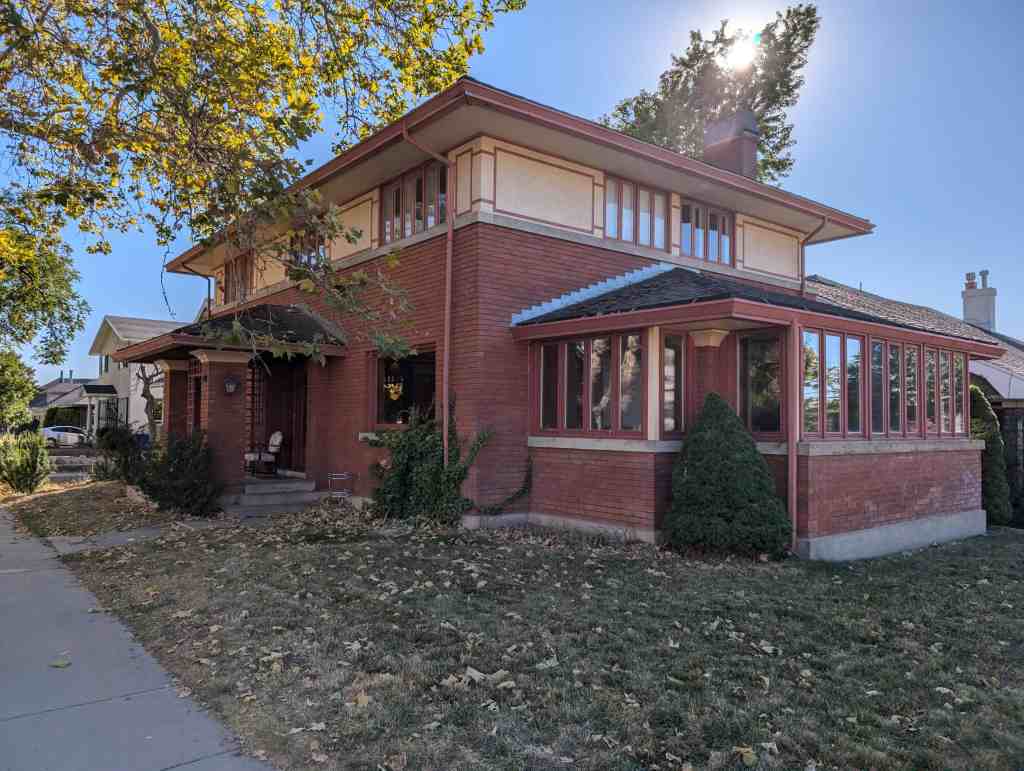
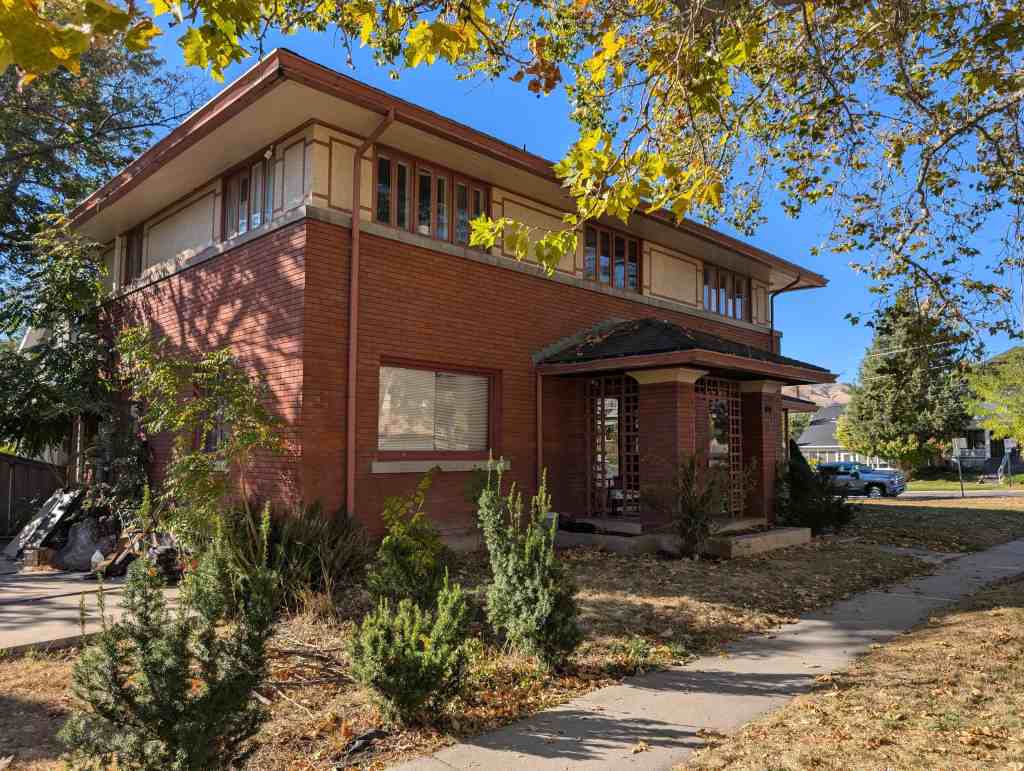
The James G. McAllister house, built in 1915, was identified in a comprehensive survey of Salt Lake City’s central-southern area as one of several excellent examples of the Prairie School style. Others in this portion of the city include: the Hyrum T. and Almon A. Covey houses (listed in the National Register); 962 Windsor St.; Elmer Pett House, 627 East 900 South; and the Niels Christensen House, 631 East 900 South, (all potentially eligible for the Register). As Salt Lake City grew, around the turn of the twentieth century, new neighborhoods developed to the east and south of the city center. Architecturally, the Prairie Style became popular with examples found in the Avenues Historic District (listed in the National Register), the Federal Heights area (east of the Avenues and a potential source for future Prairie style nominations to the Register), and the central-southern region. These neighborhoods represented distinctive periods of growth, and within them the Prairie Style became an important feature of their landscapes. The McAllister house is significant for its Prairie Style architecture. It possesses the composite massing, low hipped roof, horizontal banding of windows, and the pronounced shelf roof between the upper and lower stories that characterizes the style. In comparison to other examples, the James G. McAllister house remains in excellent original condition, thus retaining its historic integrity.
Located at 306 South Douglas Street in the University Neighborhood and the University Neighborhood Historic District in Salt Lake City, Utah and added to the National Register of Historic Places (#82001751)
The turn of the twentieth century found the young State of Utah in an era of rapid change. The LDS Church’s long battle with the Federal government had, in historical terms,; only recently been resolved, and Utah was just beginning to enter the mainstream of American political and economic life. During the early years of the new century the state saw a series of periods of rapid growth, with concomitant surges in building activity.
The early years of the new century saw the development of a new American school of architectural thought: ,SullIvan, Spencer,; Wright, Maher, Griffin, Drummond, Mahoney, and others associated with Chicago’s Steinway Hall and Wright’s Chicago Studio sought a new architectural expression based on simplicity of form, functional design, and the horizontal emphasis of the prairie from which it arose. What would come to be called the “Prairie School” in fact represented a family of related designs springing from a group of architects, and proved to be a popular style in Salt Lake,City during this period.
Home Beautiful, Craftsman, and other architectural magazines that were available to the Utah building community enthusiastically proselytized the new Midwestern style in their pages. Salt Lake City architectural firms (including Ware & Treganza, and Pope & Burton) soon were beginning to experiment with the new style in their own designs. The Prairie Style movement was near its height in 1914 when construction began on the James G. McAllister home. The original building permit, issued on October 26, 1914, lists “Builders Loan and Trust company” as both the owner and the builder of the property (the “architect” entry on the permit is unfortunately left blank but other evidence points out that it was probably the firm of Ware and Treganza). A survey of the surrounding University of Utah/Federal Heights neighborhood reveals at least two other houses of apparently identical internal and external design (with the exception of cosmetic and remodeling differences) located at 24 Virginia Avenue and 1417 Butler Avenue. Both list “Builders Loan and Trust Company” on their building permits as both owner and builder, while listing no architect. It seems possible that all three homes were built speculatively for an upper income market. Only the McAllister house retains its original historic appearance.
The James G. McAllister home was completed on August 24, 1915 and Mr. McAllister was known to have moved from 351 Earls Court to his new residence in the same year. Additionally, a building permit for the garage associated with the home was issued in the name of “J.G. McCallister” on September 24 1915, indicating that if McAllister did not commission the house, he at least was closely associated with it before or very shortly after its completion.
John D. T. McAllister (James G. McAllister’s father) converted to the Mormon faith in his native Delaware. He soon became a close companion of Brigham Young and, after the death of Joseph Smith, came to have positions of importance both within the church and in the secular state which grew up following the move to Utah. McAllister was a carpenter and is credited with the construction of many buildings in the valley and mills in the surrounding canyons. He served as president of the St. George Temple, president of the newly constructed Manti temple, and finally as a president of the First Quorum of Seventies. At his death John McAllister could claim nine wives, the second of whom was Angeline Sophrina Goforth.
James G. McAllister, born in 1860 in Salt Lake City, was one of thirty-two children. He served a carpenter’s apprenticeship and worked on the tabernacle, helping to build the famous pipe-organ. He also followed farming, teaming, and carpenter contracting. As he grew older and the metal mines opened in Park City, he became actively engaged in teaming and freighting, having a contract to haul the machinery for the Marsac mill, which was one of the first mills built in Park City. He served an apprenticeship as a wagonmaker and blacksmith, and during 1887-88 he engaged in mining in Marysvale, Utah, going from there to Ophir and then to Bingham Canyon. He became head salesman and assistant manager of the Studebaker Bros. Co., 1897-1906, and in 1902 organized the McAllister Bros. Sheep Co. (John D. H. and James G. McAllister), which in 1911 was incorporated as the McAllister Land and Live Stock Company, of which he was the president. In 1907 he associated with Frank Esshom in the beginning of the history of the “Pioneers and Prominent Men of Utah,” being the first president and director of the company, and a director until the completion of the work. He and C. B. Stewart were the originators, promoters and the organizers of the Fanners and Stockgrowers Bank, which was incorporated Jan. 20, 1913, when he was elected director and member of the executive board. As one of the members of the board, he purchased the ground and arranged for the construction of their banking house at 123-125 South Main Street. He was director and chairman of the executive board of the Bird’s Eye Marble Company and director and adviser in other manufacturing, mercantile and industrial companies. McAllister was a member of the committee that organized the first Republican party in the state, and remained constantly with the party.
Official records currently indicate only that James G. McAllister married Emily Marinda Chase on October 15, 1889. Emily Chase was at the time a widow of ten years with two young children, having previously been married to H. W. McKee. Family records, however, also note a marriage to Minnie Erwin on September 7, 1879. John D. T. McAllister recorded in his journal that he performed a “sealing” ceremony for his son James on the stated date. It is noteworthy that John D. T. McAllister was an active polygamist, and that he presided over the Salt Lake Endowment House at the time of his son’s purported first marriage.
In about August, 1915, James G. McAllister moved with his wife Emily and son James G. McAllister, Jr. from 351 Earls Court to his new home on Douglas Street. The property was recorded in the name of Emily M. McAllister under an original mortgage of $6000.00. On July 14, 1920 the home was sold to F. L. Cowan, an “engineer for the Denver and Rio Grande Railroad”, with a mortgage for $9000.00 at 7 percent per annum interest. At that time the McAllisters moved to Los Angeles, California where James was prominent in real estate and served as a Los Angeles city councilman up to the time of his death on September 9, 1933.
Mr. Cowan retained the property for only two years, transferring it on April 4, 1922 to John V. Dawson and his wife Flora. John V. Dawson, “whose Activities. ..placed him among the leaders of the lumber business in the west”, died July 16, 1924 from appendicitis in a Salt Lake hospital. He was vice-president of the Overland Lumber Company and treasurer of the George E. Merrill Company. His widow Flora continued to occupy the house until January 25, 1937, when it was sold to Jedediah F. Woolley, Jr. Mr. Woolley and his family lived in the house until Mr. Woolley’s death in 1979. The house was sold on July 1, 1980 to Dr. Brent C. and Karen S. James, who are its present tenants.
The James G. McAllister House, constructed in 1915, is a fine Utah example of the Prairie Style of architectural design. H. Alien Brooks’ description of the Prairie Style in 1972 provides an excellent starting point for describing the McAllister house:
… it affected virtually every aspect of the residential design — the disposition of the single mass or composite massing, the shape of the low, long hipped or gable roof, the horizontal banding of the windows, the emphatic belt course or shelf roof between the storeys — which often continued oh one side as a lateral porch and the broad, often forward-set foundation upon which the building was securely placed. The continuity of line, edge, and surface an inheritance from the earlier Shingle Style lent horizontal unity to the design, and against these horizontals a spirited interplay was established with short vertical accents, such as piers, mullions, and subsidiary masses.
The home consists of a central rectangular mass, 40 feet wide by 28 feet deep and two stories high, topped with a low-pitched hip roof with wide overhanging eaves. The lower one and one-half stories of triple-course red brick are capped by a wide band of grey cast stone which runs horizontally around the entire house, forming the sill of the second storey windows. These windows are of the sliding casement type, reaching from the cement sill to the hip roof. They are symmetrically grouped in twos and threes to further emphasize the horizontal nature of the entire building, while the intervening wall space between the sill and the roof is covered with textured stucco over metal lathe. Flat three inch wood slats are imbedded in the stucco to form a simple decorative rectangular pattern, again emphasizing the horizontal theme of the exterior.
The ground floor of the home is asymmetrically extended northward by a single story sun porch. The porch mimics the second story: a cast stone band, capping the brick exterior wall, runs at the lower window sill level entirely around the porch’s circumference, while a low-pitched hip roof caps the extension. It differs, however, in that casement windows fill all available space between the sill line and the eaves. The resulting southward view of the house typifies the entire design: a broad horizontal line at ground level is provided by the light-colored foundation. A dark masonry wall rises from the foundation only to quickly end in another light-colored horizontal band at thy level of the porch window sill. The vertically of the casement windows is balanced by their wide horizontal expanse, which is again topped by the horizontal line of the porch roof. This roof slopes slowly upward to yet another horizontal band of cast stone, while the final horizontal eave line caps the upper casement windows.