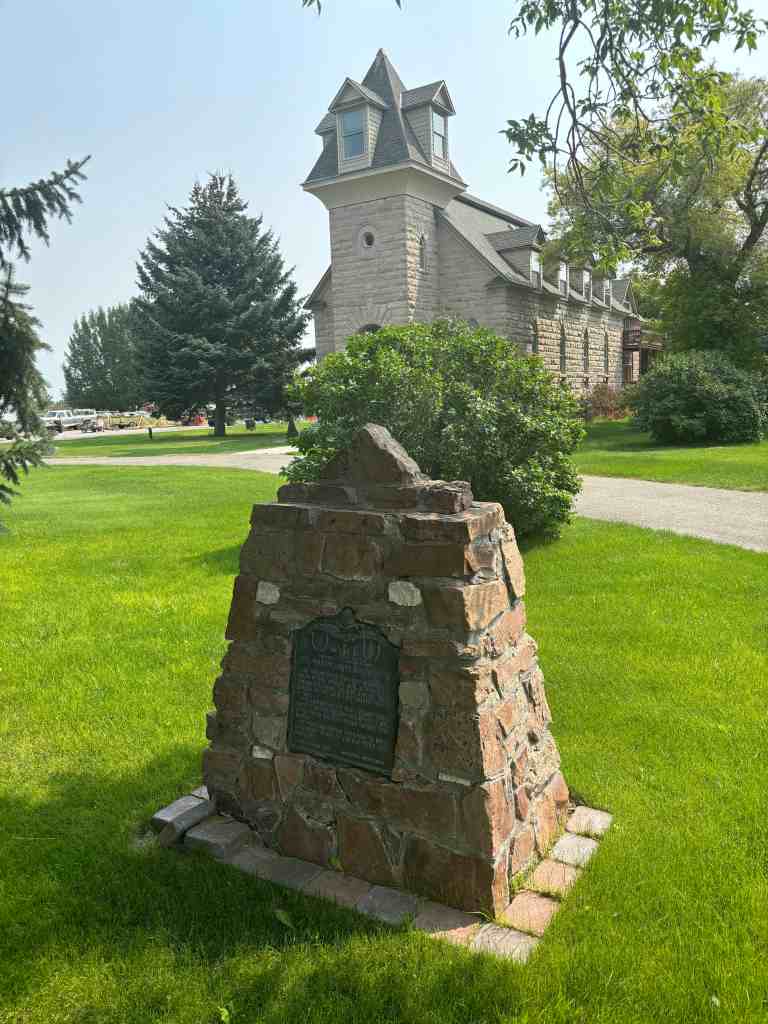
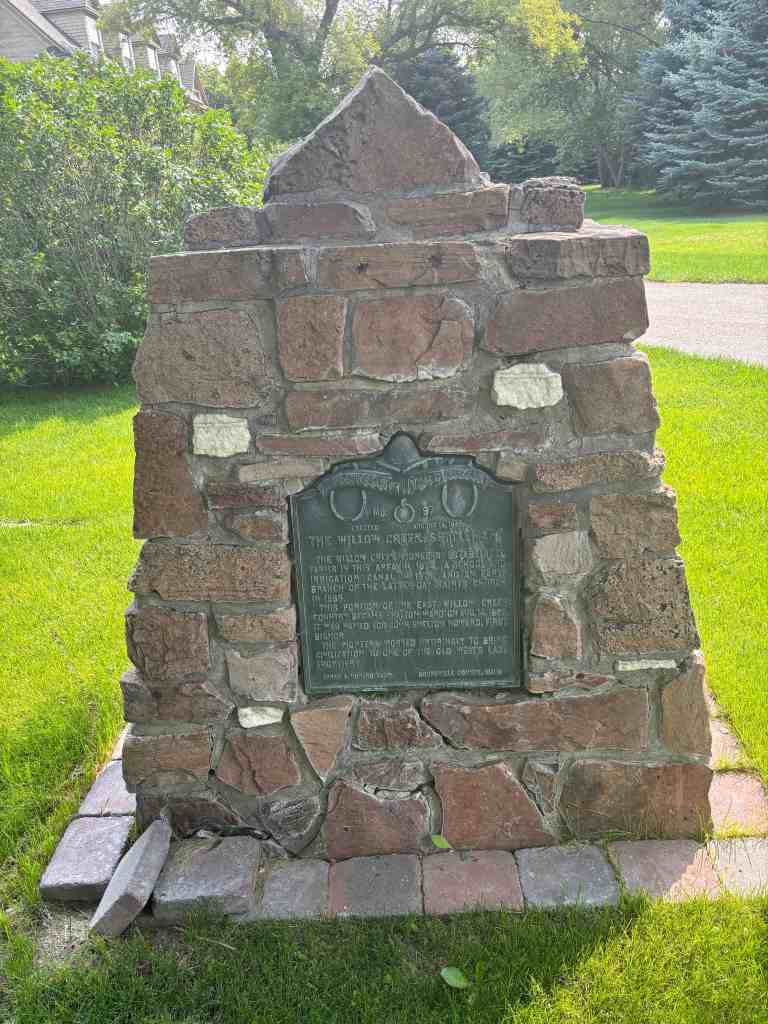
The Willow Creek pioneers established farms in this area in 1874, a school and irrigation canal in 1879, and an early branch of the Latter-day Saints church in 1885.
This portion of the East Willow Creek Country became Shelton Ward on August 14, 1892. It was named for John Shelton Howard, first Bishop.
The pioneers worked untiringly to bring civilization to one of the old west’s last frontiers.
This is Daughters of Utah Pioneers historic marker #87 (other markers listed here) located at 13576 North 105 East in Idaho Falls, Idaho.
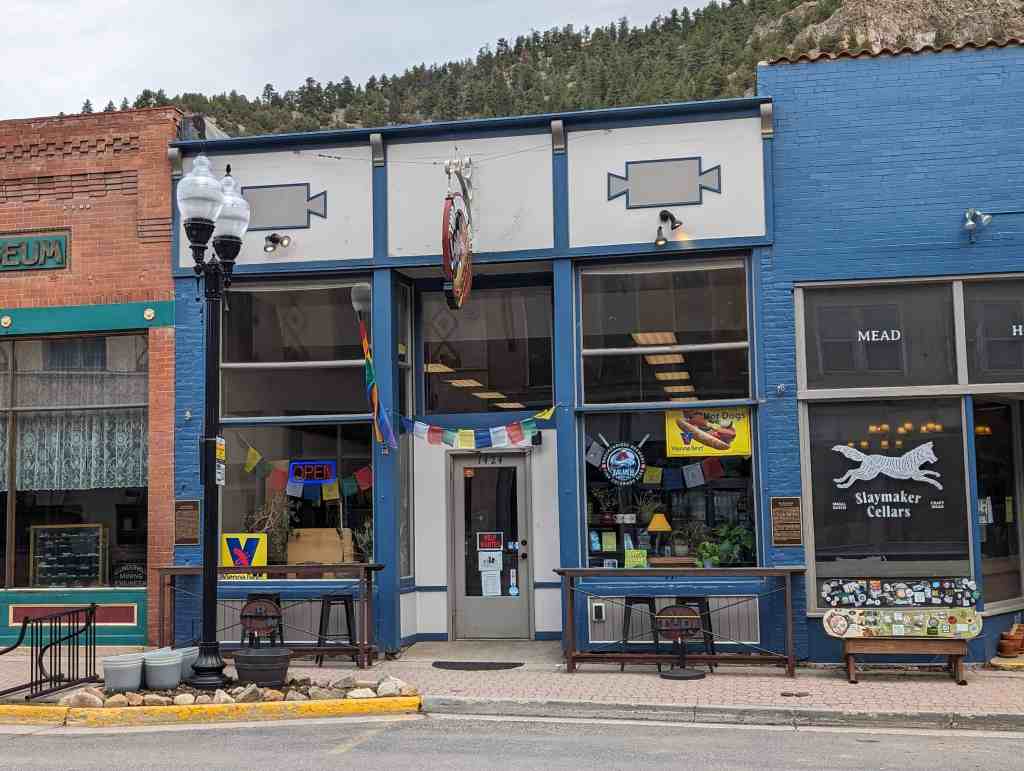
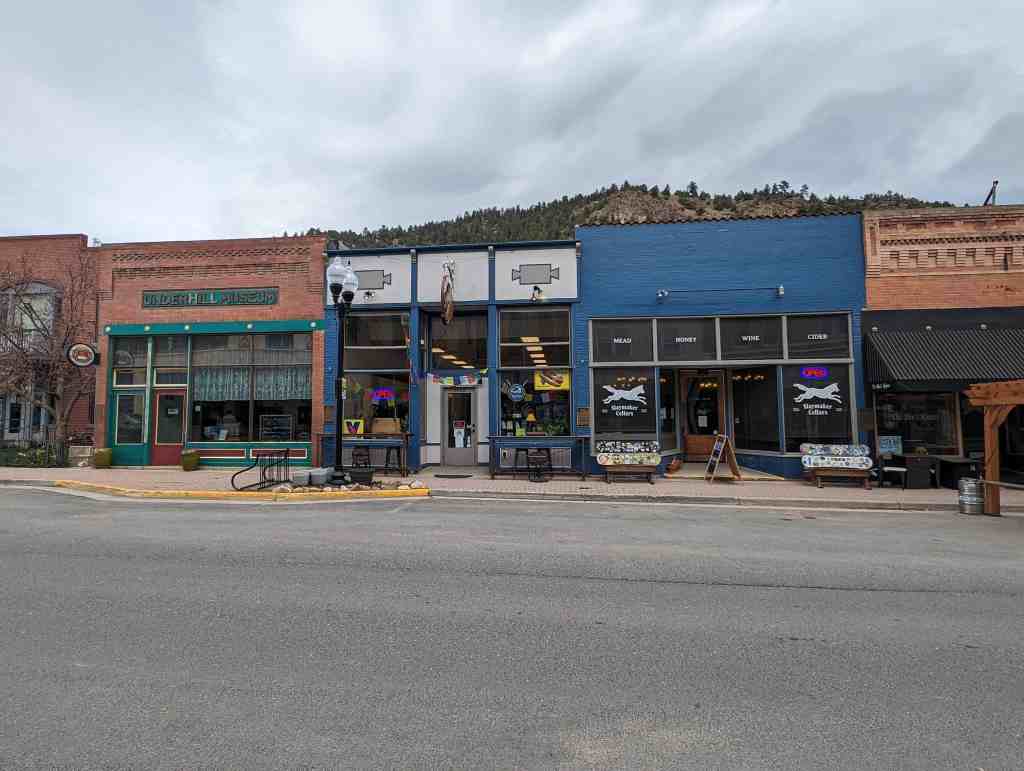
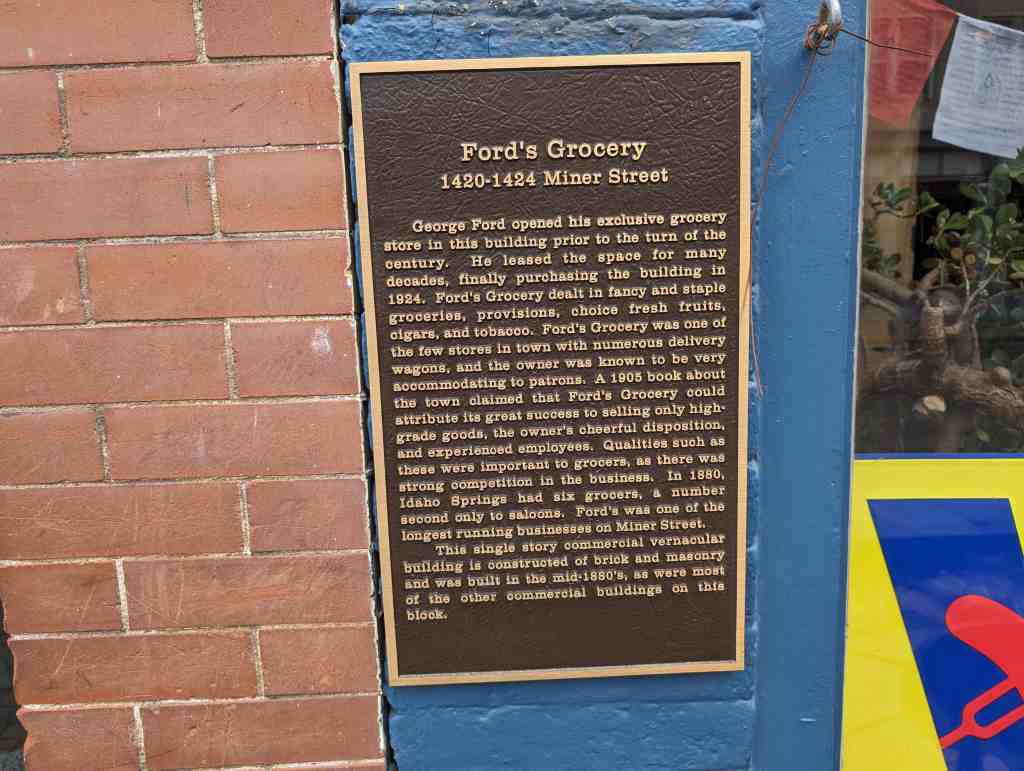
George Ford opened his exclusive grocery store in this building prior to the turn of the century. He leased the space for many decades, finally purchasing the building in 1924. Ford’s Grocery dealt in fancy and staple groceries, provisions, choice fresh fruits, cigars, and tobacco. Ford’s Grocery was one of the few stores in town with numerous delivery wagons, and the owner was known to be very accommodating to patrons. A 1905 book about the town claimed that Ford’s Grocery could attribute its great success to selling only high- grade goods, the owner’s cheerful disposition, and experienced employees. Qualities such as these were important to grocers, as there was strong competition in the business. In 1880, Idaho Springs had six grocers, a number second only to saloons. Ford’s was one of the longest running businesses on Miner Street.
This single story commercial vernacular building is constructed of brick and masonry and was built in the mid-1880’s, as were most of the other commercial buildings on this block.
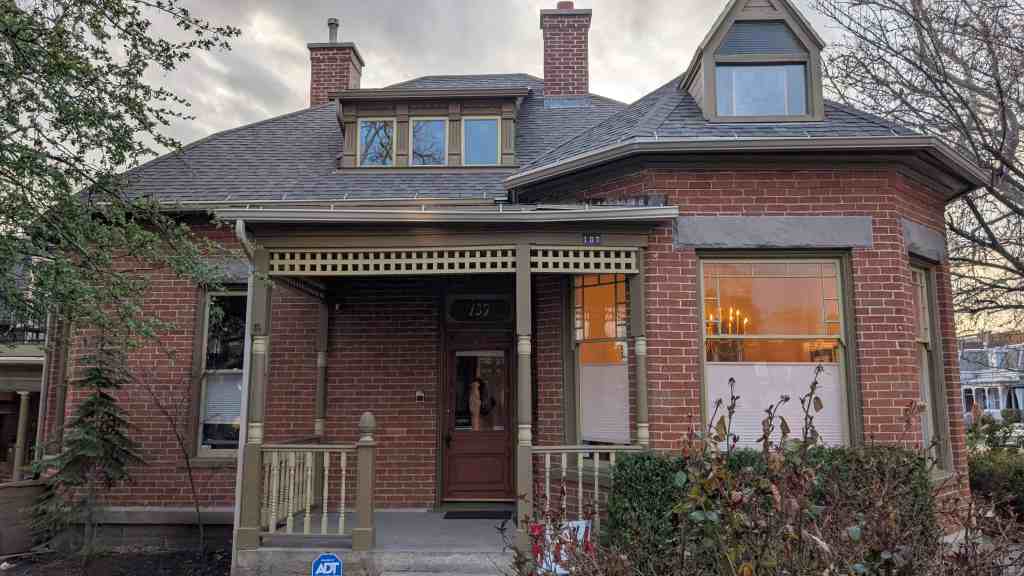
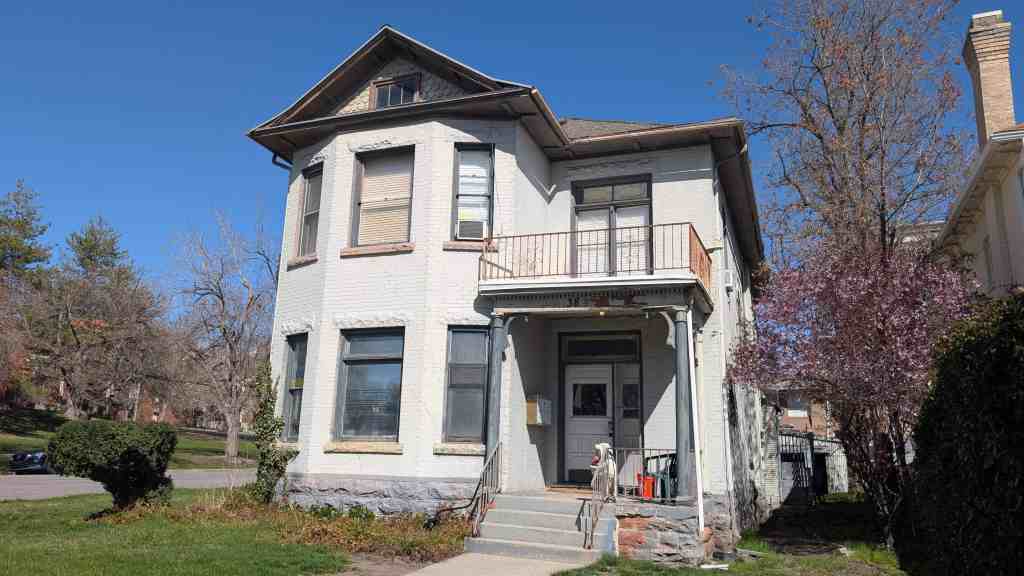
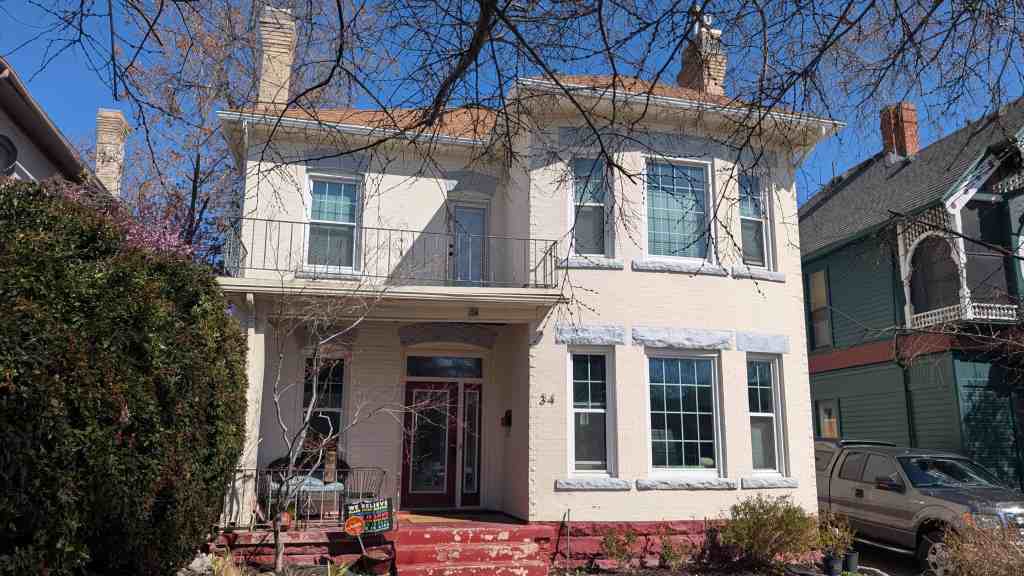
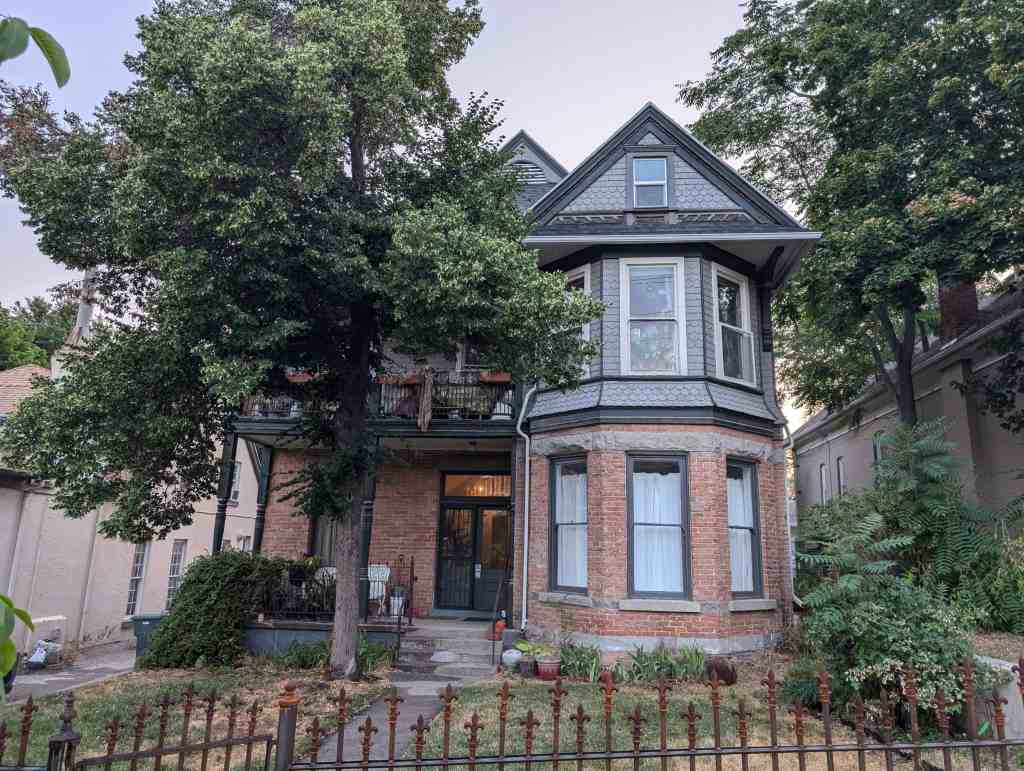
This one-and-one-half-story home is a good example of the Victorian eclectic style popular in Utah between 1885-1910 and characterized by the irregular plan, complex roof structure, and ornate moldings. The house was built in 1890 for Christian A.F. and Jartina Orlob at a cost of $4,000. Christian lived here until his death in the late 1920s and Jartina owned the house until the mid 1940s. Other members of the Orlob family lived at 133 I Street and 825 2nd Avenue.
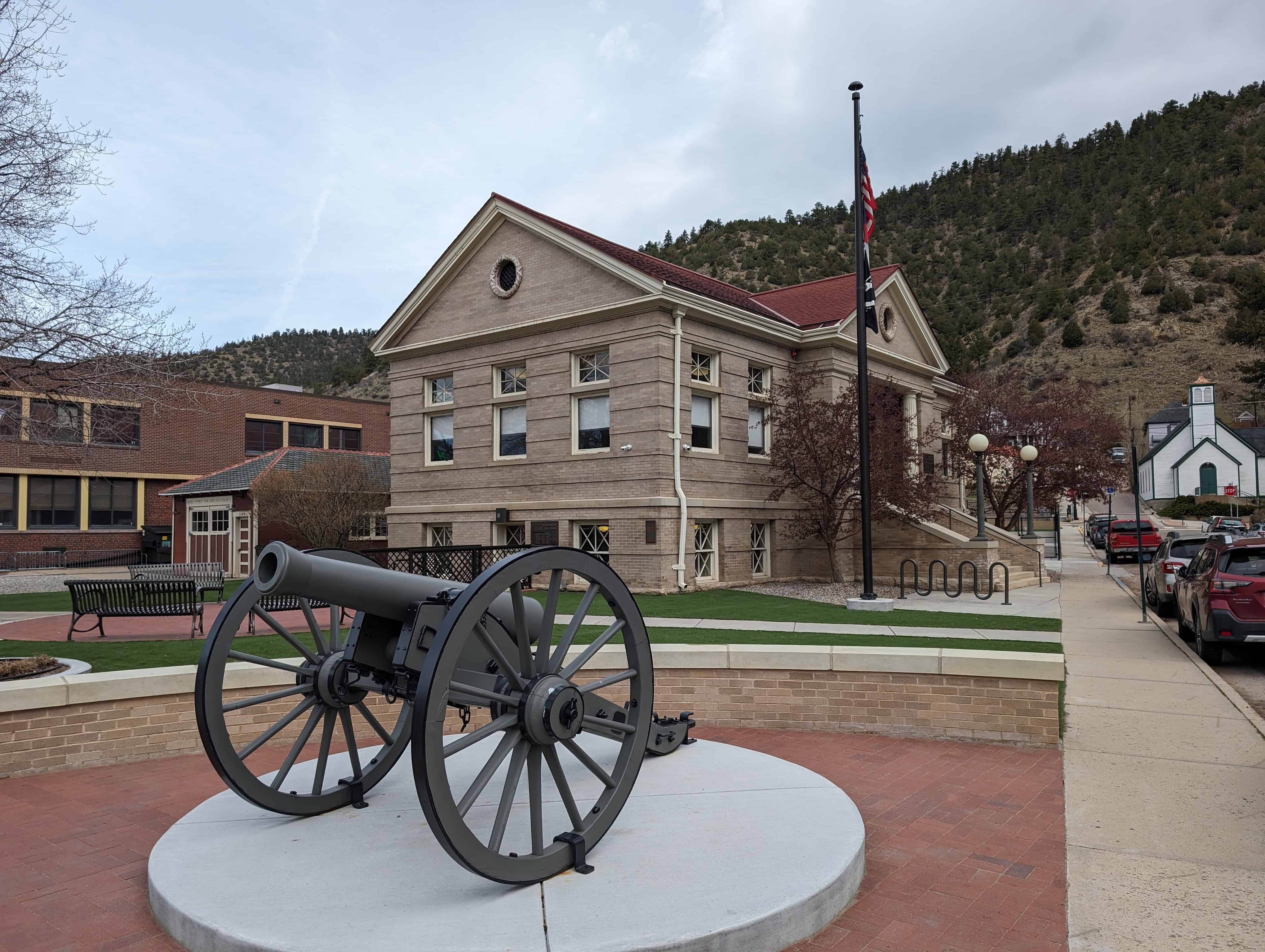
Andrew Carnegie donated the money to build 2,509 libraries, 1,689 of them in the Unites States. I come across them in my exploring and decided a list of them here would be good to create.
Carnegie Libraries by location:
Alabama:
Anniston Carnegie Library (demolished)
Avondale Carnegie Library (demolished)
Bessemer
Decatur
Ensley Carnegie Library (demolished)
Eufaula
Gadsden Carnegie Library (demolished)
Huntsville Carnegie Library (demolished)
Montgomery
Selma
Talladega
Troy
Union Springs
West End Carnegie Library (demolished)
Arizona:
Phoenix
Prescott
Tucson
Yuma
Arkansas:
Eureka Springs
Fort Smith
Little Rock (demolished 1964)
Morrilton
California:
Alameda
Alturas
Anaheim
Antioch
Auburn
Azusa (demolished 1959)
Bayliss
Beaumont
Berkeley (demolished 1929)
Biggs
Calexico
Chico
Chula Vista (demolished 1960)
Claremont/Pomona College
Clovis
Coalinga (demolished 1955)
Colton
Colusa
Concord (demolished 1959)
Corning
Corona (demolished 1978)
Covina (demolished 1962)
Dinuba (demolished 1975)
Dixon
Eagle Rock
East San Diego (demolished 1964)
El Centro (demolished 2016)
Escondido (demolished 1956)
Eureka
Exeter
Ferndale
Fresno (demolished 1959)
Fullerton (demolished 1942)
Gilroy
Glendale (demolished 1977)
Grass Valley
Gridley
Hanford
Hayward (demolished 1949)
Healdsburg
Hemet (demolished 1969)
Hollister
Hollywood (demolished 1958)
Huntington Beach (demolished 1951)
Imperial (demolished)
Inglewood (demolished 1967)
Lakeport
Lincoln
Livermore
Lodi
Lompoc
Long Beach (demolished 1973)
Los Angeles Arroyo Seco (demolished 1959)
Los Angeles Boyle Heights (demolished 1974)
Los Angeles Cahuenga Branch
Los Angeles Lincoln Heights
Los Angeles Vermont Square
Los Angeles Vernon (demolished 1974)
Los Gatos (demolished 1954)
Mill Valley
Monrovia (demolished 1956)
Monterey
National City (demolished 1954)
Nevada City
Newman
Oakdale
Oakland Main
Oakland Golden Gate
Oakland Melrose
Oakland Miller (demolished 2018)
Oakland – Mills College Margaret Carnegie Library Building
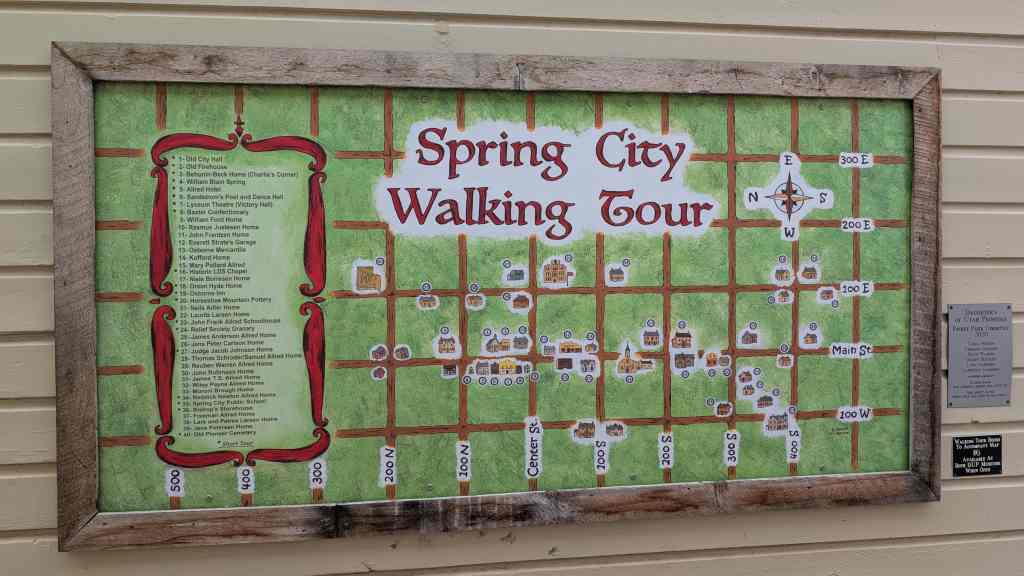
WELCOME TO SPRING CITY! The best-preserved example in the USA of an early “Mormon village.”
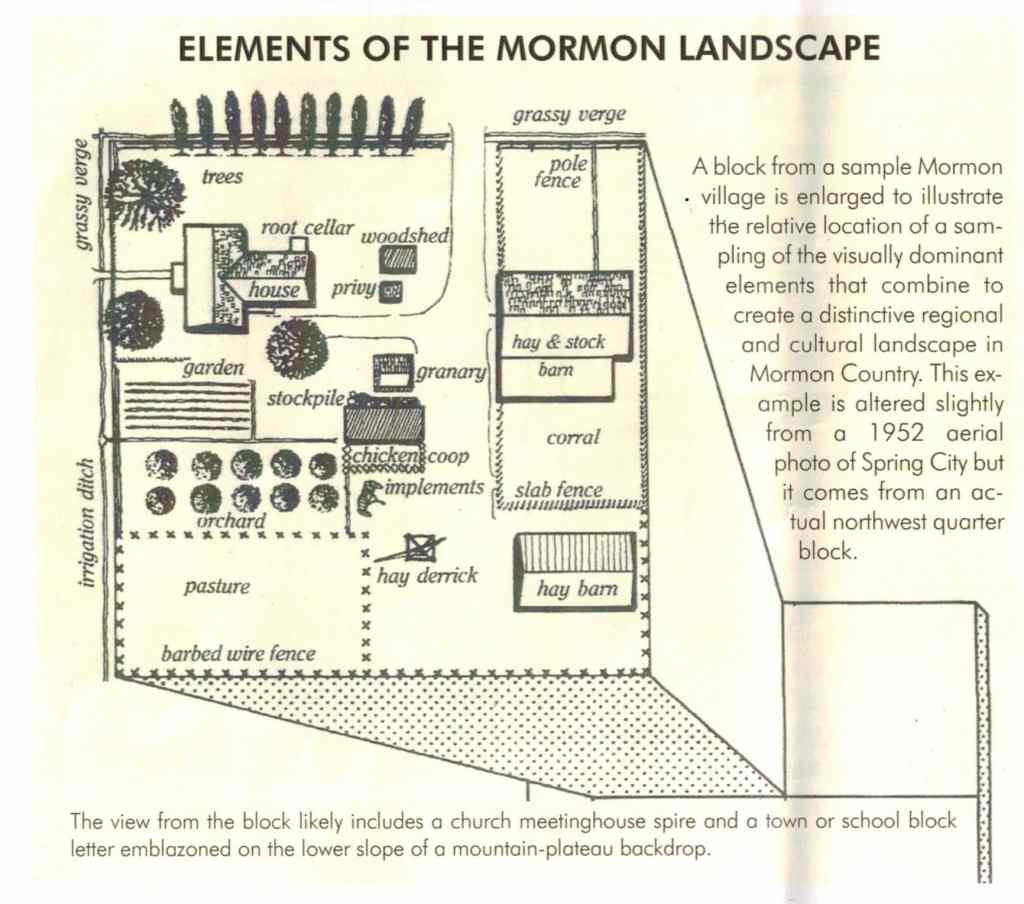
(text from the walking tour’s pamphlet) Dear guests, if you have attended Heritage Day before, we’re thrilled to have you back! If this is your first time visiting us, you’re in for a treat. We have 15 pioneer-era prop- erties on tour, and just as many additional historic commercial buildings open around town. Plus, this year, we have a unique and educational twist. Meet the “Mormon Landscape!” The diagram on page 3 inside shows the elements of the Mormon Landscape that became common in the way the pioneers laid out their homesteads from the 1850s to the 1920s. This pattern was encouraged by Brigham Young and other church leaders as the best means to provide for families and animals. Sadly, only remnants of these elements remain in most communities today. Through preservation efforts by local residents and the Friends of Historic Spring City, there are still a number of such landscapes left in Spring City.
The Home Tour today includes three excellent examples, where you can walk around the corrals, chicken coops, gardens, orchards, granaries, and hay barns, or in one case, view the various elements from the sidewalks. They are noted in bold on the property descriptions.
Heritage Day is sponsored each May by the Friends of Historic Spring City (FOHSC), a non-profit organization of 180 volunteers who are passionate about restoration and honoring the past. Because of Spring City’s one-of-a-kind look and feel, it is in high demand by new move-ins. Handling this growth while at the same time preserv ing our special National Historic District is becoming more of a challenge each year. All proceeds from ticket and art sales today go toward ensuring your grandchildren for years to come will still be able to enjoy Heritage Day and take a walk back in time.
If you too are interested in historic preservation, please visit our website at friendsofhistoricspringcity.org. We invite you to become a member or consider donating to our cause. Find out how at the “Get Involved” tab on our website.
MORMON LANDSCAPE PROPERTY EMIL ERICKSON OUTBUILDINGS 119 W 200 N, HOUSE BUILT IN 1888 The outbuildings on this property are typical of the “Mormon Village” plan idea and a testament to the owner’s dedication to historic preservation.
ALBERT & MARTHA PUZEY HOUSE 87 WEST 200 NORTH, 1906 This brick house was originally a “T” shape and had a small front porch on the east side. A wrap-around front porch and rear addition have been added while exterior aluminum siding has been removed.
MORMON LANDSCAPE PROPERTY ALEX JUSTESEN OUTBUILDINGS 187 N. MAIN ST., c. 1900, 1920s, 1950s As is typical of the “Mormon Village” idea, the property has several outbuildings on the 1.06 acre lot. The small outhouse and wood granary were built along with the main house in 1900. Sidewalk viewing only.
BEHUNIN/BECK HOUSE 19 E 100 N, c. 1883 This large stone house was built in 1883 by Isaac Behunin, who explored what became Ephraim. He was an original Sanpete County settler and moved to Spring City in the 1860s.
HANS JORGEN HANSEN HOUSE 93 N 200 E, 1874 This house is one of Spring City’s few examples of a Scandinavian plan called “Parstuga” or pair house. A pair house has a central main room, typically a living room or kitchen, flanked by two smaller (pair) rooms.
ANDREW OLSEN HOUSE 92 S 100 W, c. 1877 This substantial brick one and one half story hall- parlor plan home has a rear wing and is unique for its three over five openings on the front façade.
JENS C. ANDERSEN HOUSE 91 E 100 S, c. 1884 This one and one half story brick house is significant for its early use of locally fired bricks from a brickyard west of town.
MORGAN JOHNSON/JACK WATSON HOUSE 90 E 100 S, 1904 This house was built for J Morgan Johnson, who started a town newspaper called “The Spring City Echo” in 1897. The paper survived for six months.
ALBERT M. & MARTHA ALLRED HOUSE 310 S MAIN ST., 1904 The style of this home was very popular in the late 1800s when it was frequently popularized in house pattern books.
ALLRED SCHOOL 63 W 300 S, 1876 This Greek Revival style structure has a carved stone inscription over the doorway that includes a compass, square, beehive, and building date. It was commonly referred to as the Allred School after a teacher who taught here for 26 years.
RELIEF SOCIETY GRANARY 69 W 300 S, 1874 This structure was built for the “Female Relief Society of Springtown.” The granary was used for both food storage and Relief Society meetings.
JENS PETER CARLSON HOUSE 355 S 100 W, 1896 Known for his spectacular masonry, Carlson la- bored on the house for eight years to provide shelter for his two wives and eighteen children. He died before he could finish and the family hired a carpenter to complete the attic story.
MORMON LANDSCAPE PROPERTY MORONI BROUGH OUTBUILDINGS 383 S 100 E, c.1880s Just to the east of the Moroni H. Brough House, this log cabin was built around 1880 and was moved to this property. It serves today as an art studio.
GEE LOG HOUSES (RELOCATED) 8201 E. CANAL CANYON ROAD. c. 1880s This log cabin was originally located in Mt. Pleas- ant, while the guest cabin was built in Gunnison. With the opening of sawmills in the county, the logs were milled in a sawmill, not hand cut as was typical in earlier times. Both houses were dismantled and reassembled at the current location.
JACOB JOHNSON FARMHOUSE S.E. ON CANAL CANYON ROAD, 1876 Jacob Johnson homesteaded here and created a large farm on 160 acres of what had been uncleared land. The stone house was built in 1876 and Johnson lived here for five years.
OTHER HISTORIC SITES
A. OLD FIREHOUSE, OLD JAIL, & DUP MUSEUM: 39 N. Main Purchase Home Tour tickets at the Old Fire- house and head next door to the 1893 Old City Hall and DUP Museum for the bake sale and interesting artifacts. The Old Jail sits at the back of the property. B. SPRING CITY HALL (Old School): 45 S. 100 E. Buy Home Tour tickets here. Purchase or bid on original art on the second floor. Another DUP museum is on the first floor. The City Offices are located here. This restored R.C. Watkins School was built in 1899 and is the centerpiece of the FOHSC’s efforts to date. C. SPRING CITY ACTIVITY CENTER (Old Junior High and Home to Spring City Arts Gallery and Crafts & Antiques Fair): 150 E. Center This served as the town’s junior high school from 1916 to 1957. It was then used as the elementary school until 1986. It is FOHSC’s current restoration project. D. LORENZO AIKEN SERVICE STATION 500 N. Main The city’s first gas station was built in 1924 on a corner at a 45-degree angle to allow easy access for cars. A tiny shingled room housed the station attendant. E. PIONEER CEMETERY: 240 N. 100 E. This was Spring City’s main burial ground until 1869. The larger, current cemetery is lo- cated on 300 N., and west of town. F. BAXTER & BLAINE STORE 190 N. Main Built in 1895, and known for the 1940s Squirt ads painted on the side, this is the best-preserved 19th century commercial building in town. G. SPRING CITY NATURAL SPRING: 100 N. Main Located in the heart of town, this fresh water spring is one of many for which the town is named. H. LYCEUM THEATER/VICTORY HALL: 35 N. Main The Lyceum, later known as the Victory, was constructed in 1915 by John R. Baxter Jr.. It featured silent films and later “talkies.” I. LEGACY HOME COLLECTION (ANTIQUES): 9 S. Main The logs of this 1800s schoolhouse in Mt. Pleasant were numbered, dismantled, and moved to Spring City. The reconstruction of the school was completed in 2022. J. STRATE’S GARAGE: 53 S. Main The first automobile came to town about 1915. Everett Strate sold Pontiacs and Olds- mobiles, and operated the garage from 1919 to 1962. K. OSBORNE MERCANTILE: 76 S. Main Build in 1930, this store currently houses the Roots 89 Grill. It has had a colorful history and was the location of a shoot-out back in the day. L. JOCK JONES WINDSOR CHAIRS: 125 S. Main Jock creates fine quality Windsor Chairs using traditional tools and methods. His craftsman-style bungalow shop was con- structed by Jock to reflect the style of his 1910 home next door. M. SPRING CITY CHURCH OF JESUS CHRIST OF LATTER-DAY SAINTS: 164 S. Main This oolite limestone chapel was designed by architect R.C. Watkins and was built between 1897 and 1911. It was saved from demolition in the 1980s and expanded. N. ARTHUR JOHNSON MEAT MARKET: 278 S. Main Best remembered after 1916 as the Meat Market, this 1905 brick building has a two- part block and false front. The store is now home to Joe Bennion’s Horseshoe Mountain Pottery.