Tags
Eastlake style, Grantsville, Historic Homes, Queen Anne style, Tooele County, utah, Victorian Eclectic, Victorian Queen Anne style
James and Penninah Wrathall House
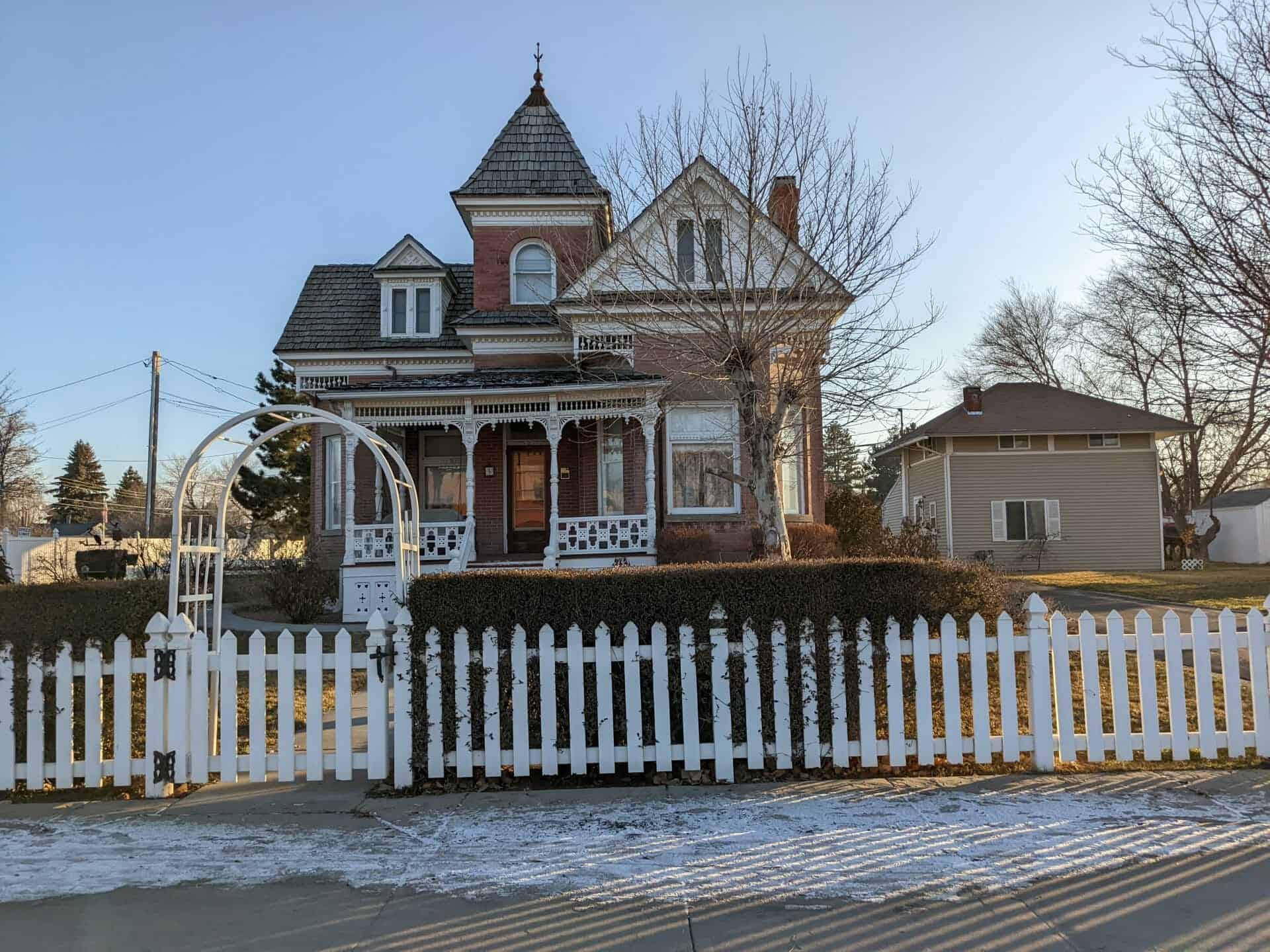
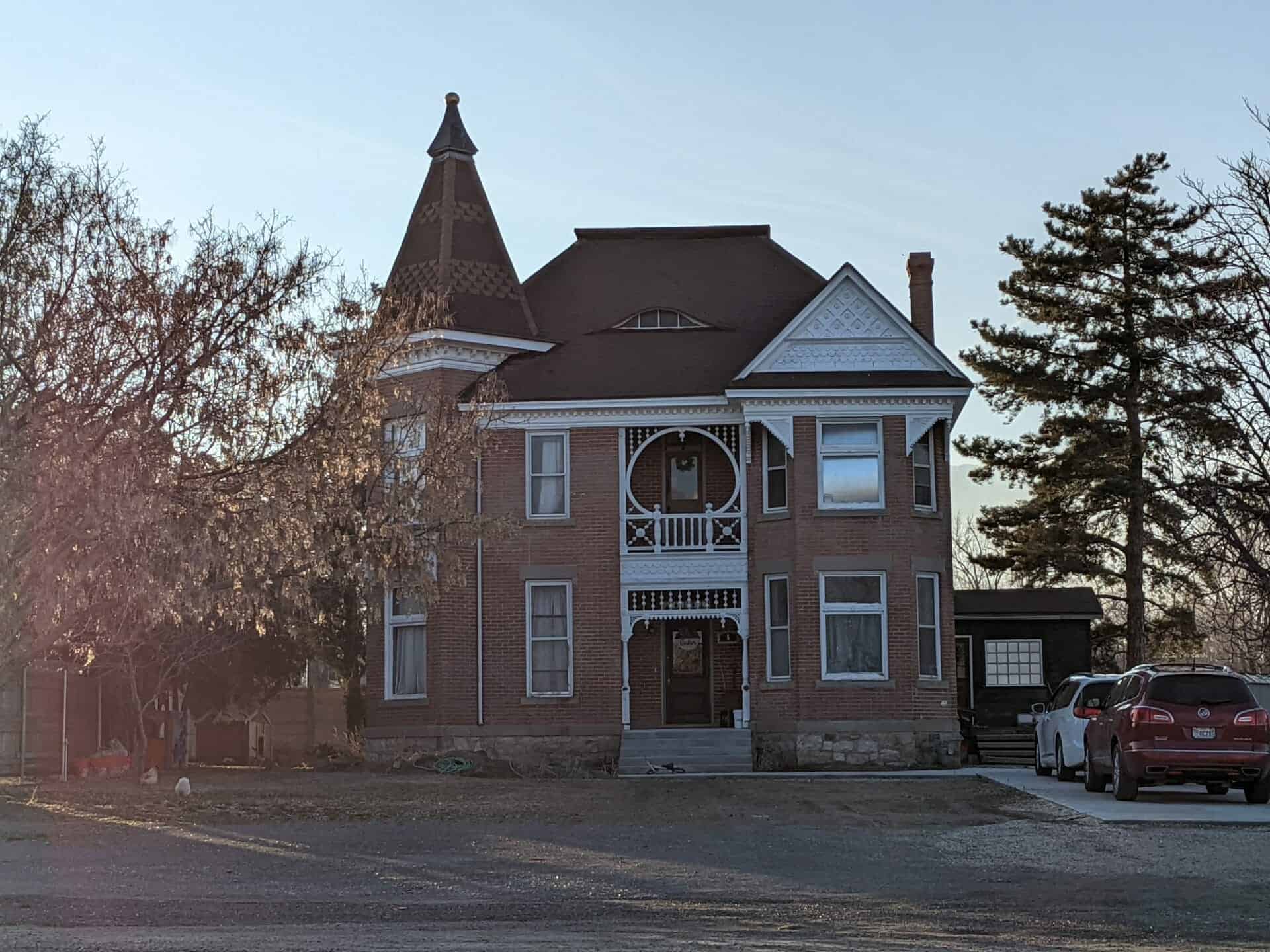
The James and Penninah Wrathall House, built in 1898, is located at 5 North Center Street in Grantsville, Utah. The Wrathall House is a two-story central-block-with-projecting-bays type house. The house is constructed of brick with sandstone foundation, lintels and sills. The style and ornamentation is Queen Anne with an Eastlake style porch. The house has a wood shingle roof with the original decorative shingles on the turret roof. The house has a circa 1940s one-story frame addition at the northwest corner. The 0.84-acre lot includes two contributing outbuildings (a circa 1910 garage and a circa 1900 coop), and one non-contributing outbuilding (a circa 1980s shed). There is also a contributing structure, a circa 1950 metal Butler silo.
Though technically a central-block-with-projecting-bays type house, the footprint of the building is contained within a roughly 40 by 40 foot square. The one-story addition is located in a niche at the northwest corner and extends 12 feet to the north. The house was constructed of brick with a facing of fired red brick and an adobe brick lining on the interior. The brick is laid in a running bond with flush mortar joints. The tan-colored sandstone foundation is rough-faced ashlar blocks with concave mortar. A smooth sandstone stringcourse is above the foundation at the water table. Similarly smooth sandstone blocks provide the lintels and sills from most of the windows. The house faces Center Street to the east. The facade features an octagonal bay to the north and a projecting square turret tower to the south. The centerpiece of the fa9ade is the entrance, which features Eastlake details (spools, spindles, lathe-turned, brackets, etc.) above the main floor entrance and on the second-story porch. The concrete deck and steps, and the wrought iron rail are later additions (circa 1930s-960s).
The Wrathall House has an imposing presence. The attic space under the central truncated pyramidal roof is nearly a story-high. The roof is covered in square-butt wood shingles with a small eyebrow dormer above the main entrance. The slender turret roof is higher than the main roof by ten to twelve feet. It is covered with wood in an alternating pattern offish-scale and square-butt shingles, and is capped metal. The octagonal bay has a simple-gable roof. The bay’s gable trim combines paterae within a weave of wood and a base offishscale shingles. Other ornamentation includes both fan-shaped and scroll-shaped brackets with knobs, and a dentilated cornice. The windows are original (the smaller windows are covered in storm windows, date unknown). The larger windows are fixed frame with transoms. The horizontal mullions are notched with a centered paterae. The tall narrow windows are one-over-one, double-hung wood sash. The front door is original with Victorian carved ornamentation. The exterior wood work is painted grey with dark green accents.
The secondary elevations are less elaborate. Several of the narrow windows on these elevations have been shortened or blocked (circa 1940s to 1970s). The north elevation features a second eyebrow dormer and a leaded and colored-glass window, which lights the staircase. There are corbelled brick chimneystacks on the north and south elevations. The south and east elevations are relatively plain and not easily visible due to the mature trees near the house. The circa 1940s addition at the northwest corner is a one-story frame structure covered in shiplap siding on a concrete foundation. The addition has a concrete stoop on the east side. There are doors on the east and west elevations. The east elevation door is half-glass (with multiple panes). The window also is a multi-pane wood sash window. The west door is at grade level.
( This was added to the National Register of Historic Places (#05001629) on February 3, 2006 and is located at 5 North Center Street in Grantsville, Utah )
On the interior, the house has approximately 2,700 square feet of space divided between the two floors. The full-height attic is expansive, but the basement is only 20 percent excavated. Though a central-block house, because it has a square footprint, the interior feels more like a foursquare. The central entrance has a foyer. The semi-open stair is on the north side. It features a ball and spindle balustrade, knobs, brackets, square newel posts, and a curved rail. At the stair landing, the stained glass window glows in colors of rose and gold. With the exception of the stair rail, the woodwork in the foyer has been painted white. The interior doors are all original with hopper window transoms. The door and window casings feature fluted stiles and paterae. The room in the octagonal bay is to the north. The parlor is on the south in the projecting turret tower. The parlor is the most intact room. The oak woodwork is in excellent condition. The room features an elaborate two-tier mantel featuring columns acanthus-leave capitals, a mirror inset, and a tile surround. The tall oak pocket doors lead to a large dining room in the southwest corner of the house. The kitchen is in the northwest corner. The house has a total of thirteen rooms with four bedrooms and a bath on the second floor. The interior was painted and re-papered in the 1950s.
The Wrathall House is on the south half of a 0.84-acre rectangular parcel. A 0.12-acre portion at the corner of Main and Center Streets was divided from the main property and a one-story commercial building (circa 1970s) sits right at the corner. There is a concrete sidewalk leading from Center Street to the main entrance. A wood fence at the rear separates the house from the Main Street property. The landscaping is overgrown and the mature trees near the house obscure views of the secondary elevations. For many years, two 100-year old evergreens obstructed the façade view, but these trees were cut down recently. North of the house is a large field where the outbuildings are located. They include a contributing wood garage with a simple gable roof. This building was built circa 1900 to 1910 and originally may have been an agricultural outbuilding. South and west of this building is a contributing shed or coop (circa 1910), which is partially dilapidated. There is also a non-contributing circa 1980 wood shed. The round metal Butler silo (circa 1950) is a contributing structure. The James and Penninah Wrathall House is in good condition and contributes to the historic resources of
Grantsville, Utah.

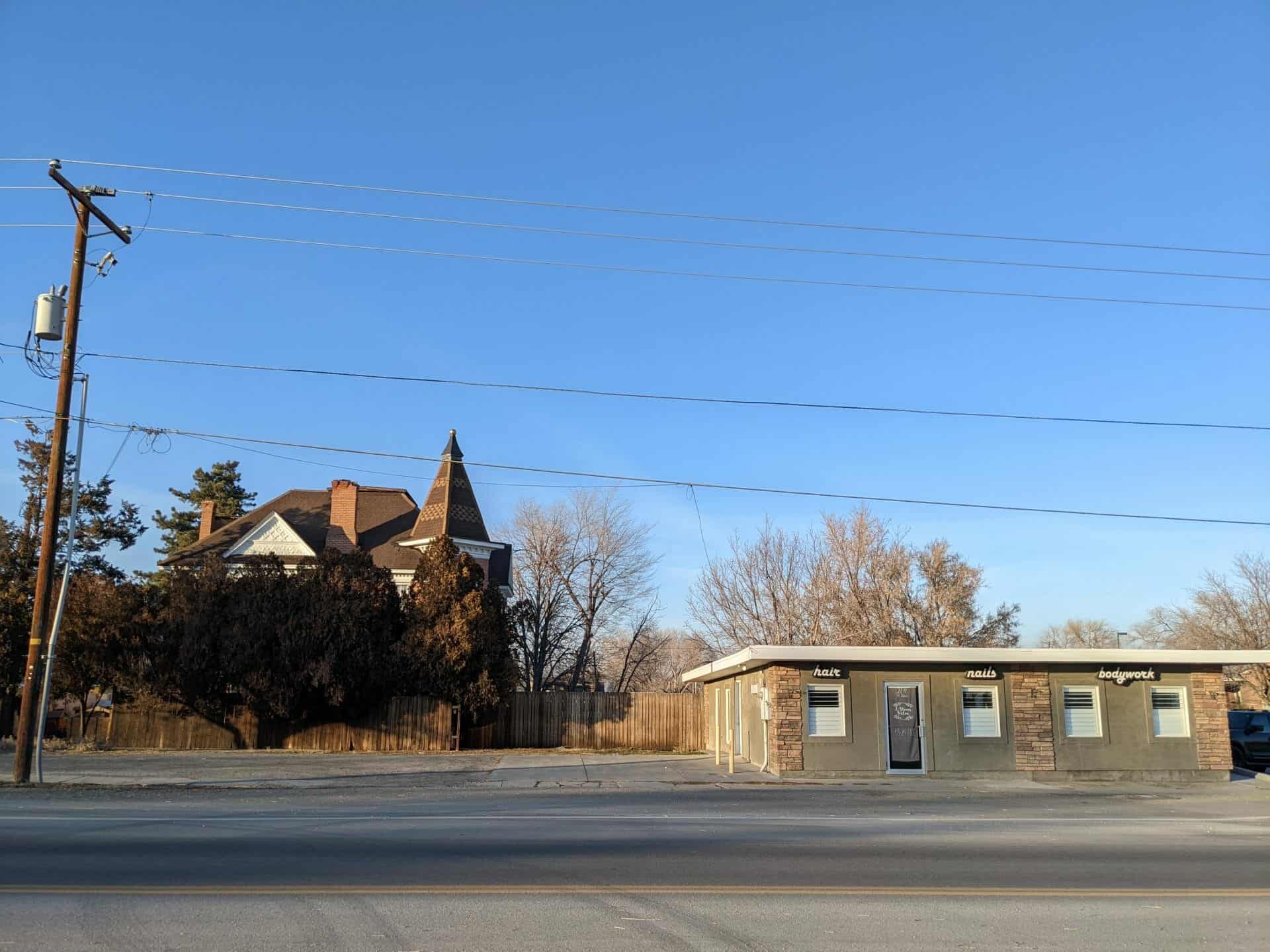
The James and Penninah Wrathall House, built in 1898, is significant under National Register Criteria A and C for its association with the development of Grantsville and its contribution to the architectural resources of the rural Utah community. The owners, James and Penninah Wrathall were prominent second-generation members of the community. The property is eligible within the Multiple Property Submission: Historic and Architectural Resources of Grantsville, Utah, 1850-1955. The history of the house spans all of the historic contexts: “Mormon Agricultural Village Period, 1867-1905,” “Impact of Technology and Transportation Period, 1905-1930,” and the “Economic Diversification Period, 1930-1955.” The Wrathall House is architecturally significant as an unusual and well-preserved example of the Victorian style known as Queen Anne. The design shows the influence of design books, particularly in the Queen Anne and Eastlake details, but the execution by local builder, Charles Z. Schaffer, is unique. The imposing residence is a landmark at the corner of Main and Center Streets. The Wrathall House is a contributing historic resource in Grantsville, Utah.
The community of Grantsville was settled on October 10, 1850, three years after the first settlement of the Salt Lake Valley by members of the Church of Jesus Christ of Latter-day Saints (LDS Church or Mormon Church). After several altercations with the nomadic Native Americans who camped in the area, the Grantsville area was settled and known as Willow Creek. In 1852 a town site was surveyed and in 1853, the town was renamed Grantsville in honor of George D. Grant, who led a company of the territorial militia to protect the settlement. In April of 1890, James L. Wrathall bought Lots 1 & 2 of the Grantsville survey’s Block 3 from fellow Grantsville pioneer John Eastham (1820-1893). At the time a small Victorian cottage was located in the southeast corner of Lot 1. The Wrathall family lived in the cottage while their substantial brick home was construction. The local newspaper pinpointed the construction year in an article dated November 25, 1898, which read: “Bishop Wrathal’s [sic] fine home is nearly completed, all of the latest modern design, and shows the skill and fine machanical [sic] labor of C. Z. Schaffer, the builder.”
James Leishman Wrathall was born in Grantsville on September 22, 1860. He was the son of prominent
Grantsville pioneers, James Wrathall (1828-1896) and Mary Leishman Marston (1822-1871), English
immigrants who came to Utah in 1850. On February 2,1882, James L. Wrathall married Penninah Hunter.
Penninah Susan Hunter was born in Grantsville on January 14, 1862. She was the daughter of Edward Hunter (1821-1892) and Mary Ann Whitesides (1825-1914), who were also English immigrants. James and Penninah had ten children, with the last two born after they moved into their new house.
James Wrathall’s early life was spent herding his father’s cattle and sheep on the plains of Tooele County. He saved and invested, eventually becoming the owner of several large herds of sheep and cattle. He also acquired over 4.000 acres of farm and ranchland. He raised hay and sugar beets. He had a large fruit orchard, which included apples and other small fruits. As a prosperous rancher and farmer, he had numerous business interests: North Willow Irrigation Company, president; Richville Milling Company (flour mill in Tooele), president; Utah-Idaho Sugar Company, stockholder; Consolidated Wagon & Machine Company, stockholder; etc. James Wrathall was a member of the Grantsville City Council. He also served on the Grantsville School Board for thirteen years and on the Tooele County Board of Education for seventeen years. He held numerous leadership positions in the LDS Church, including serving as Grantsville’s bishop between 1890 and 1906. A biographical sketch of James L. Wrathall written in 1919, began: “There is no name perhaps that figures more conspicuously and honorably in connection with the business development of Grantsville and Tooele County than does the name of Wrathall. James L. Wrathall is now extensively engaged in farming in this section of the state and he is also at the head of various important business enterprises which constitute a dominant factor in the general development and progress of the district in which he lives.”
An earlier biographic sketch, noted that “He makes his home in Grantsville, where he erected, in 1898, a
beautiful home of twelve rooms. The house is a two-story brick, and modern in every respect.” According to Lisa Miller, “The Wrathall house was known as one of the most elegant residences in Grantsville. Local
citizens still remember the rosettes that adorned the ceilings in the original parlor and dining room and a grand stairway that features a beautiful stained glass window. The house is also believed to be the first residence in Grantsville to have acquired electricity.” Hazel Johnson, the youngest daughter of James and Penninah, remembers the silverware (which she had to polish every Sunday) and the napkins had the family’s initials on them.
At the age of seventy-three, James L. Wrathall gathered his family around him at home and predicted his death. He died the following day, November 29, 1932. In addition to raising ten children, Penninah Wrathall served in the Relief Society and Primary organizations of the LDS Church. She also served as the president of her local Daughters of Utah Pioneers organization. Penninah Hunter Wrathall died on November 16, 1934.
A portion of the property (Lot 2) had been deeded to a son, Morris Y. Wrathall, in 1931. After Penninah’s
death, the remainder went to Irene Wrathall Page in 1936. Irene Page was listed as living with her parents on the 1930 census enumeration. Irene was born on February 13, 1890 in Grantsville. She married George W. Page in 1918. He died in 1936. It is not known how long Irene lived in the house, but she did rent it out for a few years. In 1944, she sold the property to her sister, Hazel Wrathall Johnson. Irene Page died in Missouri on April 5, 1973. Hazel Wrathall was born on July 18, 1905, the youngest child of James and Penninah. She married Milan Johnson on November 17, 1921. Milan “Mike” C. Johnson was born on October 5, 1903, in Grantsville. They had eight children. The Johnsons remodeled the house and restored portions of the downstairs in the 1950s. They lived in the home until their deaths. He died on September 22, 1978, and she died on August 24,1993. In 1994, ownership was transferred to their daughter, Janice Johnson Sommerfeld, and her husband Sigmund Sommerfeld, who are the current owners.
The Wrathall House is architecturally significant as an imposing and unique adaptation of the Queen Anne style. The Queen Anne style was popularized by the 19th century British architect, Richard Norman Shaw. It was the most picturesque of the various Victorian Eclectic style popular in America in the late 19th century. Variations of the style were popular in Utah between 1884 and 1905. Residential examples are characterized by their asymmetrical façade, irregular plans, and variety in materials. The most common house type for Queen Anne residences was the central block with projecting bays. The Wrathall House is an unusual example: it appears as a block mass (almost a foursquare) flanked by a turret and an octagonal bay. The house includes a variety of juxtaposed materials: rough-faced and smooth stone, brick, wood shingles and other ornamentation. The Eastlake-style porch was adapted from a style book written and illustrated by English architect, Charles Locke Eastlake. Most Eastlake homes were constructed entirely of wood frame and shingle, and lacked the variety of materials of the Queen Anne style. The Eastlake style was popular in Utah between 1880 and 1900, but because Utah builders preferred brick, there are very few pure examples of the style. In Utah, as in the case of the Wrathall House, the Eastlake style is most often found on porches and decorative gable cornices in combination with Queen Anne and other Victorian Eclectic styles.
The builder of the Wrathall House was Charles Zephaniah Shaffer. 8 He was born in Pennsylvania on May 13, 1843. He was living in Grantsville at the time of his marriage to Ellen Barrus in 1895. He was listed as a
“carpenter” in a 1900 business gazetteer. Charles Z. Shaffer is also known to have built the Alex and Mary
Alice Johnson House at 5 West Main Street in Grantsville, listed on the National Register on December 13, 1995. The Johnson House was built in 1900, two years after the Wrathall House. Shaffer had probably gained confidence as a builder with his work on the Wrathall House. The Johnson House is a more exuberant expressive of the builder’s skill with extended bays and elaborate wrapping Eastlake porches, but it is also more typical than the Wrathall House. The Alex and Mary Alice Johnson House was listed on the National Register of Historic Places in 1996. It is not known whether Shaffer was responsible for other Queen Anne homes in the Grantsville area.9 Charles Z. Shaffer died in Grantsville on August 29,1904.