
Tags
Catholic, Churches, Downtown SLC, Historic Buildings, Historic Churches, Salt Lake City, Salt Lake County
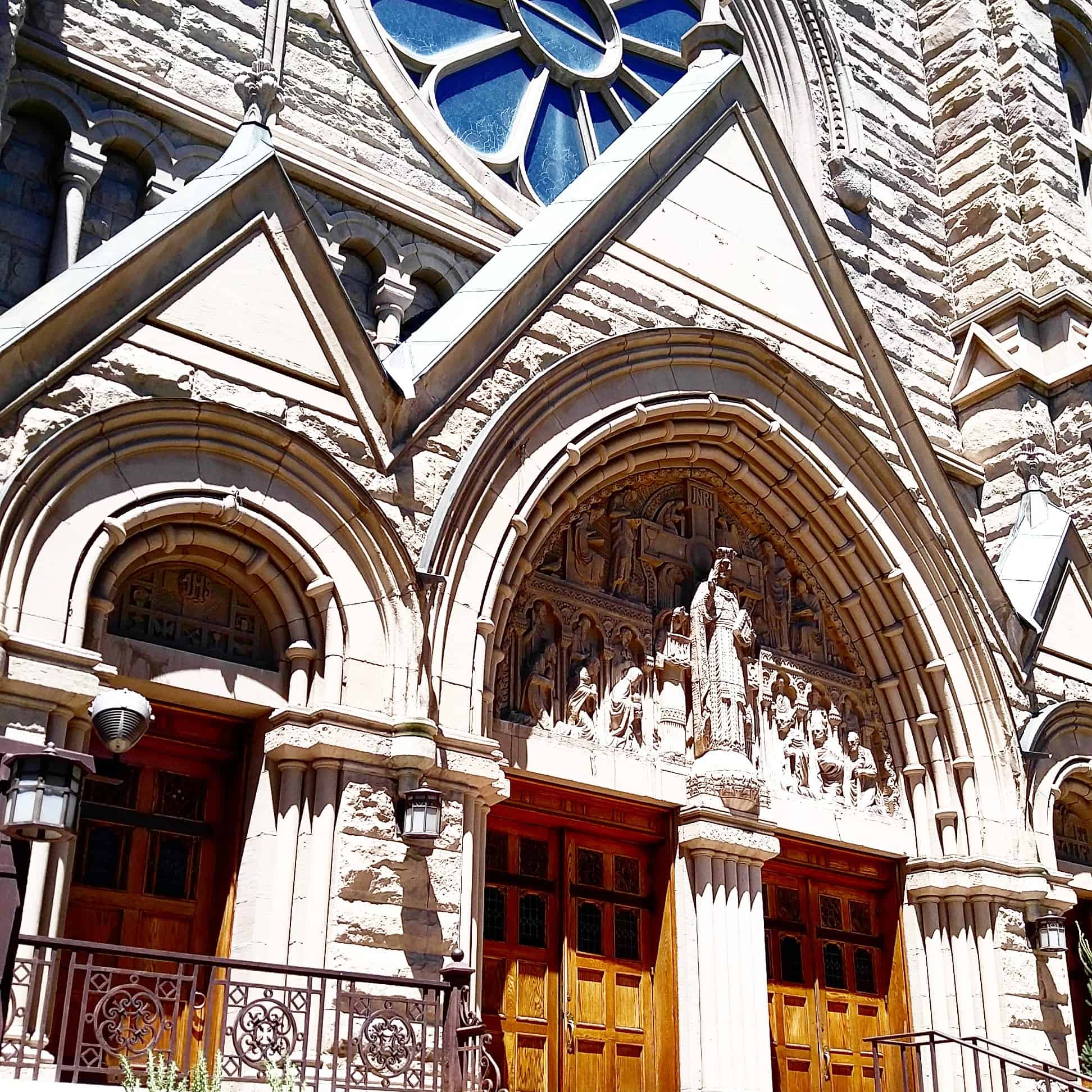
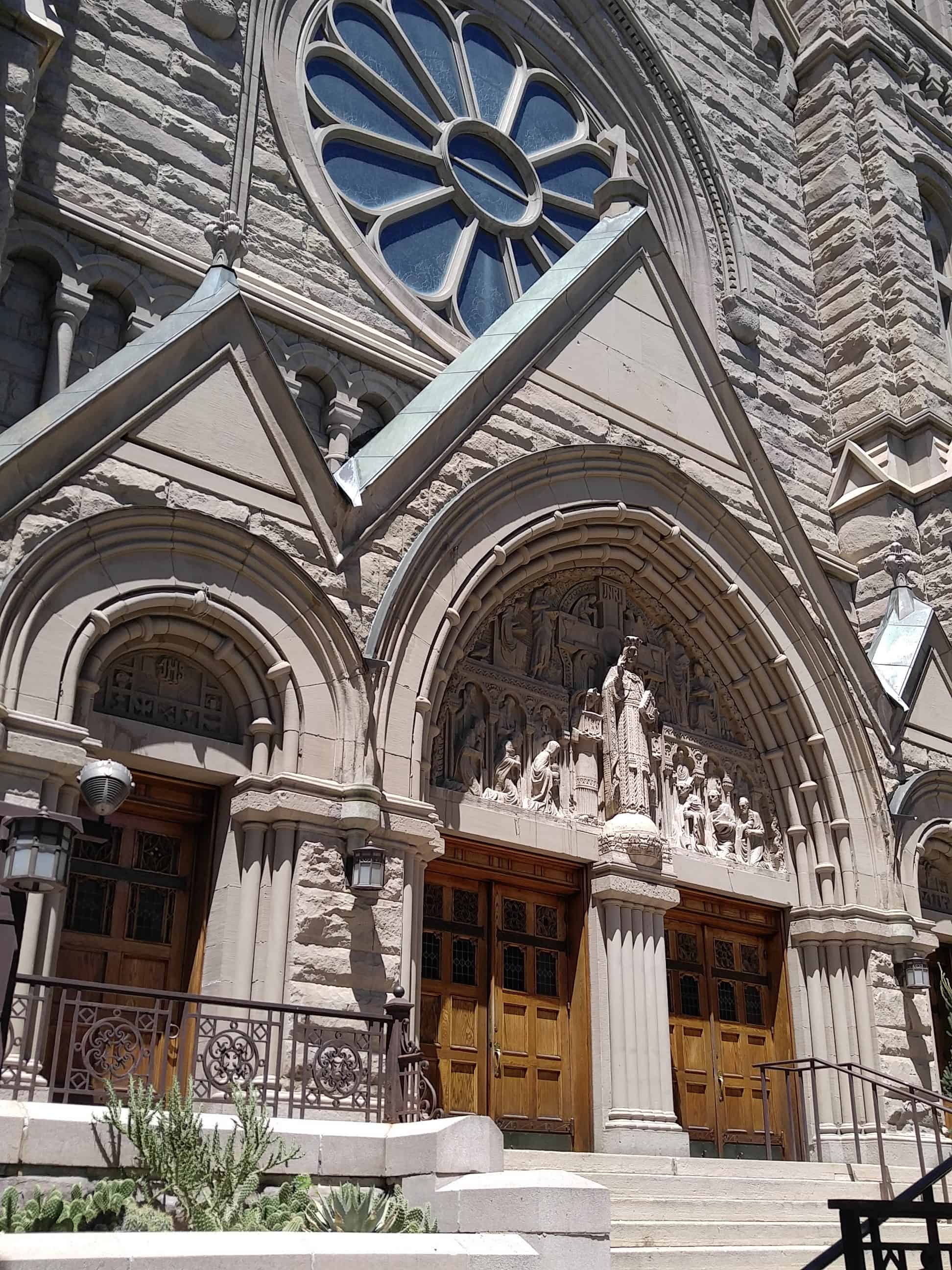
The Cathedral of the Madeleine is a Roman Catholic church in Salt Lake City, Utah, United States. It was completed in 1909 and currently serves as the cathedral, or mother church, of the Diocese of Salt Lake City. It is the only cathedral in the US under the patronage of St. Mary Magdalene.
The cathedral was built under the direction of Lawrence Scanlan, the first bishop of Salt Lake. It was designed by architects Carl M. Neuhausen and Bernard O. Mecklenburg. The outside is predominantly a Neo-Romanesque design, while the inside tends more toward the Neo-Gothic. Construction began in 1900 and was completed in 1909. It was dedicated by Cardinal James Gibbons, Archbishop of Baltimore.
The Cathedral is located at 331 East South Temple (technically the parcel is 27 C Street in The Avenues) in the South Temple Historic District in Salt Lake City, Utah and was listed on the National Historic Register (#71000845) on March 11, 1971.








http://signaturebookslibrary.org/seeing-salt-lake-city-01-10/
The Cathedral of the Madeleine has a very interesting history in which four important facets of Utah and American history are expressed. First of all, it was designed by Architect C. M. Neuhausen, and demonstrates his attachment to H. H. Richardson’s architecture, popular in America at the turn of the century. Some writers suggest that the influence of Sir Christopher Wren is also evident as a result of the Irish background of Bishop Lawrence Scanlon.
Secondly, the Cathedral represents the missionizing efforts of Catholicism in settling the American west. Fathers Antanazio Domingues and Silvestre Velez de Escalante were the first white men to explore into Utah. In addition, in 1776, the “Pious Fund” established by the early Jesuit Padre Kino and Father Salvatierra, for building churches in the Californias (1697), became available after more than two centuries of “controversy,” Allowing a ruling by the Hague Tribunal in 1902. Monies from these Jesuit funds were paid to the “Bishops of the Californias” of which $124,080.54 sent to the Salt Lake Diocese for building the Cathedral, a fitting tribute to the long and continuing impact of the Catholic missions on the American west.
Thirdly, much of the money used to build and furnish the Cathedral came rom Utah mines, which also provided the first attraction for major Catholic emigration to Utah. Such names as David Keith, Thomas Kearns, Mrs. Mary Judge and others are among the contributors. The Father of Utah mining, General Patrick Connor, was a Catholic. Many of the thousands of miners who came to exploit Utah’s minerals were and still are Catholics. Between 1873 and 1915 all were directly affected by the Cathedral builder, Father Scanlon.
Finally, the lovely Cathedral is the crowning, tangible monument to the extensive and effective labors of Bishop Lawrence Scanlon. Father Edward Kelly had been assigned to Salt Lake City in 1866, and his successor, Father Patrick Walsh, came in 1871. They had purchased land and built the first Catholic Church in Salt Lake City, yet the edifice retained a debt of $6,000 Scanlon arrived in 1873.
Under Scanlon’s direction, churches were built in most of the mining and larger communities of Utah. all parishes in Utah before his death, and all charitable and educational institutions as well, including All Hallows College, St. Mary’s Academy, St. Ann’s Orphanage, and Holy Cross Hospital.
The Cathedral itself evolved slowly. In 1889, land was purchased from Don Carlos Young for about $39,000. Ground was broken on July 4, 1889, but the cornerstone was not laid until July 22, 1900. By 1907 the building was almost finished except for the spires. At that time Bernard O. Mecklenburg was hired as a new architect. Construction was completed and the structure dedicated August 15, 1909. It was a day for celebration, especially by Utah Catholics. Construction costs have been estimated at over $300,000 plus furnishings.
Bishop Scanlon worked successfully with Mormon and civic leaders, who held him in high regard. His death May 10, 1915 was mourned by all Utahns. In tribute to him, his remains were placed in the crypt under the Sanctuary. The words of Bishop Keane, given at the time the Cathedral was dedicated, pay eloquent tribute to this structure:
“This magnificent temple is a confession of faith of the Catholics of Salt Lake. Families will come and go, revolutions will arise, but Temples such as this remain as lasting monuments to those who built them, monuments to the living faith in human hearts.“

(from Preservation Utah’s walking tour)
The Cathedral of the Madeleine
331 E. South Temple 1899-1909, Carl M. Neuhausen (1899-1907), SLC, and Bernard O. Mecklenburg (1907-1909), SLC
Open to the public M-F, 7:30 am-9 pm, Sat. & Sun., 7:30 am-7 pm. Guided tours available Fridays at 1 pm and Sundays at 12:30 pm.
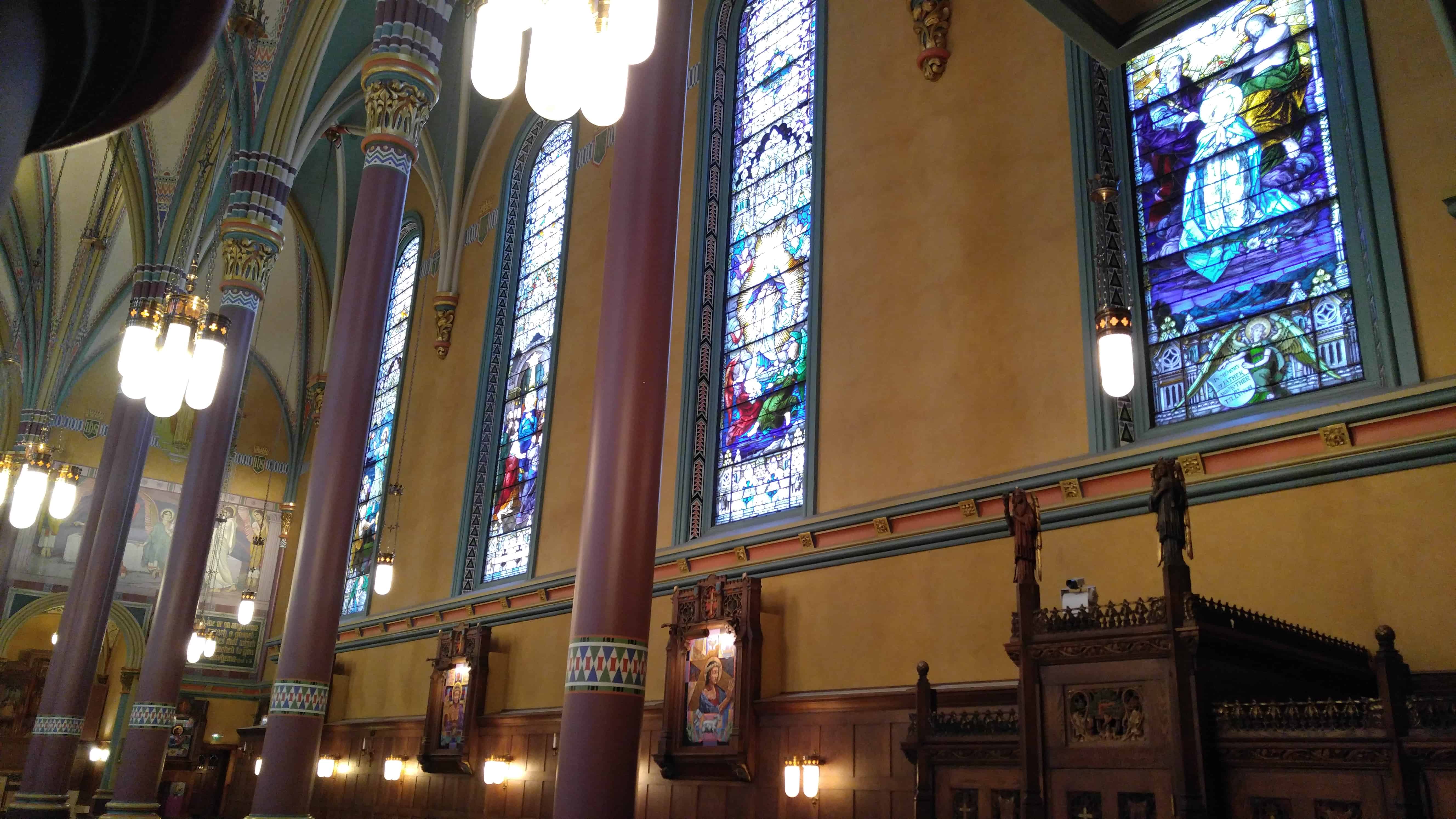
The mining fortunes that gave rise to South Temple’s grandest mansions also helped fund the construction of Utah’s first Catholic cathedral. The Cathedral of the Madeleine was built between 1899 and 1909 under the direction of the Right Reverend Lawrence Scanlan. It was designed by prominent Utah architect Carl M. Neuhausen as a Romanesque-style building with round Roman arches and rough-cut stone. Later, when Bishop Scanlan acquired additional funds for the project, the towers and pointed Gothic style portico were added to the plans. Upon Neuhausen’s death in 1907, Bernard O. Mecklenburg was hired to complete the roof and towers. While the exterior of the cathedral was substantially complete by 1909, the interior remained quite plain. In 1915, the Right Reverend Joseph Glass embarked on a three-year project to enhance the interior. Under the direction of noted American architect John Comes, the finest craftsmen of the day created paneling, painted murals, and carved wooden altarpieces for the building. The resulting ornate, polychrome interior is an outstanding example of the Gothic Revival style popular in the early 20th century. Comes also oversaw the completion of the exterior of the cathedral with the addition of the tympanum carving, tower gargoyles, and bi-level front steps.
Both the exterior and interior of the cathedral have undergone extensive restoration to preserve their historic character. The National Trust for Historic Preservation recognized the excellence of the interior restoration with a prestigious Honor Award in 1994.
Pingback: Salt Lake City, Utah | JacobBarlow.com
Pingback: Historic Churches in Salt Lake City | JacobBarlow.com
Pingback: Bernard O. Mecklenburg | JacobBarlow.com