Austin-Wherritt House
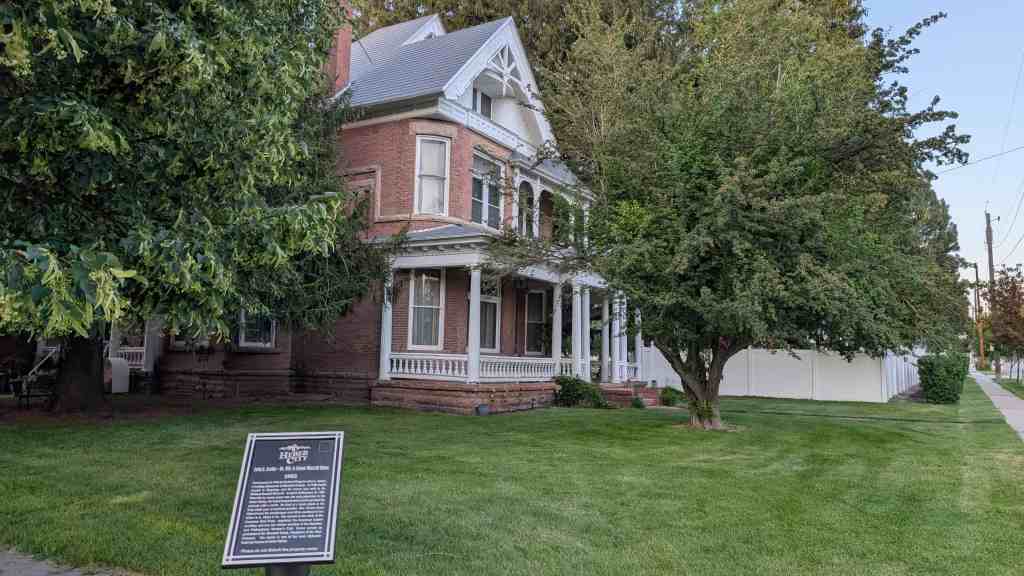
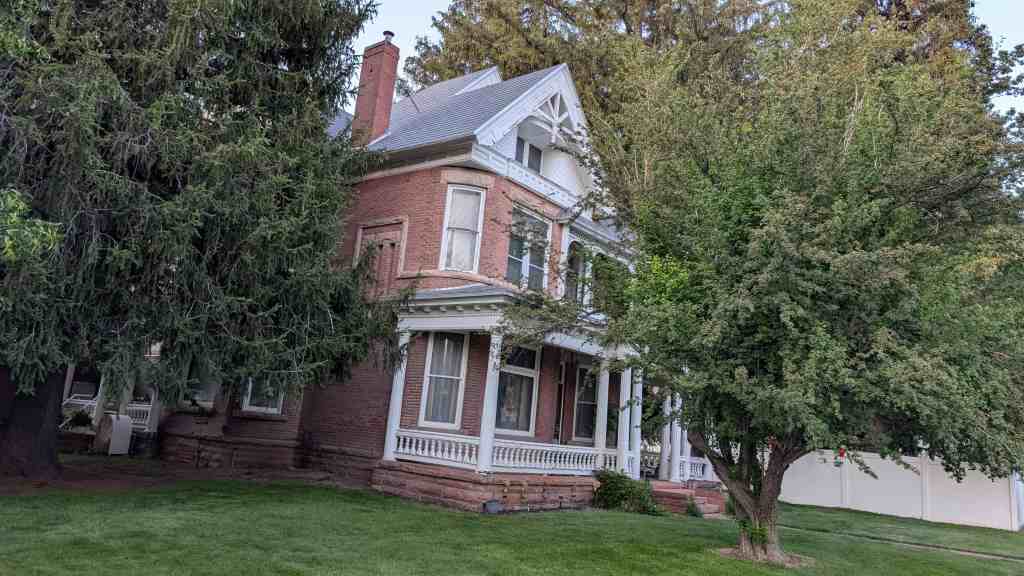
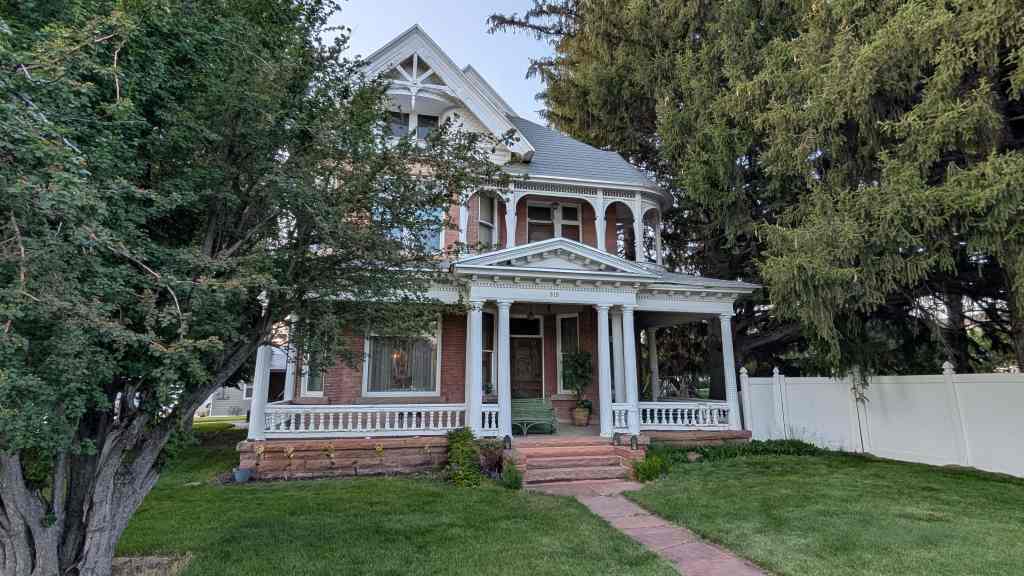
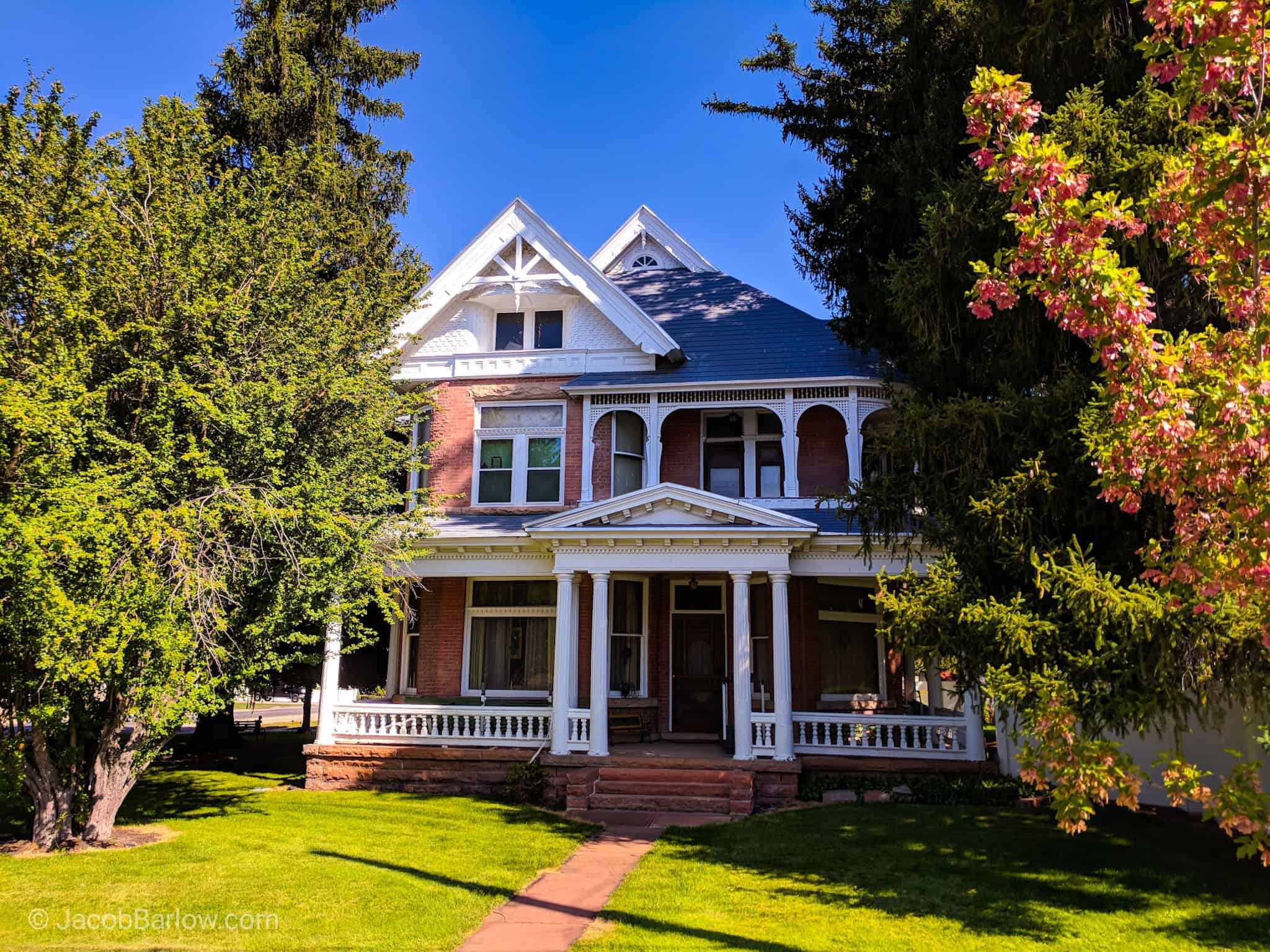
This house was constructed in 1903 by Herbert Clegg for John E. Austin, a leading sheepman in Wasatch County. In 1908 Austin moved to Wyoming and the house was sold to Dr. William Russell Wherritt. A native of Missouri, Dr. Wherritt was for many years the only physician in Heber Valley. The house is one of the most elaborate Victorian homes in Heber Valley. It is now owned and occupied by Dr. Wherritt’s daughter, Mrs. Dean Todd.

The John E. Austin-William Russell Wherritt House is located at 315 East Center Street in Heber City, Utah and added to the National Register of Historic Places (#79002520) on January 25, 1979. It is also part of the Historic Home Tour.
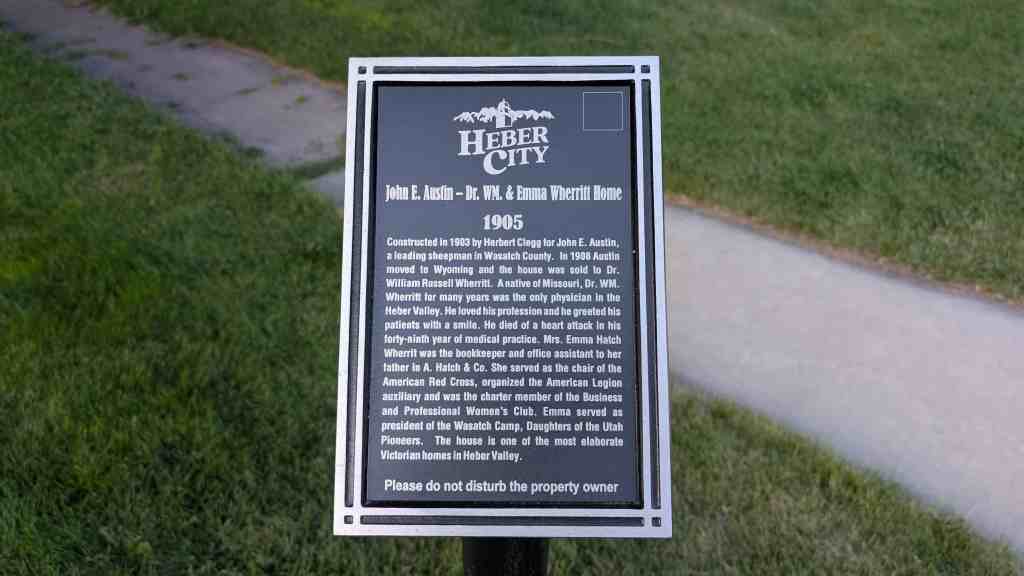
The plaque for the Historic Home Tour says:
John E. Austin-Dr. WM. & Emma Wherritt Home
1905
Constructed in 1903 by Herbert Clegg for John E. Austin, a leading sheepman in Wasatch County. In 1908 Austin moved to Wyoming and the house was sold to Dr. William Russell Wherritt. A native of Missouri, Dr. WM. Wherritt for many years was the only physician in the Heber Valley. He loved his profession and he greeted his patients with a smile. He died of a heart attack in his forty-ninth year of medical practice. Mrs. Emma Hatch Wherrit was the bookkeeper and office assistant to her father in A. Hatch & Co. She served as the chair of the American Red Cross, organized the American Legion auxiliary and was the charter member of the Business and Professional Women’s Club. Emma served as president of the Wasatch Camp, Daughters of the Utah Pioneers. The house is one of the most elaborate Victorian homes in Heber Valley.

From the national register’s nomination form:
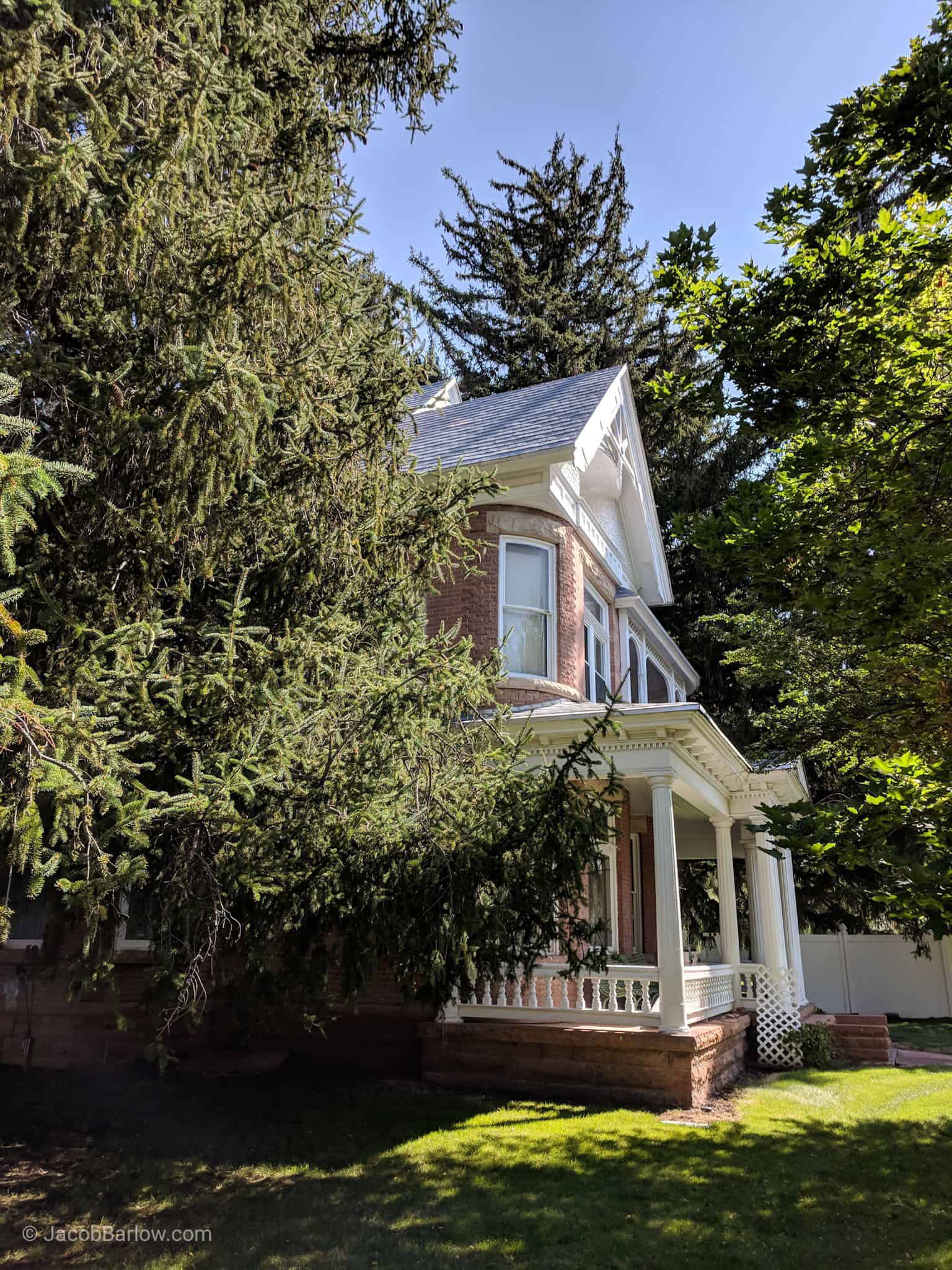
The Austin-Wherritt House is significant because the sophistication of its design and construction, relative to the predominant contemporary architectural expressions of Heber City, describe, illuminate, and document the social aspirations and cultural level of the professional elite of a small agricultural community. The Austin-Wherritt House is the most elaborate Queen Anne/Colonial Revival home in Wasatch County and in interior and exterior appearance is almost entirely original. A large two and a half story brick structure, the home reflects the emphasis on dominating roof planes and large porches that are part of the era’s emphasis on the domestic qualities of the home. The mature landscaping, including enormous evergreens, makes for an integrity of setting consistent with the importance of the house.
During the nineteenth century Wasatch County’s economy was mainly supported by the cattle and sheep industry. The sheep industry was especially profitable in the area because of the excellent grazing land. The industry was so large in the area that for several years more sheep were shipped from Heber to the stockyards of the Midwest than from any single part of the United States. John E. Austin, the original owner of this house, was one of the largest individual sheep owners in the area. Austin also served as chairman of the county commissioners in Wasatch County in 1903. In 1904 he helped organize the Heber Land and Livestock Company, a local association of sheepmen in the valley. Austin was the main stockholder and served as general manager of the company.
When Austin was elected to the county commission, he moved from Center Creek, a small farming and grazing community in Wasatch County, to Heber City, the county’s seat. When he moved, he hired some of the local masons, including Herbert Clegg, to build this house. Austin lived in the house for two years and then moved to Wyoming. Dr. William Wherritt was one of the few people in the community who could afford such a home, and following its purchase in 1908 it remained the Wherritt residence until his death in 1948. The imposing dignity of the home was a visible reminder to the community of the social importance of the physician.
Wherritt, a native of Missouri, played a prominent role in the development of medical services in Wasatch County. During the nineteenth century many of the “doctors” in the rural areas of the United States had received either no formal training or were practitioners in some form of quackery. Many people simply hung up a sign and started to practice. Therefore, it was quite a coup for the community that Wherritt, a graduate of the Kansas City Medical College, should decide to set up in Wasatch County, a decision he made after visiting his brothers in Park City, Utah, and deciding he liked the area.
For many years Wherritt was the only physician in Wasatch County. He established an office in Heber City first in the bank building and later in a small building behind this house. (Dr. Wherritt’s office still stands behind this house but it has been altered extensively.)
Wherrit was appointed by the city council to serve as Heber City health physician and by the County Commission to serve as the Wasatch County health physician, In these positions he advised the local governments on sanitary conditions and help set quarantine regulations when there was a breakout of disease in one of the communities. Wherritt also worked as the railroad doctor.
Wherritt provided a valuable service to Heber and Round Valley during the flu epidemic of 1918. Following World War I, a major flu epidemic swept across the United States. The epidemic was especially hard in the state of Utah. To prevent the spread of the disease, travel through out the state was controlled. Therefore each area of the state had to be nearly self sufficient. Dr. Wherritt’s only help from outside of the area was a trained nurse, Kapalani Makahanohaus, who was sent by the State Board of Health in Salt Lake to assist him. With her help and the help of the local citizens, Wherritt set quarantines and established regulations to prevent the spread of the disease. Without his help, the flu would have had a disastrous effect on Wasatch County.
Description:
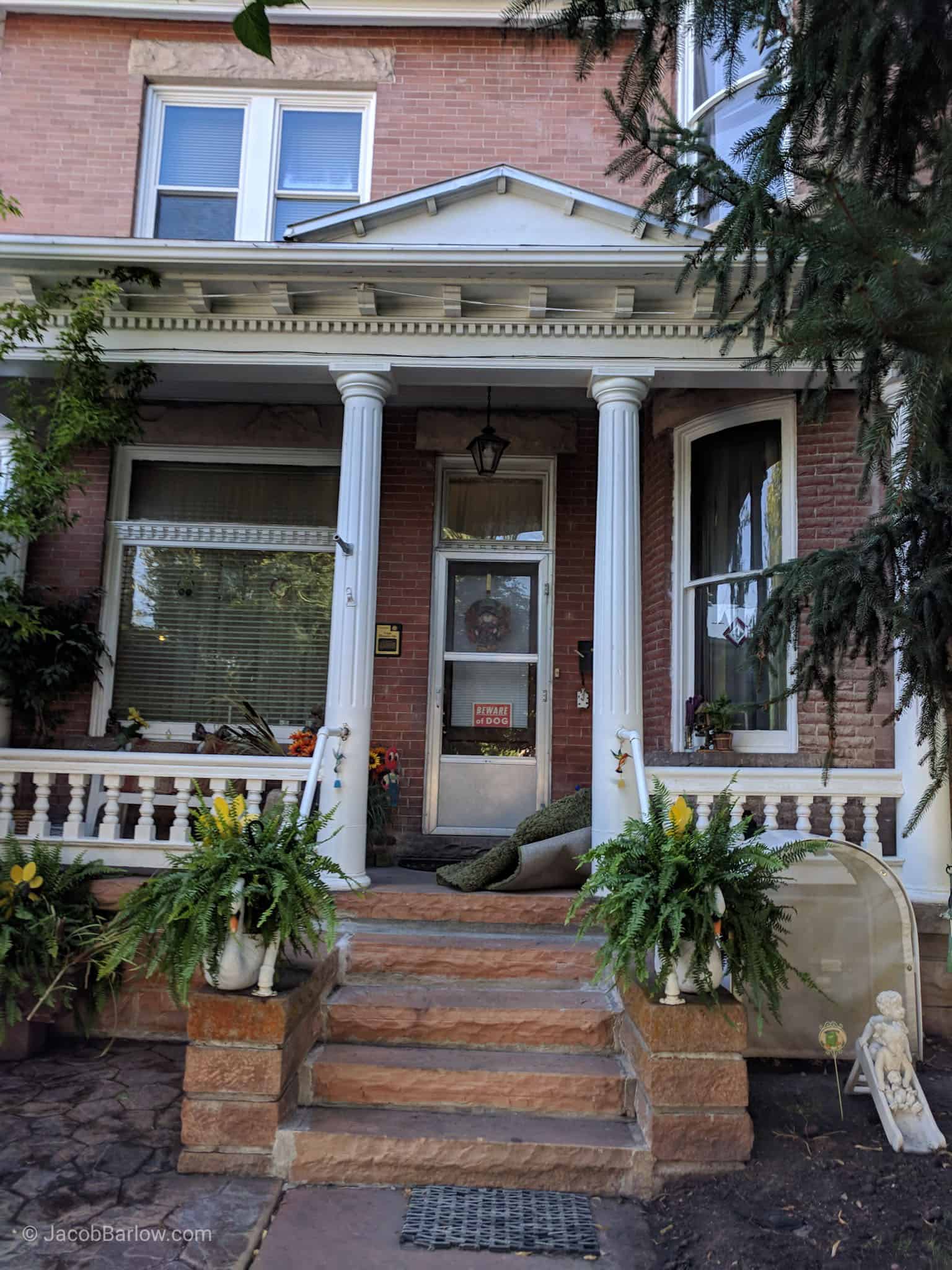
A large, two and a half story brick structure, the home reflects the emphasis on dominating roof planes and large porches that are part of the era’s emphasis on the domestic qualities of the house. Queen Anne, Classical and Stick Style design elements are used freely. The full pediment of the porch is supported by double columns. The rectangular, classical porch spans the full width of the home, and reduces the asymmetry of the large projecting two story bay on the left side. A small porch is created on the second floor by the large roof overhang, but this porch uses Eastlake instead of Classical detailing, ornamental porch ports and a full-width, spindle band beneath the fascia.
Both the front and side gables are filled in with decorative stickwork–king post, braces and pendant–and the gable window is recessed behind the plane of the windows. A small gable at the ridge of the roof is filled in with a linette window. Most of the windows are built with rough-cut stone lintels and sills. The most unusual window treatment is on the west façade, at the hall level, corresponding to the interior stair landing. A tripartite window of three tall narrow lights is set in a brick and stone frame, with brick corbelling beneath the narrow stone sill.
The interior retains almost all of the original elaborate wood work. The front entry includes a beautiful sitting alcove in the curve of the left front façade, and a curved, grained balustrade. The double panelled doors of the front entry and between the parlors are intact, as is the front parlor fireplace. The kitchen which is in the same location has been remodelled. Much of the original furniture is in the house, including several large pieces that were wedding gifts to the Wherritts in 1900. The second floor grained wood work is unaltered. The present owner, Mrs. Lois W. Todd, is a daughter of William Russell Wherrit. She and her son, David, are determined to preserve the integrity of the house,