
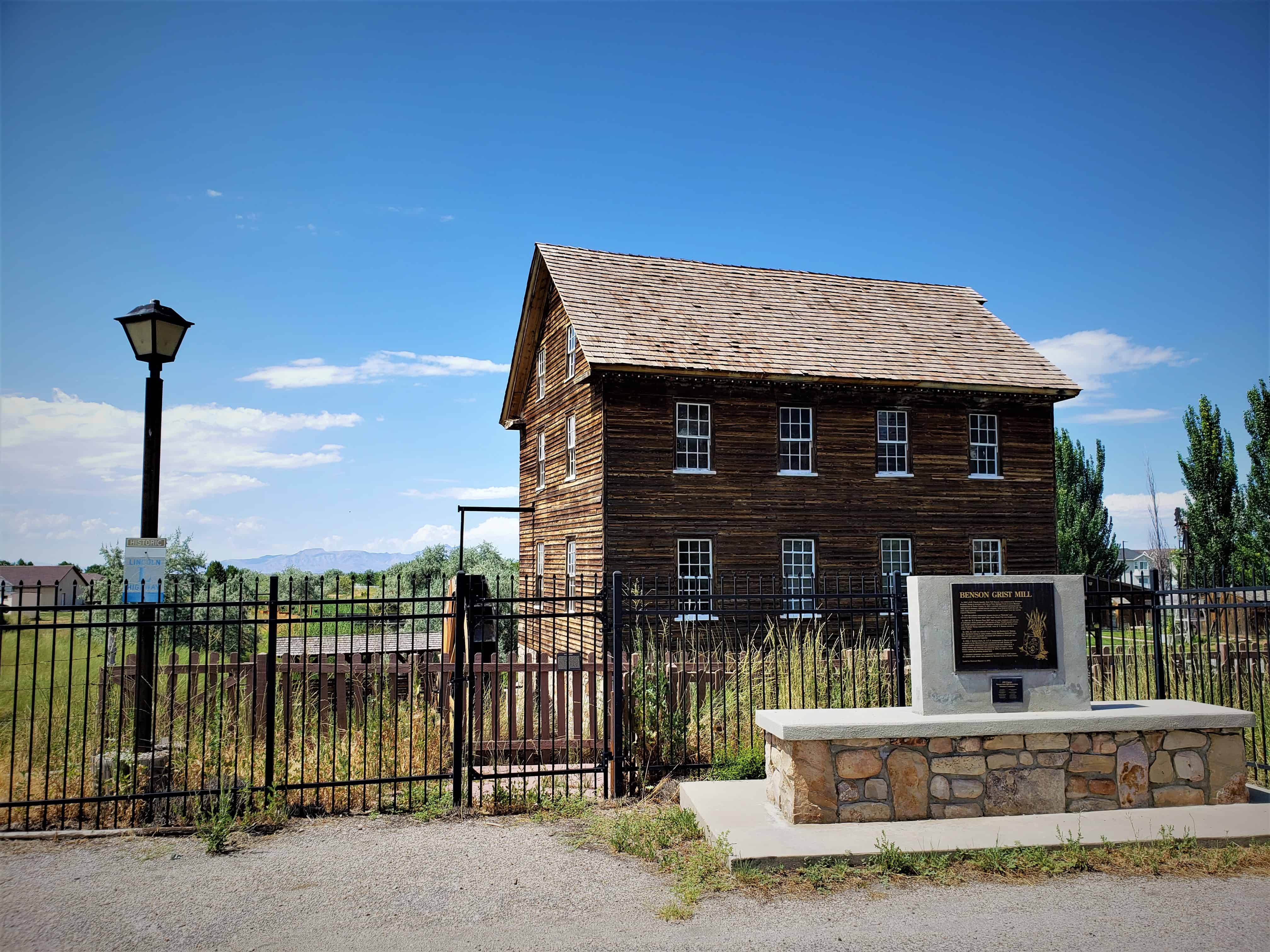
In 1851 L.D.S. Church Apostle, Ezra Taft Benson, was authorized by President Brigham Young to develop a mill site at Twin Springs Creek to serve Mormon communities in Tooele County. In 1851 a sawmill commenced operating and in 1854 the Lee brothers, skilled pioneer artisans, were hired to build the mill. The mill’s large mortised timbers were hauled by team and wagon from the nearby Oquirrh Mountains.
In 1855 the millsite community became known as “Richville” and served as the County Seat until 1861, when Tooele City was designated.
In 1860 the “E.T. Benson Flour Mill” had one male employee and one run of millstones which produced 1,200 barrels of flour, 72,000 pounds of bran and 56,000 pounds of corn meal, together valued at $17,000. In the same year, Brigham Young acquired the mill, when E.T. Benson moved to Cache Valley.
By 1862, the mill was referred to as “Young and Rowberry’s,” Bishop John Rowberry being an early resident of the Milltown (Richville) area. The mill that year reportedly processed 200 bushels of wheat per day under a 250 horsepower capacity.
In 1922, J. Reuben Clark, Jr. (A U.S. Ambassador to Mexico and later an apostle in the Mormon church) purchased the mill. Earlier it’s original wooden waterwheel and millstones had been replaced by metal turbine and imported free-standing “grain breakers.” After finally ceasing flour-milling operations in 1938, the mill was used several years for grinding animal feed.
A volunteer committee was organized in 1883 to acquire and restore the historic mill, which was donated by Terracor Corp. to Tooele County.
The Benson Mill is located at 325 South Highway 138 in Stansbury Park, Utah and was added to the National Historic Register (#72001260) on April 14, 1972.
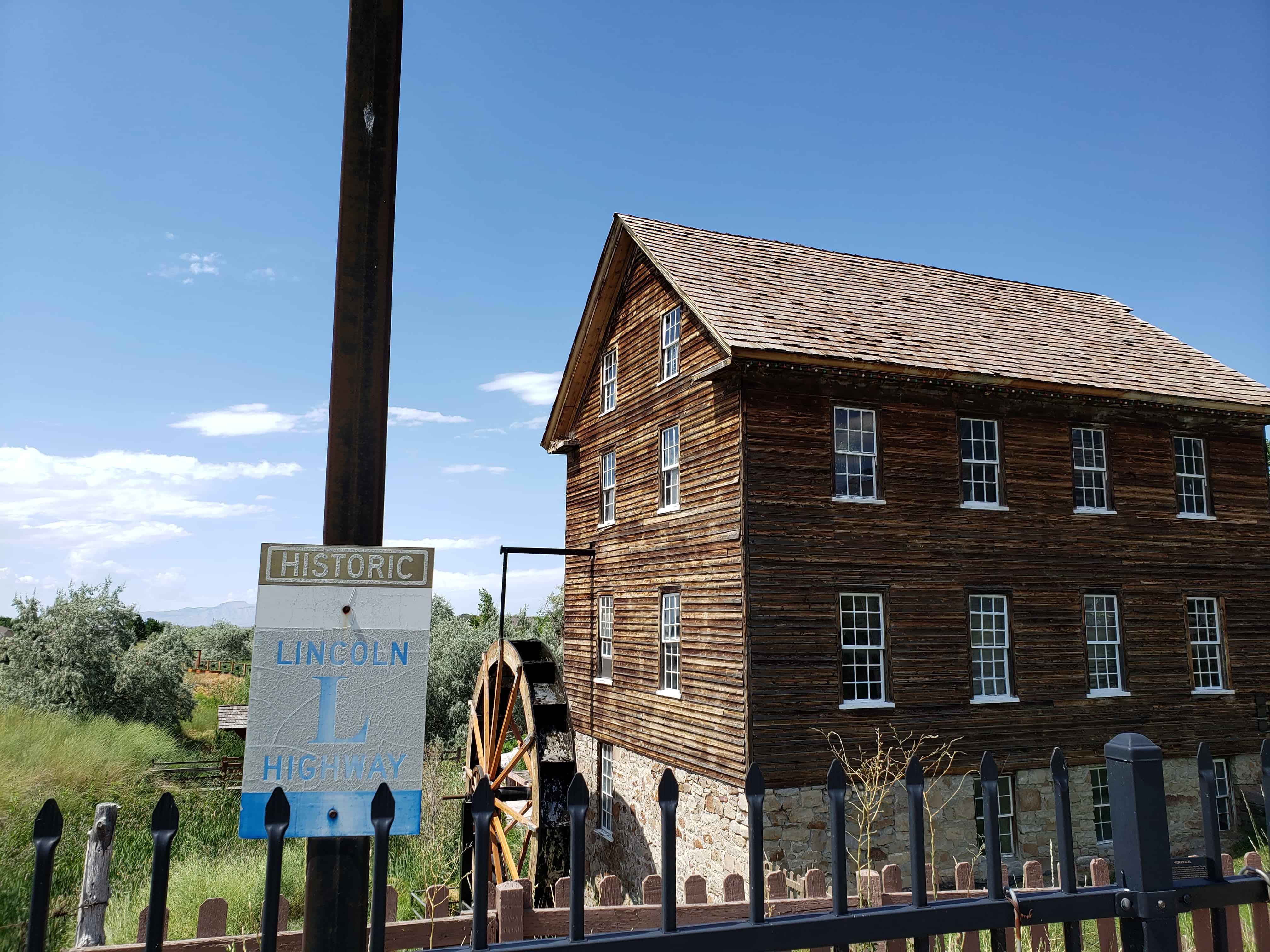


In September 1849 the first settlers entered Tooele Valley. In their search for water power sites, a place on Twin Springs Creek was selected. A saw mill was completed by the spring of 1851 and was known as Ben son’s Saw Mill. The saw mill was destroyed several years after its construction.
In 1854 a grist mill was built on Twin Springs Greek and located near the saw mill. The grist mill was built by Thomas Lee who was hired by a church corporation among whose members included Ezra T. Benson, Benjamin Grosland and John Rowberry. The mill remained in the hands of the church corporation until June 1866 when Ezra T. Benson paid Brigham Young the sum of $3,333.33 for all claim to the grist mill known as Benson’s Mill located on Twin Springs Greek.
Sometime before January 1878 the grist: mill once again returned to the hands of a church corporation which was headed by Stake President Francis M s Lyman. In 1900 the Richville Milling Company, with a Mr. Wrathal as president and Mr. Rowberry as secretary, took over the grist mill. The Richville Milling Company operated the mill until 1922, when J. Reuben Clark Jr» bought the mill. An attempt was made by President Clark to produce flour to be sold commercially, but the small mill was unable to compete with the larger grist mills throughout the State. In 1936 a hammer mill was installed to grind feed for turkeys arid dairy cattle which belonged to the Clark Family, The mill served this function until 1960 when it was abandoned.
The E. T. Benson Mill is of significance for several reasons, It is one of the oldest buildings still standing in Tooele County and in Western Utah, According to many travelers, it is regarded as the most significant structural landmark between Salt Lake City and Reno, Nevada. Its successful operation for more than seventy-five years indicates its importance to the area. The economic evolution of the mill represents a similar experience of other business ventures in early Utah, Initially, in the 1850’s, it was built as a church cooperative effort. During the 1860’s it was acquired by a private individual, and during the 1870’s, the heyday of the cooperative movement of the church, the mill was obtained and operated by a church corporation. By 1900 the mill had returned to the control of private individuals. The survival of the mill, while most of the other early Utah grist mills have been destroyed, has been because of its long-time service to the area.