
Tags

55 West Center Street in Heber City, Utah
Former location of the Wasatch Wave Publishing Company Building, which was added to the National Register of Historic Places (#79002519) on December 27, 1979 and demolished in ~2000.
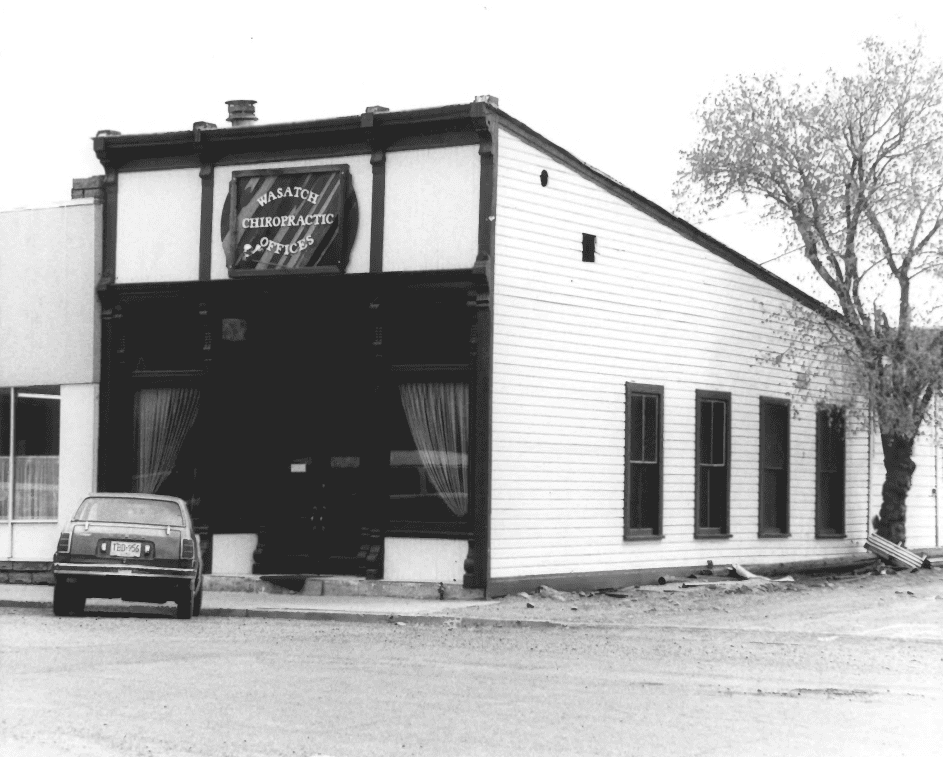
The Wave Publishing Company Building is significant because of architectural style and because of its importance in the development of communication in Wasatch County. It is also one of the oldest newspaper offices in the state of Utah, and one of a handful of unaltered wood Victorian boomtown storefronts in the state. It is one of only five commercial frame buildings now standing in Heber City. The building was the home of the local newspaper, the Wasatch Wave from 1901 until the early 1970s. Since the newspaper was ~the only way other than word of mouth to spread local news through the county, it played an important role in keeping the people informed of what was happening in the area. The paper not only provided news, but promoted changes in the community. It encouraged development of a water system, electric power plant and railroad through its editorials. The Wave continues to promote improvements in the county and to be the “voice” of Wasatch.

When the Mormons moved south during the Utah War in 1857, Brigham Young formed a company to build a road up Provo canyon to provide work to the men and to provide a route for Army supplies other than through Salt Lake City. With the new road, many people in Utah Valley who did not have land decided to move to a remote valley below the mouth of Provo River. They named the valley Provo after the river and their main community Heber City in honor of Heber C. Kimball, a Mormon leader.
Since Provo Valley was isolated from the rest of the settlements in the territory, news traveled ^slowly to the small communities of Heber, Midway, Charleston, Daniels Center Creek, and mainly had to depend on people traveling to L.D.S. Church meetings in Salt Lake, L.D.S. Church officials coming to the area or the mail system for news of the outside world. The only way for news to travel throughout the valley was through mail or word of mouth. In 1889 William Buys, a local surveyor and attorney, recognized the need for some way to spread information more efficiently throughout the valley. He decided to start a weekly newspaper. The small paper which he started has continued to operate as a weekly newspaper in Wasatch County. Although the residents can now tune into Salt Lake City radio and television stations for state, national and international news, the newspaper is still the main source of information for local events.
The first issue of the Wasatch Wave was 1889, William Buys named it the Wave because “we realize that it but a tiny ripple upon the great ocean of journalism, but we sincerely hope and trust that it may grow and gather strength as its proceeds on its perilous journey.” Buys solicited correspondence from everyone and announced he would carry articles on “general news, farming, mining, science, history, literature and series.”
Buys served as editor and publisher of the newspaper most of the time between 1889 and 1909 when he died. From 1891 to 1895 his son-in-law, George H. Barzee was the editor while Buys was ill. Co Glanville and Joseph A. Murdock had a lease to run the paper from 1895 to 1898.
From 1905 to 1909 the Wave was owned by the Wasatch Real Estate and Development Company. The development company hired Buys as the editor of the paper but he was required to work with the board of that the company appointed in setting newspaper policy.
After publisher Broadbent The first issue of the Wasatch Wave was 1889, William Buys named it the Wave because “we realize that it but a tiny ripple upon the great ocean of journalism, but we sincerely hope and trust that it may grow and gather strength as its proceeds on its perilous journey.” Buys solicited correspondence from everyone and announced he would carry articles on “general news, farming, mining, science, history, literature and series.”! Buys served as editor and publisher of the newspaper most of the time between 1889 and 1909 when he died. From 1891 to 1895 his son-in-law, George H. Barzee was the editor while Buys was ill. Co Glanville and Joseph A. Murdock had a lease to run the paper from 1895 to 1898. From 1905 to 1909 the Wave was owned by the Wasatch Real Estate and Development Company. The development company hired Buys as the editor of the paper but he was required to work with the board of that the company appointed in setting newspaper policy, the development company dissolved, William Buys became the of the paper again. He died in December 1909 and Charles of Provo was hired to replace him. Broadbent was the editor until 1939. John A. Wallis was editor from 1939 to 1942. Frank W. and James F. Mountford later took over the paper. Frank was editor in 1942 and in 1958 James joined his staff.
The Wave has carried a variety of news over the years that it has been in operation. It usually had general news stories, a serial, and a “comings and goings” section that told who had traveled during the week, who was visiting and any changes that were taking place in the community. Since the area was predominantly a Mormon community, ward announcements and stake conference minutes were included. The editorials in the Wasatch Wave helped make the citizens aware of the need for local improvements. The Wave pushed for the development of a power plant, a water system, a fire department and general civic improvements. It also was the public voice of disapproval when the Denver & Rio Grande Railroad made plans to cut the number of runs to the valley and the voice of encouragement when the Pike Peak Coast to Coast Highway decided to come through Heber.
The Wave bought this plot of land in June 1901 to build a new office. The newspaper moved into the building in September that year. In 1909 the building was enlarged and the floor was raised. The newspaper continued to use the building until the offices were moved to the old Bank Block at the corner of Main and Center. The building was vacant until 1978 when Gerald W. Klein, a chiropractor, bought it. Although he has had to alter some of the interior of the building to adapt to the needs of his equipment, he has maintained the original integrity of the exterior.