
Tags
Willow Beach Gauging Station
From instagram:
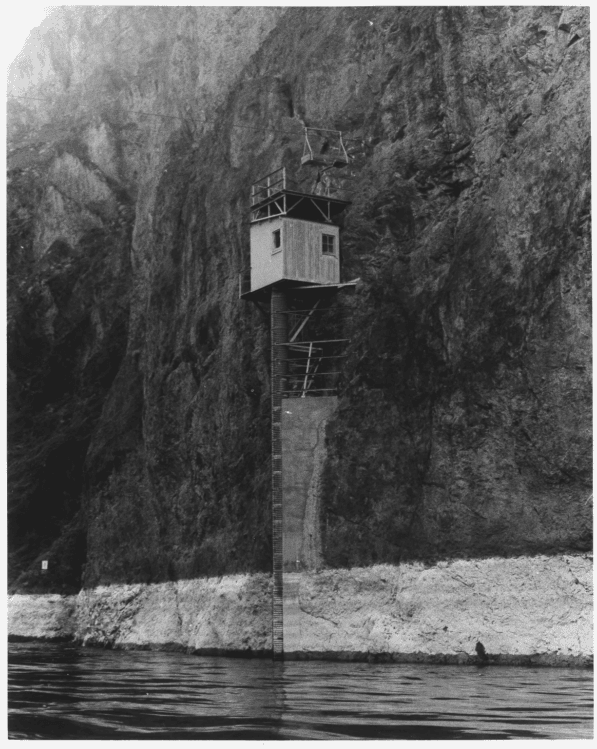
The Willow Beach Gauging Station was constructed after the completion of Hoover Dam to provide data on Colorado River flow downstream of the dam.
The gauging station was constructed on the Nevada side of the river on the vertical wall in Black Canyon.
Originally consisting of two gauging stations and a bucket tramway system for access, this historic structure provides a glimpse of the past at Lake Mead National Recreation Area.
Please enjoy viewing the gauging station from the river, but not not climb or attempt to access the structure – it is both dangerous and could damage a historic structure.
The Willow Beach Gauging Station is located in Clark County, Nevada and was added to the National Register of Historic Places (#86000587) on March 21, 1986.
From the historic register’s nomination form:
The Willow Beach Gauging Station and its ancillary structures were erected to provide data on the flow of the Colorado River downstream from Boulder Dam after its completion in 1935, As such, the Willow Beach Gauging Station is a part of a complex of facilities which relate to the history of construction and operation of a nationally significant dam erected for flood control and irrigation purposes and, secondarily, to supply hydroelectric power. The Willow Beach Gauging Station contributed in its small way to the initial years of operation of this historic dam. It is also of local significance in engineering in its own right as reflected by its construction, hanging from the precipitous, vertical wall of the Black Canyon of the Colorado River, and its difficult access by cable tramway and catwalk hung from the canyon walls.
Reconnaissance to locate the site for a gauging station below the site of the new dam whose construction was just beginning was undertaken in 1931 by District Engineer W.E. Dickinson along with J.C. Hoyt, of the U.S. Geological Survey, and O.G. Patch, of the Bureau of Reclamation. Actual construction under the supervision of J.A. Baumgartner of the U.S. Geological Survey occurred in two phases, from January to July, 1934, and November 1934 to July 1935. Once completed, resident engineers at the gauging station were W.L. Heckler and W. E. Dail. The station operated until October 1939, when it was replaced by a new station closer to the dam (.8 mile downstream)
The Willow Beach Gauging Station, its cable tramway, and its catwalk and trail approach, are located in the steeps-walled Black Canyon of the Colorado River downstream from Boulder Dam, whose operation it served by measuring the flow of the Colorado River in the canyon below the dam. Originally the gauging station consisted of two gauging stations, both on the Nevada (west) side of the Colorado River, connected by bucket tramway cars hanging from cables across the river, which met on the Arizona side a combination of trail, catwalk hung from the wall of the canyon, and a third cable tramway across a side canyon, which extended southward along the Arizona side of the river to a residence and garage for the resident engineers. The residence and garage have been demolished, leaving only the terraced hillside with stone retaining walls on which they once stood. The lower gauging station and downstream tramway across the Colorado River also are gone. The remaining structures which are deemed to possess integrity, include the upstream gauging station, the cable tramway across the river from the gauging station to the trail, the trail along the Arizona side, the deteriorated but intact catwalk along the cliff, the trail south of the catwalk, the cable tramway across the side canyon on the Arizona side, the trail south of the catwalk to the residence site, and the stone retaining walls which mark the site of the residence and garage, which were approximately one and two thirds miles, as a crow flies, upstream from Willow Beach.
The gauging station itself consists of a small, square, shed-roofed metal room hung on a vertical cliff about forty to fifty feet above the surface of the river, whose level varies according to volume of flow. Beneath it, a corrugated pipe about four feet in diameter extends vertically from its floor into the water. The lower two thirds of the pipe above the water, and presumably all below, is connected not only to the cliff by metal supports, but shielded by solid concrete which prevents the water from passing between the pipe and the cliff and tearing it out. Above this concrete diverter, the gauging station is held to the cliff only by metal supports. The metal gauging room has three small £our-lite windows* one next to the cliff on its north side, one on the north or upstream edge of the side which faces across the river, and one on the canyon wall or western edge of the side which faces downstream. On the outer edge of the south wall is a doorway, and along the entire south side of the gauging room is a porch. From that porch, a metal ladder leads upstairs to a flat platform with railing, mounted several feet above the shed roof of the gauging room. Near the canyon wall, another platform is mounted 1 story below the gauging room porch, which allows transfer from a ladder which leads down from that porch to the main ladder which is mounted near the corrugated pipe, and leads down to near the surface of the water* The gauging station may be approached either by boat and ladder from below, or by cable tramway to the platform above. The tramway consists of a flat, shallow rectangular bucket hung by steel supports at each of its four corners from a pair of pulleys, one at each end, suspended from a single cable suspended across the river. From the east (Arizona) terminus of the cable tramway, a combination of trail along the edge of the cliff, a catwalk of wooden planks laid on steel supports driven into the cliff, with a railing of metal supports and metal cable along its outer edge, more trail, another cable tramway across a side canyon similar to the one described, and more trail, leads southward a distance slightly more than a mile to the site of the residence and garage, marked today only by concrete foundations and rubble retaining walls. The cable of a second tramway across the river to the second gauging facility (now gone), is still in place.