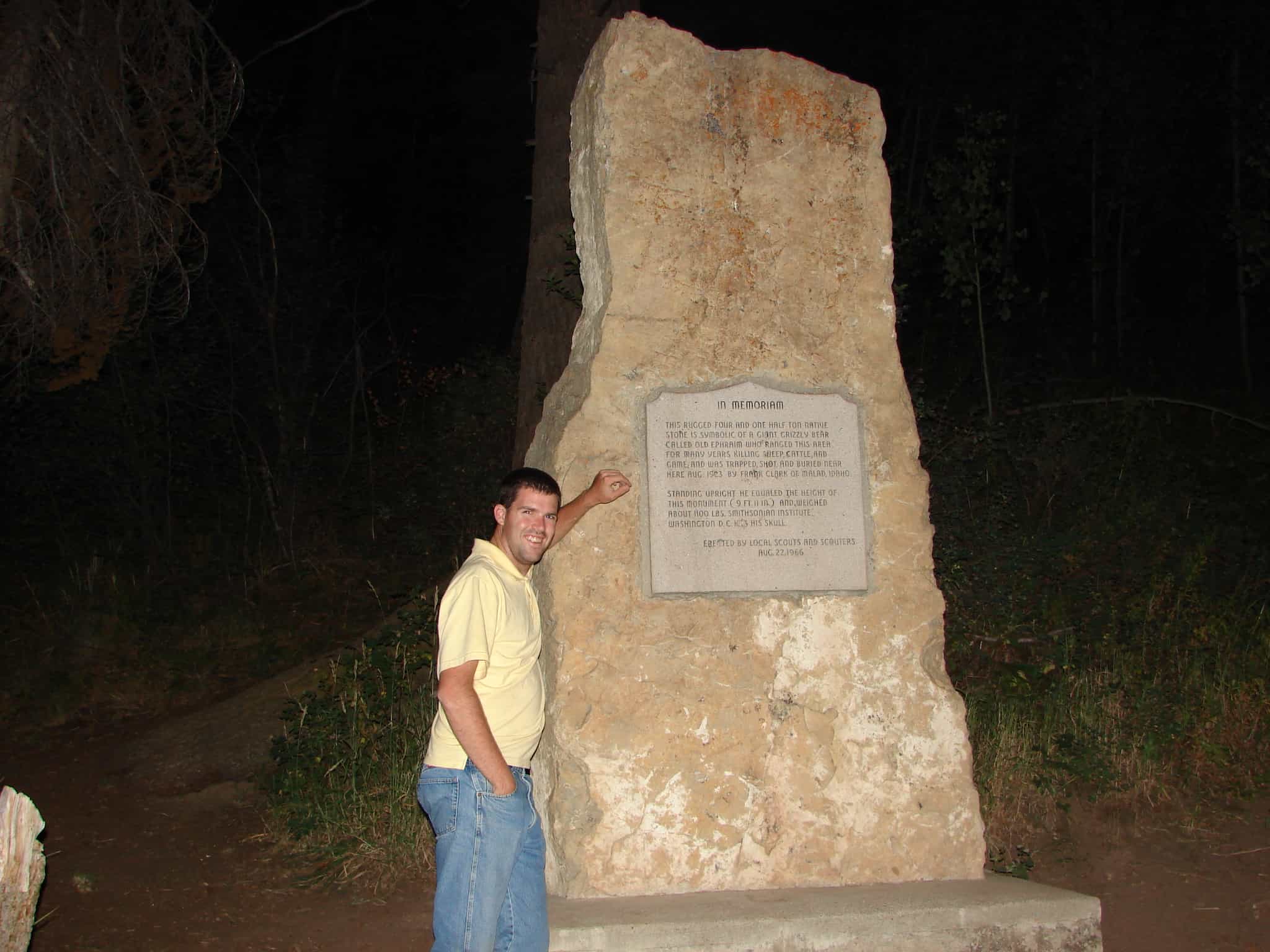
The Grave of a Giant Bear, the stone monument over the grave is as tall as he was ( 9 feet 11 inches ), he weighed 1,100 lbs.
In Memoriam
This rugged four and one half ton native stone is symbolic of a giant grizzly bear called Old Ephraim who ranged this area for many years killing sheep, cattle and game and was trapped, shot, and buried near here Aug. 1923 by Frank Clark of Malad, Idaho.
Standing upright he equaled the height of this monument (9 ft. 11 in.) and weighed about 1,100 lbs. Smithsonian Institute Washington D. C. has his skull.
Thomas E. Ricks arrived in Cache Valley with his family In 1859. Between chores such as building a school and a cabin for his family, he explored Logan Canyon In search of timber. During one trek he discovered this spring which was later named for him.
Frontier communities required large quantities of lumber to build churches, businesses, homes, and fences. In 186. Thomas Ricks and other town leaders proposed building a road in Logan Canyon to that timber could be hauled to the valley. As timber supplies close to Login were exhausted, the road was pushed further up the canyon. Brigham Young, President of the Church of Jesus Christ of Latter Day Saints (Mormons), recommended in 1889 that the road be completed to Bear Lake Valley Thomas Ricks and other volunteers accepted the challenge and completed the first twenty-five miles to what is now known as Ricks Spring before winter.
For many years. Ricks Spring was believed to be pure mountain spring water. Visitors drank from the spring and filled jugs with water to take home that is until they became sick. In 1972, an ice jam on Logan River provided the answer to the origins of Ricks Spring.
Ricks Spring usually slows to a trickle in November, and begins to flow again in April as the snow melts. In 1972, however, a severe blizzard caused an ice flow to dam Logan River. Suddenly, Ricks Spring began to flow in January. When the ice jam cleared, the flow slowed. Later, bitter cold weather caused another ice jam on Logan River and the flow of Ricks Spring increased once again. Scientists placed green dye in Logan River and the dye appeared in Ricks Spring indicating that they are directly connected by an underground fracture in the rock.
This spring has always been a “childhood memory” of mine, my dad stopped here once and told us about how he came here when he was younger.