
Tags
Huntington Roller Mill and Miller’s House
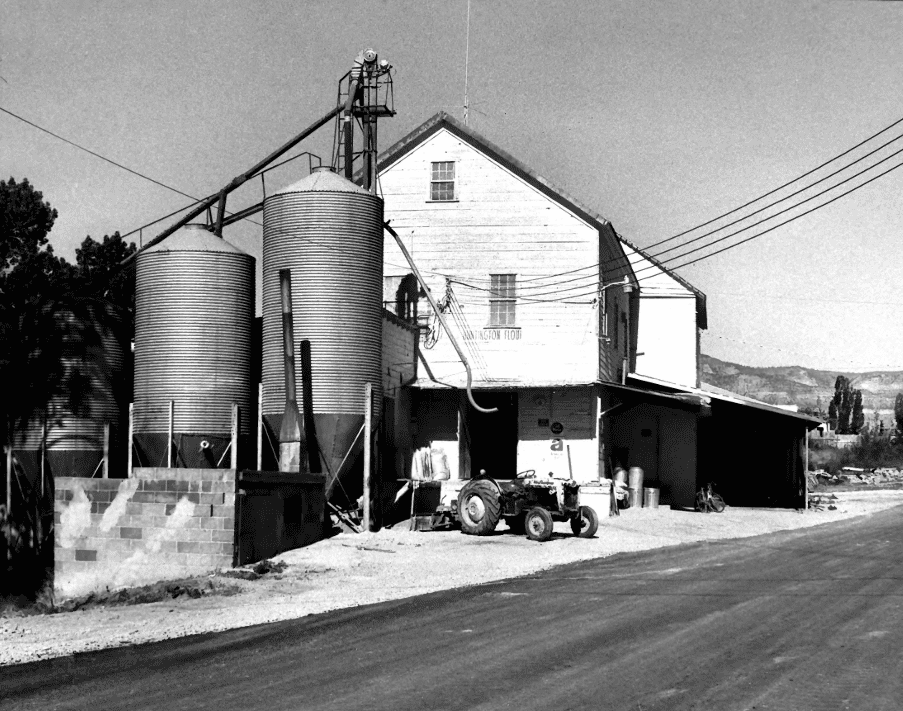
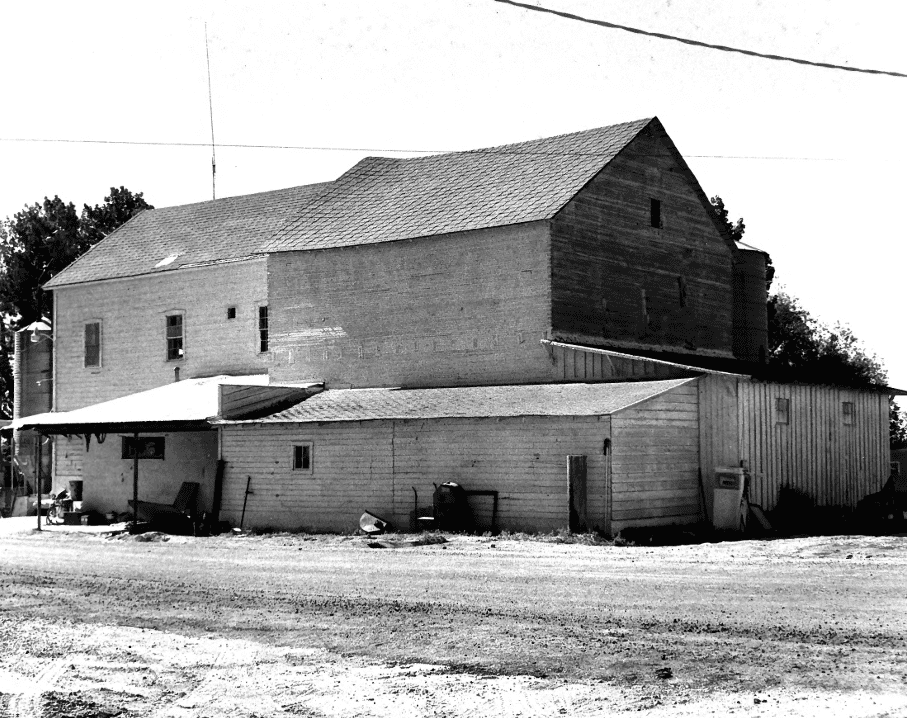
The significance of the Huntington Flour Mill comes from its continual operation since 1896. It has always been an integral part of the community and entire surrounding area, providing flour and feed for generations fo farmers and townspeople from all over Carbon and Emery counties.
The Huntington Roller Mill and Manufacturing Company was organized in 1893 and officially incorporated on January 7, 1895, with officers and directors gleaned from Huntington’s leading citizenry. Three and seven-eights acres of land was deeded to the company by George A. and Olive M. Humble on April 24, 1893, and another five aco?es by Charles and Ann Pulsipher on January 24, 1895. According to J. Albert Jones’ history of Huntington, “The mill was built on a site about a quarter of a mile west of the northwest corner of the townsite at the foot of a small hill . . . The two former bishop’s (sic) Bishop Elias Cox and Bishop (sic) Charles Pulsipher set up their sawmill between the roller mill and the hill and presumably sawed the lumber used in construction of the flour mill, as well as sawing lumber for the corrmunity . . . The logs for sawing were hauled from the Canyon with teams and wagons. “
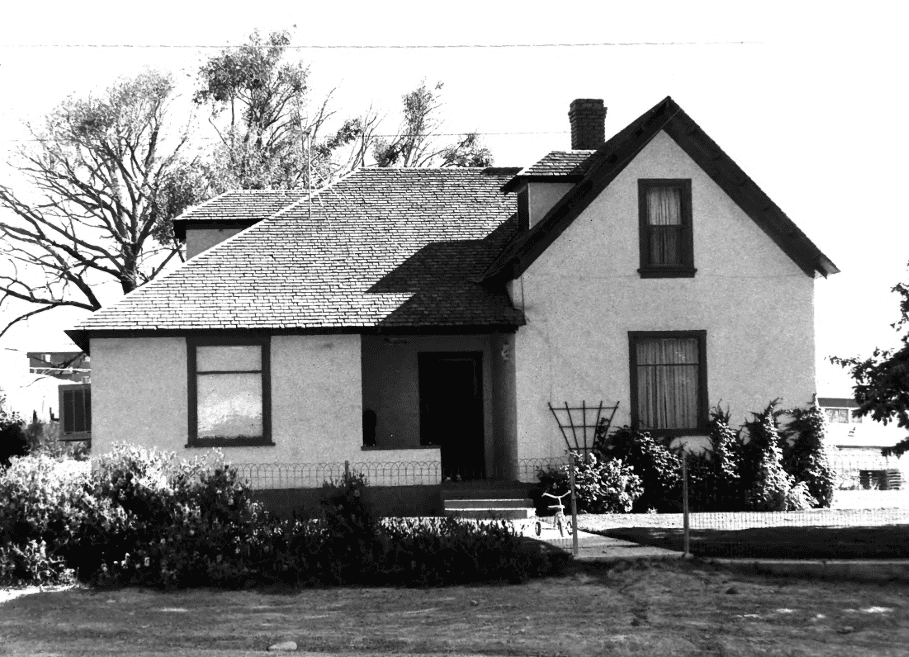
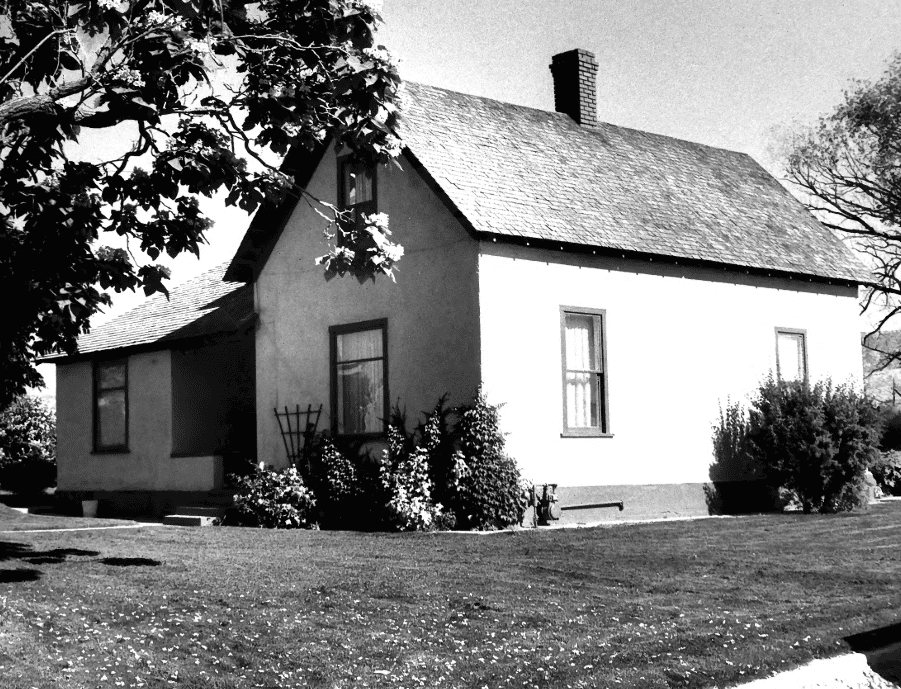
The Huntington Roller Mill and Miller’s House is located at 595 West 400 North in Huntington, Utah and was added to the National Register of Historic Places (#79002495) on September 27, 1979.
The main carpenters to work on the mill were: Oliver J. Harmon, William Hunter, William Marshall, Peter Johnson, James P. Johnson, Charles Jensen and George W. Hales. Some of these men were also shareholders in the corporation.
The mill was first powered by a steam engine from the nearby sawmill, but that proved unsatisfactory. A flume and penstock were then built from the town ditch a few yards to the south to divert the water to a wheelhouse on the south side of the mill. Inside the wheelhouse was a Pelton metal undershot wheel which was used to generate power when water flowed through the flume. The wheel, 8 feet in diameter, was set 6 feet into the ground to increase the force of the water flowing under it. In the fall, when most of the grinding was done, the ditch would become clogged with leaves, diminishing the water power. In the winter it froze up, halting work for the season.
The company then tried using a larger, rope-driven steam engine, but were forced to return to water power. When miller Olaf William Sandberg arrived in 1917, he realized that the only solution was to install electricity. As his son, Willard Sandberg, describes it: ” . . .he went to Utah Power and Light. And I think he had to pay $2,500 to have them put a line up there; it was about two blocks. And he had to sign a guarantee of so much power usage a year. He had to buy the wiring, and he had to buy the transformers . . . ” After that he could mill all fall and winter. The Pelton wheel was buried where it stood.
Up until 1925 when the mill was officially sold to Olof Sandberg, it was run by a corporation known as the Huntington Roller Mill and Manufacturing Company. Its first president was Christopher Wilcock, who seemed well-suited to the job as he had previously been half-owner of a shingle mill. He was one of the prime organizers of the company, and actively encourage others to join. The corporation then hired several millers to run the mill. First they lured Ludrick Miller from Sanpete County, them Lewis Marshall, Lewis W. Johnson and Isaac Black,
But the mill was not a very profitable venture under their direction. Olof William Sandberg took over as miller in 1917. He had worked in a series of mills since age 14 and, according to the Sandberg family history:
This venture, from the beginning was the hardest of all that the couple had to face. They paid $5,000 for the mill plus another $3,000 for a lawsuit brought about because of a mortgage which was not known to have existed at the time of the purchase. Besides this, Olof found that it was a corporation that owned the mill and he had to pay off each sotckholder to become sole owner of the mill, Olof paid off the stockholders. Along with the disappoint- ment and strain of the legal trouble, they found the water power for running the mill was worthless and the machinery was badly in need of repair . . . Before they took over the mill, people used to come to get flour in a bread pan for a batch of bread.
A lot of flour was lost during the milling process because it squeezed out of the joints of the flour spouts. These were held together with nails, which worked loose with the vibration of grinding. Sandberg replaced them with screws, installed electric power, built on an addition at the rear of the mill and set about upgrading its operation.
It didn’t (sic) take long for Olof to find out that he had settled in the poorest milling wheat district that he had ever been in. He called it a “two crop” wheat because it was planted in the spring and only part would come up. Then after more irrigation some more of it would come up, making the harvest wheat of inferior quality. He had two carloads of hard wheat hauled into the mill where he gave it to the farmers for seed wheat to be planted in the fall, This wheat came up free of weeds and the harvest yield was a good quality of wheat. During the harvest season, the mill was running all day and far into the night. It wasn’t long until the mill had built up such a good reputation throughout the area that Olof had almost more work than he could handle and many times during the harvest season, wagons were lined up from the mill to Geary’s corner waiting to be taken care of by the mill.
These wagons came from all over Carbon and Emery counties, the area traditionally served by the mill. In January of 1895, Spring Glen pioneer Teancum Pratt mentions going to mill graham wheat at the HuntLngton roller mill.H Non-Mormon :inmigrants also began to require the mill’s services. A son of Italian immigrants describes how in the early 1900’s his family took a wagon and team to the Huntington Mill twice a year, spending up to fice days for each trip. They got flour for bread and took the bran and “shorts” as feed for their pigs. 12 The people from out of town had to camp out by the mill while their grain was ground until Olof William Sandberg started the system of “exchange work.’ Willard, Olof’s son explains:
For every bushel of wheat, in return the farmer would get 30 pounds of flour, 14 pounds of bran. What was left over in my dad’s day, that was what profit he made on it. I didn’t do it in my day, in my time. They brought their wheat in there on deposit and they came and got what they wanted. Cash, flour, feed, or anything they wanted. Feed was on a cash basis and flour, I did do a little exchange on that but I gave them 28 pounds of flour on a bushel of wheat. When I first started it was 36, then it went to thirty, and finally to 28, They never said anything about it either, when I dropped( it. Well, I told them this way. I had these ingredients I had put in it, cost money, and I shipped in wheat to improve the quality, so I never had any trouble in that respect.
Willard Sandberg, who was deeded the mill by his father in 1953, became a miller because of the Depression, He learned something of the business as a young boy, helping to sack flour and sew the sacks in his father’s mill. After high school he left Huntington and eventually wound up in New York, where he worked in a bank for eight years. Then the Depression hit. “The bank I was working at had 7,500 employees and let 2,500 go at one crack … My father needed somebody to help, so I started in the mill and I kind of modernized it a little bit , . « Instead of making one straight grade type of flour, I made three grades. And I put in an electric sewer for the bags.” In order to make three grades of flour he needed hard wheat in addition to the soft wheat his father introduced. So Willard Sandberg introduced hard wheat to Emery County in the middle 30 ( s and got the farmers to raise it, However, the locally grown wheat couldn’t meet the demand for flour, so wheat was shipped in from northern Utah and Idaho, Truckers would haul wheat to the mill and haul coal from Carbon County back home. Willard Sandberg also coined the name, “Castle Valley’s Best” for the flour, added a pellet mill in 1961 to produce livestock feed, and started enriching the flour as decreed by law in 1942 or 1944. He started a regular weekly delivery service to retail stores in Carbon and Emery counties, one in Sevier County, and went once a month to Fruita and Moab. The once-weekly trip through Emery County used to dispose of 3,000 to 4,000 pounds of flour. Now the demand for flour has dropped off sharply, except in Carbon County. “Carbon County, I believe, bakes as much now as they did years ago. The Italians and Greeks . . . They wouldn’t take this Wonder bread, take a bite of it and wonder what you got in your mouth.”
The mill is continuing to diversify under the new miller, L. Jay Powell, who has been running it for about seven years. He and his younger son work together at the mill and will have title to it on January 1, 1982. They plan to:ocontinue operating and improving it into the foreseeable future.
Not only has the mill expanded its products over the years, it has also expanded its connections with the rest of the world. Willard Sandberg served two terms as president of District 12 of the Association of Operating Millers, which is comprised of the entire state of Utah. TSis is an American-based international association which holds annual meetings in various cities around the U.S.A. (last May they met in Salt Lake City). Millers come from as far away as the Middle East, South America, Asia, and Europe. They discuss common problems, and manufacturers of milling equipment display their wares. The international nature of the organization is essential, as all interior milling machinery is now made outside U.S.A., primarily in Germany, Switerzerland, Italy, France and England.
The Huntington Flour Mill is becoming something of a rarity in this country. As Willard Sandberg explains, “In 1920 there was (sic) around 10,000 flour mills in the United States . . . There’s less than 250 now . . , Small ones are gone and the big ones have gotten larger. The largest mill in the country is in Buffalo. It makes enough flour in 24 hours for a loaf of bread for everbpdy in the United States.” As a small working mill with a fascinating past and a viable future, the Huntington Flour Mill should be preserved.
Directly to the north of the Huntington Roller mill is the Miller’s home. It was built around 1910 as a residence for the miller, and has always been sold with the mill. The house and land were sold separately from the mill parcel for the first time in 1974; however, the current miller, L. Jay Powell, bought it. (He is presently buying the mill as well.) Jay’s oldest son, Kimball Powell, lives in the house with his family and up until December 1, 1978, he also worked in the mill. One can therefore sya that the miller’s home has always been and continues to be associated with the mill.