
Tags
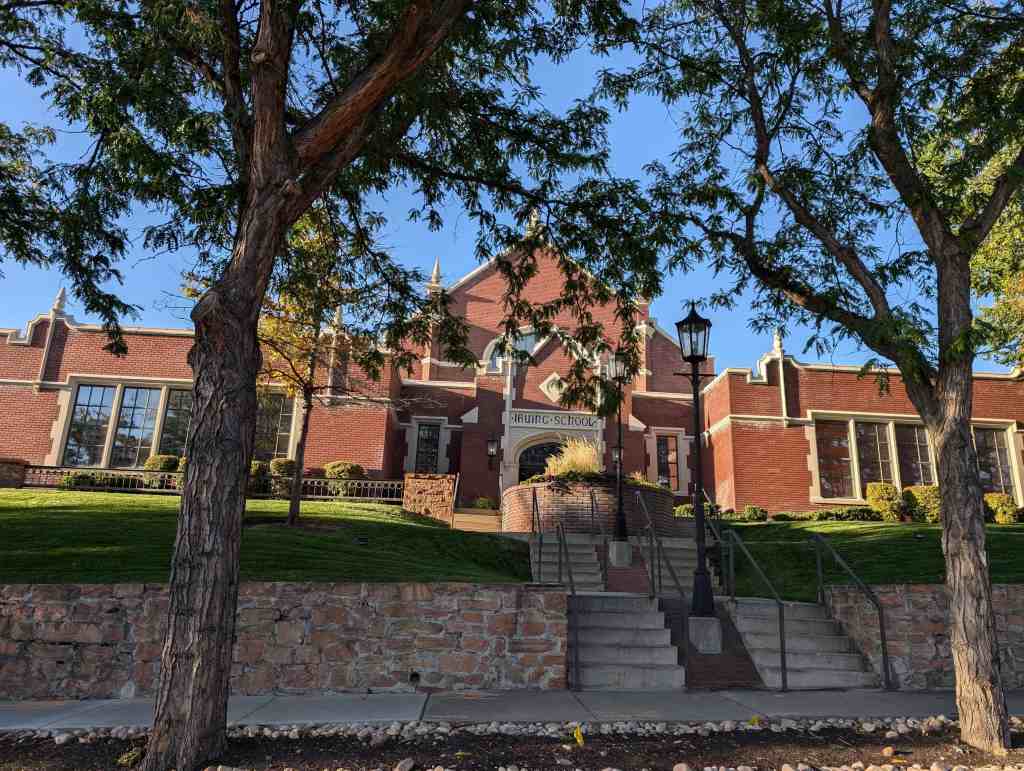
Irving Junior High School
The community of Sugarhouse in Salt Lake City, Utah, was settled in the spring of 1848 and is considered among the first ten of Mormon settlements in the Great Basin. Located about six miles southeast of the center of Salt Lake City, the colony was organized for the purpose of building a sugar factory to process locally grown beets into refined sugar. Excellent molasses was produced but numerous attempts to manufacture table sugar at this location failed. Nevertheless, the settlement established a firm agricultural and commercial economy and survived after the sugar factory failed. Physical evidence of the early colony such as the Sugar House and the Mormon meetinghouse and school have been replaced by newer structures in recent decades. One of the oldest surviving public building of note in Sugarhouse is the Irving School.
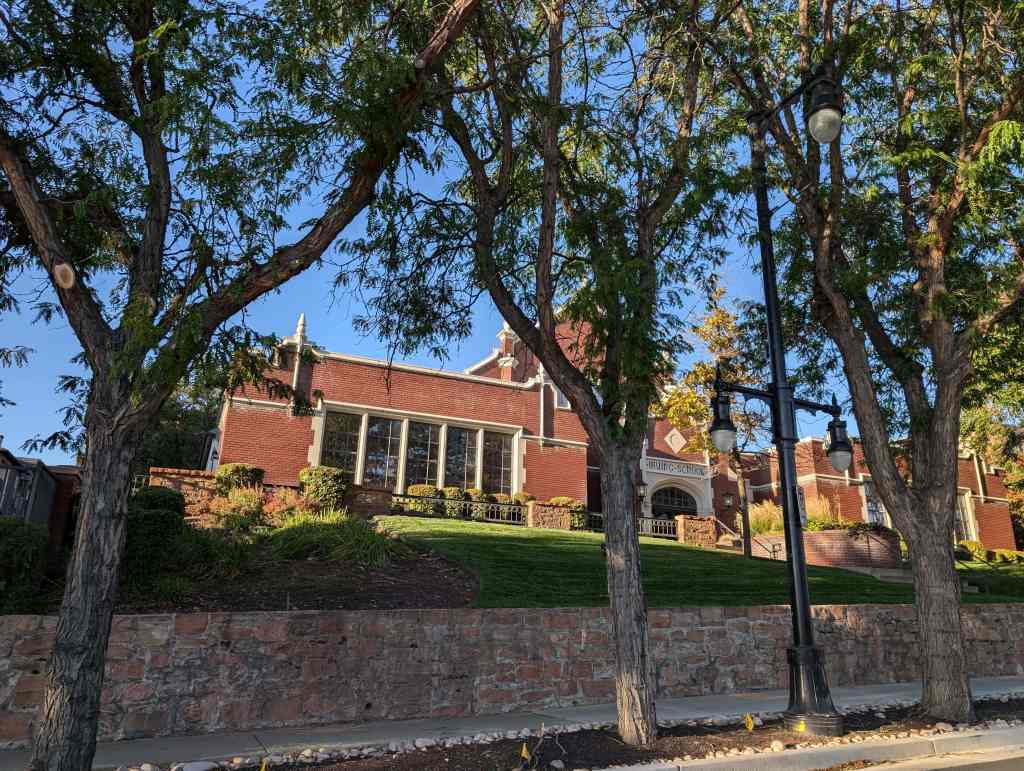
Located on an elevated site along the north side of 21st South Street (the main east-west axis of the community), Irving School overlooks the area’s commercial and residential districts. The school’s terraced site, with sandstone retaining walls, is a major historical focal point in Sugarhouse. Since its opening in 1916, Irving School has serviced the educational needs of the neighborhood’s middle-school or junior high school children.
Irving School is one of the best and earliest examples of the Jacobethan Revival Style in Utah. Utah’s earliest significant example of the style is Converse Hall (National Register) built in 1906 as the main administrative building for Westminster College. Irving School, built in three idealistically styled sections in 1916, 1926, and 1930 is characteristic of the Jacobethan Revival in many of its design elements. Particularly significant features include the steeply pitched gables, Elizabethan windows of various types with cast stone frames and mullions, and decorative cast stone copings, pinnacles, string courses, quoins, labeled arches, and inscription plaques. The cast stone ornamentation is itself significant for being among the earliest examples of that type of material in that region.
The interior of Irving School, while conventional in plan, features interesting exposed trusses, a proscenium stage, molded wooden trim, Tudor-arched bays, and light fixtures which carry the Jacobethan theme throughout the building.
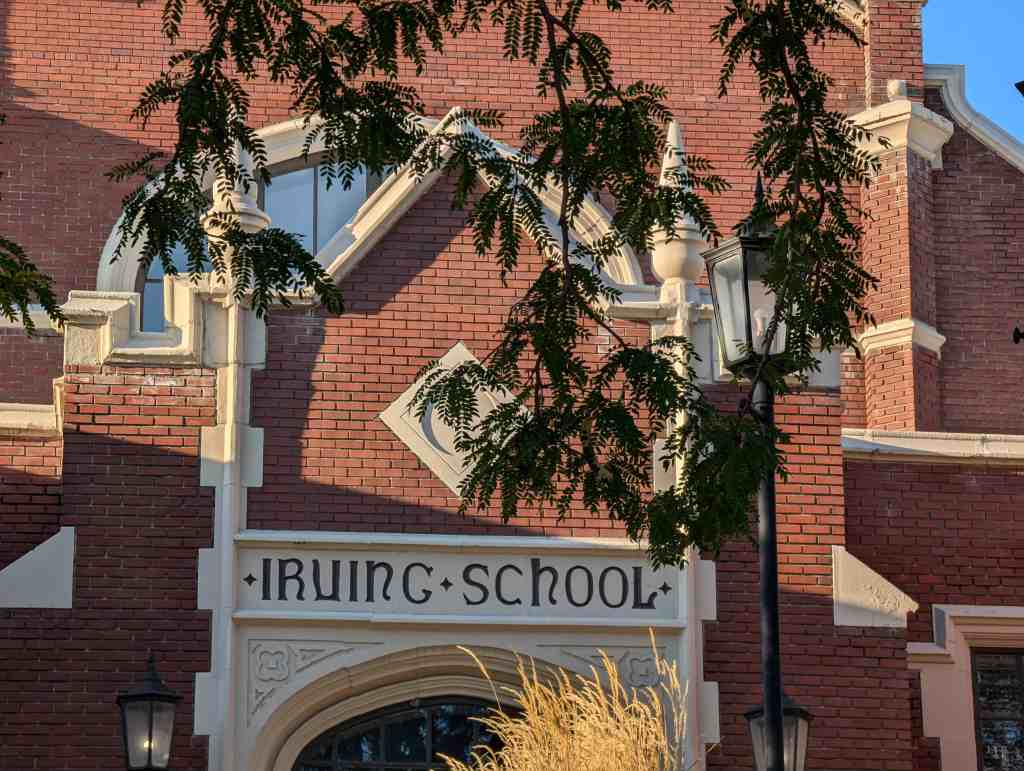
Located at 1179 East 2100 South in the Sugar House Neighborhood of Salt Lake City, Utah and added to the National Historic Register (#78002674) December 22, 1978. The text on this page is from the nomination form for the national register.
The primary architects of the Irving School were Charles S. McDonald and Raymond J. Ashton. McDonald’s practice, which spanned the period from 1909 through 1918 was cut short by his untimely death at age 39. During his career, McDonald was associated with architect Frederick A. Hale and later became a partner in the firm of McDonald and Cooper with Walter J. Cooper. Although he designed homes, theaters, and commercial buildings, McDonald’s major commissions were school buildings for the Salt Lake City, Board of Education. Besides Irving School, McDonald designed two other 26-room schools in Salt Lake City in 1916.
Following McDonald’s death, architectural work on Irving School was done by Raymond J. Ashton. Early in his career Ashton was associated with a prominent local building contracting firm known as the Ashton Brothers. R. J. Ashton became a draftsman for the firm which led to his becoming an architect, a profession which he engaged in for over 40 years. Primarily known for designing many of the area’s older church buildings, Ashton was quite sensitive to historical architecture. He chose to carry on McDonald’s Jacobethan Revival theme as he made additions to the pre-existing school. The final result, despite having been built in several stages, displays a cohesive, well-integrated design.
Irving School is a load-bearing brick wall structure which varies from one to three stories in height. Set back on a terraced prominence overlooking the Sugarhouse area of Salt Lake City, Utah, the school is impressively situated amongst mature Evergreen shrubbery. With wood floors and trusses and a Jacobethan Revival façade and interior, the building is somewhat anachronistic considering some of the more contemporary architectural and engineering trends which were developing in 1916, the year the first section of the school was constructed. The reaction against academic formalism as well as the austere, geometric rigidity of styles such as the Prairie Style was considered legitimate at the time, however, and resulted in Irving School’s fanciful dark red brick and light east stone appearance. Basically H-shaped in plan, the building was built in several stages over a twelve-year period. Typically, the school contains classrooms flanking central halls, an auditorium, gymnasium, shop and music rooms and other special-use spaces, kitchen and cafeteria, offices and other rooms related to the building’s original school functions. Much of the school’s interior appointments are intact including wood trim and doors, columns, exposed trusses, decorative plaster trim, stairways, theater seats, radiators, and fountains.
On the exterior, Irving School displays dark red brick in the field of its walls, with decorative cast stone trim in a light color as contrast. Door and window bays are of various shapes and sizes and include Tudor-arched bays and various rectangular, flat-arched bays. All bays, as well as the cornice copings on the gables and parapets, are of cast stone. Cast stone is also used in a plastic way to give form to pinnacles, splayed entry casings, label arches, string courses, quoins, stepped buttress caps and various panels and plaques. This ornamental trim, together with the variety of massing and form inherent in the building, give it a quality of considerable visual interest.
Pingback: 224 E Street | JacobBarlow.com