
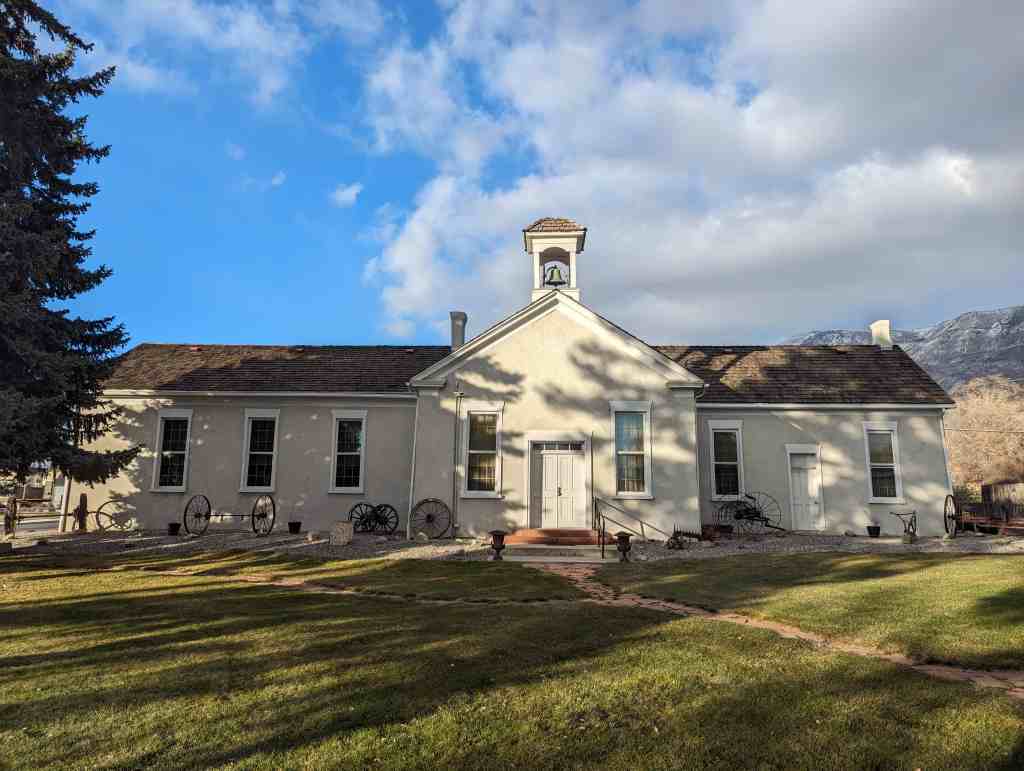
Pleasant Grove School / “Old Bell School”
The Pleasant Grove School House, known locally as the “Old Bell School”, is significant as the oldest remaining school building in Pleasant Grove and as one of the oldest remaining pioneer school buildings in Utah. The building is significant in that it was constructed of adobe including adobe made in 1852 and used in the original Pleasant Grove school house.
The school is located at 55 South 100 East in Pioneer Park in Pleasant Grove, Utah and was added to the National Register of Historic Places (#80003978) February 20, 1980. The text on this page is from the nomination form for the register.
The building is significant as a long time community center for Pleasant Grove. It was used for school, church, theatrical performances, dances, banquets, and other social activities. Since 1945 the building has been the object of community preservation efforts spearheaded by the local organization of the Daughters of Utah Pioneers.
Pleasant Grove, one of the first Mormon communities in Utah Valley, was settled in September 1850. In 1852 the first school house was built of locally made adobe. However, when settlers were instructed to move into the fort that year because of the threat of Indian hostilities, the school was torn down. The adobe and lumber, however, was saved and reused in the second school house built in 1853 on the fort site. In 1860, the second school burned and school was held in private homes.
The third school, the Old Bell School, was constructed in 1861 from adobes and in the two previous schools. Henry Greenhalgh, a native of England, was the architect. He designed the arched ceiling which made for good acoustics for the entertainments held in the building. William H. Adams, Sr. was the mason who laid the adobes and William Paul did most of the carpentry work.
The building was used as a community center with a small stage at the east end, across which curtains hung for entertainments and dramatics. Outside a bowery was built adjoining the south wall for outside celebrations. Neither the stage nor the bowery remain.
By 1871 the school population had increased, making the building overcrowded. It was necessary to hold some classes in City Hall, and some in private homes.
In 1880 the second room (middle) was added to the school house. It was arranged with a stage in the new addition, with sliding doors between and seats in the west room. Knud Swenson, a school trustee, was overseer of the construction. William H. Adams, assisted by his son, John H. Adams, laid the adobes. The formal opening was December 3, 1880.
The primer, first, second, third, and fourth readers were taught in the school.
About 1886-7 a third room was built on the east side of the building. J. L. Harvey, a trustee, was supervisor of the building. Olaf Monson was the mason.
The building was used as a school house until 1893, when the expanding population required a new building to be constructed on a different site.
In 1910 the school house was re-opened and used as a high school until 1912. After this it was used as a library until 1940 when the library moved into the new civic center.
In 1945-46 the building was repaired and redecorated. It was dedicated as a permanent relic hall and center of the Memorial Park Site on September 13, 1946, and is now called Pioneer Museum.
The Daughters of Utah Pioneers Museum is located in the west wing or original 1861 school. The two other rooms are used as city shops. However, plans are to renovate the entire building and expand the museum into the middle and east section.
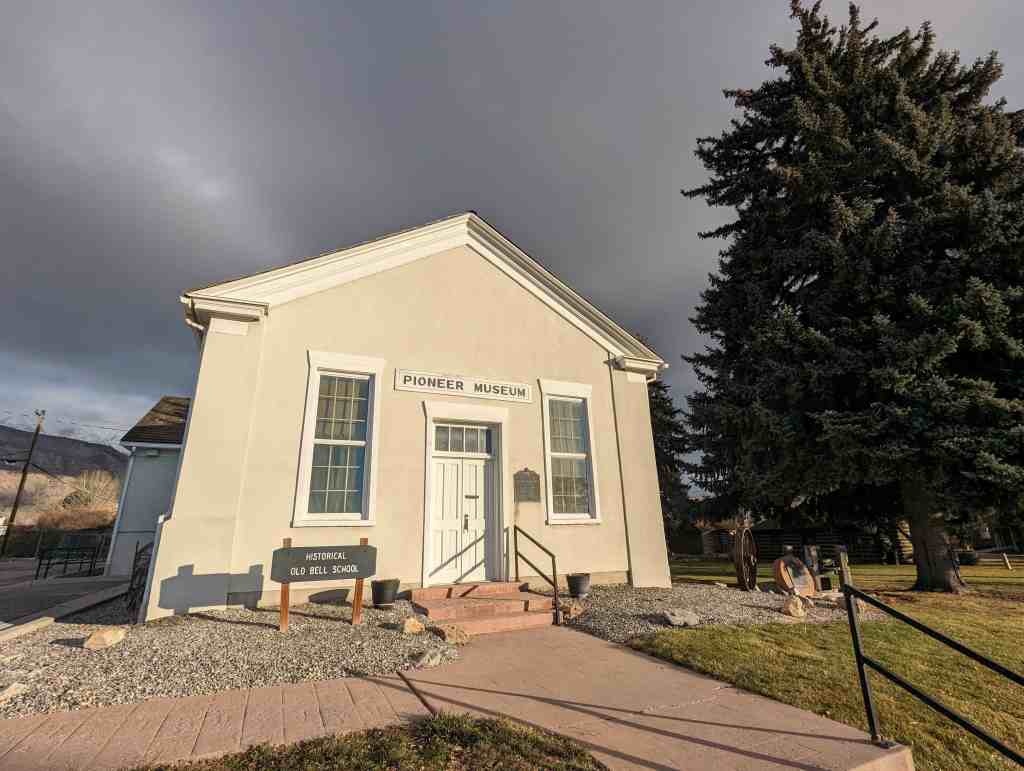
The Pleasant Grove School House is a one-storey building in a rectangular plan. There are two wings, on the east and west sides, and entrances on the west and south sides, with only the west entrance being used.
The exterior wall is made of two thicknesses of adobe brick, covered over with whitewashed stucco. The bond appears to be regular, stretcher – stretcher. There is no wall design or detail.
The roof shape is centre gable and is made of wooden shingles. The chimney locations, side to side, are centre; front to back is centre and rear. They are made of brick and have a single stack unit. The cornice is boxed and plain, with a plain frieze.
The roof trim and eaves material is wood. The raking-type of the roof trim is a plain, boxed cornice, with a return and frieze. The raking material is wood. The only unique roof feature is a bell tower.
The main window structural shapes are flat and identical throughout the building. The surround-head is a plain, wooden lintel. The surround-sills are lugsills, made of cut stone. The main windows have 2-sash divisions with a double hung slide. The upper and lower sashes have nine panels each.
The main door location is centre door in a gable façade. The structural opening shape is flat. Its surround-head is a plain, wooden lintel. There are no surround-sides. The main door architrave is plain, with no embrasure. The door is plain, with a recessed panel and a three-paneled window. It has a stationary sidelight with a window.
The main stairs are ground floor and plain.
This building has a rubble stone foundation, and the building’s water table is the same height as the foundation. The interior of the building consists of three rooms, side to side, with only the west room (the main and original one) restored and open to the public. The other two rooms are used for storage.
The interior walls are covered with lime plaster. The floor is made of wooden planks, with an infillling of sand to deaden sounds. It is possibly built in two layers, with an intermediate layer of sand. Another possibility is that the whole foundation is filled with sand, wooden planks being laid on top of that.
The ceiling, probably the most important structural and historical feature of the building, is arched. Unavailable for inspection, it is most likely a curved wooden trussing system, and appears quite similar to the roof structure of the Mormon Tabernacle. It was possibly built in the same manner. It gives the building good acoustical qualities.
Physical Appearance – Original
The school house originally consisted of only the west wing and one room in that wing. The roof was a medium gable shape, as it is at present, and the chimney was at the east end. The main door was on the west side.
The exterior walls were exposed adobe brick, being covered with stucco in 1946. Other than this, the building is the same in appearance now as it was originally.