
Tags
Topolovec Farmstead
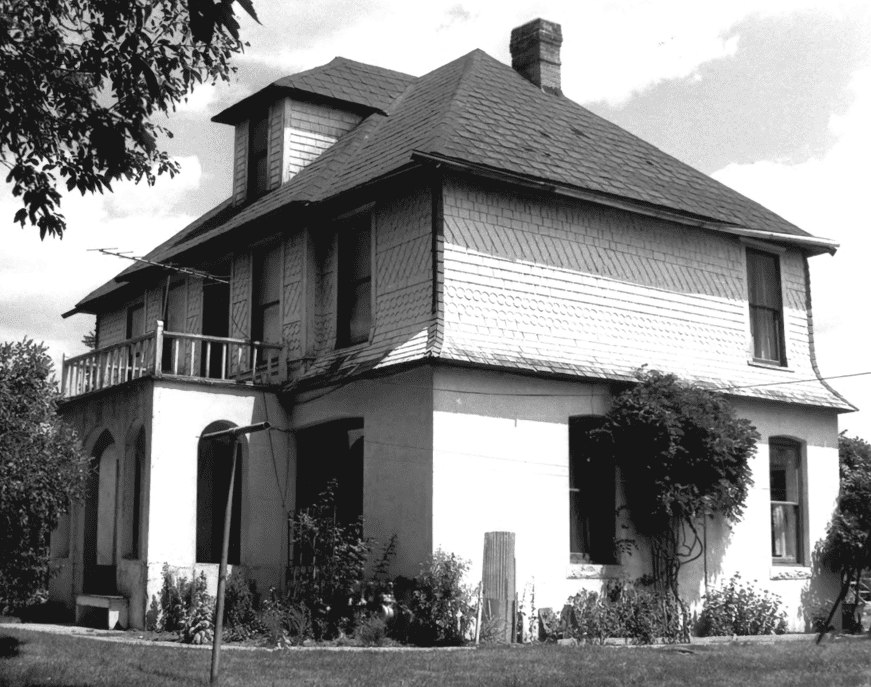
The Topolovec Farmstead, originally built in 1913 and enlarged in 1925, is primarily significant for its local association with the early twentieth religion science sculpture social/ humanitarian theater . . transportation other (specify) century immigrant cultural experience in the Carbon County coal mining region of southeastern Utah. Purchased by August Topolovec, a Slovenian miner, in 1922, the large two-story residence represents both a symbol of immigrant success and an architecturally unique dwelling in the community of Spring Glen. The house served as one of two main social centers for South Slav activity in this multi-ethnic community. Combined with the Millarich Hall (MR), the Topolovec Farmstead figured prominently in the cultural life of the Slavs, as Topolovec served as the treasurer for the local lodge of the Western Slavonic Association. This insurance/mutual aid society eased the transition of the Slavic immigrant into the rigors and demands of an industrial society; and as treasurer, Topolovec held a responsibility in accounting for the funds used by the immigrants for insurance, medical benefits, and to provide for the descent burial of their people. Topolovec’s buying of the farm also symbolized the evolution of immigrant intent from that of a temporary status in the United States to one of permanence. The purchase of a substantial home sustained this commitment to stay, and further acted as an outward sign of security and success. In addition, the house is also significant because it represents the new wealth injected into the area after the arrival of the railroad and the creation of the nearby town of Helper as a main division point in the 1890s. The residence was constructed in 1913 by Frank Jerome, an entrepreneur from Helper, who had the resources to build this unusually extravagent house in a community of camp houses and bungalows — a house that would later serve the changing needs of the Spring Glen community.
The Topolovec Farmstead is located at 4323 North 2000 West (Main Street) in Spring Glen, Utah, it was added to the National Register of Historic Places (#82004117) on August 9, 1982.
The history of Spring Glen (Ewell), Utah can be divided into three stages. The first settlers of the area were Mormon pioneers whose initial concern was to bring water to the land and to provide the necessities of life for the community. The first owner of the property on which the Topolovec farm stands was Heber John Stowell, the first Mormon bishop of Spring Glen (ordained in 1889). He arrived in the region in May 1886, helped to organize the Spring Glen Canal Company in December of that year, settled down on this land, and finally patented it in 1894. With the help of his neighbors he dug the first ditch, started in 1887 and completed seven years later. The Stowell ditch is still in use and waters the property of the Topolovec farm and others in the immediate vicinity. During this initial period of settlement, agriculture was the main form of local subsistence.
The second stage in the growth of Spring Glen was linked to the development of the Denver & Rio Grande Railroad, and the growth of Helper, a railroad town two miles to the north. During the late nineteenth century rail expansion occurred throughout the western United States, and the D&RG was completed through this area in 1883. In 1890 Helper was designated as a division point on the railroad’s main line, between Grand Junction, Colorado, and Salt Lake City. Here “helper” engines were coupled onto trains to power them over the steep grade and summit (Soldier Summit) to Salt Lake City. Without these helper engines the commerce of the entire Intermountain West would have suffered. The creation of Helper as a main terminal encouraged settlement into the area, especially those involved in the service industries. The railroad had opened-up the vast coal deposits of southeastern Utah, and with this industry came professionals, merchants, immigrants, and laborers.
Frank Jerome entered the region at the turn of the century. The Jeromes had migrated from Kansas or Nebraska, and arrived in the Spring Glen area where Mr. Jerome entered into the Saloon business, opening one saloon in Helper and reportedly another in Spring Glen. Both concerns were in partnership with other individuals. Thus, he represented the rising merchant class of the area. In 1913 he erected the present structure in Spring Glen, probably due to the existence of large tracts of land in that community. Jerome furnished it with some of the finest furniture then available, including a desk, full-length mirror and stand, brass bed, and other items which still remain in the house.
The house represents the largest and most architecturally unique residence in Spring Glen. A majority of the other dwellings are of the rectangular pyramid-roofed type (four rooms) or bungalows, and lack the scale, ornamentation, and design present in this structure. After 1906, when independent coal producers broke the monopoly of the D&RG’s Utah Fuel Company, new coal camps emerged. With this development came a transition of Spring Glen and surrounding towns where coal miners, railroad section hands, and merchants came to settle. The Jerome residence stood in stark contrast to the camp-type houses of Spring Glen.
Oral testimony places Jerome as one of the wealthiest men in Spring Glen. His first wife, Ella, bore him one living son before she died in 1918,, For reasons unknown he left Spring Glen and sold the land to the present owner, August Topolovec, in 1922. It is reported that Jerome probably moved to Helper where he still remained a Justice of the Peace for Spring Glen from 1922 until 1928.
The third and final stage of growth in Spring Glen was due to the influx of immigrants. The United States as a whole had experienced an increase in immigration beginning in the late 1840s. It continued and increased, with the influx of southern and eastern Europeans, until nativism (anti-foreign sentiment) led to the immigration restriction legislation of the early 1920s. By then, most of the immigrants had come to Carbon County with the result that the area is the most ethnically diverse in Utah. These peoples were drawn to the county by labor opportunities in the coal mines and for the railroads. August Topolovec, the present owner of the farmstead, was part of this movement to the “New World.” An immigrant who had mined coal for seven years in his native Yugoslavia, he came to the United States in 1910. 6 had worked in several mines in Utah and Colorado, exhibiting the He characteristic fluidity in geographical mobility evident among many of these immigrants. He was at Standardville, Carbon County, when the nation-wide coal strike erupted in 1922. During the strike August Topolovec bought the farm from the Jeromes, probably to provide some security in the face of the instability of the coal mines. In addition, the purchase of a house, especially one of this scale, represented a mark of economic success, as well as the fulfillment of a dream not easily attained in Topolovec’s native land. In fact, in order to make faster payments on the property, the Topolovecs rented the house for the first year, but after the renter was forced to leave the family immediately took up residence in the house and have lived there since that time.
During Topolovec ownership of the residence and land two important factors emerged that illustrated the farmstead’s importance to community development. First, the property was transformed into a working farmstead, providing nearby coal camps with needed produce and goods. August Topolovec and his sons continued to work in the coal mines while farming part-time. Such was often the case among the peasants of southern and eastern Europe; thus, this pattern was continued and maintained in Spring Glen.
In 1925 two Slovenian brothers, George and Leonard Mahorich, sought a place to live, and with August’s permission they constructed the small frame house at the rear of the main house. Leonard paid board and continued working in the mines, while George ran the farm. In 1926 Leonard built the barn, and the other outbuildings were erected at about this same time. Eventually, the farm produced wheat, alfalfa, corn, hay, and all varieties of vegetables and fruits. The family also raised milk cows, horses, pigs, chickens, turkeys, ducks, and bees. During the summer months, when work in the mines eased, the Topolovec boys peddled their farm produce in the surrounding coal camps of Kenilworth, Consumers and National, and to those in the Spring Canyon area. Customers also stopped by the house to purchase food, with Julia Topolovec handling the sales from the front room. Mrs. Topolovec also made butter and cottage cheese for sale, and often sold milk to the Blue Hill Dairy, a Spring Glen enterprise owned by the Italian Fazzio family.
This aspect of the Topolovec experience is of particular importance since the family now represented one entering the business sector of the economy, partially leaving the ranks of labor. This transition from the proletariat to the local bourgeois occurred among many Carbon County immigrants. Those involved were most conscious of the change and the acquisistion of the Jerome residence may have been a way in which August Topolovec expressed this to the rest of the community.
The second factor illustrating the farm’s importance to the community is found in its role as a cultural and social center for the Slavic peoples of the area. By the 1920s Spring Glen contained numerous Italian and South Slavic peoples. The town was to serve as a main center for South Slav activity. In this regard, people were drawn to the Topolovec farmstead primarily by the Western Slavonic Association (Zapadni Slavenski Savez), an insurance/mutual aid organization headquartered in Denver, Colorado, which served all Slavs in the western United States. Such organizations were started to help mitigate the ill effects of employment in industrial occupations, and served as fraternal lodges for immigrants living in a strange environment. August Toplovec served as the secretary-treasurer for the local lodge and members came to him in order to pay monthly dues. The first meetings of the Spring Glen lodge were held at this site, and in the future were also held here as well as at Millarich Hall(NR). They were usually conducted at the frame house in the rear, where lodge parties were also held. These social gatherings usually involved food, drink, and a general informality reminiscent of traditional folk socials. In addition, the Topolovecs boarded local school teachers, sometimes upstairs in the main house or in the smaller frame house after the Mahorich brothers moved out in 1928.
In 1939 August married his present wife Mary, after his first wife and only daughter were killed in an accident in 1936. With Mary’s four children and brother living in the house, the residence was again fully occupied. At this time (1939) the main house underwent its only major remodeling. A bathroom was added on the ground floor, the kitchen was modernized, and the old heating stoves were removed. Part of the front porch was also removed in 1939, but the house otherwise remains unchanged since 1913.
The farm remained in operation until 1945, when the last of the live stock was sold. In 1949 most of the land was subdivided among all the children of August and Mary, and the youngest Topolovec boy, Sylvester, was granted joint title to this property with his father. Sylvester intends to retain the house and eventually restore it to its original external appearance by replacing the rest of the front porch. This plan is strongly supported by his brothers and other relatives who remain in the area. In the meantime, however, the peace of the elder Topolovecs will remain undisturbed by construction.
The preservation of this site should definitely be encouraged by its inclusion in the National Register of Historic Places. It was identified as significant through an architectural and historic survey of Spring Glen and Carbon County, and is only the third known site in the state of Utah considered as significant in documenting the lives of South Slav immigrants (the Millarich Hall/Slovenian National Home (NR) and the Anton “Tony” Skriner barn in Spring Glen (to be nominated) are the others). With the current energy demands and the revitalization of the coal industry, Carbon County is undergoing rapid change and new development. National Register listing is seen as an important tool in ensuring the preservation of this cultural resource. The farmstead not only retains its integrity, but the main house has unique and beautiful architectural features. The property as a whole provides an important visual record of the growth and change of the town of Spring Glen, and the existence of the South Slavic immigrants in Carbon County, Utah.