
Tags
Al Starr entered the Henry Mountains as an early prospector in the 1880’s He started a mine on Mt. Killer which he worked a few years. Evidently the mine was not a paying operation and in 1890 he settled at Starr’s Spring to start a cattle operation. This operation too succumbed to economic disaster and by 1900 the ranch was abandoned.
The significance of the site lies not in its role in history, but in the unique form of construction of the ranch house and smoke house. As mentioned, it is now a scenic attraction at Starr Springs Campground.
The site is of local significance since Al Starr was not a major figure head in the early settlement of the Henry Mountains or the West.
Local legend has it that the ranch was often visited by Butch Cassidy and his cohorts.
A short lived venture, Starr Ranch failed probably because of overgrazing. Today, the region’s primary economic base is ranching, and the Starr Ranch represents an early effort at this occupation in the south end of the Henry Mountains,
Of unusual construction for the area, the ranch house, was built of dressed granite (diorite) and chinked with mud. Much time and care was taken in the construction of the building in relation to its relatively short use span.
The smoke house, too, is uniquely built. A dugout, its only visible support is the earthen sides of the structure, and its arched roof. The only wooden posts found in the building are two pole stringers used as meat drying racks.
Starr Ranch is located in Garfield County and was added to the National Register of Historic Places (#76001816) on April 23, 1976.

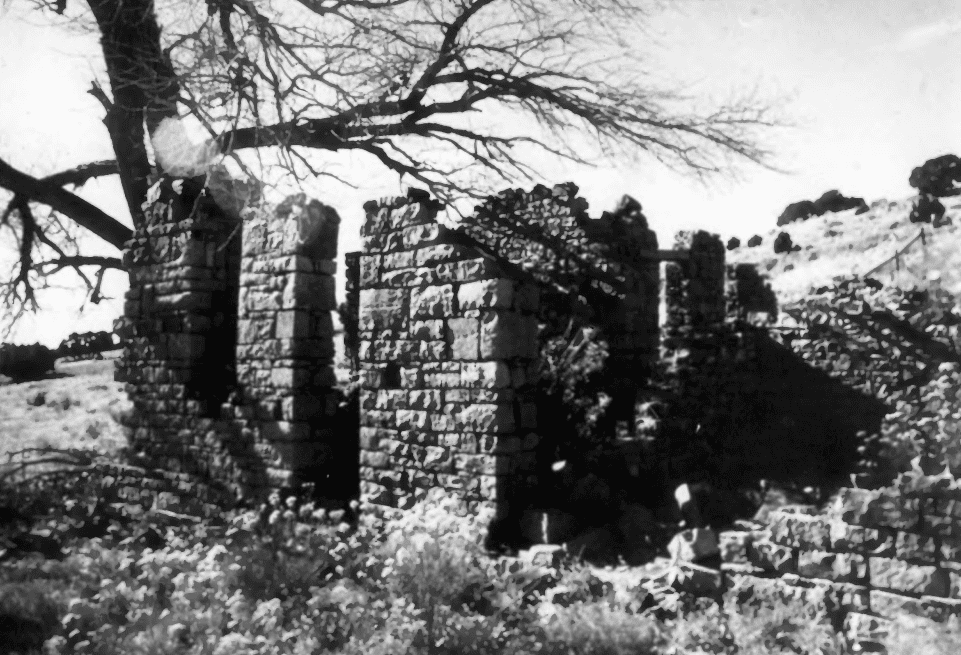


The site represents the first permanent ranch in the southern end of the Henry Mountain in 1890. The site consists of a ranch house and smoke house. The smoke house appears to have been the residence while construction of the house was taking place. The roof of this subterranean structure was made of fitted granite rocks in an arched form of construction. There is no internal or external form of support for this roof. No mortar was used in construction of either the smoke house or the ranch house. The ranch house was also constructed of closely fitting granite rocks with soil used for sealing of the rock walls. The walls were about two feet thick.
The site is now protected by a fence. Vandalism is evident on the main ranch house, with many of the interesting sculptured window sills removed. The smoke house is still intact.
The terrain is rolling hills to flats, near a large spring which bears Starr’s name, The surrounding area is now a developed recreation area and is one of the points of interest in the southern end of the mountains.
The buildings have been altered by deterioration and vandalism