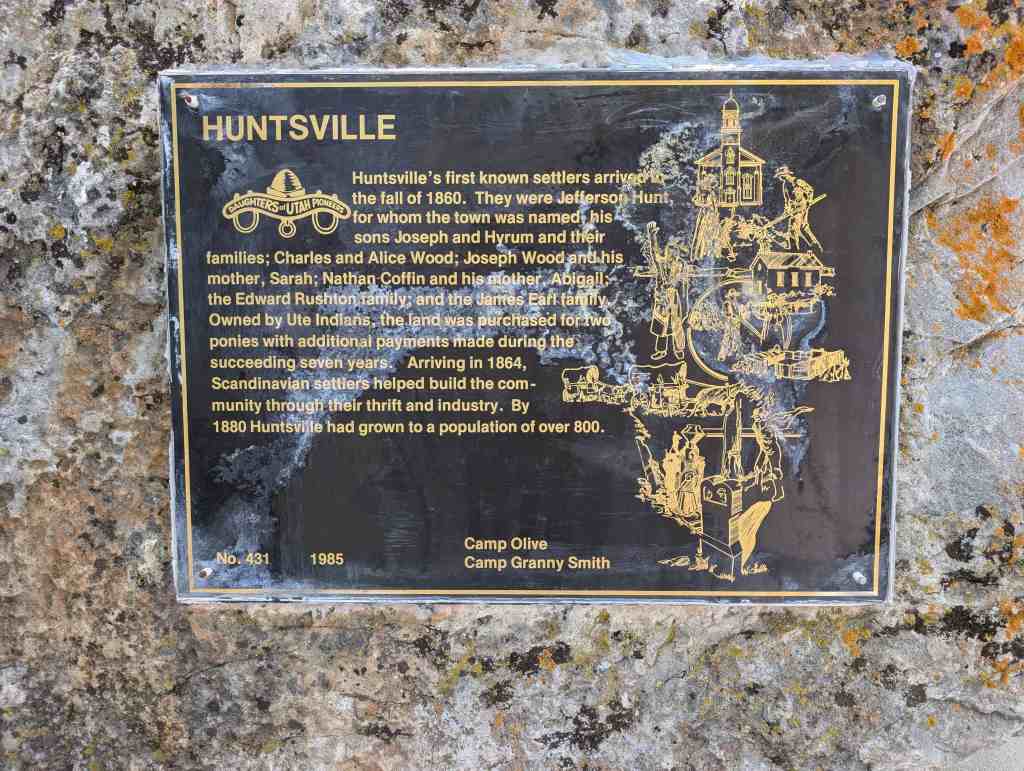
Huntsville’s first known settlers arrived the fall of 1860. They were Jefferson Hunt, for whom the town was named his sons Joseph and Hyrum and their families; Charles and Alice Wood; Joseph Wood and his mother, Sarah; Nathan Coffin and his mother, Abigail; the Edward Rushton family; and the James Earl family, Owned by Ute Indians, the land was purchased for two ponies with additional payments made during the succeeding seven years. Arriving in 1864, Scandinavian settlers helped build the community through their thrift and industry. By 1880 Huntsville had grown to a population of over 800.
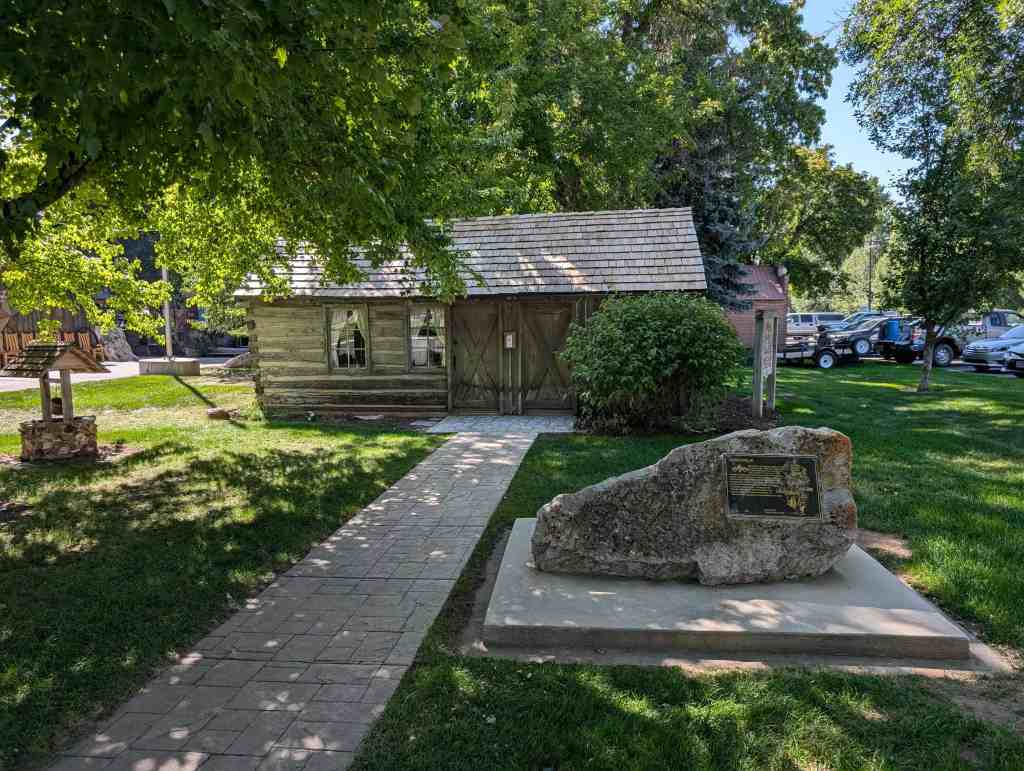
This is Daughters of Utah Pioneers historic marker #431, placed by the Camp Olive and Camp Granny Smith camps of the DUP in 1985 and located at the Robert F. Aldous Cabin at 205 South 7400 East in Huntsville, Utah
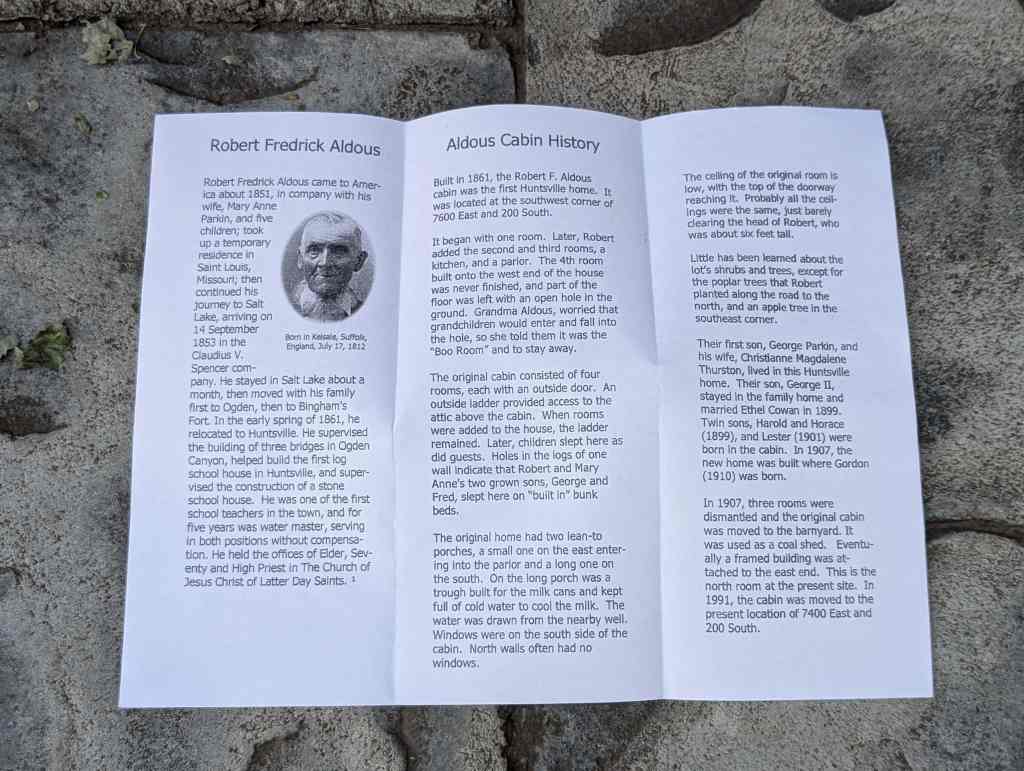
Robert Fredrick Aldous Born in Kelsale, Suffolk, England, July 17, 1812
Robert Fredrick Aldous came to America about 1851, in company with his wife, Mary Anne Parkin, and five children; took up a temporary residence in Saint Louis, Missouri; then continued his journey to Salt Lake, arriving on 14 September 1853 in the Claudius V. Spencer company. He stayed in Salt Lake about a month, then moved with his family first to Ogden, then to Bingham’s Fort. In the early spring of 1861, he relocated to Huntsville. He supervised the building of three bridges in Ogden Canyon, helped build the first log school house in Huntsville, and super- vised the construction of a stone school house. He was one of the first school teachers in the town, and for five years was water master, serving in both positions without compensation. He held the offices of Elder, Seventy and High Priest in The Church of Jesus Christ of Latter Day Saints.
Aldous Cabin History
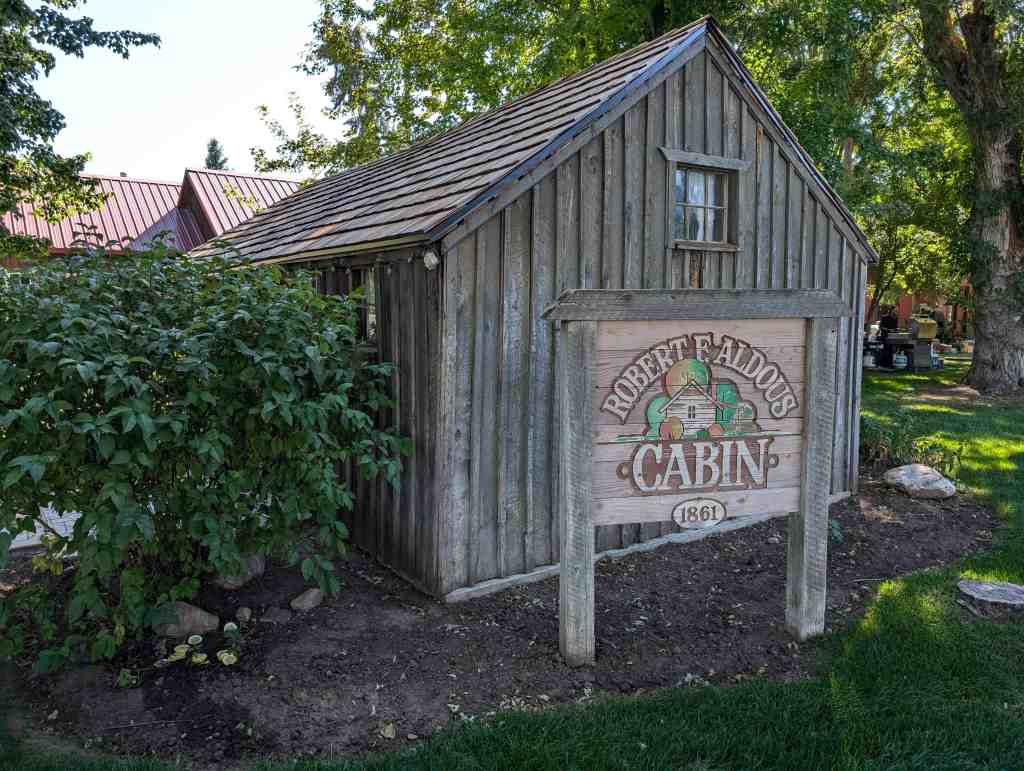
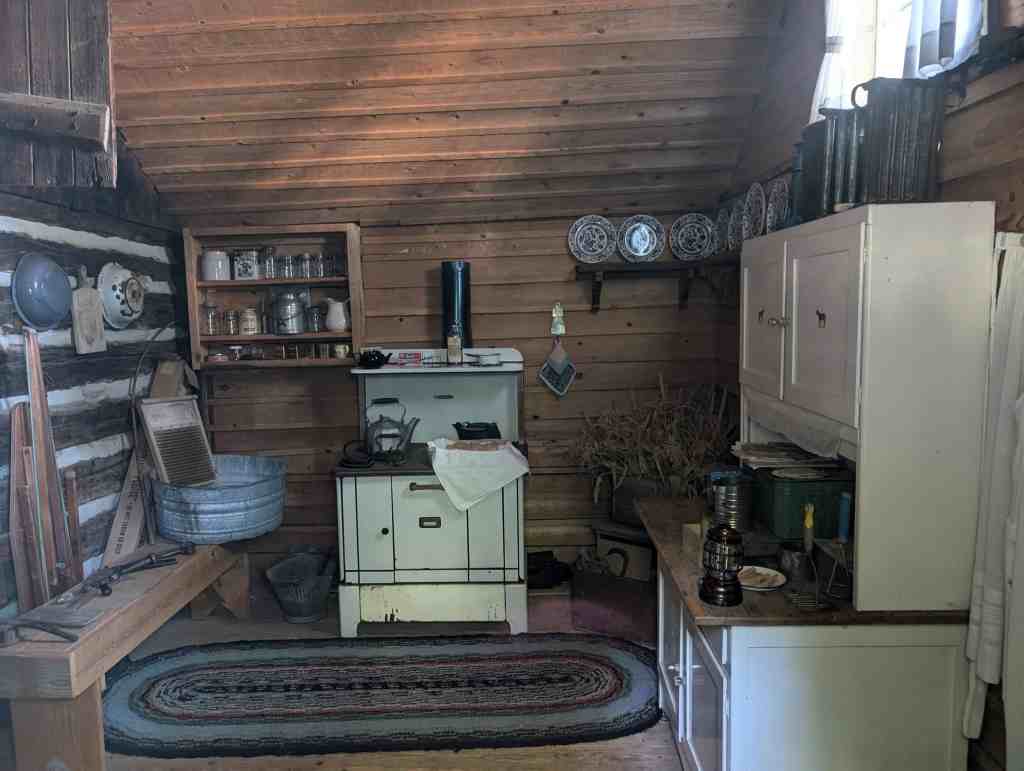
Built in 1861, the Robert F. Aldous cabin was the first Huntsville home. It was located at the southwest corner of 7600 East and 200 South.
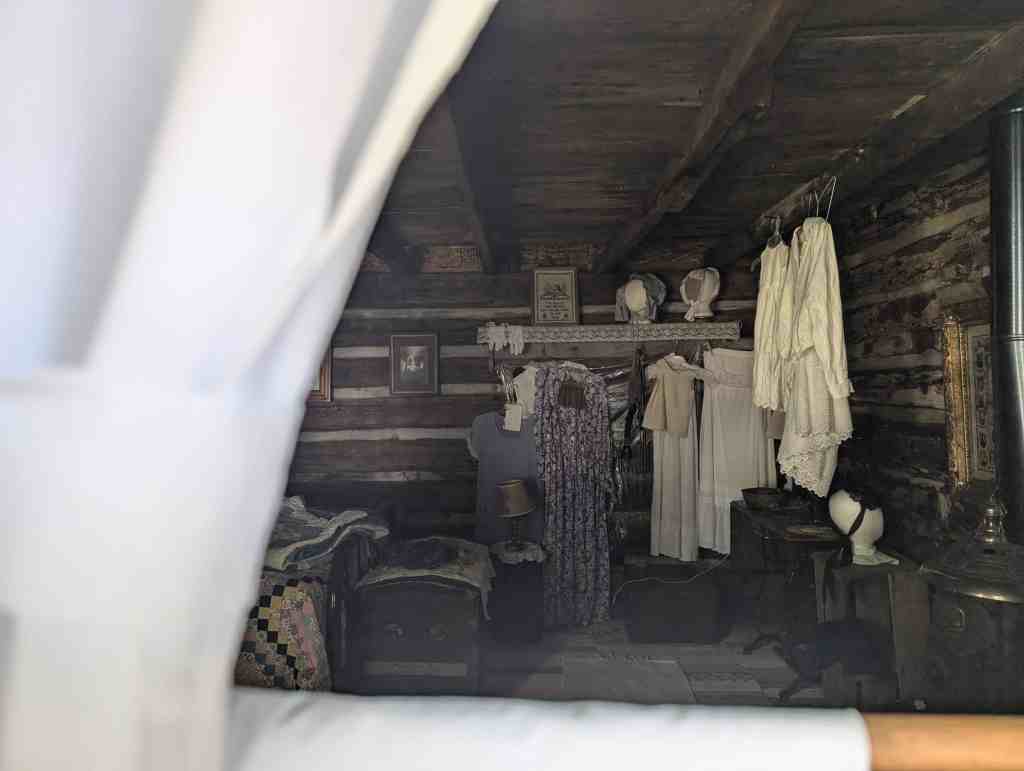
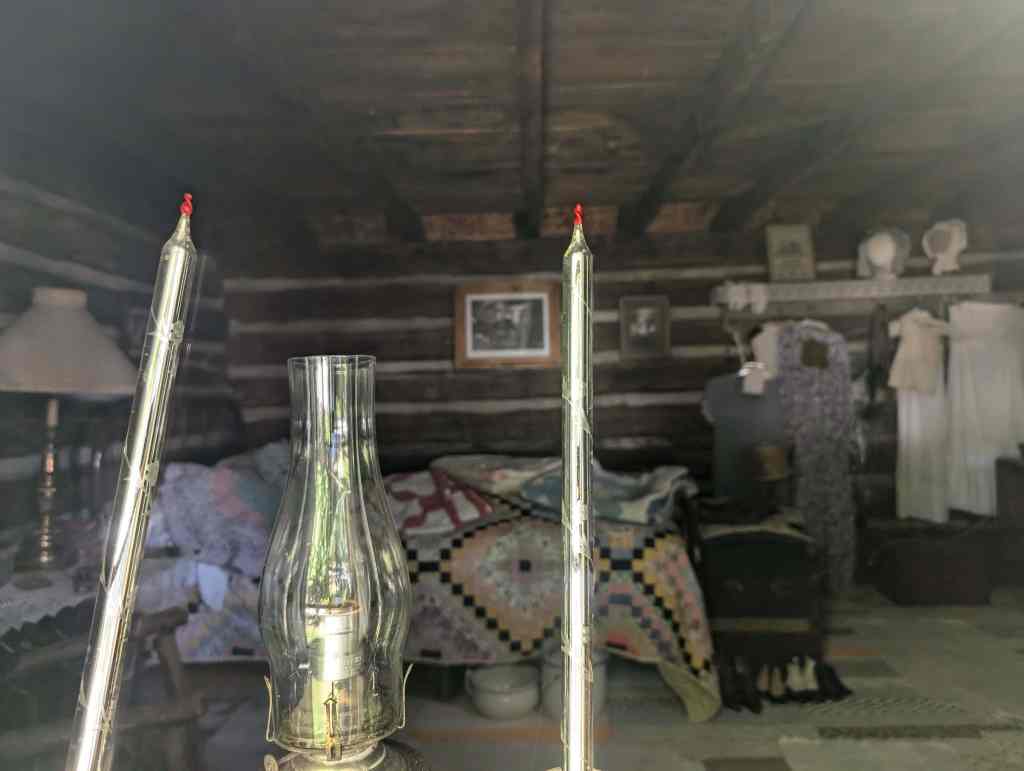
It began with one room. Later, Robert added the second and third rooms, a kitchen, and a parlor. The 4th room built onto the west end of the house was never finished, and part of the floor was left with an open hole in the ground. Grandma Aldous, worried that grandchildren would enter and fall into the hole, so she told them it was the “Boo Room” and to stay away.
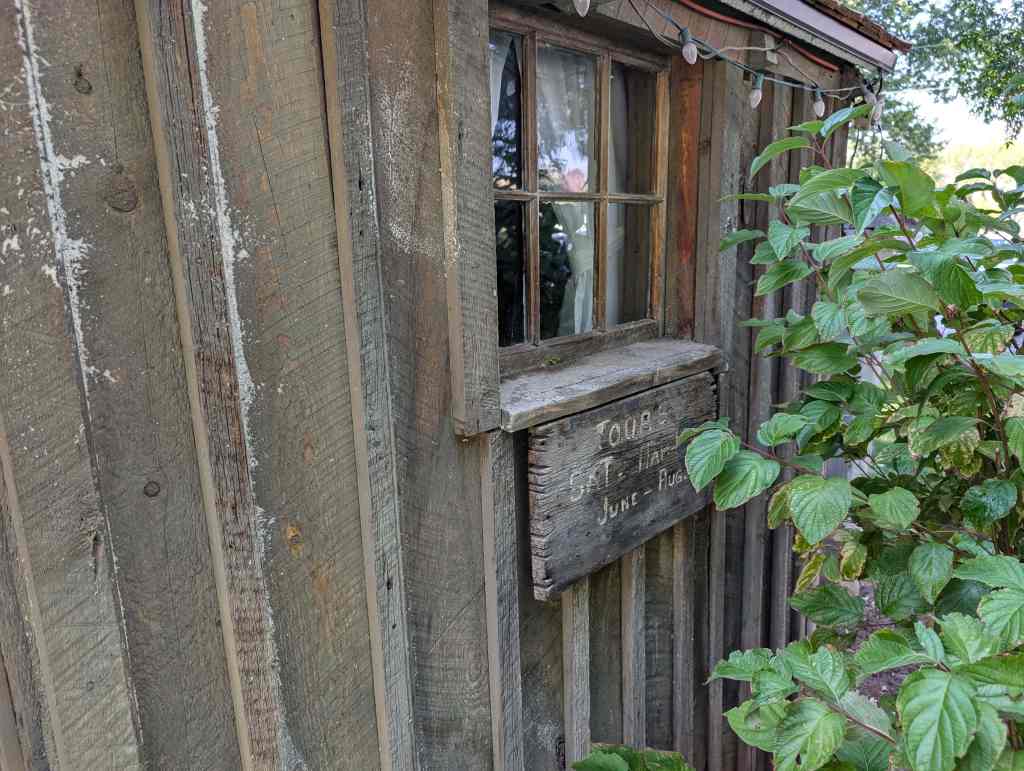
The original cabin consisted of four rooms, each with an outside door. An outside ladder provided access to the attic above the cabin. When rooms were added to the house, the ladder remained. Later, children slept here as did guests. Holes in the logs of one wall indicate that Robert and Mary Anne’s two grown sons, George and Fred, slept here on “built in” bunk beds.
The original home had two lean-to porches, a small one on the east entering into the parlor and a long one on the south. On the long porch was a trough built for the milk cans and kept full of cold water to cool the milk. The water was drawn from the nearby well. Windows were on the south side of the cabin. North walls often had no windows.
The ceiling of the original room is low, with the top of the doorway reaching it. Probably all the ceilings were the same, just barely clearing the head of Robert, who was about six feet tall.
Little has been learned about the lot’s shrubs and trees, except for the poplar trees that Robert planted along the road to the north, and an apple tree in the southeast corner.
Their first son, George Parkin, and his wife, Christianne Magdalene Thurston, lived in this Huntsville home. Their son, George II, stayed in the family home and married Ethel Cowan in 1899. Twin sons, Harold and Horace (1899), and Lester (1901) were born in the cabin. In 1907, the new home was built where Gordon (1910) was born.
In 1907, three rooms were dismantled and the original cabin was moved to the barnyard. It was used as a coal shed. Eventually a framed building was attached to the east end. This is the north room at the present site. In 1991, the cabin was moved to the present location of 7400 East and 200 South.
Located at 205 South 7400 East in Huntsville, Utah – also located here is D.U.P. #431.
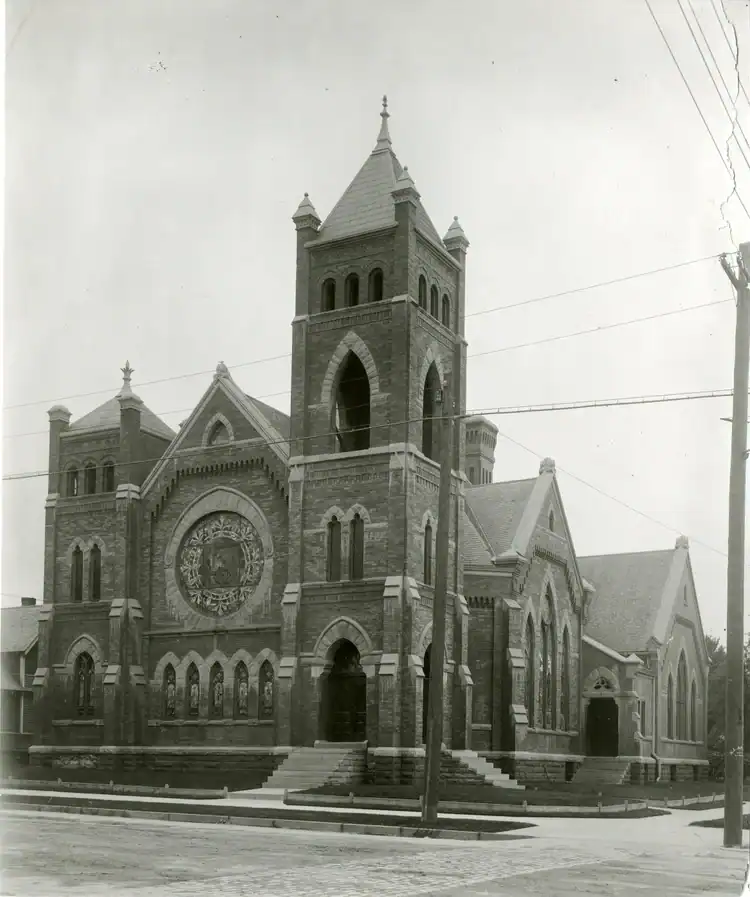
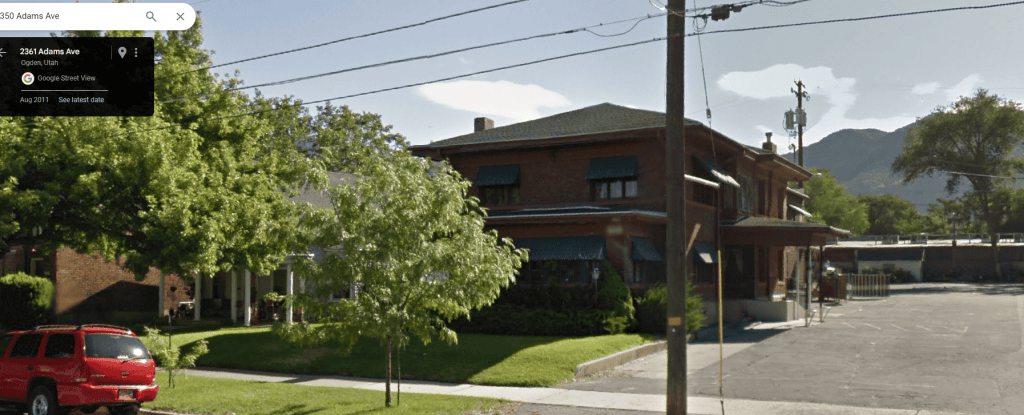
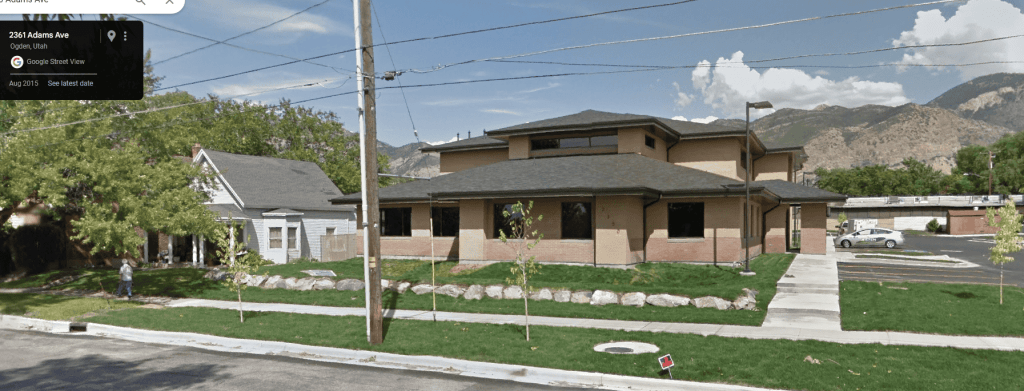
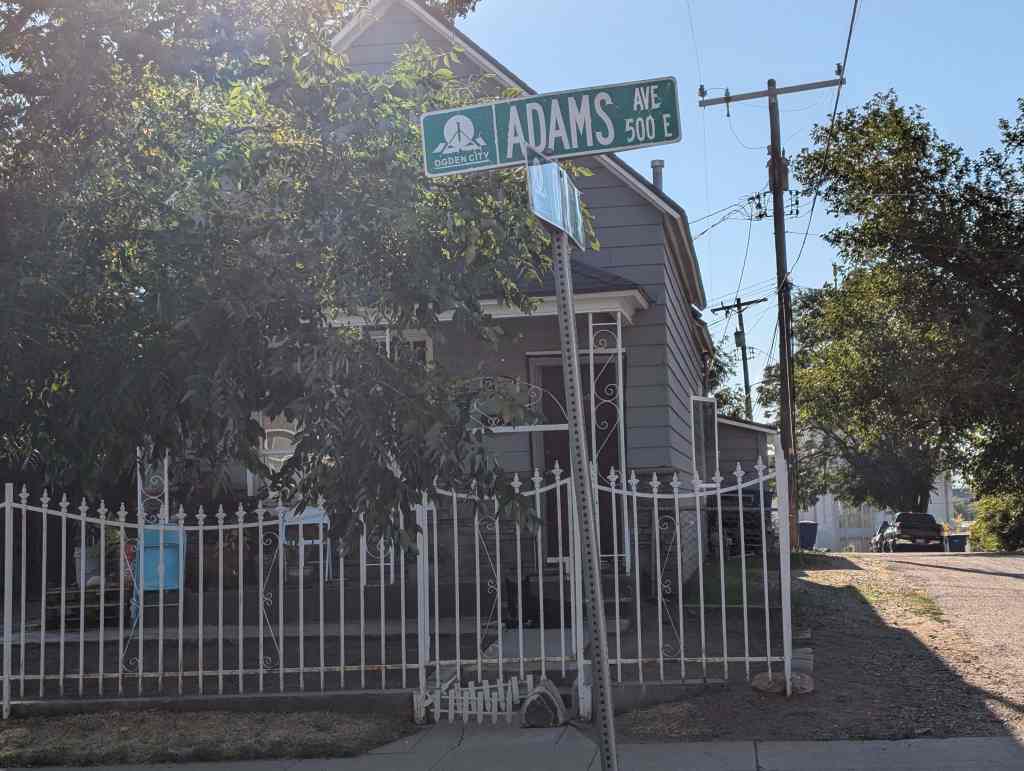
mentioned in Ogden’s Central Bench Historic District: Most of Ogden’s historic churches are found in the Central Bench Historic District, almost all of which were built by the year 1920. Several of the churches were noted in the Ogden Chamber of Commerce’s 1930 Ogden: the Gateway to the Intermountain West. In fact, all five churches featured in the pamphlet were located in the district. Including the magnificent St. Joseph’s Church at northwest the corner of 24th and Adams Avenue; the Presbyterian Church at the southwest corner of 24th and Adams Avenue (now heavily altered); First Baptist Church of Ogden at southwest corner of 25th and Jefferson Avenue; First Church of Christ, Scientist, at 780 24th Street; Methodist Church at 2604 Jefferson Avenue (part of church was originally J. Pingree’s home built in 1908, then the church purchased the property in the 1920s); and several LDS meetinghouses. Another interesting religious facility was the LDS 4th Ward Theater located at 2323 Monroe Boulevard, which was used as an amusement hall until 1900, when it was then sold and converted into a home.
mentioned in Ogden’s Central Bench Historic District: By 1909-1910, due to the strength of railroad and industries related to it, Ogden had once again become a “Queen City of the Rockies.” In fact, during the years 1909, 1910, and 1911, a subdivision was platted in each of those years. The most noted being the Eccles Subdivision, in 1909; the other two include the Manhattan and Hoff subdivisions. Due to its significance, the Eccles Avenue District was placed on the National Register in 1976. Leslie S. Hodgson and Eber Piers were the two architects credited with the design of the homes on Eccles Avenue. They also designed several other buildings in the district, including the LDS Church Branch for the Deaf located at 740 21st Street (designed by Hodgson), and the Albert Scowcroft home located at 2350 Adams Avenue (designed by Piers). The district is also known for the significant families who resided on Eccles Avenue, who were prominent in local, state, and national affairs.
mentioned in Ogden’s Central Bench Historic District: …Other Victorian styles found in the district include the Richardsonian Romanesque style such as the Madison School at 2418 Madison Avenue; Victorian Gothic style house at 2332 Adams Avenue; and the Shingle style at the Wright home at 566 24th Street.